Elon vs Crypto Battle
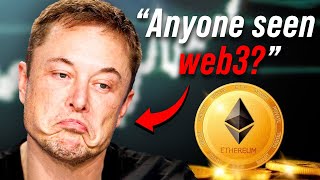
John Coogan examines why Elon Musk opposes Web3 and crypto. Musk worries about token concentration and VC control, while also competing for engineering talent. The video explains how blockchain and NFTs promise decentralization but face real obstacles in practice.
Elon Musk hates Web3, but not for the reason you might think.
I don't quite understand this whole smart contract thing. I'm too dumb to understand smart contracts.
Elon has a love hate relationship with crypto. At first he was all in on Bitcoin, then he shifted to Dogecoin and now he's warning people about Web3. And sure, Web3 is a buzzword that has recently spiked in popularity, but I think there's something deeper going on here. Remember, Elon is extremely optimistic about the future and and he's not one to write off new ideas. So why does Elon Musk think Web3 sounds like BS? And what does the crypto community need to do to convince him that there is meaningful innovation going on? Well, let's start by defining the term Web 3. Web 3.0 comes after Web 2.0, which of course comes after Web 1.0. So let's go back to the 1980s and explore the dawn of the Internet to see how we got here. What if every computer, irrespective of who made it, which vendor built it, was able to transfer data instantly to any other computer in the world? The Internet. And it is a realization of precisely that vision. After computers began making their way into the homes of everyday people during the PC revolution, it became clear that there was a huge opportunity to connect these computers via an information network. These networks were built on open protocols like the Hypertext Transfer Protocol or HTTP. When you see in a link to a website, that's because that website is using the HTTP standard to transmit information. With these open protocols in place, entrepreneurs started building real companies on top of the technology. AOL and Yahoo were two of the earliest so called Web 1.0 giants. During this time, the Internet was mostly read only. That meant that when you went to a website, there wasn't much user interaction. You couldn't upload your own content, yet you just had to read what was put there by whoever owned the website. This system worked well and companies started to grow significantly. The process of transmitting information over the Internet was standardized by these open protocols, so so companies could now invest millions of dollars building functionality on top of things like HTTP. If an entrepreneur spent nights and weekends building the next great website, there was zero risk that they would wake up the next day and find out that the protocol had changed and they could no longer run their website. The same was true for email, which was built on top of the Simple Mail Transfer Protocol or smtp. Everyone might use Gmail or Outlook these days, but without a standardized Protocol like smtp, these email clients couldn't talk to each other. There was one major problem with the Web One Point era though. Because these sites were mostly read only, all the content had to be produced by the companies that created the websites. This was extremely costly and was really limiting the usefulness of the Internet. Lots of computer nerds figured out how to host websites and write HTML, but Internet usage was still a fraction of what it is now. Everyone knew that the Internet would be so much better if users could create content on their own so quickly. Web 2.0 was born. Throughout the mid 2000s, tons of big tech companies built services that allowed for both consuming and more importantly, creating content. Facebook is a great example here. Before Mark Zuckerberg launched the Facebook.com in his Harvard dorm room, university students would have to look up information about each other in a static directory. These were essentially read only and couldn't be modified by the students directly. Facebook changed all of that, of course. And within a few years, millions of people started posting all sorts of content to the Internet with zero programming knowledge. All of a sudden, people didn't need to know any HTML to publish something. The Internet and the amount of content online exploded. Additionally, the cost to publish content fell essentially to zero, since most of these Web 2.0 services were ad supported. But as people migrated from the web 1.0 world to the web 2.0 world, they lost something along the ownership. Back in the web 1.0 days, developers could guarantee that the underlying protocols they relied upon wouldn't change overnight. But that wasn't True for Web 2.0 protocols. As Facebook and other major stores social media sites began to take over the modern Internet, developers shifted their attention from open protocols like HTTP to closed APIs like the Facebook Open Graph. Facebook's API allowed developers to build applications on top of Facebook's platform. Naturally, this design pattern turned out to be a double edged sword. On the one hand, developers no longer had to worry about boring and difficult to build features. Want a simple login flow? Just use the Login with Facebook button. Want to let your users connect with their friends? Use the Facebook API to import their contacts? But relying on a massive web 2.0 company could come back to bite you. Using the Facebook API would speed up your growth in the short term. But if Zuckerberg decided to change how the API worked, your entire application could come crashing down. Sometimes these changes were for the best and focused on improving security and stopping scammers. But other times, it was just an attempt to steal market share from a developer who was doing a little too well using the Facebook API. Sometimes this affected big companies too. Zynga had been making tons of money with their game farmville before they started to fight with Facebook over how they could use the platform. At the time, Zynga was worth billions of dollars and accounted for 19% of Facebook's total revenue. And this kind of thing didn't just happen with Facebook. All throughout the Web2 era, we saw countless examples of developers fighting with their host platform platforms. Google and Yelp fought it out about how restaurant reviews should appear in Google search results. Epic games and Apple wrestled over what the transaction fees should be in Fortnite. And Twitter changed how third party apps could interface with streams of tweets. All throughout the tech industry, entrepreneurs were starting to learn that being completely dependent on another platform was a huge risk. If you're going to build a house that lasts a thousand years, you need a solid foundation. There's still an open question though. Why did things get so adversarial on every single tech platform? When we write the history books about the Internet, I think it will go, we invented the world wide web and then we invented blockchain. It wasn't like this was only happening on Facebook. So it was clearly some sort of market force. Well, it has to do with network effects. When these platforms were first getting built, they needed to get as many people to use them as possible. No one would show up to use a new social network that didn't have any users. So it was incredibly important for these web two companies to be as network nice to their users as possible. And that includes developers building services and apps on top of the platforms. It's obvious that in the early days, Google benefited from having restaurant reviews in search results. Facebook benefited from having fun games, and Twitter benefited from third party apps. The problem starts once the platform is mature and they've locked in their network effect. Once everyone is using a particular platform, it's very difficult to leave. All your friends are on a specific network and you can't just take them with you. So the incentives flip. And now these tech companies need to extract as much value as possible from the networks that they've built. This leads them to competing with the developers, creators and businesses who allowed the platform to flourish in the first place. And this is why so many people are excited about Web3 and crypto in general. See, the general pitch for Web3 is an Internet that is owned by the builders and the users. Instead of a company like Facebook or Twitter having the ability to change how developers interact with their services, Web3 platforms are decentralized. This means that no one entity can decide to change how a protocol works on a whim. So that's the fundamental promise of Web3. Right now, we create new services using blockchains that guarantee future functionality. That way, developers can create new applications without worrying about building on shaky foundations. That all sounds pretty reasonable. So why is ELON so against Web3? Well, let's explore how these Web3 technologies are actually developing in production practice. First, we have to discuss how Web3 is different from just crypto. It's easy for these two terms to get blurred together since they're so closely related, but there are actually some significant differences. Crypto is all about replacing money, but Web3 is more focused on alternative assets. The biggest success to come out of crypto has been Bitcoin, which has proven itself as a sort of digital gold. The biggest success to come out of Web3, on the other hand, is unquestionably NFTs. This is a hotly debated topic, but you don't have to believe that any particular JPEG is worth millions of dollars to appreciate the underlying technology. At their core, NFTs just give users the ability to own things. In the digital world, we mostly see NFTs that represent ownership in art or photos, but there are already NFTs that represent music, text, credentials, governance rights, and more. These NFTs exist on top of blockchain chains, with the most popular one being Ethereum. You can think about Ethereum like a massively distributed computer that is owned and operated by its users. Because Ethereum is a blockchain, anyone can access it, but no one owns it. This means that when you build something on top of the Ethereum blockchain, you don't need to worry about the underlying protocol changing on you. That solves the main problem with Web2 platforms, developers can guarantee that what they build today will still work as expected in the future. But there's a problem. See, the word decentralized gets thrown around a lot, and it can mean a lot of different things. In general, any crypto system can only reap the benefits of decentralization if the ownership of the tokens that control the network are actually distributed broadly. If any one person can gain control of all of the miners in a proof of work system like Bitcoin, or all of the tokens in a proof of work stake system like Solana, they can effectively make changes unilaterally. And this is probably part of why Elon thinks web3 is BS after making a joke about web3 Jack Dorsey replied to Elon saying that it's somewhere between A and Z. Jack is of course referring to Andreessen Horowitz or a 16Z, which has been one of the most active investors in the Web3 space. Detractors of Web3 argue that venture capitalists are trying to control the supply of tokens in these new blockchain networks, which will effectively give them the same power as all the Web2 companies. That's a disconcerting thought, so it's worth investigating seriously. It's helpful to use Solana as an example here. Solana is a proof of stake blockchain that enables fast and cheap transactions. Sounds good on paper, but the crypto community is deeply divided about it. Supporters say that having a network with low fees and high throughput will enable new kinds of Web3 applications to be built. Detractors, on the other hand, say that Solana is not decentralized enough and often point to this chart. Because the so called insiders own so much of the Solana token, they could potentially collude to change how Solana functions and wind up crippling applications built on top of Solana in the process. It'd be web 2.0 all over again, and suddenly the benefits of all this hard work begin to evaporate. This entire debate revolves around who controls the network, but there's still a fundamental difference between the way web2 and web3.3 works. See, it's important to remember that VCs just didn't appear out of nowhere and start funding web3 projects. Andreessen Horowitz was a major investor in Facebook, and Marc Andreessen still sits on the board of directors. The thing is, as Web two platforms grew, two things happened. First, the ownership of these companies became less concentrated. Sure, the founders might start out owning a majority of the stock, but by the time the company went public, it wasn't uncommon for a founder to own less than 20% of the company. At the same time, these new Web2 founders were able to retain a remarkable amount of control over their companies. Consider Mark Zuckerberg, who owns just 17% of the stock in Meta Platforms but controls around 58% of the voting shares. The ownership of the company has arguably become more decentralized, but control of the company certainly hasn't. These new Web3 platforms are designed to prevent this from happening, so if ownership is diffuses over time, so should control. And this is something you'll hear from Web3 proponents. Things are getting more decentralized, not less. But the VCs aren't giving up control out of the goodness of their own hearts. They still want to make as much money as possible. But things have changed. These investors believe that decentralized networks can lead to more innovation, which in turn will provide more opportunities to make money. Fundamentally, they're trying to avoid a situation where entrepreneurs, developers, and investors stop taking risks because they simply can't build new projects on top of centralized platforms. But I still don't think this is why Elon is so skeptical about Web3. After all, he openly admits that crypto can improve the monetary system.
I think the cryptocurrency thing is an interesting approach to reducing the error in the database that is called money.
Believing in cryptocurrency, but not Web3 is a unique position these days. After all, most of the people who made a fortune on bitcoin Quickly moved to investing in new Web3 projects. And it seems odd that financial innovation would start with bitcoin and end with dogecoin. But I think this will help explain what's really going on here. Fundamentally, Elon is in a war for talent. He wants to land on Mars and deliver fully autonomous vehicles. Those are incredibly ambitious projects, and he needs a lot of talented engineers to help him get there. If the next generation of brilliant minds goes into Web three, He'll have a much harder time hitting his own goals. And I think this is what drives most of the arguments in tech right now. Everyone wants their particular industry to succeed, and letting a hot new tech trend take over seems like a disaster. This is actually healthy for the industry, though, and I'll explain why. I'm a big fan of everything Elon is working on. I think space exploration and artificial intelligence are going to be incredibly important industries, and they already are. At the same time, I do think Web3 can create a lot of value by realigning incentives. As a society, we need to pick our priorities carefully. We can't overinvest in a single area, and we really do need all of these technologies to work together. Our financial system is remarkably outdated. Just listen to how Elon describes it.
Right now, the money system, actually, for practical purposes, is really a bunch of heterogeneous mainframes running old cobalt. Banks are still buying mainframes in 2021 and running ancient cobalt code. The Federal Reserve is like, probably even older than what the banks have, and they have an old cobalt mainframe, and so the. The government effectively has editing privileges on the on the money database.
He's not making that up either. Mainframe computing is still growing, even in 2022. Clearly, there has to be a better way. Web3 represents an important, important improvement to the way the Internet works. Even if the buzzword we use to describe this set of technologies changes over time, my hope for 2022 is that we can create more harmony between the various groups in technology. I want to see a conversation between Vitalik Buterin and Elon Musk. And if you're Looking for more Web3 content, please check out this video on Solana's founding story. It's a really incredible journey. Thanks for watching.










