Every Elon Musk Controversy | 2021 Review
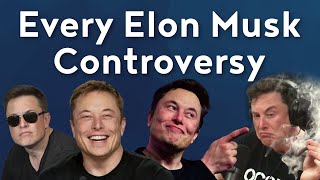
A 2021 YouTube video by John Coogan that reviews major controversies involving Elon Musk (family background, early lawsuits, academic record, PayPal co-founder dispute, SpaceX criticism, Tesla scheduling culture, and Musk’s warnings about AI). The host assesses which criticisms are fair, provides entrepreneurial lessons (e.g., honesty about credentials, handling co-founder disputes, realistic deadlines, competition), and often contextualizes accusations with outcomes or mitigating facts.
Questions this video answers
January 2021
Sold to Compaq for $307 million.
$125,000.
Over $186 billion.
Elon’s degrees from the University of Pennsylvania were recorded as granted in 1997, two years later than he had previously stated.
Hi, I'm Elon Musk. Wait, what? No, I'm not. I'm John Coogan. Man, that artificial intelligence stuff is really getting out of hand. But we'll get to that. Anyway, today we're running through every Elon Musk controversy and discussing what's legitimate, what's unfounded, and how you should think about controversies if you're an entrepreneur. Elon Musk recently became the richest person on earth with over $186 billion to his name. He's a super controversial guy, so I thought it'd be interesting to run through some of the biggest controversies he's faced in his career and give my thoughts. The first Elon controversy starts before he was even born. It's the claim that his father owned an emerald mine in Zambia. And it's often used by his detractors to paint him as someone who had everything handed to him and didn't really have to work to become successful. There are two key points here. First, is the claim true? And second, does that diminish his success? On the first point, the evidence is a bit mixed. It does look like his father owned a 50% stake in an emerald mine for a time, but that the mine eventually went bust. And there isn't any evidence that his father was a mining tycoon or anything close to it. He was an engineer. But it does appear that Musk grew up fairly wealthy by South African standards. It's clear that Elon had plenty of books to read and the opportunity to buy a computer at a young age, when they were still widely inaccessible to the general public. His family owned one of the biggest houses in Pretoria, and he was able to attend a private school. So even though the emerald mine story might get a bit exaggerated by people trying to bring him down, Elon was fortunate enough to come from a financially secure background. Interestingly, while nearly everyone who cites the emerald mine story now hates Elon and is doing it to bring him down. The story was originally posted by a huge fan of Elon Musk who just thought it was an interesting tidbit of history. So if Elon did come from money, should that change your perception of him? I don't really think so, because the vast majority of his wealth was created through businesses he started and grew himself. There are plenty of rich kids who just coast through life and never really take the time to try and learn hard science or have an impact on the world at all. So if you are fortunate enough to have a wealthy family, just know that expectations are only going to be higher for You. You can't change where you're from, so the only option is to put your head down and build. The second major controversy in Elon's career came shortly after he sold his first company, Zip2, to Compaq for $307 million. A physicist named John O'Reilly filed a lawsuit alleging that Elon had stolen his idea for the company. While it's true that elon had met O'Reilly before founding Zip2, it looks like O'Reilly never really pursued the idea and was mostly looking for a piece of Elon's windfall. In fact, O'Reilly's company had already been dissolved by the time he brought the lawsuit, and the judge ultimately dismissed the case and ordered O'Reilly to pay Elon $125,000 in legal fees. Elon never made him pay, though. So what's the takeaway for entrepreneurs? Well, if you get sued after selling your company, it probably will be a headache, but you'll definitely have the money to defend yourself. But what about people stealing your idea? In my experience, any good startup idea will be copied, iterated on, and mutated as soon as it starts getting traction. That's part of competition in the capitalist system, and if you're an entrepreneur, you should be ready for that. You will always have competitors, so your job is to build a stronger company that delivers a better product to its customers. The third controversy actually came directly out of that lawsuit. While O'Reilly was digging into Elon before bringing him to court, he found that Elon's degrees from the University of Pennsylvania were granted in 1997, two years later than Elon had been stating publicly in his biography of Elon. Ashley Vance dug into this academic record and found that everything actually checked out. It turned out that Elon was just missing two credits to graduate on time, and he was planning on doing them at Stanford. But after Upenn changed their graduation requirements and Elon decided not to do a PhD at Stanford at all, Upenn let him graduate. Oddities in academic records like this are dime a dozen in Silicon Valley. Dropping out is extremely trendy, and people often take gap years to work on startups. The important lesson to take away from this is that you need to be honest about what you've actually done. No one in the technology industry cares if you're missing a random history credit, but if you lie about it, that will erode trust and hurt your credibility. After Elon sold Zip2, he started a new venture called X.com in the online payments space. X.com eventually merged with Confinity to become PayPal. While nearly everyone acknowledges Elon as a co founder of PayPal now, that wasn't always the case. Startup mergers can be very messy, and at the early stages it's often unclear who's doing what. Add to that the fact that Elon was ousted as CEO after only a few months in the role, and you can see why people were unclear about whether or not he really was a co founder. This all blew up in the press when Sequoia Capital, one of the early backers of PayPal, pulled Elon's picture from their website. This could have just been them rotating pictures, but the tech industry gossip blogs jumped on it. Nevertheless, Elon responded by writing a lengthy open letter explaining exactly what he had contributed to PayPal while he was there. The most powerful part of Elon's argument to me is the fact that he was the largest shareholder when the company went public. Typically, if there's a co founder dispute early on and someone leaves, they won't vest their shares or they'll be deluded. So the fact that he held on to so much of the company makes me believe that his contribution was real. Co founder titles can mean different things at different startups. Sometimes there's a technical person with a co founder title who doesn't really oversee the business or sit on the board. Other times there's a co founder who serves only as the chairman of the board and doesn't really have a day to day role at all. It's important to clarify these things early on when the company is formed, since people can have a very emotional connection to their co founder title. Oh, and Sequoia Capital, the VC firm who took Elon off of their website, they just gave Elon $500 million during SpaceX's latest funding round. So I doubt there are any hurt feelings today. Speaking of SpaceX, our fourth controversy comes from a 60 Minutes interview where Elon had what some thought of as an overly emotional response to criticism from some NASA astronauts. Here's the clip.
But SpaceX's lack of experience bothers some NASA legends like Apollo astronauts Neil Armstrong and Georg Gene Cernan. They've testified to Congress that the Obama administration's drive to commercialize space could compromise safety and eventually cost the taxpayers. Now is the time to overrule this administration's pledge to mediocrity. You know, there are American heroes who don't like this idea. Neil Armstrong, Gene Cernan have both testified against commercial spaceflight. In the way that you're developing it And I wonder what you think of that.
I was very sad to see that because those guys are. Yeah, those guys are heroes of mine. So it's really tough. I wish they would come and visit and see the hardware that we're doing here, and I think that would change their mind.
They inspired you to do this, didn't they?
Yes.
And to see them casting stones in your direction.
Difficult. I think it's fine to be passionate about what you're working on. And this clearly shows that Elon really cares about advancing space travel. To be fair to the astronauts who testified against SpaceX, this was back in 2012, and there was still a lot of uncertainty about Whether or not SpaceX's approach of cheaper, reusable rockets would ever work. But looking back on it now, they look ridiculous. SpaceX just delivered NASA astronauts to the International Space Station, and they did it flawlessly. Elon has a unique ability to think in decades and undertake wildly ambitious projects. This is certainly true of SpaceX, and it's also true at Tesla. But that has also led to many, many controversies. Elon has a long history of publicly announcing a launch date for a new Tesla model and then missing that deadline. This is because he tends to think of timelines as the true minimum amount of time it would take to do something in if everything goes perfectly. Early in his career, the engineers he was working with at Zip2 had a mental model for dealing with Elon's ambitious timelines. They said, we came to interpret an hour as really taking a day or two, and if Elon ever did say something would take a day, we allowed for a week or two weeks. It's good to be ambitious about timelines when you're running a startup, since you're likely not profitable. Every extra day burns more of your cash and pushes you closer to running out of money. But it's important to have a fundamental reason for why a deadline is where it is and believe that it's actually possible to hit it. Here's how Elon describes it.
One thing I should say is when I sort of cite a schedule, it is actually the schedule I think is true. It's not some fake schedule that I don't think is true, maybe delusional, that is entirely, you know, possible. Maybe it's happened from time to time, but it's never some knowingly fake deadline ever.
Setting impossible deadlines will demotivate employees. So it's important to at least have a shot at hitting your goal, even if you know that something might inevitably come up and delay the project. The last controversy I want to cover involves Elon's take on artificial intelligence. Unlike most Silicon Valley techno optimists, Elon is terrified of AI taking over. Here's how he summarized his position in.
2018 I'm really quite close to. I'm very close to the cutting edge in AI and it scares the hell out of me. It's capable of vastly more than almost anyone knows, and the rate of improvement is exponential. You can see this in things like AlphaGo, which went from in the span of maybe six to nine months, it went from being unable to beat even a reasonably good GO player, to then beating the European world champion who was ranked 600, then beating Lee Sedol 4. 5, who had been world champion for many years, then beating the current world champion, then beating everyone while playing simultaneously. Then there was AlphaZero, which crushed AlphaGo 100 to 0. And AlphaZero just learned by playing itself. And it can play basically any game that you put the rules in for whatever rules you give. It literally read the rules, play the game, and be superhuman for any game. Nobody expected that rate of improvement. If you ask those same experts who think AI is not progressing at the rate that I'm saying, I think you will find that their predictions for things like GO and other AI advancements, their batting average is quite weak. It's not good.
After Elon started talking publicly about the potential dangers of AI, there was a fair amount of backlash from the AI industry. What I find so interesting about Elon's position is that it's very rare to see techno pessimism coming from within the tech industry itself. Typically, the loudest voices that are critical of new technology come from journalists, academics, and executives at industries that stand to benefit from that technology stagnating. Elon is often criticized for being overly optimistic and spreading a tech will save the world message every chance he gets. But his position on AI really shows you that he considers each technology on its own merits. And, and I like that there are honestly a ton more controversies involving Elon, but I don't want this video to run too long, so I'll have to do a follow up. If you liked this video, please consider subscribing to the channel. And if you have any thoughts on Elon Musk, just leave a comment below. Thanks for watching.










