How Flexport Fixed Shipping
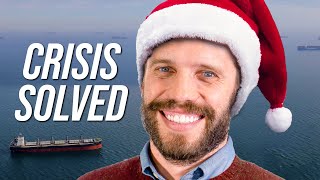
Ryan Petersen toured LA ports in October 2021 and tweeted 30 solutions to shipping chaos: stack containers higher, add trucks, build temporary yards. Flexport's data platform had already helped customers survive strikes, shipping-line collapses, and tariffs by showing them what was coming.
Questions this video answers
October 21, 2021.
Over 70 ships.
Seven working cranes visible.
450 containers.
6:38 am (posted a 30-tweet thread the next day).
On October 21, 2021, Ryan Peterson chartered a boat. The global supply chain had ground to a halt and he was going to find out why. Despite running a multi billion dollar company with thousands of employees, Ryan wasn't attending meetings on this particular Thursday. Instead, he would spend the day touring the ports of Los Angeles and Long beach to find the root cause of this crisis. Ryan's company, Flexport, had plenty of data about global trade and and could clearly see that dozens of container ships were waiting to unload. But he was still surprised by what he saw out on the water. Even though There were over 70 ships filled with containers, nothing was getting unloaded. He could only see seven working cranes out of hundreds at the port and these weren't even moving particularly quickly. So Ryan went ashore to talk to the dock workers and truck drivers who actually unload the cargo. These blue collar jobs are hard and often dangerous, so the last thing they want is some tech CEO asking them questions about why things aren't moving fast enough. But a few days are. Earlier, Ryan had delivered a taco truck to support the Herculean effort at the port. So everyone was eager to talk to him. During any crisis, it's easy to point fingers and call someone lazy. But Ryan quickly learned that everyone was working harder than ever. The problem was yard space. See, under normal circumstances, a truck driver arrives with an empty container and exchanges it for a full one. If for some reason there are too many containers sitting on the port, the extras can be stored in local yards until they can be cleared. The problem was that all of the container yards were full and so the ports weren't allowing truckers to bring in new empty containers. If a driver had a truck with no container on it, they were good to go. But that's a rare situation. One trucking company that Ryan Talked to had 450 containers just sitting idle on trucks with no place to put them. The total lack of available trucks meant new containers couldn't come off the ships in the harbor. The traffic jam was getting worse by the day and showed no signs of clearing. So the next day, Ryan woke up and started collecting his thoughts. At 6.38am, he posted a series of 30 tweets describing what he'd seen the previous day and proposed some solutions. Containers can usually only be stacked two high in storage yards, so increasing that to six high would be an easy win. Bringing in extra trucks could could also help carry away containers from the ports. And the government could set up a temporary holding yard on government land for empty containers and then use trains and barges to clear the backlog. Ryan isn't a politician, and these were just some off the cuff observations. But the response was overwhelmingly positive, and pretty soon lawmakers were asking him for advice. Gavin Newsom called Ryan personally to discuss solutions. The National Economic Council, which advises the president, wanted to know how the federal government could help, and the mayor of Long beach started rolling out Ryan's proposed changes, effective immediately. It was a huge success for a guy with no meaningful political connections prior to his Twitter thread, but Ryan had spent nearly two decades building a repertoire of skills that would allow him to have an impact in global trade. So let's go back to the beginning to understand how we got here. Ryan grew up in Bethesda, Maryland, not too far from the US Capitol. After graduating from high school, he flew across the country to attend UC Berkeley. It's clear that Ryan had a very entrepreneurial mindset from a young age and wasn't cut out for a defined career track. Through college, he took tons of different classes, learned multiple languages, and traveled abroad, all before settling on a major in economics. After graduating in 2002, Ryan teamed up with his older brother and moved to China to work on exporting goods to the United States. Now, Ryan wasn't a full partner in that business, but he learned a lot and fast. The Chinese automaker Geely was expanding quickly and had tons of affordable motorcycles just waiting to make their way to America. Ryan and his team started importing these motorcycles and making decent money. Their business grew to millions in revenue, but the margins weren't great. A big part of Ryan's job was vetting new manufacturers, and he came up with a really funny cheat code for quickly judging a new factory. All too often, a supplier would set up a makeshift facility to trick an importer into buying goods from them. So during factory tours, Ryan would ask to use the employee bathroom. If the manufacturer couldn't even take the time to build a usable restroom for employees, they clearly couldn't be trusted to manufacture high quality goods. But a few years into his time in China, Ryan started reflecting on his life and realized that he needed a change. He wasn't starving, but there wasn't a clear path to anything bigger. Living in China was exciting, but he had fallen in with a predominantly European crowd and wasn't really getting to know any locals. So he moved to a remote part of China on away from the hustle and bustle of the city and started to plan his next move. Business school seemed like a good way to reset his career and assess new opportunities, so he applied to Columbia Business School and he got in. Business school gave Ryan the time to go deeper into the economics and financial aspects of global trade. That had interested him for years. But looking around at his classmates, he could tell that he was different. Most of his peers loved the New York lifestyle and wanted to go work in investment banking or management consulting. And sure, he probably could have made decent money following that path. But Ryan knew that he wanted to start a company. So as soon as he finished his mba, Ryan teamed up with his brother once again to start a company. This time they would take a more tech enabled approach. His brother had studied computer science, which was extremely rare in the import export industry. The company they started was called importgenius.com, and it's still around today. The entire business was built around a very simple realization that feels obvious in hindsight. Every time freight moves across the globe, the goods are accompanied by what's called a bill of lading. This document just lists out what the shipment is, where it came from, and where it's going. To most people, that's pretty boring information. But if you're trying to manufacture something or understand your competitors, it's incredibly valuable. Now, most people would think that this information would be private, but these documents are actually public records. So Ryan and his brother started digitizing these shipping manifests and aggregating the information in a database. ImportGenius.com was born and started growing pretty quickly. Ryan worked on the business for several years and eventually grew revenue to over $1 million per month. And unlike the import export business he was running previously, this was a software business, so the margins were great. Still, it seemed like import genius had a limited upside. They hadn't raised any venture capital and it wasn't clear that they should. So Ryan and his brother went on a walk to start thinking about what they they should do next. At this point, Ryan had accumulated a very unique set of skills. He had an economics degree, an mba, spoke five languages, and had operated two international businesses. Finding an opportunity where he could leverage all of these skills would be critical. When Ryan thinks about startup opportunities, he generally considers two criteria. The first is the ratio of global GDP to software utilization. This sounds complicated, but it's actually pretty simple. Let me explain. Industries obviously vary in size. The financial industry is massive, whereas the movie industry is relatively small. Now you might think that just picking the biggest industry to go after is a guaranteed recipe for success, but that's not quite right. Some industries have already seen remarkable progress in technology. Advertising has been completely transformed by software. So it's a much more competitive place to start a new tech company. Freight forwarding, on the other hand, is a massive industry and has been extremely resistant to technological change. Ryan thinks that new and disruptive tech companies will be built in large industries with historically low amounts of software adoption. And that's where the idea for Flexport came from. Ryan had seen firsthand how difficult it was to track what was going on with shipments as they made their way from the factory to the customer. Flexport would be a software firm first freight forwarder and put data directly in the hands of customers. No longer would companies have to play phone tag with old school logistics managers or sift through endless email threads to understand the status of their shipments. Flexport would put all of that information into an online dashboard and automate as many boring tasks as possible. This wouldn't be easy though. The global supply chain is incredibly complex and there are very few in industry standards for data interchange. And this is where Ryan's second key startup philosophy comes into play. Ryan had read a popular blog post by Paul Graham called Schlep Blindness, and to say that it resonated with him is an understatement. He really can't stop talking about it.
Schlep blindness. Schlep blindness. Schlep blindness. Schlep blindness. Schlep blindness.
The general idea is that there are certain startup ideas that everyone should be able to see because they are so obvious, but continually get ignored due to the perceived difficulty. The original blog post points to Stripe as a key example of this phenomenon. Everyone who had integrated payments with a website prior to Stripe knew that the existing solutions were terrible. But only the Collison brothers were bold enough to actually go out and try and fix the problem, and they wound up building a massive company in the process. It's very natural to avoid tasks that seem tedious or unpleasant, and a schlep is just that. Writing code to process payments wasn't as sexy as building a social network. And building a new freight forwarder certainly wasn't glamorous work, but the opportunity was huge. So in 2010, Ryan decided to throw up a simple landing page to test his idea for a tech enabled freight forwarding company. Since this was clearly going to be a massive schlep, he had to be absolutely sure that there was demand demand for his idea. Fortunately, the results quickly became clear. This was bigger than he ever imagined. With just a basic email entry form and some Google Ads, Ryan received interest from some of the biggest companies in the world. Foxconn, the maker of the iPhone, signed up. Then the largest oil company in the world, Saudi Aramco, signed up. He thought he was going to be helping small ebay sellers, but clearly everyone needed this solution. There was a problem, though. Freight forwarding is a tightly regulated industry. You can't just throw up a website and start bringing products into the country. You need to get licenses, pay taxes, and clear the Department of Homeland Security. It can take years. But that didn't bother Ryan. He knew this idea was worth the work because the freight forwarding market is massive. It took years of planning to launch Flexport, but it paid off. In 2014, Ryan received his acceptance to Y Combinator and was finally ready to start scaling the business. But he didn't take the typical path here. He'd already been working on Flexport for years, so it didn't make sense to bring on a co founder at that stage. But he did need a talented management team if he was going to start working with large companies and scaling the business. So Ryan recruited one of his old friends from business school named Sanne Maunders to serve as chief operating officer. And this guy had an incredible resume. He was actually a partner at the bottom, Boston Consulting Group, before joining Flexport. That's super rare to see in the tech industry. Adding someone with that level of experience while the company was still relatively young was a big win for Flexport because it allowed them to professionalize their operation and work with bigger companies. Even though Ryan had a clear vision for Flexport and wanted to ultimately partner with companies of all sizes, startups were still great early customers. I actually used Flexport while at Soylent today, get our products from our manufacturer to our distribution center, but we were a relatively small client. A big turning point for Flexport came when Ryan was able to ink a deal with Warby Parker. At the time, Warby was already one of the biggest eyeglass makers in the world. And signing them as a client allowed Flexport to negotiate lower rates with shipping companies. Flexport started making money in 2014 and has grown to over a billion dollars in revenue today. But it wasn't all smooth sailing. Ryan has had to fight his way through a constant string of setbacks and challenges over the last few years. In 2015, the International Longshore Workers Union went on strike and shut down all of the west coast ports. Billions of dollars of goods were stranded at sea and unable to get to their final destinations. Customers who counted on Flexport to get their products delivered on time were frustrated. But Ryan and his team were actually in a relatively good position because Flexport took such a Technology first approach approach. They were able to give their customers unparalleled clarity about the status of their shipments. Knowing the real time physical location of your products when they are in transit is half the battle. And this information allowed customers to route around the closed ports to avoid delays. Then, in 2016, the price of ocean freight collapsed. This was a massive disruption to the industry and actually led to a major shipping company going bankrupt. The South Korean company Hanjin Shipping shut down so quickly that entire containers were stranded on their ships. Creditors were fighting over who would get the remaining business assets, and customers were stuck in a tough situation. Once again, Flexport's dashboards helped customers understand what products were at risk and plan accordingly. It was a tough situation for everyone in the industry, but Flexport was in the right place to help out as much as possible. The following few years were extremely tumultuous for the global shipping industry. Then President Donald Jackson Trump was rolling out tariffs on Chinese imports on a regular basis, and they were often effective immediately. In some cases, these tariffs could be passed on to American consumers in the form of price increases. But some companies didn't have that option. After all, if your competitor is manufacturing domestically and not subject to tariffs, you can't really raise your prices. But Ryan and his team still wanted to help their clients. So they held a series of educational sessions to explain the various tariffs and outline future options going forward. All of those crises were nothing, though, compared to what was coming in 2020. The global supply chain was about to see the largest restructuring in decades, and it was going to be a make or break moment for Flexport. The lockdowns in early 2020 drove everyone inside and dramatically shifted consumption patterns. There was a brief recession as companies laid off employees and markets fell. But the US Government was extremely aggressive in response. The stimulus package was remarkably large and hit bank accounts immediately. So Americans actually started spending money again pretty quickly. The problem for the supply chain was that consumers were spending that money in completely different ways. Instead of going out to restaurants, people were ordering new kitchen appliances and cooking at home. Instead of going out to movie theaters, people were buying new TVs and streaming content at home. And instead of going out to gyms, people were buying stationary bikes and dumbbells to work out at home. This massive surge in demand for physical goods put a huge strain on our shipping infrastructure. A lot of this stuff comes from Asia, and it doesn't always travel by boat. A remarkable amount of cargo is transported via commercial airlines. Every time you step on a plane to fly across the Pacific Ocean, you can be sure that there are dozens of products sitting in the cargo hold right below your feet. Normally this process works quite well, and it allows important goods to get to America faster than they would by boat. But most of the flights from Asia have been grounded since early 2020 and they aren't coming back anytime soon. Things have gotten so backed up that we are now seeing inflation in the price of goods because everything is in such short supply. In fact, the price of shipping a single container across the Pacific increased more than 10x during peak congestion. All of this leads to the obvious what should we do now? Ryan has outlined a number of solutions that that should help in the short term, but the long term is much more complicated. Our infrastructure is remarkably outdated in the United States and it's starting to have real impacts on the American economy. Automation is one of the most important ways we can increase the efficiency of our supply chains in the long term, but it's a delicate issue. Every major port strike has been about automation and port workers really value their jobs. Only 2 out of the 12 ports in Los Angeles are fully automated, and that's due to pushback from the workers there. But sometimes resistance to automation can have disastrous long term consequences. We've seen this in the Bay Area, where all major shipping activity moved from San Francisco to Oakland because the SF dock workers refused to adopt standardized shipping containers. All major ports now use shipping containers that are the exact same size, but the SF port still has no cranes to unload them. We rolling out new technology requires focusing on safety. As much as people like to paint this industry as resistant to new improvements, that's actually not the case. Container ships were quick to adopt GPS systems and mapping technology. Truckers now routinely have several connected devices with them at all times to manage routes and increase efficiency. And even dock workers were happy to start using a stronger kind of rope called HMPE that was less likely to snap. Proponents of automation will need to frame the conversation in terms of safety and make sure that workers in the supply chain are not forgotten in the process. All that will take time though, and we can't sit on our hands during this crisis. We need more founders like Ryan who are willing to just get out there and use their expertise to find solutions that can have an immediate impact. This supply chain crisis is far from over, so I'd encourage you to go follow Ryan on Twitter to stay up to date on the story. And while you're there, you can follow me too. In the meantime, please check out this recommended video. The YouTube algorithm thinks you'll really like it.










