How Sputnik Created DARPA
When the Soviets launched Sputnik in October 1957, the U.S. rushed to create ARPA within months. Joseph Licklider's DARPA-funded work on computer networks became ARPANET, the foundation of the modern Internet, first connecting two computers on October 29, 1969.
This unassuming office building in Arlington, Virginia, has a big secret. It's home to darpa, the world's most successful and secretive research agency. People in this building are responsible for funding the next generation of US Military technology. But despite making such important decisions and managing an annual budget of more than $3 billion, DARPA has only around 200 employees. So how exactly does DARPA deploy so much money and still stay efficient? Most government agencies are bloated with thousands of extra employees, but DARPA was able to basically lay the foundation for the entire modern Internet with just $1 million. The story begins more than 65 years ago, on a day that changed the course of human history. At 10:28pm Moscow time on 4 October 1957, the Soviet Union launched the Sputnik satellite from scientific research test range number five and reached the first major milestone of the space race. Publicly, America's leaders did their best to remain calm, but privately, they were reeling.
Until two days ago, that sound had never been heard on this earth. Suddenly, it has become as much a part of 20th century life as the whir of your vacuum cleaner. It's a report from man's farthest frontier radio signal transmitted by the Soviet Union. Sputnik, the first man made satellite as it passed over New York earlier today.
Across the country and within the corridors of power, there was a fear that the Soviet Union had gained a decisive upper hand in the Cold War. Sputnik was bad enough, but our national security officials understood that the rocket that launched it into space could potentially be used to carry much more destructive payloads. Fear quickly morphed into determination. Our leaders promised that never again would the United States be taken by surprise by an adversary. From the 6th of October 1957 until the end of that month, the New York Times published 279 pieces which mentioned the satellite. That's more than 11 articles every single day. Remember, it was less than 15 years since the end of World War II. With the destruction of Nazi Germany and Imperial Japan. America's military and civilian leaders were confident that the nation was on the path to becoming the world's most powerful country. They knew the Soviet Union was also in a strong position after the war, despite the massive number of casualties it had suffered. But they were shocked by the speed and size of the technological leap that Sputnik represented. In a column published six days after the launch, one of America's most respected commentators, Walter Lippmann, wrote that Sputnik showed that America had become complacent. Lippmann was searing in his analysis? Russia was in shambles after World War II, but somehow they were moving faster than America. If the United States wanted to prove that capitalism was a better economic system than communism, they needed to respond, and quickly. It wasn't just commentators who were ringing the alarm bell. Night after night, America's leaders told the public that Sputnik meant that the United States was under threat. Just listen to what Sam Rayburn, the Speaker of the House of Representatives at the time, had to say about it.
The people of the United States have been humiliated. They're disturbed and they're unhappy.
Sputnik was a massive propaganda victory for the Soviet Union and its leaders. Less than half a century after being a backwards country ruled by a dysfunctional aristocracy, the Soviet Union had beaten the mighty Americans into space. And as if the first Sputnik launch wasn't worrying enough, just over one month later, the Soviets launched a second satellite. Weighing over 1,100 pounds, Sputnik 2 was much larger than its predecessor. And it proved definitively that the rocket used to launch the Sputnik probes into space could also be used to launch intercontinental ballistic missiles. Despite the seemingly obvious threat, President Eisenhower initially played it cool. When reporters asked him for his thoughts about the launch, he said it didn't raise his apprehensions, not one iota. Why was the US President, a man who had been America's greatest soldier, so calm about the Soviet Union launching the world's first satellite? The answer is actually pretty simple. America's intelligence and military leaders knew that it was coming. According to recently declassified documents, the CIA had forecast that Moscow planned to put a satellite into orbit before the end of the year. One intelligence officer even predicted the exact launch date and and was only off by two weeks. Eisenhower was being honest when he said he wasn't surprised or worried. But the fact is, millions of Americans were. And they couldn't understand the President's reaction.
Do you smile? The Russians are doing it or not? No, definitely not. We should have been the first ones to have it. Such things because the American people are warned that a foreign country, especially an enemy country, can do this. What do you think about America not being able to do the same? Well, if I was in military service, if I was out on a job like that, I could stand a court martial. Somebody's fallen down on a job badly.
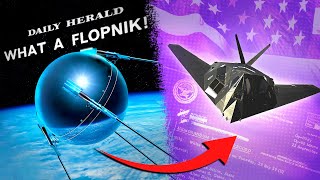
Eisenhower realized that he needed to respond, even if the response was mostly just about pr. Luckily, a response was already in the works. In an effort to encourage scientific collaboration between nations, a group of scientists and diplomats organized a global Scientific collaboration called the International Geophysical Year. It brought together 67 countries including the US and the Soviet Union. And Eisenhower's press secretary, months before the project kicked off had publicly announced that the US intended to launch small earth circling satellites. So even while Sputnik was circling the planet and invading the headlines the US Navy was hard at work. Just two months after the Sputnik launch the Vanguard TV3 stood on the launch pad at Cape Canaveral. It hadn't been easy. Even on the day of the launch technical problems kept pushing back the countdown. Journalists from Washington D.C. joked that the Vanguard was like a civil servant because it won't work and you can't fire it. But at 11:30 local time the countdown reached zero. The first stage booster ignited and the rocket shot off the launch pad. Everything went fine for about two seconds. Then the engines cut out and in front of millions of Americans watching on live television the Vanguard TV3 fell back onto the pad and exploded into a giant fireball. The Vanguard wasn't a civil servant anymore. Now headlines called it names like Flopnik, Kaputnik, Oopsnik and Stay Putnik. A second launch on 5th February 1958 failed less than a minute after it launched. For the Navy which had been asked during the directly by the President to design the Vanguard rocket it was a disaster. But for the army it was an opportunity. A week after the Soviets launched the follow up to Sputnik the U.S. secretary of Defense directed the army to launch a satellite of its own. The end Product Explorer 1 became America's first ever successful satellite launch. When it entered orbit on February 1st, 1958 it was smaller than Sputnik but its launch sent it deeper into space. The Soviet Union may have made the first move but the US was now firmly in the space race. The Eisenhower administration had other tricks up its sleeve too. Around the same time as the Vanguard TB3 was exploding on the launch pad the US Secretary of Defense Neil McElroy had a meeting with two veterans of the Manhattan Project. One of the men who met with McElroy was a nuclear physicist named Ernest Lawrence. Lawrence was so brilliant that that he won the Nobel Prize when he was just 38 years old. By the time he met with the Secretary, Lawrence was advocating extensively for government sponsorship of large scientific programs. The other man who met with McElroy was Charles Thomas. His post government career took him in a different direction. He was the President of Monsanto. In their meeting these two men invoked the inspiring example of the Manhattan Project to try and persuade McElroy that that the US government should create a new agency to lead the country's space research. McElroy promised that he would consider the idea. After two weeks of deliberation, McElroy returned to face Congress. He and Eisenhower had made their decision. The United States government would create an agency to consolidate the Pentagon's missile technology and space programs. What would go on to become the world's most successful military research agency was born not with fireworks but with a two page memo on February 7, 1958. It was called the Advanced Research Projects Agency, or ARPA. And just as a quick note, ARPA would eventually be renamed to darpa, the Defense Advanced Research Projects Agency. So to avoid confusion, I'm just going to call it DARPA from here on out. The new agency needed people to run it. After consulting with his peers Outside of government, McElroy settled on Roy Johnson, a charismatic vice president at General Electric, as DARPA's inaugural director. In what would have been a highly controversial choice, McElroyd briefly considered choosing the German rocket scientist Wernher von Braun to be the first chief scientist. Instead, he settled on the young physicist Herbert York. York was still a young man. He wasn't even 40 yet, but he'd worked at the Oak Ridge Laboratory, the place where the uranium was enriched for the little boy bomb which was dropped on Hiroshima. After that he was put in charge of recruiting scientists to design the first thermonuclear weapons. Following the national crisis of confidence brought on by the launch of Sputnik, the United States had responded by launching a satellite into orbit and creating a military research agency. Quickly, DARPA had its two most important personnel in place. Which made it all the more surprising that less than two years later, darpa, the initiative was already on death's door. When NASA was created In July of 1958, it assumed responsibility for America's civilian space research. But everyone thought that DARPA would hold on to the military space programs. The armed forces had another idea. They sensed weakness and they started a bureaucratic war inside the Pentagon to get their space programs back. It didn't help the DARPA's head scientist, who Herbert York, had left the organization and was now working at the Pentagon. Roy Johnson, who was running DARPA at the time, was desperately trying to keep the organization relevant. But he didn't have many supporters left. The press was starting to promote the idea that military space projects were the exclusive domain of the Pentagon, not darpa. And so when the New York Times published an article calling Herbert York the top space official in the US Government, Roy Johnson was furious. He wrote to the Secretary of Defense demanding clarification and included a copy of the article on which he physically wrote that the Deputy Secretary had promised him that DARPA would be responsible for all space matters. There was just one problem with his the Deputy Secretary that Johnson was citing had been dead for almost three weeks. Johnson and York had never seen eye to eye. One was a businessman appointed to run a tight ship. The other was a scientist with his head in the clouds. And now York had the upper hand. By the end of the year, York had successfully transferred America's military space programs back to the armed forces. And just like that, DARPA's main reason for existing didn't exist anymore. The question now was why even keep DARPA around at all? It had just lost the battle. Inside of the Pentagon, it didn't have its own offices or any permanent employees. There were calls for it to be folded into the Pentagon, even abolished. The future looked bleak. But an unlikely hero was about to emerge. William Godel was a very unusual choice to serve as DARPA's next deputy director. He'd been hand picked to represent the intelligence community. He wasn't a scientist. He didn't work in a lab or at a desk. He didn't even care that much about futuristic technology. He actually believed that the space race was mostly a sideshow. Godel had been handpicked to represent the intelligence community. And while most Pentagon officials were focusing on Soviet nuclear and conventional forces, Godel believed that the bigger threat to American interests was in small scale insurgent conflicts in places like Southeast Asia and the Middle East. To learn more, Godel went on a fact finding mission across Southeast Asia. He was looking for answers to two key why were the Communists gaining a foothold? And what what could the United States do about it? At the time, America's intelligence and military leaders believed in the domino theory, which argued that communism in one country would quickly spread to its neighbors. Godel believed that DARPA could help the dominoes stay upright. His plan was to undermine communist influence in Southeast Asia, all without the use of any US soldiers. Instead of relying on massive numbers of ground troops, Godel would focus on developing new technologies. A month after Godel returned home, he helped create Project Agile. And with a stroke of a pen, DARPA had a new guiding counterinsurgency bill. Godel wanted to use Project Agile to create a global database of people and places that the United States could draw on whenever it needed. Once it had enough training data, it could be used to provide policymakers with specific recommendations that best suited the tactical system situation. Godel was especially interested in South Vietnam. The conflict wasn't on the radar of most Americans yet, but it was flashing bright red on his. Godel could see that the communist insurgency was gaining strength. So he searched for a way to undermine the Soviets and prop up an American ally. Plus, he figured stopping the insurgency would put DARPA in the Pentagon's good graces. Godel's basic pitch was, if we can't fight communists in space, we why not fight them in the jungle? In June of 1961, he set off on a top secret mission to Saigon with $18,000 in cash in his briefcase. I know it sounds like something ripped directly from a spy movie, but Godel was serious. That $18,000 was a down payment for a US funded combat development and test center. The idea was that this new Saigon outpost would be a research hub to develop technology for the South Vietnamese counterinsurgency effort. It was an example of DARPA's founding philosophy, the development of military technology that enabled the US and its allies to surprise its enemies. Project Agile had an important ally, the new President, John F. Kennedy. Kennedy was an ardent cold warrior during the election campaign. He repeatedly claimed that the Soviet Union's missile stockpile was an imminent threat to the United States. And this was a really smart campaign. Booth. Even though Kennedy kept saying that the US had way fewer missiles than the Soviet Union, that wasn't actually true. But his opponent, Eisenhower couldn't call him out on it because details about the missile program were classified. Kennedy's plan worked and America elected him president. DARPA also got a new director with a PhD in electrical engineering. Jack Ruina was every bit the scientist that Bill Godel was not. The two men represented opposite sides of the debate that had been raging ever since DARPA was created. Was it a national security agency where the scientists followed orders? Or was it a science agency that also served national security? Godel, the former spy, believed it was all about national security. Rowena, the persistent scientist, believed it was more of a science agency. The debate didn't get resolved in the jungles of Vietnam. And unfortunately, it would soon be overshadowed by a harrowing sequence of events. First was JFK's assassination. Kennedy's death meant that DARPA's staff didn't just lose a leader. They also lost a staunch ally who happened to sit atop the US Government. Second was Godel's indictment on fraud charges. And third, of course, was the United States being dragged into the quagmire of Vietnam. What started as Bill Godell's dream of defeating the North Vietnamese without sending any American troops in became a nightmare. Judged by these metrics, Project Agile was a failure. It failed to stop the insurgency from escalating into full blown war, it failed to prevent the commitment of US soldiers, and it failed to save South Vietnam. Project Agile was canceled in 1974. When Bill Godel was asked to list his successes, he gave a one word answer. None. I actually disagree. Project Agile was a failure, but it still marked a turning point in the history of darpa because following the loss of its space projects, DARPA seemed destined to fade into obscurity. Vietnam rescued it and elevated it to the status of Pentagon Insider. We'll never know the full story, but it's possible that the legendary innovations that DARPA would go on to be associated with, such as stealth aircraft, GPS and drones, could only happen because of the role played by men like Bill Goodell in Vietnam. Let's leave Vietnam and go to another theater of the Cold War. Cuba. You remember the Cuban Missile Crisis? It was a genuinely terrifying standoff. For 13 days the world held its breath until the Soviets finally agreed to remove their nuclear missiles from Cuba on the condition that America removed their own missiles from Italy and Turkey. It was the closest that the Cold War ever came to a full scale nuclear war. Today, the Cuban Missile Crisis is remembered as a massive humiliation and loss of prestige for the Soviets. Its very own Sputnik moment. But its legacy is actually much more important. Once the relief in euphoria had subsided, leaders at the Pentagon conducted a postmortem analysis of those 13 days. Their analysis led them to the realization that that one of the reasons the situation almost spiraled tragically out of control was because they couldn't communicate effectively in real time with either their own forces or with Soviets. The risk that the Pentagon had identified was a subset of the command and control problem. Basically, this refers to how designated commanding officers exercise authority over their forces. Accurate and timely communication is clearly an important part of this equipment. But it had become clear that despite the huge technological advances that had been made in weaponry like nuclear weapons, ICBMs and advanced bombers, communications technology just hadn't progressed at the same rate. And in a world with nuclear weapons, a single action taken on the basis of wrong or outdated information could spell the end of the world. It's easy to see how this was a problem that kept people at the Pentagon up at night. Thankfully, it was the kind of problem DARPA excelled at solving. And although the Pentagon's leaders didn't know it yet, the most important Piece of the puzzle had just entered the building. This puzzle piece went by the name of Joseph Carl Robinette Licklider, or Lick, to his friends. His history with DARPA began when he received a letter from a man named Charles Bray. Bray wasn't actually a DARPA staff member. Instead, he wrote to Lick Leiter in his capacity as a member of a research group that had been directed by the Pentagon to look into using psychology for national defense purposes. That might sound pretty weird, but remember, hysteria about brainwashing was at its peak. The Manchurian Candidate, a book about a returned POW who gets converted into a deep cover Soviet spy, had just gripped the nation. DARPA and the Pentagon already had experience using insights from physics and chemistry to develop new military technologies. They thought psychology might hold valuable knowledge that could help American forces gain an edge on the battlefield. Bray had a hunch. He believed that the Pentagon's command and control issue and the application of psychology to warfare had more in common than people realized. After all, he reasoned, both were ultimately about communication. And in Joseph Licklider Bray Gray thought he had just the guy to help him turn a hunch into an actual project. Licklider was a psychologist with a keen interest in the new field of computing. Shortly before he received the offer to join darpa, Licklider had published an influential paper titled Online man Computer Simulation. The paper describes many of the logical components of modern computing. But Licklider didn't stop there. He also predicted that man computer symbiosis was would be essential for military officials who wanted to leverage computers but not completely delegate decision making. Licklider would quickly build on that work. Within six months of joining darpa, he wrote a memo that is regarded as one of the most significant intellectual milestones in what eventually became the Internet? He addressed it to the intergalactic computer network. This was partly a nerdy joke and partly a clever reference to how DARPA operated. Remember how DARPA has just over 200 employees? Well, they achieve so much with such a small headcount because they bring together teams of experts from different sectors to work on specific projects. This means they can work efficiently, only spend what they need to and disband the team when the project is over. To work on the intergalactic computer network, Licklider brought together a team of scientists, researchers, and even people from the business world. It didn't matter where they were from. They shared a single purpose. Licklider's memo to them began by asking one important how do you get communication started among totally disconnected groups? Licklider went on to sketch the solution that was coming together in his head. He covered concepts that are commonplace in software engineering today. Things like metadata, natural language processing, compilers, and debugging. He explained that he wanted the intergalactic computer network to be capable of writing programs, storing photos, and facilitating communication. It's amazing to read something where a person is trying to tie together a bunch of threads in a way that no one ever has before. Remember, Licklider was part of an agency inside of the Department of Defense at the height of the Cold War. He may have been a scientist, but he understood his brief. This new network had to deliver a ton of features by the standards of the 1960s. It had to be fast, it had to be secure, and it had to withstand nuclear war. Licklider laid out an incredible vision for what would basically become the modern Internet decades later. And he did it while only working at DARPA for two years. But he certainly made the most out of his time there. Not only did he build out a plan for a military Internet, but he even explained to his colleagues how civilians would use computer networks in the future as well. In one presentation at the Marriott hotel in Washington, D.C. licklider explained to his co workers how in the future people could have a console in their kitchens which they would use to find recipes. This was 60 years ago. People didn't have Alexas, they didn't have wifi, they didn't even have clunky personal computers yet. All of that was years away. But this guy could clearly see the future. He understood that most of the technology required to realize his vision was years away. But he also knew that securing buy in from his colleagues and superiors was a vital ingredient of success. The intergalactic computer network team continued to meet even after his departure. In 1965, Licklider handed over the project to a man named Bob Taylor. Now, Taylor wanted to create a network that would span America. So he went to his boss, DARPA Director Charles Hertzfeld. This guy was a huge fan of Licklider and had been obsessed with computers since he was a young man. Getting a cross country Internet network on the ground wouldn't be easy. They'd need to build new technology, they'd need to wrangle different government organizations, and they definitely need money. Today, ambitious projects like that often require multiple lengthy grant applications. But here's how Bob Taylor applied for the funding to build the network. He just knocked on his boss's door. Hertzfeld asked how much money he needed to get the work off the ground. Taylor thought for a moment and then answered a million dollars or so. Hertzfeld thought for a moment and then gave his answer. You got it. And that was it. It was money well spent. The new network was now called arpanet, and the first host to host connection was established at 10:30pm on October 29, 1969. By December, a 4 node network was up and running. Ray Tomlinson, a member of the Intergalactic Network, used the ARPANET to send himself the world's first email in 1971. By 1973, the people using the network started to refer to it as the Internet. Two decades later, the project had run its course and was ready to be handed over to the private sector. ARPANET was formally decommissioned in 1990, and tech companies have been aggressively growing the Internet ever since. This was a perfect demonstration of DARPA at its best. After overseeing the technology from its inception to its proof of concept, it pushed it out into the world where it transformed the way we live our lives. In order to understand how private technology companies have capitalized on the growth of the Internet, you have to watch my video on the complete history of Silicon Valley next. Thanks for watching.










