Old Military Tech Created Modern Smartphones
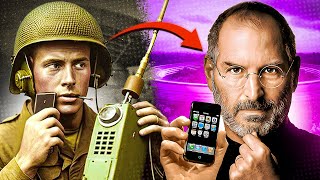
John Coogan traces how WWII radar labs like Rad Lab and Radio Research Lab, led by figures like Vannevar Bush and Fred Terman, transformed U.S. science and military collaboration. Terman used those wartime networks to build Stanford's research ecosystem and Industrial Park, which became the foundation for Silicon Valley and its defense-tech ties.
July 1942. The United States is fighting tooth and nail to beat the Nazis. It's a nationwide effort to defeat the greatest evil the world has ever known. So the head of a secret government agency directs Harvard to create a research lab to build advanced anti radar technology. This lab was so secret that I can't show you a photo of it because no photos of it even exist. It was called the Radio Research Lab. It ultimately helped the Allies win the war. But the. But that wasn't even its biggest legacy because the lab marked the beginning of Silicon Valley as we know it today. Apple, Google, Microsoft, Amazon. These companies owe their entire existence to an incredible series of events that unfolded during World War II. Don't believe me? Well, let's dive in. Adolf Hitler wanted to take Britain out of the war. But he knew that a land invasion against a heavily defended island would fail. So he turned to his commander of the German air force and decided to bomb British industrial targets. For months, German bombs fell on British cities in a campaign known as the blitz. Starting on September 7, 1940, London was bombed by the Luftwaffe for 56 of the following 57 days and nights. It was terrifying. But thanks to a combination of British resilience and ingenuity, the blitz failed. And this opened the door for a counterattack. Allied air commanders knew the Germans had over committed but they were still cut off from the massive land battles raging on the European mainland. So they launched a major strategic bombing campaign of their and their aim wasn't to sow terror. Instead they wanted to cripple the Nazis ability to wage war. Actually executing this plan however, required taking back control of the skies. Thousands of fighters and bombers took off from British and American airfields. Piloted by men barely older than boys. They were flying straight into the belly of the beast. Even by the standards of World War II, aerial missions were insanely dangerous. Over the course of the war, half of all Allied air crews were killed while on operations. Of the many threats Allied pilots faced, one of the most formidable was the German air defense network. The Germans brought it online in 1941. British pilots named it the Kammhubert Line for the colonel who devised it. The first version of the line consisted of several overlapping radar stations covering a zone about 20 miles long and 12 miles wide. These stations were linked by a Himmelbert zone. If you speak German, you'll know that Himmelbet means canopy bed. Only these were much less inviting. Each Himmelbet zone consisted of a Freya radar with a range of more than 60 miles. These radars controlled a master searchlight a Himmelbed was also assigned one primary and one backup fighter plane. RAF pilots flying into Germany had to cross the Kammhuber Line. When they did, the Freya radar operators used the master searchlight to spot them and then sent night fighters to shoot them down. These night fighters were some of the best planes the Luftwaffe had, and they were flown by some of Germany's top pilots. As if that wasn't enough, the Germans soon developed a more accurate tracking radar called the Wurzburg, which they added to each Himelbet zone. One Wurzburg would lock onto the German interceptor, while the second would lock onto the Allied plane as soon as the Freya picked it up. Each Wurzburg radar had a 45 mile range and was fully mobile. When the Germans suspected more bombers were incoming or that their radars could come under attack, they would simply put them on a truck and and move them somewhere else. Initially, the Kamhubert Line was devastatingly effective. British commanders just didn't have an effective counter. Their pilots were guided by their instincts, not by tactics. They flew their own paths towards German airspace and were easily picked off. Something had to change. Enter a man named Reginald Victor Jones. Jones was a British physicist and military intelligence expert. He also loved practical jokes. Once, when he was a student in the 1920s, Jones called a classmate and convinced him to drop his phone into a bucket of water to clean out the bugs. A few years later, Jones convinced a reporter that he had invented a device which, when attached to a phone, allowed him to see everything the reporter was doing. The reporter was skeptical until Jones described how he was dressed with perfect accuracy. How did he know? Because he was peering down at the reporter from the next building. His love of tricks and deception filtered through to his work during the blitz. He was one of the first people to realize that the Germans were using radio beams to guide their bombing runs. When faced with the problem of how to safely cross the Camehubair line, Jones told British Air Force commanders to reorganize their attacks into streams and fly in a tight cluster down the middle of a himlabbed zone. The new tactic made its debut on the night of May 30, 1942, when 1,100 RAF bombers attacked the German city of Cologne. Codenamed Operation Millennium, it was the biggest bombing raid of the war so far. British commanders hoped that the raid would be so devastating that it might even knock Germany out of the war. That didn't happen, though, and in truth, the results were slightly underwhelming. Cologne was still standing, but Operation Millennium proved that Reginald Jones was right. Less than 4% of the bombers sent on that raid were shot down. The German air defenses, which had struck fear into British hearts, were overwhelmed. But the Germans weren't about to give up so easily. They immediately started making important adjustments. Luftwaffe commanders began directing all available fighters within range to intercept the British bomber stream. And the German war machine got to work, producing hundreds of additional Wurzburg radars. At the height of the war, more than 5,000 were deployed in a line stretching from Denmark to the middle of France. Further technical improvements meant that the Himmelbet zones expanded until they reached 100 miles across the Germany's biggest cities and industrial areas were soon shielded by concentric layers. The Kammhuber Line once again became highly effective at deterring Allied bombing raids. The bomber stream worked until the Germans responded. The next major innovation came when the British and then the Americans developed air to ground pathfinding radar to help their bombers see through the clouds. The Germans realized that this effectively turned the Allied bombers into big beacons in the sky. So in response, they invented a mobile radar receiver, codenamed Naxos that picked up their locations. This was really just the world's most dangerous cat and mouse game at this point. The Allies would devise a solution to increase the efficiency of their bombing raids. The Germans would respond, the Allies would respond back, and on and on it went. Control of the skies was the difference between the German war machine being stopped in its tracks or rolling across Europe. Allied air commanders knew the German air defense systems were devastating their bombers. But they didn't even know what radars the Germans were using or how they were controlling their night fighters. In order to defeat the Kammhuber Line, the Allies needed to understand it and they needed to do it fast. But the same old incremental improvements wouldn't cut it. They needed a complete paradigm shift. A technological innovation so big that the Germans simply couldn't keep up. Finding it would require transforming the relationship between scientists and the military. Many people believe that if the Japanese hadn't attacked Pearl harbor, then the United States would have never entered the war. While it's true that the attack shocked the world, America's leaders had already been preparing for years. It was just impossible to miss the ominous storm clouds that were gathering during the 1930s. In Germany, Hitler rose to power by exploiting resentments about the aftermath of World War I. In Spain, a group of fascist military officers staged a couple, which led to a brutal civil war. Meanwhile in Asia, the Japanese had invaded China and were occupying Manchuria. Tensions Were rising across the world. Every part of society had to respond. In the United States, the scientific community was led at that time by a man named Vannevar Bush. And Bush is an absolute giant in the history of American science. Originally an engineer who received his PhD jointly from MIT and Harvard, his inventions in the field of analog computing Led to him being promoted to senior positions in science administration. When the Nazis invaded Poland on September 1st of 1939, Bush held the prestigious position of president of the Carnegie Institute of Science. He could see that the US Desperately needed closer cooperation between its civilian scientists and the military. All across the country, thousands of talented men and women were working on technologies that could change the outcome of the war. But they weren't encouraged to share or commercialize their results. Bush wanted them to be closer to the action. On June 12, 1940, he secured a meeting with President Roosevelt. Bush brought a single piece of paper describing his idea. A new agency that would oversee research on the problems underlying the development, production and use of mechanisms and devices of warfare. It must have been a good presentation because FDR approved it in 10 minutes. Two weeks later, the National Defense Research Committee, or NDRC, was born. By enlisting some of America's best scientists and engineers directly in the war effort, Bush knew he was going against the grain. The NDRC focused on accelerating the development of two key military technologies. The first was the atomic bomb. The second was radar. The potential of radar to identify and track military targets was widely understood. And important work was already going on all over the world. Two American brothers, deeply alarmed by acts of unprovoked German aggression, Collaborated with Stanford to create a device which eventually proved to be the key to microwave based radio detection. And just a few months before President Roosevelt created the NDRC With a stroke of his pen, Researchers at Birmingham University invented a device called the cavity magnetron. The magnetron was a huge step forward because it made high frequency microwaves viable. Microwaves had long been considered one of the most promising radar technologies. They could carry more information using less power, but there wasn't a reliable way to actually generate them. The magnetron solved that problem. Shortly after this breakthrough, President Roosevelt and prime minister Churchill agreed that their countries should share their top secret research. British scientists showed the magnetron to their impressed American counterparts. Military leaders wanted to make them at home and scientists wanted to work on further improvements. The Americans and Brits agreed to establish a new jointly administered research facility. It opened at MIT in October of 1940. It was called the Radiation Laboratory, the Rad Lab for short. The name was deliberately deceptive. It was chosen to make people think that the lab focused on nuclear physics research at a time when almost no one believed nuclear physics had viable military applications. Seeded with money from the ndrc, the RAD lab grew rapidly. At its peak, the lab employed more than 4,000 people. It was the perfect example of what the physicist Ernest Lawrence called big science. The idea behind big science was simple but revolutionary. Fields like physics and electronics had advanced to the point where most cutting edge work was too complex for small academic labs. The era of individual physicists doing an experiment at their desks was over. In its place, you needed big, multidisciplinary research teams working in labs full of sophisticated equipment. Running those labs required scientists, engineers, managers, accounts and support staff like secretaries and janitors. Simply put, big science wasn't cheap. In fact, it was too expensive for the private sector, which left just one source of the government. And it was a natural fit. Proponents of big science saw it as the perfect marriage of America's scientific prowess and prodigious intelligence. Industrial manufacturing capabilities. They convinced the government that science could solve the country's biggest problems. In June of 1941, the US government established the Office of Scientific Research and Development. Vannevar Bush was appointed its inaugural director. Before World War II and before Vannevar Bush, military R and D was performed exclusively in military labs. His fundamental insight was to enlist America's universities and scientists in the war effort. His office funded universities directly. We're talking tens or even hundreds of millions of dollars, huge money for the 1940s. Vannevar Bush's time at the Office of Scientific Research and Development transformed the relationship between academic science and the US Government. And he was about to change the life of a man named Fred Terman. I was always interested in science and electrical engineering, electrical things way back when I was 10, 11, 12 years old. Terman completed his undergrad and master's at Stanford in the 1920s. After graduating, Terman went back to California to join Stanford's engineering faculty. And he didn't waste any time. He designed a course, created a new lab focusing on research into vacuum tubes, and even wrote one of the most important textbooks on electrical and radio engineering. Terman could have carved out a great career in relative obscurity. But then the world changed, and all of a sudden, his skills were critical to the allied war effort. One day in early 1942, the phone rang. It was Terman's old thesis advisor, Vannevar Bush. Bush explained that his agency was about to open a new lab to conduct top Secret research on electronic countermeasures, an emerging field of technologies that blocked enemy radars and communications. Bush believed that electronic countermeasures could provide the Allies with the decisive advantage they needed to win the European air war once and for all. And he wanted Fred Terman to run the lab working on it. Terman didn't have deep expertise in electronic countermeasures. The field was so new that no one did. It's fascinating to think about what was running through Terman's head at that time. He must have had doubts, but he understood that he was being asked to do something important for his country. So he moved back to Massachusetts to run the Harvard Radio Research Lab, help the Allies win World War II, and although he didn't know it at the time, take a huge step toward the creation of Silicon Valley. Fred Terman was the general of a very new kind of Army. The 850 men and women he led at the Radio Research Lab weren't soldiers. They fought their battles in the lab, not in the trenches. But make no mistake, they were fighting. Terman and his staff had one to systematically dismantle every part of the German air defense system over the course of the they created more than 150 anti radar devices. The radio Research lab was the dark twin of what was happening across town at the RAD lab. Sometimes the MIT scientists would notice their radar equipment wasn't working. What they didn't realize was that their colleagues at the Harvard Radio Research Lab were turning on their jammers and screwing with them. Reginald Jones, the fun loving British scientist who came up with the idea of the bomber stream, would have been proud. Now radar countermeasures have two main uses. The first is basically blinding the enemy's radar or tricking it into reporting wrong information. The second is to get the enemy's radar to unintentionally reveal its location, effectively turning the master's creation against him. Whatever the nature of the specific task, the first step in countering enemy radar is locating where it's coming from and its wavelengths and frequencies. During the air war over Europe, this reconnaissance was done by small Ferret planes, so called because they used search receivers to ferret out enemy radar signals. Crucially, anti radar detectors had a big advantage over radar itself. Radar was limited to the distance at which it could pick up the echo of its own signal. Anti radar devices didn't need to broadcast. They could just listen in near silence. Once the enemy's radar was located, it had to be jammed. Two main radar jamming techniques were developed in the Field and perfected at the radio research lab. The first method involved aluminum floor. The scientists had discovered that if you cut a strip of any metallic object to half the wavelength of a radar signal, the signal would bounce back, confusing the radar and the person operating it. Foil was chosen because it was cheap and light, so it floated in the sky. The Allies called it window. We know it today as chaff. Suddenly, planes escorting Allied bombers started dumping thousands of chaff packets out of their holes with each other packet containing thousands of individual strips. This tactic was first used in Operation Gomorrah, a bombing run of Hamburg in July of 1943. Clouds of aluminum foil strips dropped by Pathfinder planes and the initial bomber stream completely clouded the German radar defenses. The result was the city's total destruction. As many as 40,000 people perished. One third of Hamburg's large factories and almost half of its small factories were destroyed. It's believed that Hitler himself was alarmed that several more bombing raids like the one inflicted on Hamburg could push Germany out of the war. The second method uses electronic jammers, high frequency transmitters which overwhelmed enemy radar installations with radio waves broadcast at the same frequency. They became known as carpet jammers. Thanks mainly to the work of Fred Terman and his team, 24,000 carpet jammers were installed installed on allied bombers. There were entire factories in the US making only carpet jammers. The mighty German radars that had been a thorn in the side of allied bombers for years. The Freya, the mammoth, the Wurzburg simply couldn't handle it. German anti aircraft efficiency was reduced by 75%. The Radio Research lab team led by Fred Terman even developed a powerful ground based jammer to use against enemy airborne radar. The Germans managed to devise some predecessors partly effective counter jamming measures. But they were never able to fully answer the questions that the Allies had started asking. By the end of the war, 90% of Germany's high frequency radio experts, about 7,000 men were diverted from other urgent work to try and prevent the jamming of German radar. The battle for supremacy of European skies was over. And soon so was the war. Fred Terman built the Harvard Radio research Lab from nothing into the world. Leader in every type of advanced microwave device. The work done by his lab was credited with preventing the loss of 450 bombers and more than 4,500 lives in the United States main bomber squadron, the 8th Air Force. But with the war over, it had fulfilled its role. It was disbanded in 1946 as silently as it started. And Fred Terman was faced with a question. What now? He decided to return to the place he knew best, Stanford. Terman already had tenure there and after his work running the radio research lab, he had three more. An address book full of high powered military contacts, access to some of the country's best scientists, and massive amounts of funding from the US Government. Newly installed as dean of the School of Engineering, Terman set about turning Stanford into one of the best places in the entire world to be an engineer. In 1945, he was influential in the creation of Stanford's first independent research lab, which looked into further further applications for microwave technology. He used his military connections to help found a new electronics research lab. Terman's mission was helped massively by the emergence of the next major global conflict. The United States and Soviet Union never met each other on a physical battlefield. They didn't fight each other with guns. Instead they fought with radar, spy planes and ICBMs. Deterrence and intrigue mattered more than raw military force. This meant that someone of Turman's reputation could always receive the funding he needed to do the research he wanted in areas like electronics and signals intelligence. The military approached Terman and asked him to establish an applied electronics lab which would perform classified military work. They doubled the size of Stanford's electronics program and they in effect made Stanford a full partner with the US Military and government. This was big science at its best. Fred Terman transformed Stanford into the advanced R and D arm for America's military and government industrial complex. But going from massive contracts with the US Military to the entrepreneurial culture of Silicon Valley required breaking some long established rules. By the early 1950s, Terman realized that the research he was overseeing in Stanford's engineering department and its growing number of independent research labs could create huge amounts of private sector value. He also knew that Stanford was in some financial trouble. So he did something that had never been done before. He spearheaded the creation of the world's first university research park. Certainly a lot of it was based on research with practical applications. Led to Cisco, to Sun, et cetera. Jointly administered by both Stanford and the city of Palo Alto, Stanford Industrial park generated income for Stanford and tax revenue for Palo Alto. But more importantly, it brought together the area's most promising high tech companies to share facilities and knowledge with each other and the broader Stanford community. The degree to which Silicon Valley has its roots at Stanford is essentially the degree to which Fred Terman was able to conceptualize and then persuade the trustees that his concept was meritorious. Whether he knew it or not, he was tapping into California's centuries long history of risky Business ventures. California was always the the place where men and women could come to make their fortunes. The gold rush of the mid-1850s brought legions of people out west. One of them was Leland Stanford. Before he established Stanford University, he was a businessman who made his fortune selling picks and shovels to gold miners. In a way, that's what Terman did with the Stanford Industrial Park. He gave entrepreneurs the equipment, the facilities, the talent. In other words, the tools to make fortunes of their own. In 1953, the park got its first tenant. Remember those two brothers I mentioned earlier? The ones who worked with researchers from Stanford to create a device which became a crucial part of microwave based radio detection during World War II? Their names were Russell and Sigurd Varian. And not only were they the first tenants of the Stanford industrial park, in 1956, Varian Associates became the first Silicon Valley company to ever go public. One of Varian Associates first employees was a payroll clerk named Clara Jobs. And her son went on to become kind of a big deal in technology. Other notable early tenants included Hewlett Packard, a company started by two of Fred Terman's engineering students. General Electric, one of the world's biggest semiconductor manufacturers, and Lockheed Martin, still one of the world's biggest defense companies. Since then, companies like Tesla, Facebook and Rivian have all been tenants of the Stanford Research Park. And that isn't all Terman did. Instead of encouraging his grad students to get their PhD PhDs, which had been the way things worked for decades, if not centuries, Terman encouraged them to leave and start companies. He himself sat on a number of corporate boards and suggested that his colleagues do the same. This was heretical, but by this stage, Terman had years of experience doing things that hadn't been done before. By the late 1950s and early 1960s, the valley was teeming with companies that were expanding the frontiers in fields like microwaves, vacuum tubes and early semiconductor. It was also crawling with Soviet spies. Many companies were still funded by the US Government to perform research and make devices that were used as part of the Cold War. Fairchild Semiconductor won its first business building chips that helped send American astronauts to the moon. After setting up shop in Sunnyvale, Lockheed Martin got a contract to build all the missiles for the US Navy. It quickly became the area's biggest employer. Eventually, public funding was eclipsed by private capital. But without that critical early help from the US military, Silicon Valley would have never become what it is today. When wired magazine turned 25 in 2018, they threw a party. And the party had a surprise speaker, Jeff Bezos. Bezos said something during his talk that ruffled some feathers. Take a listen. We are going to continue to support the DoD, and I think we should. Sometimes one of the jobs of a senior leadership team is to make the right decision, even when it's unpopular. And if big tech companies are going to turn their back on the U.S. department of Defense, this country is going to be in trouble. He knew this wouldn't be popular with the people in the room, but Bezos knew what he was talking about. His grandfather, a man named Lawrence Preston Guise, was a founding member of the Pentagon's Special Research Project Agency, darpa. And his comments have aged very well. The world is entering an era of intense strategic competition. The threats are diverse. China, terrorism, rogue AI, black hat hackers in Russia. Managing them will require a close partnership between technology companies and the Pentagon. Some big technology companies understand the stakes. Microsoft has worked closely with the military for decades. And Google worked with the Pentagon on an AI project to improve the precision of drone operations on the battlefield. However, most tech workers absolutely, absolutely hate the idea of working with the military. That collaboration between Google and the Pentagon was shut down after more than 3,000 Google employees signed an open letter. They got their way. But what they didn't understand is that Silicon Valley was created because the US Government needed to access the best scientists and engineers in order to defeat an existential threat. Today, that need is as great as ever. The US Government is investing billions of dollars to meet the threats of today and tomorrow. That support is enabling the emergence of a new type of defense company. Names like Anduril, Palantir, and SpaceX that want to do totally new things instead of just doing the old thing better. And they all follow in the footsteps of men like Fred Terman. Now, if you'd like to know more about the financial history of Silicon Valley, just watch this video next. Thanks a lot.










