Shooting a video
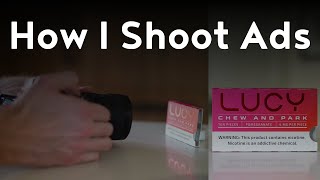
John Coogan shares how he learned to shoot and edit video ads in-house for his startup Lucy, cutting costs while maintaining creative control. He discusses his hands-on approach to production and why entrepreneurs need to understand the creative work they're managing.
This is how I shoot ads. Hey, everyone, I'm John Coogan. This video is going to be a little bit different from my usual content because it's entirely focused on my actual job. I've been an entrepreneur for the past decade, and that title can mean a lot of things. At Soylent, I was co founder and cto, so my primary focus was on building the E commerce website where we sold our products. I also helped out with finance, legal, HR and marketing. But most of my time was spent managing a team of software developers and designers to help scale our online sales. After five years spent building Soylent, I started a new company focused on putting an end to cigarettes. We named this company Lucy, after the Luce cigarettes that some smokers buy and refer to as Lucy's. We all kind of shuffled positions this time around. David Rentel, who was the Chief Marketing Officer at Soylent, stepped into the CEO role at Luci, since it was really his idea for the company to begin with. And Sami Hamdous, who was our VP of research at Soylent, stepped into the COO role at Luci. We knew that marketing was going to be really important since smokers are fiercely loyal to their cigarette brands. And we weren't going to need to build as much custom software as we did at Soylent because Shopify had gotten significantly more capable in the last few years. So I became the Chief Marketing Officer and have been working on figuring out how to get smokers to trade cigarettes for our nicotine gums and lozenges ever since. As cmo, I spend most of my time thinking about how to grow the company. I work on finding ways to improve our website, spend our advertising dollars more effectively, and making new creative assets to help promote our products. And that's what I'm going to cover today. We need some new ads and I'm going to try and shoot them in house with the help of our creative director, Julio Miles, who was also the Creative director at Soylent. As you can see, we really like the team that we built there. And now to give a bit of perspective, we could afford to pay an agency to shoot ads for us. And we have in the past at Soylent, we paid a few thousand dollars to a small team in LA to shoot our crowdfunding video. And it came out so poorly that our investors later told us that they actually thought we made it bad intentionally to make fun of Kickstarter videos. Later, when we raised our Series A, we spent over $100,000 on a professional shoot where we lit a plane on fire at Luci We've tried to take more of a middle of the road approach, spending a few hundred dollars with small creators and then doing the occasional bigger shoot with agencies that charge around 10k. We're fortunate enough to have raised about $15 million in funding, so we could probably afford to pay agencies all the time. But this is less about saving money and more about the learning process. As I mentioned in my last video, my favorite thing about startups is that they are amazing learning environments. Shooting this ad myself will save my company money, but it will also help me learn what goes into making a great ad so that the next time I hire someone to shoot new creative for me, I can properly assess their abilities and understand the trade offs involved in what they do. It's very hard to manage someone if you don't have an appreciation for their craft. This is really true for programmers and it's a big reason why there is so much focus on learning to code. If you're going to start a tech company, even though you might not be programming regularly, if the company is successful, you'll need to understand code in order to run the company effectively. Paul Graham had a great tweet about this. He said, if you want to start a startup, it's good to know about multiple unrelated things. Startups often depend on four or five different kinds of knowledge, and it's great if they can all be found in just two founders. I think that Lucy's success depends on knowledge of programming, biochemistry, law, science, sales, and video production. So this is how I'm developing knowledge around video production. Before we turned on any cameras, Julio and I worked through our goals for this project. We agreed that we wanted to make Lucy look approachable to smokers and stay away from the clinical themes usually seen in pharmaceutical ads. We also only want to appeal to adults since our products are sold to people over the age of 21. With that in mind, Julio mapped out a few storylines that could resonate with our target audience. The Unboxing experience, which emphasizes how convenient it is to get our products delivered to your door instead of needing to run out for cigarettes, which you can't buy online. The Working experience, where Lucy can help you skip those smoke breaks that take you away from what you're working on, and the driving experience so you can keep your car smelling fresh. Here's us shooting the Unboxing Experience. We started with a shot of the package arriving staged in my living room with some junk mail behind it to make it look like a receiving area. Then we moved to my coffee table to Show Julio opening the package and trying the product. I tried to get some cool motion with the camera so that the shots would look more visually dynamic and could be cut together in interesting ways during the edit. I'm using a Sony A7S III here with a 24mm lens. It's a really nice camera and it isn't cheap, but you can totally achieve similar results with a phone if you're just starting out. Never let gear hold you back. I shot everything in 120 frames per second, so I would have the ability to slow things down in post to highlight certain beats within each sh. Some of the camera moves were pretty tricky to line up with Julio's movements, so we had to do about 10 takes for each shot before we got something that we liked. I shot everything handheld, but because it's all in slow motion, there isn't too much camera shake. Here's the raw footage before any of the editing. It looks pretty good by itself, but we can spice it up a lot by adding some speed ramping I edit everything in Adobe Premiere Pro, but you can do all of this stuff in pretty much any editing software. Just start by looking up tutorials on YouTube. That's honestly what I did. So after ramping the speed so each clip is fast at the start and the end, but slow in the middle, here's what I had. Not bad, but transitions between clips will help tie everything together. So I grabbed a pack of transitions off of Envato and dropped the effects on each cut in the timeline. Lastly, I added a subtle color grade just to boost the colors a bit, and add a vignette to focus the viewer's eye towards the center of the frame. Then I added a piece of stock music from Epidemic Sound and exported the video. Here's how the final edit turned out. So my takeaway here Would I run this at the Super Bowl? Probably not, but is it worth testing online? Definitely. More importantly, I'm getting more comfortable shooting this type of content and feel like I have a better understanding of what goes into making great video ads. This whole shoot was heavily inspired by Daniel Schiffer and other YouTubers who make amazing ads on really tight budgets. I can only learn so much by watching those videos though. At a certain point I need to just try some things for myself and get a feel for it. We shot for about five hours and I only showed you the final version of one of the ads I We filmed four other scenes and are going to work on editing those together over the next week. I already have a bunch of ideas for how I can improve these projects in the future and really can't wait for the next shoot. It's so fun to learn a new skill, even if the beginning process is super rough and everything is just terrible for a while. Hopefully this video is helpful to anyone who needs to make ads for their startup. Even if I was selling a software product, I would still probably learn how to make great video content to help promote it, but let me know what you think in the comments below. Do you like this type of video? I still plan on doing more deep dives on tech topics, but I figured that I could mix in some of my real world experiences for variety. I have a bunch of videos planned for this year, so please consider subscribing to the channel. And as always, thanks for watching.










