The Epic History of Artificial Intelligence
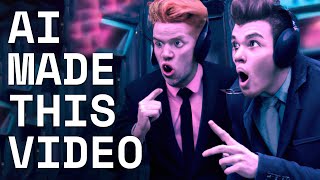
John Coogan traces AI from ancient automata through Turing and the 1956 Dartmouth conference to today's generative models. The video covers Deep Blue beating Kasparov, AlphaGo's victory, and how neural networks revived the field after the AI winters when funding dried up.
This is the complete history of artificial intelligence, illustrated entirely by artificial intelligence. Thousands of years ago, Greek myths told of giant automatons. Talos was a bronze giant designed to defend the island of Crete. He would throw boulders at the ships of invaders and slowly circle the island every day. The myth says that Hephaestus forged Talos as a gift to the son of Zeus. The ancient Egyptians also believed in artificial intelligence and built sacred mechanical statues that were said to be capable of wisdom and emotion. And many other civilizations built realistic humanoid automatons in an attempt to reproduce the true nature of humanity in a mechanized form. Throughout the 17th and 18th centuries, many philosophers reasoned that the process of human thought could be mechanized. Thomas Hobbes and Rene Descartes explored the possibility that all rational thought could be systematized as simple algebra. Even though simple calculating machines had existed for centuries, it wasn't until the early 19th century that Charles Babbage and Ada Lovelace designed a truly programmable computer. It was called the Analytical Engine. And although it was never built, it remains a remarkable turning point in the development of computer science. The theoretical underpinnings of modern computing progress steadily, with George Boole inventing Boolean algebra in 1854, and then Bertrand Russell and Alfred Whitehead describing formal logic in 1913. The first half of the 20th century led to an explosion of science fiction depicting artificially intelligent robots. The wizard of Oz featured a Tin man who lacked a heart but otherwise operated like any other human being. And in 1927, a German science fiction film named Metropolis depicted a machine person who poses as a woman. By the 1950s, proper work on artificial intelligence was starting to take shape. The English mathematician Alan Turing suggested that humans use available information as well as reason in order to solve problems and make decisions. So why couldn't a machine do the same thing? Turing was born in 1911 and by all accounts was a mathematical savant. Upon graduating from college, he published a paper titled On Computable Numbers, in which he described what would later be known as a Turing machine. This paper built on ideas proposed by Kurt Godel and outlined a machine that would be capable of solving any computable function. Today, we use the term Turing Complete to describe fully functional real world general purpose computers or programming languages. Essentially, this new Turing machine would not be specialized, but instead could solve any computing problem. During World War II, Turing focused on practical applications of mathematics and computer science. He used cryptography to break access ciphers and decode military communications. This code breaking work was highly specialized and didn't utilize a Turing machine, but it demonstrated the incredible abilities of the nascent computer science field. After the war, Turing began working on artificial intelligence. But there were some big obstacles in his way. First, computers needed to fundamentally change. Before 1949, computers were unable to store commands. They could only execute them. Basically, computers could be given instructions, but they couldn't remember what they did. Second, computing was extremely expensive at the time. Leasing a computer for a single month would cost upwards of $200,000. Only large technology companies and prestigious universities could afford to experiment with computers. But this was about to change. Artificial intelligence researchers needed to get some attention. They needed high profile people to endorse new initiatives, and they needed reliable sources of funding. Fortunately, the field of artificial intelligence was about to get a lot more interesting. In 1950, Alan Turing was the deputy Director of the Computing Laboratory at the University of Manchester. While there, he published a paper in a philosophical journal called Mind with a simple idea called Imitation Game. Turing asked, if a computer could imitate the sentient behavior of a human, would that not imply that the computer itself was sentient? Essentially, if a human tester could no longer tell the difference between human and computer interactions, then the computer would pass the test and we would have to admit that computers possessed human level intelligence. Building a machine that could pass this so called Turing test wouldn't be easy though. The computer would have to process natural language, be able to learn from a conversation and remember what had been said. Then it would need to communicate ideas back to the human and understand common sense. That same year, Isaac Asimov published his Three Laws of Robotics. The first, a robot may never injure a human being or through inaction, allow a human being to come to harm. The second law, a robot must obey the orders given it by human beings, except where such orders would conflict with the first law. The third, a robot must protect its own existence as long as such protection does not conflict with the first or second laws. Asimov explored the implications of these three laws in a variety of science fiction stories and wound up educating the public about machine intelligence and illustrating some of the complex paradoxes inherent in attempts to control robots. With interest in AI growing steadily, things were about to hit a Turning Point. In 1956, Dartmouth College held the Summer AI Conference. A group of scientists had created an AI proof of concept called the Logic Theorist. The program was designed to mimic the problem solving skills of a human and is often called the first AI program in history. The Dartmouth Conference was Hosted by John McCarthy and Marvin Minsky and had a clear goal show the world that AI was the future. The Conference brought together top researchers from various fields and actually marked the the first usage of the term artificial intelligence. The event fell short of expectations though, with most people leaving without strong alignment around standard methods in the field. Despite this minor setback, everyone now believed that building AI was achievable. And that set off a 20 year boom in the field. The 50s and 60s led to remarkable progress in AI research. Computers were getting faster, cheaper and more accessible. Machine learning algorithms were improving rapidly. And most importantly, people got better at knowing which algorithm to apply to specific problems. Many early AI programs used an algorithm called Reasoning as Search. The idea was to have the program proceed toward a goal step by step, as though it were trying different routes in a giant maze. The problem was that for many problems, the number of possible paths through this maze was simply astronomical, a situation known as combinatorial explosion. Researchers would reduce the search space by using heuristics or rules of thumb to avoid unlikely paths. But this brute force approach still had many drawbacks. Nevertheless, advances in so called symbolic AI led to a number of key projects. It was during this time that Carnegie Mellon researchers developed the General Problem solver and John McCarthy and Marvin Minsky created the MIT AI Lab. The first chatbot was developed at MIT in 1965. The program was called Eliza and would carry on a conversation in English on any topic. General Motors also began using an industrial robot called Unimate on their automobile assembly line. These successes convinced the US government to fund more AI research at leading institutions. DARPA was particularly interested in developing a machine that could transcribe and translate spoken language, something that AI is extremely good at today, but was still in its infancy. Back in the 60s, everyone was optimistic about the coming age of artificial intelligence. And that led to aggressive predictions about the future. In 1970, Marvin Minsky told Life magazine that we will have a machine with the general intelligence of an average human being in three to eight years. The basic framework now existed for developing AI systems, but a host of new problems were about to emerge. Breaking through the initial fog surrounding the fundamental concepts of AI revealed a vast majority mountain of obstacles. The biggest challenge was the lack of computing power. At the time, Computers simply couldn't store enough information or process it fast enough to do anything meaningful. Human communication requires knowing not only the meanings of a huge dictionary of words, but also how to understand them in many combinations. A doctoral student of John McCarthy named Hans Moravec articulated the problem well when he said computers were still millions of times too weak to exhibit intelligence. As progress stalled, so did the funding streams. The well of government money that had been fueling innovation dried up, and research stagnated for a decade. It was the first AI winter, and it would shape the way researchers thought about making predictions for decades to come. Part of the problem was that AI research was largely undirected at the time. Researchers would try lots of different ideas with no clear application in mind. But the mansfield Amendment of 1969 put pressure on DARPA to fund mission oriented directed research. As a result, DARPA shifted to funding projects with clear objectives, like autonomous tanks and battle management systems. The permafrost left by the AI winter would finally thaw. During the 1980s, a new methodology called expert systems Promised to be more directly applicable to real world problems. So corporations began funding new research. Expert systems were designed to directly mimic the decision making processes of humans. The idea was to collect information from experts on how to respond to all sorts of situations. And once a reasonable answer has been collected, for virtually every situation, Anyone could use the system to receive advice. The Japanese government poured hundreds of millions of dollars into these expert systems as part of their fifth generation computer project. But unfortunately, most of the ambitious goals Fell short of expectations. Despite this particular approach failing to launch, the increased funding did inspire an entire generation of young engineers and scientists to pursue artificial intelligence research. And although expert systems would prove to largely be a dead end, in another corner of the research world, A new method called deep learning Was starting to take hold. In 1982, the physicist John Hopfield Was able to prove that a neural network could learn and process information in a completely new way. Around. Around the same time, Geoffrey Hinton and David Rumelhart Popularized a method for training neural networks Called backpropagation. These neural networks would be commercially successful in the 1990s, when they began to be used as the engines Driving programs like optical character recognition and speech recognition. Even though AI researchers were finally making headway and about to reach the top of the mountain, Another AI winter set in. Many of the ambitious goals had once again fallen short of expectations, like the ability for a machine to carry on a casual conversation. So governments began slowing the funding pipeline to a drip. The AI winter that lasted from 1987 to 1993 was different from the previous winter, though this time, AI thrived despite tight budgets, the public had stopped paying attention, and robotics were no longer on the COVID of every newspaper. But leading AI researchers kept working. In 1997, artificial intelligence was back in the limelight After a chess playing computer program named Deep Blue Defeated the world chess champion and grandmaster, Garry Kasparov. The match was highly Publicized and marked the first time in history that a reigning world chess champion had been beaten by AI. In the same year, speech recognition software hit the mainstream with the release of Dragon. Naturally speaking for Windows, it was now clear that AI could not not only play games, but could also speed up everyday life. AI research expanded to new areas. Around the turn of the millennium, interactive robot pets became commercially available. MIT researchers created a robot with a face that could express emotions. And iRobot launched an obstacle avoiding autonomous vacuum. Many of these systems were still incredibly limited. But advances in deep learning and big data were about to change all of that. The 21st century brought about the exponential growth in both computing power and data storage. Neural networks had proven capable of incredible results. But they needed to be trained on massive data sets using the most powerful computers in the world. In 2004, DARPA launched the Grand Challenge and offered prize money for any team that could produce a functional autonomous vehicle. This kicked off a heated race to develop a fully self driving car that still rages on to this day. Sebastian Thrune led the development of a robotic vehicle named Stanley that won the 2005 DARPA Grand Challenge. He then joined Google to lead their self driving car project. NASA also began using autonomous systems to control rovers on the surface of Mars in the mid-2000s, further drawing the public's attention to the exciting progress in robotics at the time. The 2010s saw deep learning approaches accelerate to new heights. ImageNet launched the large scale Visual Recognition Challenge to quantify quantitatively assess the ability of AI systems to identify objects and images. In 2011, IBM's Watson beat Jeopardy. Champion Ken Jennings, proving that AI systems could understand and answer trivia questions remarkably effectively. Then big tech companies started rolling out virtual assistants like Apple's Siri for the iPhone. This helped people start to become familiar with interacting with AI technology. Then in 2012, two Google researchers, Jeff Dean and Andrew Ng, trained a large neural network to recognize images of cats, despite giving no background information by showing it 10 million unlabeled images from YouTube videos. This was clear evidence that neural networks were capable of learning. And it was all made possible by the recent revolution in deep learning. Deep learning models are deep in three distinct ways. First, these deep networks have more layers, and each layer can process a process problem at a different level of abstraction. Layers that are close to the input layer handle low level concepts such as the edges in a picture. And as we move deeper into the network, we find more abstract concepts. Second, deep learning networks also have a deeper pool of neurons to use to solve a Given problem, a typical neural network from 1990 might only have 100 neurons. The human brain, on the other hand, has about 100 billion neurons. That meant that these these old shallow networks were limited. But a state of the art neural network from 2016 could have over 1 million neurons, which is about the same number as a bumblebee. And based on current trends, we might see neural networks with the same number of neurons as the human brain in 40 years. But human brains aren't just collections of neurons. They also have structure. Finally, deep learning is deep in the sense that the neurons themselves have many more connections. In a highly connected connected neural network from the 1980s, each neuron might have 150 connections with other neurons. A state of the art neural network today might have as many connections as there are in a cat's brain. So deep neural networks have more layers of neurons, more total neurons, and also better connected neurons. This rapid advancement in AI technology was getting worrisome though, and smart people started to ask if this could backfire. AI still had plenty of skeptics. After all, identifying cats in photos seemed relatively trivial compared to solving real artificial general intelligence. But Elon Musk, Stephen Hawking and 3,000 others were concerned enough to sign an open letter banning the development and use of autonomous weapons. In 2015, AI systems built using deep learning were showing no signs of slowing down. And it was becoming clear that some of these systems could replace human workers. That led Geoff Hinton, the father of modern deep learning, to recommend that we stop training radiologists. In 2016. The job of identifying cancer in medical images seemed like an ideal task for a deep learning system, and he thought that AI would quickly take over. Hinton's prediction is still hotly debated in medical and AI circles today. The last few years have seen remarkable AI progress in competitive games. In 2016, the team at DeepMind built a deep learning system called AlphaGo and beat the reigning championship, being Lee Sedal, in a best of five match. Not only was Lee stunned to lose to a computer, but announcers were shocked by some of the unorthodox moves played by the AI. Moves that were assumed to be errors in the code turned out to be brilliant new strategies that had never been tried before. After mastering classic games like Chess and Go, the AI researchers set their sights on more modern computer games. OpenAI built a system that could play Dota 2 and DeepMind mastered Starcraft 2. 2017 saw AI researchers gather at the Asilomar Conference on Beneficial AI to discuss how to avoid the existential risk from artificial intelligence. AI was beginning to outperform humans in all manner of activities, and it was clear that researchers needed to think very carefully about how these systems were designed. AI could now be used by anyone with a simple computer to create essentially whatever digital information they wanted. Deepfakes could generate lifelike video of human form, faces that could fool casual viewers, and OpenAI's GPT3 could write complete sentences about anything on command. And that brings us to today. OpenAI just released Dall E2, a system for generating remarkable images from simple text prompts. And that's what you've been seeing throughout this video. What a time to be alive. If you want to learn more about how AI is advancing the self driving car industry, just watch this video next. Thanks a lot.










