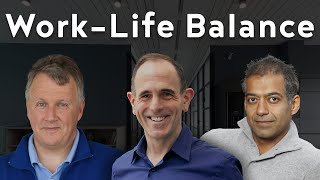
John Coogan explores how Naval Ravikant, Paul Graham, Keith Rabois, and Jason Fried think about work-life balance in startups. He shares what changed for him after becoming a parent and examines different philosophies on burnout and success in entrepreneurship.
Work life balance is an extremely fraught topic in the startup community. Some people argue that the only way to succeed is to outwork your competition, while others insist that spending 100 hours a week coding for years on end will lead to burnout and suboptimal outcomes. So who's right? I'm John Coogan and here are my thoughts on work life balance. This topic is top of mind for me because I just had my first child. It was a really amazing experience that I would definitely recommend to anyone who is on the fence about starting a family, but it's definitely not easy. In fact, supporting a family is so time consuming that many people in the startup world think you really shouldn't even try to start a startup if you're currently supporting a family. Here's what Paul Graham had to say about I wouldn't advise anyone with a family to start a startup. I'm not saying it's a bad idea, just that I don't want to take responsibility for advising it. I'm willing to take responsibility for telling 22 year olds to start startups. So what if they fail? They'll learn a lot and that job at Microsoft will still be waiting for them if they need it. But I'm not prepared to cross moms, and I generally agree with that sentiment. A family is a ton of responsibility, and I can't imagine the stress of raising a child while getting a startup off the ground. Fortunately for me, I did exactly what PG recommends and started my first company when I was 22. I had zero responsibilities at that time and it was easy to sink over 100 hours a week into coding and building products at the early stage. Now, nearly 10 years later, I feel like I have things a bit more under control. That's not to say that startups are easy by any means. I'm constantly putting out fires at my current startup, Lucy, but fortunately I have a great team of co founders and employees who can cover for me. While in this early stage of parenting, it's very hard to create one size fits all startup advice, and that's certainly true here. The craziest refutation of the you have to be young to start a tech company has to be David Duffield, who founded Workday at the age of 64. Before starting Workday, Duffield had founded PeopleSoft in 1984 and was a huge name in the tech industry. Still, founding a tech company when you're on the cusp of becoming a senior citizen certainly takes guts, but it paid off massively. Workday is now worth around $60 billion. So what about the broader question of work life balance? There have been a few big debates about the topic throughout the years, but one of my favorites involves Jason Freed and Keith Rayboy. Jason Fried is the co founder of Basecamp, a workplace collaboration company that bucked the trend of raising massive VC funding in favor of bootstrapping over the past decade. Jason has written a number of books on the topic of work life balance and generally argues that success in business does not require working to the point of burnout. Keith has a very different view of this issue. He's a proud member of the PayPal mafia and has seen the intense work ethics of entrepreneurs like Elon Musk and Peter Thiel firsthand. He generally believes that since there will always be dozens of highly intelligent and talented teams working on a given problem, the startup that succeeds will be the hardest working. Keith and Jason have battled it out on Twitter several times, and I've always found their exchanges interesting. For example, in this exchange, Jason argues that he himself is evidence that his work life balance mentality can lead to success. He's written several books while running a profitable company for 18 years, but Keith fires back in his typically brash tone that $30 million revenue businesses just aren't particularly interesting. I think Keith has a good point here, but the two are kind of talking past each other. If you read biographies of Elon Musk, Jeff Bezos, and really any of the other massively successful entrepreneurs, you will definitely see that their work ethics are unparalleled and the rewards of hard work have been chronicled in more rigorous detail in books like Grit by Angela Duckworth. But that doesn't mean that Jason is completely wrong here either. There's certainly nothing wrong with running a lifestyle business if that's what your goal is. I'm personally a fan of what Naval Ravikant had to say on this issue in his amazing Twitter thread, How to Get Rich Without Getting Lucky. Naval advises entrepreneurs to arm themselves with specific knowledge and writes specific knowledge is found by pursuing your genuine curiosity and passion rather than whatever is hot right now. Building specific knowledge will feel like play to you, but will look like work to others. I have completely optimized my career around building specific knowledge, and it's let me blur the line between work and life in a very natural way because startups require knowledge in so many different domains. I'm always trying to learn new things, and fortunately learning never feels like work to me. In fact, when I started out I would feel a bit guilty and unproductive when I'd spend hours poring over a textbook or watching online classes to learn something new, but it's always paid off. Even now. A big part of the reason why I'm making these YouTube videos is to learn about content production so I can apply that knowledge to my business. Naval says you should be too busy to do coffee while still keeping an uncluttered calendar, and I agree with that sentiment wholeheartedly. Burnout is real, but I find that for me at least, it tends to set in when I'm spending all my time on one thing that could easily be outsourced or automated. Fortunately, I really love entrepreneurship and the type of challenges it tends to throw at me. Mark Twain probably said it best Find a job you enjoy doing and you'll never work a day in your life. So even when I have a crazy week at work and wind up losing sleep over a particular problem, I'm still enjoying the process. And that's what's most important.