Who is Peter Thiel?
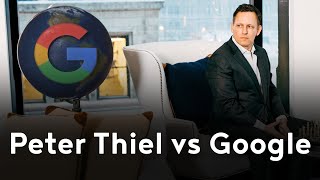
John Coogan examines Peter Thiel's views on tech monopolies, tracing antitrust law from the Sherman Act through Brandeis and the Chicago School. The video explains why defining markets for Google and other giants is harder than it looks, and why both parties now want to break them up.
Questions this video answers
1890
1916–1939
88% (search engines)
2018
Peter Thiel has mixed feelings about monopolies. He thinks entrepreneurs should aim to build a monopoly if they want to be really successful.
I have a single ide fixe that I'm completely obsessed with on the business side, which is that if you're starting a company you always want to aim for monopoly and you want to always avoid competition. Hence competition is for losers.
But he's also called Google out for being a monopoly.
There are obviously individual companies that that do quite well, especially if they have world class monopolies like Google has in search. Legal monopolies. They're legal as long as they don't try to tie in and oppress other companies by extending their monopoly power unfairly. But it's quite legal to have a monopoly as long as you don't abuse it.
And recently he's been funding politicians who are bringing antitrust lawsuits against big tech monopolies.
Google has now been hit with its first third antitrust lawsuit in just a few months. This one is coming from. It's being led by the Colorado Attorney General and a group of 38 states and territory. The suit claims that Google, we've heard this before, has illegally maintained a monopoly in general search and search advertising through anti competitive conducts and contracts.
I'm John Coogan and this is my deep dive into technology monopolies. Today I'm going to try and answer a few questions that have been bouncing around the tech community. First, I want to explain what a monopoly is and why monopolies are illegal in the first place. Then I want to examine big tech companies and quantitatively assess whether they fit the traditional definition of monopolies as well as look at how things have changed over time. Lastly, I want to talk about the political considerations here and how entrepreneurs should think about the issue of antitrust. A monopoly exists when one company controls the entire supply of a given product. There is a consensus among economists that monopolies create suboptimal outcomes. This is because when companies use monopoly power to raise prices, customers have no choice but to pay the higher price. This creates lost economic efficiency and will hurt GDP growth in the long run if left unchecked. Antitrust laws are the US Government's primary tool for breaking up monopolies. And the foundation of antitrust enforcement is the Sherman antitrust Act of 1890. In the late 19th century, industrial monopolies were rampant. So US Senator John Sherman proposed legislation that would allow the government to break up monopolies when they were found to be hurting the American economy. The legislation became an important tool in the coming years with Presidents Theodore Roosevelt and William Taft using the Sherman Antitrust act to regulate or break up a number of American businesses, including Standard Oil. But much of the modern theory around antitrust is actually informed by Louis Brandeis, a Supreme Court justice who served from 1916 until 1939. While he was a justice, Brandeis referred to the problems caused by monopolies as the curse of bigness and wrote that monopolies are secured by cutthroat competition, espionage, doing business as fake independence, and the making of exclusive contracts. Brandeis created an entire school of thought around monopolies that lives on today. One of his core theories was that the concentration of economic power aids the concentration of political power, and that such private power can itself undermine and overwhelm public government. He also notably believed that the structure of our markets and of our economy can determine how much real liberty individuals experience in their daily lives. Most Americans have much less interaction with the government on a daily basis as opposed to the private companies they purchase things from or do business with. So companies with monopoly power can seriously limit American liberty in a very tangible way. But Brandeis isn't the only influence when it comes to monopolies. Robert Bork was a judge and legal scholar who championed the so called Chicago School of antitrust analysis. In his 1978 book the Antitrust Paradox, Bork argued that consumer welfare should be the sole standard for antitrust law. Nothing else matters. Both Brandeis and Bork remain important figures in antitrust debates, with left leaning politicians usually citing Brandeis and right leaning politicians often citing Borkman. All this political history became a lot more relevant a few weeks ago when the Biden administration picked Tim Wu as an advisor on technology and competition. Wu has published several books about antitrust and has specifically focused on the concentrated power held by technology companies. In his 2018 book the Curse of Bigness, Wu argues, as Brandeis did nearly a century ago, that extreme economic concentration yields gross inequality and material suffering, feeding an appetite for nationalistic and extremist leadership. It's not just the Democrats who are pushing antitrust actions forward against Big Tech, though. Republican Josh Hawley, who's now a senator, launched an investigation into Google back in 2018. Hawley is significant in all of this because he received political funding from none other than Peter Thiel, who has been vocal for nearly a decade about Google's monopoly on search. So let's dig into the monopoly question a bit more, starting with Google, who's clearly the biggest target here. Google is under fire for two main reasons. First is that they have the largest market share in their primary business of all the major tech firms. Here's a chart of how dominant each tech company is in its primary market. Google is clearly leading with 88% market share in search engines zooming out. People looking to answer the question, is this particular industry monopolistic? Often will look at the revenue share of the top four firms in a particular industry. And looking at that data for the tech industry, you can see that the tech sector is indeed the most concentrated of all the major American industries. But it can be extremely difficult to objectively assess market concentration for one major reason. How do you define a particular market? It's true that Google is dominant in search, but they are clearly in fierce competition with Facebook for advertising dollars. If you instead look at the advertising market over the past five years, you will see that Google's market share has remained fairly constant. The same is true for other tech subsectors like app stores, cloud, payments, business software and gaming. Increasingly, the big tech companies are bumping into each other with every new initiative they launch. Consider Google, Facebook, Facebook, Amazon and Apple. They each operate primarily in separate markets. Search, social, commerce and devices. Each company has significant control over its primary market. But if you follow new product announcements and acquisitions closely, you will see that they are all in direct competition. Google has YouTube to compete in social, Android, Nest and Chromecast to compete in devices and Google Shopping to compete in commerce. Facebook has Portal and Oculus to compete in devices, Marketplace to compete with Amazon in commerce. And they've been growing the Facebook search function to compete with Google. Apple uses iMessage to compete with Facebook in social. They have Siri which can route around Google for search traffic. And they are growing Apple pay to expand into commerce. Lastly, Amazon has a growing ad network that competes with Google. They bought Twitch which competes in social, and they have a wide array of Alexa powered devices that compete with Apple products. Increasingly, tech companies are diversifying and competing with each other, which should benefit the consumer. And data suggests that this is working. The majority of Americans still have highly favorable opinions about big tech companies. And we haven't seen cases where tech companies are raising prices and harming consumers. So why do Republicans and Democrats both seem interested in breaking up these big tech companies? Even though both political parties want to reduce the power of big tech, they have very different motivations. And it all comes back to Brandeis and Bork. Let's take a look at what Democratic Congressman David Cessellini had to say about the motivations on the left.
Because concentrated economic power also leads to concentrated political power. This investigation also goes to the heart of whether we as a people govern ourselves or whether we let ourselves be governed by private monopolies. American democracy has always been at war against monopoly power. Throughout our history, we've recognized that concentrated markets and concentrated political control are incompatible with democratic ideals. When the American people confronted monopolists in the past, be it the railroads or the oil tycoons or AT&T and Microsoft, we took action to ensure no private corporation controls our economy or our democracy.
Cessellini is making a clear callback to Brandeis here and the idea that monopolies will inevitably convert their vast economic power into political power. Even though the tech companies are mostly aligned with Democrats at the moment, that could easily shift. So it's in the interest of government representatives to curb the political influence of tech companies before it's too late. Republicans are more focused on Bork's idea of economic harm to the American consumer. Essentially, even if Google does have a monopoly on search, that's fine as long as they don't use it to raise prices. For years, Google has had an easy answer to this line of questioning. Google's search is free to the end user, so the price gouging question is moot. But Republicans have warmed up to the idea of regulating tech companies because conservative content has been severely penalized on the Internet. Republican Representative Matt Gaetz articulated this point.
Well, but I want to talk about search because that's an area where I know Google has real market dominance. On December 11, you testified to the Judiciary Committee, and in response to a question from my colleague Zoe Lofgren about search, you said we don't manually intervene on any particular search result. But leaked memos obtained by the Daily Caller show that that isn't true. In fact, those memos were altered December 3rd, just a week before your testimony, and they describe a deceptive news blacklist and a process for developing that black list approved by Ben Gomes, who leads search with your company, and also something called a fringe ranking, which seems to beg the question, you know, who gets to decide what's fringe?
So even the Republicans are generally okay with the economic activity of big tech companies. They are increasingly worried about the ability of tech companies to swing elections by limiting the spread of conservative content online. And this really gets to the heart of the issue in my mind. Democrats blame big Tech for helping get Donald Trump elected in 2016, and Republicans blame big Tech for helping Joe Biden defeat him in 2020. It's a lose lose situation for tech companies, which is why you see companies like Facebook now asking for regulation around political content. Circling back to Peter Thiel, though, what does this all mean for entrepreneurs? Well, I think Thiel's advice still rings true. Disruptive startups are rarely built in highly competitive markets. It's much better to find a new industry that hasn't really been explored yet than try to compete in a crowded space. And with that, I'll leave you with one closing thought directly from Thiel himself.
I would say that don't always go through the tiny little door that everyone's trying to rush through. Maybe go around the corner and go through the vast gate that no one's taking.










