Why Don't We Have Flying Cars Yet?
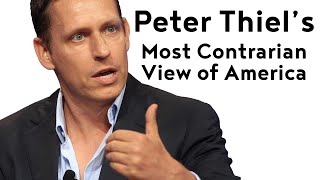
John Coogan breaks down a 2012 debate between Peter Thiel and Eric Schmidt on whether America stopped innovating after the 1970s. Thiel argued progress stalled in physical things like transport and healthcare while software exploded, blaming regulation and fear of big ambitions.
Shifting.
You're shifting to the future. I'm talking about.
Yes, that's my job.
Well, well, well.
Okay.
We're talking about the future. And, and you can easily. And that's, that's. And I'm saying we should look in to the last 40 years as clues for the future.
Yes.
If we had 40 years of stagnation where wages have been stagnant, people are wealthier, there's fewer deaths, drug addiction is lower. Right. There's all sorts of reasons why they're all flipping.
Let me jump in much.
One moment.
Excuse me, Eric.
Peter is making the point that as a general, we don't agree on a basic fact. No, no, no, I know.
This clip is from a 2012 debate between Eric Schmidt and Peter Thiel. And as you can see, they are getting nowhere with each other. The debate went on for 40 minutes, but they were never able to align on whether or not America is in a period of stagnation. So I want to try and talk about the key points here and try and see who looks right in hindsight. As a bit of background, Peter Thiel was the co founder of PayPal and Palantir and, and now runs the venture capital firm Founders Fund. Eric Schmidt was the CEO and later the executive chairman of Google. They're both intellectual heavyweights in Silicon Valley. And while they agree that computer technology has been advancing rapidly, they disagree on whether or not America has been seeing rapid growth more broadly. Their debate is interesting not only because Schmidt is a prominent Democratic donor and Thiel was a Trump backer in 2016. So they clearly have very different policy prescriptions, but they disagree on a very fundamental level as to what is currently happening in America. Thiel has been very vocal about the idea that American progress has been stagnant since the 1970s. And he summarizes it well in this clip.
I sort of date this era of relative stagnation and slowed progress all the way back to the 1970s. So I think it's been close to half a century that we've been in this era of seriously slowed, slowed progress. Obviously, a very big exception to this has been the world of bits computers, Internet, mobile, Internet software. And so Silicon Valley has somehow been this dramatic exception.
Whereas the world of.
Atoms has been much slower for something like 50 years.
Thiel himself admits that it can be difficult to precisely quantify the pace of innovation and its effect on the broader economy. He tends to focus on three areas of stagnation in particular. The first is the speed of travel. He cites the fact that the Concorde was shut down in 2003 and the true speed of air transportation has been dropping ever since due to increased airport security. The second is in healthcare, where costs have been increasing well ahead of inflation for decades, with only moderate increases to life expectancy and health outcomes to show for it. He often points to the war on cancer that President Nixon declared in 1971 and has yet to see any promising developments. Lastly, he focuses a lot of attention on education, similar to healthcare, education costs have risen significantly above inflation while median real wages have stagnated. His focus on median real wage growth is fascinating to me because it's one of the most unexplained phenomena in present day America and it has an immense impact on everyday life as opposed to a future where we all work less and are still better off. Each year he draws a comparison to the Red Queen's race in Alice in Wonderland and in this futile race, everyone must run faster and faster to stay in the same place. These are interesting points because while Thiel often describes himself as a libertarian, many left leaning political commentators agree with him that these are underlying problems that need to be addressed. They just disagree on how best to remedy these issues. Thiel points to two key areas that could be possible solutions to the problem of American stagnation. The first is government regulation. As a libertarian, he believes that regulation by the FDA has led to stagnation in drug development, local NIMBY movements have halted progress in transportation, and fear of nuclear disasters has stopped the development of alternative energy. Here's Thiel speaking about regulation in more detail.
One cut on this is always to differentiate the world of atoms and bits, and that since the 1970s we've had a narrow cone of progress around atoms. They've been sorry around bits. The computers, Internet, mobile Internet software, these have been advancing fairly quickly. The world of atoms somewhat more slowly. When I was an undergraduate at Stanford in the late 80s, I would say that almost every engineering field in retrospect was a bad field to go into. It was already obvious that you shouldn't go into nuclear engineering. Aero astroengineering weren't that good. But even all these other fields were not going to do that well in the decades ahead. But because we were, electrical engineering was still okay. Computer science was the really good field to go into in the late 80s. All the other engineering fields, it was just regulated to death. There wasn't that much you could do in the world of atoms. And it turned out that we had a lot of slow progress. And I think that if we sort of analyze this question of the rate of scientific progress politically, and think of it as sort of university professors or entrepreneurs or venture capitalists exaggerating about how much good they're doing and how great they are. We understand that the incentives are always to exaggerate and to say that we're just around the corner from curing cancer, around the corner, all these different things, and yet it's been in some significant way slower over the last 40 or 50 years.
Looking back on these points in 2020 helps us understand how intractable some of these problems really are. While he supported Trump in 2016, he pulled support for the 2020 re election campaign, which could suggest that he doesn't think Trump will ever be able to achieve the level of change necessary to spur innovation in the world of atoms, as he describes it. The second pathway Thiel sees as a way forward is to bring about a change in the way innovators think about the future. He outlines the four ways that societies generally think about the Future in a 2013 talk at SXSW.
Most simplistically, you can say that the future is either optimistic or pessimistic, and it's either determinate or indeterminate. An optimistic future is one where you believe things will be better than the present on whatever axis defines better. A pessimistic future is one where you think things will generally be worse. And then a determinate future is one where you can sort of map out reasonable amounts of it and plan against it. And then an indeterminate one is where you have absolutely no clue and it's sort of just a random walk all the way.
Thiel generally believes that Americans are currently in the upper right quadrant, meaning that they are still optimistic about the future, but they don't have a deterministic vision of how we will get there. He thinks the best way forward is for individuals to start thinking deterministically and to bring back a clear vision of the future that was so popular in the mid 20th century. He sums this up really well in a debate with Marc Andreessen from 2017.
I think we can be doing a lot better. You know, I think we can be looking at a whole range of technologies. Futuristic computer technologies, artificial intelligence, quantum computing, space technologies, biotech, next generation life sciences. We should be finding a cure for cancer, for Alzheimer's. And I think it is not a fact of nature that the slowdown has happened. It's a cultural decision. We've become risk averse, we've been regulated to death, we've become incrementalist and we're not willing to really take the bold steps. We've talked ourselves into thinking that throwing Angry Birds at pigs is the best we can do, and I think we can do better.
I think his summation of the need to be more ambitious when it comes to technological development is quite powerful because because it runs counter to the common narrative in Silicon Valley that technology is saving the world and progress is inevitable. It is in some ways scary to accept that unless we move mountains to bring about meaningful change, we will stagnate. As a country, it's much easier to believe that the future is ever advancing and we are already on the right track. But what do you think? Let me know your opinion on Peter Thiel and his core ideas by leaving a comment below. And if you enjoyed this video, please consider subscribing to the channel. Thanks for watching.










