You Don't Know the Metaverse...
John Coogan and Matthew Ball explain what the metaverse actually is and why Facebook is betting billions on it. The metaverse needs persistence, liveness, interoperability, and a working digital economy. The real barriers aren't the idea but the tech: networking, rendering, and payments.
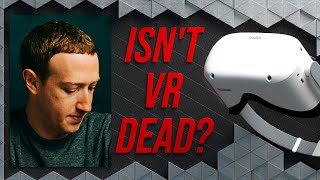
Mark Zuckerberg is on a VR spending spree.
I'm not sure folks realize, like, Facebook's largest expenditure for multiple years now has been VR.
We don't know exactly how much Facebook is spending, but most people think it's around $5 billion per year. And that's after they spent $2 billion to buy Oculus in 2014. It's now seven years later, and VR still hasn't reached mass adoption.
The average use for a virtual reality.
Head, the average number of times people use a virtual reality headset is one. Don't get me wrong, VR is an amazing technology, but it just hasn't gotten to the point where average people can enjoy it every single day. But Zuckerberg isn't taking his foot off the gas. He now has 20% of Facebook's employees working on VR in some capacity. It's a massive investment. That sounds way out of line with the current market opportunity. Both Oculus and Instagram were acquired around the same time for around the same price. But Instagram brings in more than 10 times as much money for Facebook as Oculus and at a much higher margin. So why is Zuck still so obsessed with VR? Well, there are a few different reasons, but to understand them, we need to talk about the Metaverse. So let's put on our VR headsets and dive in.
What is the Metaverse? You know, it's a virtual environment where you can be present with people in digital space. Kind of think about this as an embodied Internet that you're inside of rather than just looking at. And we believe that this is going to be the successor to to the mobile Internet.
For the past few months, everyone in tech has been talking about the Metaverse nonstop. There are lots of different definitions floating around out there, but no one has done more work to popularize the term Metaverse than Matthew Ball.
The best way to think about it is a quasi successor state to today's mobile Internet in much the same way today's mobile Internet built off of the Internet of the 90s and 2000s.
Lots of people, especially engineers, are extremely skeptical when a business blogger comes along and coins a phrase for a vague collection of technology trends. But sometimes these terms do have a practical use. Think about how we label generations. Terms like Boomer, Millennial, and Gen Z are all loosely defined around a period of dates we can't all completely agree upon. People typically use the birth years between 1981 and 1996 to define the Millennial generation. But is someone born on January 1st of 1997 all that different? From a millennial? Obviously not. But that doesn't mean that there isn't value in having a term to describe a new era. Technology has been through a few of these, and sometimes they are only clear in hindsight. After mainframe computers were adopted by corporations, the personal computing era brought technology into the homes of millions of people. It wasn't long before these computers were connected to the Internet, which marked the beginning of the dot com era. And the last 15 years have clearly been defined by the mobile phone. Each era of computing has had huge winners, but no one company can bring about a new era alone. And that's why the Metaverse is such a useful concept. It's not just Fortnite or VR or crypto. The Metaverse is an idea that ties these concepts together and seeks to explain how they all interconnect. So you're probably wondering, how will the Metaverse be any different from today's Internet? Fortunately, Matthew Ball has laid out a few key ideas that highlight what this evolved form of the Internet will look like. First, the Metaverse will be persistent, meaning that it never resets, pauses, or ends massively. Multiplayer online role playing games are the closest thing that we have to this currently, but not many other online experiences replicate this well. When you win a match in Fortnite, the map resets entirely and anything you built in that game is gone forever. Second, the Metaverse will be live. Much of the modern Internet is built for asynchronous use. You can watch this YouTube video at any time, for example, and pre scheduled events will take place in the Metaverse for sure. But everything will be designed to be live by default. Third, experiences will span both digital and physical worlds. Pokemon Go was the first massively adopted augmented reality game, and that gives us a preview of what's to come. This theme isn't restricted to gaming specifically, though Microsoft is already helping companies build digital twins that represent physical infrastructure in virtual spaces. Here's Microsoft's CEO to explain what that means.
With Azure Digital twins, you can model any asset or place with Azure IoT and keep the digital twin live and up to date. Synapse tracks the history of digital twins and finds insights to predict future states. And with Azure, you can build autonomous systems that continually learn and improve.
Fourth, there will be no cap on concurrent users. This is one of the hardest problems to solve from a technical point of view, but it's critical. Even the biggest online games still restrict each session to around 100 players, even though millions might be playing at a given time worldwide. A single server will still be capped. Massive concurrency will make Metaverse experiences feel very different from the present day Internet. Fifth, the Metaverse will have a fully functioning economy. Increasingly, the Internet is simply the best place to make money. Nearly every business has moved online now, but there's still a long way to go until we have a fully digitally native economy. Most transactions are still siloed in particular virtual spaces, and investment in digital goods is still in its infancy. Sixth, the Metaverse will have unprecedented interoperability. This means being able to bring a Fortnite skin into Minecraft and vice versa. Tim Sweeney, who founded Epic Games and owns Fortnite, has been talking about this for years now, and it's clearly an important goal. These days most Internet products are walled gardens and users have no real way of moving data, items, content or currencies between services. Lastly, user generated content will play a massive role in the Metaverse. This is basically a requirement, since no single company could ever hope to produce enough variation in their games to satisfy everyone. Roblox and Minecraft have been so successful because community members create engaging and unique experiences for each other. Now you're probably thinking that those are all pretty incremental developments, and they are. Individually, none of them are going to really change anything about how we experience modern technology, but taken together, they can create some pretty remarkable things. When multiple loosely related technologies start to get better at the same time, there are often surprising second order effects. And we've seen this exact thing happen several times in the past. Consider the second industrial revolution that occurred in the late 19th century. Thomas Edison built the first electric power stations in 1881. But it wasn't until 40 years later that electricity really started being used to power machines. That's because factories weren't designed around electricity when it became available. Most plants just replaced their steam engines with electrical ones and called it a day. This failed to take advantage of the full benefit of electrification. Older factories were designed to have a single power source that was either completely on or completely off. This meant that when the factory was on, every machine was running. But electricity can be routed locally and turned on or off based on the specific needs of the moment. Eventually, new factories were built to take advantage of the true value of electricity and productivity soared. Henry Ford built the first moving assembly line which cut the production time for a single car from over 12 hours to to just 93 minutes. This was only possible because electricity was available everywhere throughout the plant and the factory could be designed for maximum efficiency. We tend to think of Thomas Edison as single handedly bringing about the electrification of America. It was literally a light bulb moment. But that narrative completely ignores the advances in power management, manufacturing hardware, and production theory that collectively led to the real impact of electrification. That's why treating the Metaverse as Generation Just VR is so wrong. VR might be a foundational metaverse technology, but as we've seen, it's clearly not enough. We've had decent VR headsets for years now, but no Metaverse. If Thomas Edison is a little old school for you, don't worry. We can learn all the same lessons from Steve Jobs and the iPhone Most people will point to the iPhone as the beginning of the mobile Internet era, and just like the light bulb, they aren't wrong. But the full story is much more complex. Even though the first iPhone did have a web browser, it didn't have a 3G modem, and most websites had yet to be optimized for mobile. So the experience was pretty bad. It wasn't until the second iPhone that the mobile Internet really started taking off, and even then. This was almost a full decade after the Wireless Application Protocol created the standards that allowed phones to access the Internet in the first place. Obviously, there were lots of Internet connected mobile devices before the iPhone, and the impact of mobile wasn't entirely clear until apps like Instagram and Uber created businesses that couldn't exist before. The idea of a supercomputer in your pocket has been alluring for decades. In 1976, the sci fi author Arthur C. Clarke published Imperial Earth. In the book, he described a mobile video phone called the minisec, which had global data connectivity and sounds an awful lot like the iPhone. And in the 90s, a team of engineers spun out of Apple to start a new company called General Magic. The goal of that company was to basically create an iPhone, but they had to build everything from scratch and went bankrupt before launching it. The iPhone was only possible because so many other technological visions had finally become realities. Steve Jobs deserves all the credit in the world for the iPhone, but it was only possible because other entrepreneurs had built foundational technologies first, screen manufacturers made the iPhone durable, chip designers made the iPhone powerful, and app developers made the iPhone useful. The iPhone was the culmination of dozens of different independent technologies working together to produce a truly revolutionary product. Investors often talk about the iPhone moment as a key turning point in any new technology. It's the point where everything comes together and really starts working, and it often marks the dawn of a new era. In some ways, the light bulb moment and the iPhone moment couldn't be more different. The light bulb was merely an idea that sparked decades of innovation, but it didn't have immediate consumer value. The iPhone, on the other hand, was not just a single idea. It was the synthesis of dozens of technological trends. And that's how you should think about the Metaverse. It certainly hasn't had an iPhone moment yet, but there may have been a light bulb moment, even though we can't quite put our finger on it yet. In a few years, we might point to the Oculus, Fortnite or Ethereum as the true beginning of the Metaverse, but that won't matter as much as what comes next. The iPhone moment for the Metaverse will only come after we have made significant progress in several key areas of technology. Computers need to get faster in order to support more realistic rendering and physics calculations. It's no coincidence that the biggest games all have the most simplistic graphics. Fortnite, Roblox, and Minecraft are all designed to run on basically any device, so they have to be simple. Internet can Connections also need to get a lot stronger for the Metaverse to really work. Netflix is able to stream you HD video content because they can compress the footage you're watching in advance and store the file on a server in your region. We've all seen how difficult it is to maintain a stable connection, even on a basic video call, and I wouldn't call Zoom an immersive experience. Most video calls are 720p highly compressed and 24 frames per second at best. In order for VR to feel immersive, you usually need two separate streams of near 4K video running at 120 frames per second. If Internet connections get faster, the content you're viewing in VR could be rendered on a server and then streamed to you, like how Google Stadia runs games in the cloud and just sends you the resulting video feed. So hardware will need to get better and smaller, but that actually might be the easy part. See, computers basically get better every year, but the networks built on top of those computers only get more complex, complicated, intertwined and entrenched. The real promise of the Metaverse is one of universality. It's right there in the name. The verse in Metaverse only works if we develop a full fledged world that is open to anyone and encompasses everything. Big tech is in an interesting position right now. They want to help the Metaverse become a reality, but only as long as it doesn't challenge their dominance. The reason that Zuckerberg is investing so heavily in the Metaverse right now is because Facebook has by far the largest user base of any tech company. 3.5 billion people already use Facebook. That's half of everyone on earth. And all those people are creating and consuming content through Facebook apps already. This is a massive head start for Facebook, which is why Zuckerberg is happy to invest billions of dollars to make sure Facebook maintains a dominant position in what comes next. But Facebook has stiff competition. One of the cornerstones of the Metaverse will always undoubtedly be payments infrastructure. The ability to buy, sell, and most importantly, actually own things in the Metaverse could be the most transformative part of this new era. Facebook hasn't really been able to crack payments yet, but crypto certainly has. The biggest gripe that most people have with Facebook is that it's essentially controlled by a single person. Crypto still has a lot of work to do if the plan is to defeat Facebook. But Metaverse like projects are already starting to gain traction. Although they are extremely small at the moment, even though Metaverse related crypto projects are still in their infancy, it's totally possible that one of these projects winds up being the biggest winner instead of an existing tech company. As we saw with the mobile Internet era, there were tons of big winners, but Apple was probably the biggest winner of all. Even though Apple had been around for decades, they were in the right place at the right time and executed perfectly. Facebook wants to build something so fundamental to the Metaverse that that they can capture that iPhone moment. And if they succeed, the billions they've invested will look like pennies. All of this barely scratches the surface of what's going on with the Metaverse, so please subscribe for future videos. Thanks for watching.










