Ecosystem Activation: Getting Dirty with Regenerative Networks
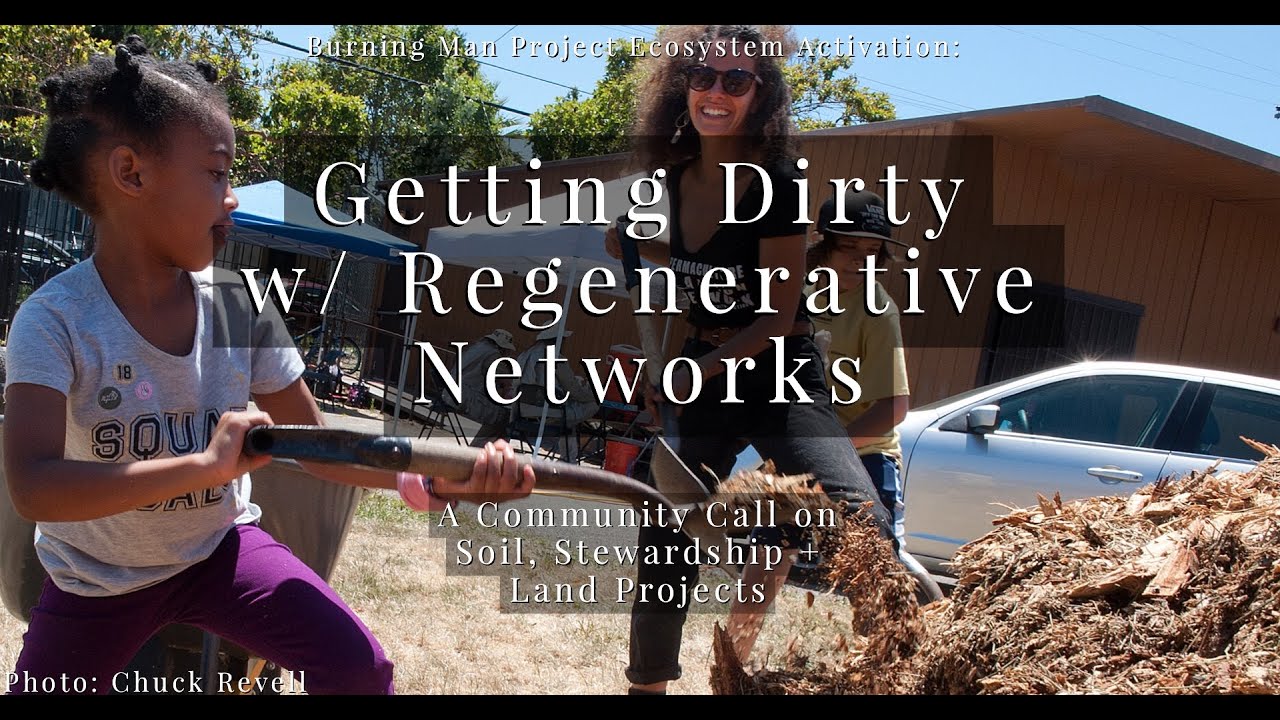
The webinar, hosted by Christopher Breedlove (Director of Activation, Burning Man), explored Burning Man’s 2019 Sustainability Roadmap targeting zero waste, carbon negativity, and regenerative goals. Speakers presented regenerative initiatives at multiple scales: Josh Whitten introduced Make Soil, a decentralized platform that maps community compost sites, connects households to local soil‑making, and aims to diversify language access—including plans to offer the platform in endangered languages—to foster ecosystem consciousness. Whitten emphasized humanity’s reliance on the single living biosphere, the need for a shift in language to stop suicidal trajectories, and described "ecosystem consciousness"—the ability to perceive hidden biodiversity (mycelium, microbes, insects) that drives an innate valuation of diversity across language, culture, and ecology. Ryan Rising described the Permaculture Action Network’s large‑scale action days and Just‑Transition Mapping, linking volunteers to regenerative projects. John D Liu and Ashley Brown presented the rapidly expanding Ecosystem Restoration Camps, autonomous global communities conducting ecosystem restoration and regenerative agriculture, while also sharing personal ancestry stories that highlighted the importance of recognizing diverse heritage within regenerative movements. The Q&A covered metrics, scaling, land‑access, decolonization, and the role of regenerative terminology for Indigenous communities. The session concluded with logistical notes—time checks, open invitation for continued conversation, and encouragement for participants to stay or leave as needed—underscoring a collaborative, inclusive approach to advancing regenerative networks.
Chapters
My name is Christopher Breedlove, and I'm the director of Activation for Burning Man, and one of the things that I get to spend some of my time on is the sustainability goals of Burning Man. You know, I'm not sure how many people know, but in 2019, we released something called the Sustainability Roadmap for environmental sustainability for Burning Man, and that listed out 3 goals that we're focusing on, which is: No matter out of place, handle waste ecologically, and become carbon negative, and also be regenerative. And so this call today is part of that be regenerative goal. It is probably the most amorphous of all of our goals because become regenerative, we have to figure out what those indicators are for ourselves in our own community. And we're also looking at these goals across a series of kind of levels, which include our properties and offices, Fly Ranch, BlackRock City, and also the global network. And one of the things we really see is that it's really this global network that's gonna be able to help us hit that Be Regenerative goal. And so today we have 3 awesome organizations that have joined us that are either run by Burners or intersecting with the Burner community in really amazing ways. And the reason we brought these 3 organizations in is because we really saw them as people who were teaching and creating opportunities for both individuals and communities to get involved with sustainable and regenerative goals at home and wherever you are in the world. And so how we've kind of structured the call today is kind of looking at things from a micro level, what you can do immediately in your home, to a macro level of what you can be doing anywhere in the world with land. And so the 3 organizations we have today with us are Make Soil, the Permaculture Action Network, and the Ecosystem Restoration Camps. We're super excited to have you all, and we're now going to go to each one of those groups to do a little bit of a presentation, and then we'll be doing some Q&A to finish it off. So I would love to invite up here Josh Whitten, the founder of Make Soil, to tell us what he's got going on and how we can get dirty with his network. Morning, Josh.
Hi everybody, good morning, glad to be here. I will go ahead and begin to share my screen. Cool, can everybody see that?
We can, you're good.
Okay everybody, I'm Josh Whitten. I'm so glad to be here, um, and of course the name of the game these days is regeneration. It's a word that's going around, uh, everywhere, uh, but it's time to make it meaningful. So right now, um, that we talk a lot about regeneration, we know the entire economy needs to transition to regeneration, to being regenerative, but there aren't any regenerative jobs right now. There's very few. The opportunities are everywhere, but as far as, you know, regenerative jobs, it's not really in the mainstream yet. And one of the reasons why is because regenerative experiences aren't really in the mainstream yet. Recycling, driving an electric car, buying solar panels, these things aren't really regenerative so much as doing less damage to the Earth. But regeneration is something else entirely, and makesoil.org is about spreading a regenerative experience worldwide. I'm actually going to switch to headphones here because there's a bit of background noise where I am. Hopefully you guys— All right, so the simplest opportunity, uh, for all of us to have a regenerative experience is probably the food waste that we're all generating on a daily basis. So if you look, you know, this is a picture of the food waste that I make in the course of a week. It's full of beautiful stuff— energy, nutrients. This is from a juice shop that I visited once. Every week they produce hundreds and hundreds of pounds of really delicious stuff you could probably actually eat. Shredded carrots, coffee grounds. Coffee grounds worldwide right now, they're not going in gardens for the most part. They're going into landfills. All those beautiful things I just showed you are usually ending up here, and it's an absolute tragedy that the Bits of earth, bits of Mother Earth that we profess to care about are more often than not ending up in this inglorious end here. That's taking the nutrients out of our food system basically forever, and it's also rotting when it goes to a garbage dump like this and causes methane. All those birds you see flying around a garbage dump, they're not looking for used electronics. They're looking for food, and it doesn't belong there. It belongs back in the earth. And in case you didn't know, I mean, all of that can be turned into new living soil. So what have cities been doing to try to handle this problem? Well, cities that are fortunate enough tend to have a curbside recycling program or curbside pickup program. And they struggle to get citizens to put the right things into the right bins. And it's different from city to city. Even when they have an organics pickup service, it takes giant trucks going around and picking up these bins, and those trucks get to like 3 miles to the gallon and produce a lot of emissions. And then they go off to a big industrial facility where a giant machine pushes the organics around and turns them into compost. And this is kind of a best-case scenario, at least in the recent past. The problem is it leaves us all in this box and bin culture. We order stuff on the internet, the box shows up on our doorstep, We chuck it in another box or bin when it's time for it to, you know, when we're no longer interested in it. And that leaves us rather ignorant about how the planet works. And quite frankly, the planet cannot have 8 billion people who know this little about how a planet works. So it's time for us to get more educated. And the best way to do that is in a hands-on, direct way to have a regenerative experience. And that is what Make Soil is about. So you can see here on our landing page, become a soil maker or find one near you. The Soil Maker is just an idea I came up with a couple of years ago as a new identity for us to step into, a new role for us to play in our neighborhoods. And who are the Soil Makers? They are people who go to makesoil.org who have a compost bin or a compost pile or whatever, and they put it on the map, literally. They add it to the Make Soil platform so that neighbors can use it. So the big idea here is actually a very simple idea. And that is, for any person who knows how to make soil or knows how to compost, you're surrounded by dozens of neighbors who would love to bring their food scraps to you. There's millions of people right now who know that food scraps do not belong in the garbage, and they would love to compost them instead, but they don't have a place to do it, or they're scared, or they don't know how to do it. I think it is quite intimidating to start for some people. So the Soilmakers, each of these little green dots, are accepting food scraps from one 2, 10. We even have a soil site on our map where they're accepting food scraps from 24 households, and they're doing a great job, and their backyard looks fantastic. Um, each of these little soil sites has a unique identifier. People can even print out, um, these QR codes and put them on their doors or fences to get their neighbors involved. And inside of each one of these soil sites, people are having conversations, they're learning, they're saying, hey, could you bring more coffee grounds home from work, or do you have any extra leaves in your backyard? People are actually coming together to regenerate the planet using this platform. And the scenes at these soil sites are beautiful. Sometimes I'm there visiting with the soil makers, but generally it's just a lot of neighbors coming together to make soil, to touch living earth, something other than plastic and metal and glass, which is all we seem to touch these days. Geeking out over how hot it gets. If you've never peeled back the lid of a compost bin and seen, you know, felt 160, 170-degree heat coming off, you're really missing out. For many people, That's the moment when they realize the Earth is actually alive. And when people do this together, when people make soil together, they just grow food together automatically. So watch this transformation here. We start with a compost bin and watch this little scraggly patch of grass, which is doing nothing but being peed on by dogs at this point in time. And there it is, the beginnings of a community garden. And that same patch of nothing becomes this giant productive garden, all with people starting by making soil together. In that particular soil site, no one who started using that compost bin knew what they were doing. They were all first-timers who just realized that their food scraps no longer belong in the trash. And this beautiful process unfolds after that. Make Soil is taking off all over the world. We're in 49 countries now and spreading. And this is Dubai. This happens because one person in the US emailed one friend in Dubai who then told the permaculture networks and all the gardening groups.. And it's one of our hottest places, no pun intended. Here's Philippines. I don't know anybody in Manila, but there are— soil sites are showing up there every day right now. So this is truly a global movement that's spreading. Kids love it. Honestly, making soil should be the center of every earth science curriculum. It's such a great launching point, something so relevant that tackles nutrition and health and community and regeneration and everything. And these soil sites are being hosted by all kinds of people: individuals, businesses, community gardens, urban farms. You know, businesses, this is a great way to get people coming to your business. You can put yourself on the map, you can say everything you want to say about yourself, you get a little profile page on makesoil.org, and if people start bringing their food scraps to your business, they might stop and shop a little bit. Apartments, don't let it stop you if you live in an apartment. Talk to that apartment manager, You can start a soil site there. Food banks, how beautiful would it be if more food banks were not just giving out kind of industrial food, but were also composting and making soil out of all the remnants of food that are left over, of which there's a lot of spoiled food at food banks, and then growing food. We have food banks on Make Soil that are soil sites like that. City and county government, we're being approached by cities now actually, because states are beginning to mandate that they do something about their landfills and keep organics out, and they're saying, yes, we've been trying for decades. What's new? And Make Soil is what's new. So what that means is that when cities in the past have maybe given out these backyard composters, which is a common thing that's happened in at least some cities, what happens is people can now list this compost bin, become a soil maker, and get 4, 5, 6 households using this one compost bin instead of just one household. A good soil maker with a good process can get a lot of people, 10 or more people, probably all composting in one single bin like this. So you can see with just this little tech innovation, we can double, triple, quadruple the amount of soil making going on in the world, even just with existing infrastructure. The other thing we're doing for cities is we're helping them finally track what their impact is. They're going to have to report these numbers soon to somebody. And so we're offering a dashboard to cities so they can begin to know how they're actually doing. We offer guides on how to build compost bins of all different kinds. If you're a woodworker, tell a woodworker, or if you know a woodworker or a makerspace or something, please tell them to go to Make Soil and check out some of the designs there. Every compost bin that they make can go on to just transform a community somewhere. Also check out our YouTube channel where I'm sort of a compost bin, um, uh, nut. And so I'm always like trying to figure out new compost bins. I think this might be the simplest design. I call it the Soil-Making Cylinder. So head over to our YouTube channel where you can get the, get the designs for that, as well as all these great interviews with soil makers who are on the platform telling you what a good time they're having. Um, and then lastly, a bit about what Make Soil is. It's a, it's a charitable organization. So we are a nonprofit, a 501 that houses the Make Soil tech platform and the movement that, that, um, that it supports all around the world. We're funded by donations right now, and we are not overfunded, I promise you. So it's a very efficient organization. If you know anybody, if your end of year giving hasn't happened yet, please consider us. If you know a millionaire or billionaire, tell them to— each dollar, really, we put it into the Make Soil equation and transformative resilient neighborhoods come out the other side. Revenue coming soon from these city partners. That's going to be so exciting for a nonprofit like this to have steady recurring revenue. And then lastly, if I could just ask everybody watching to tell a friend, literally post makesoil.org on your social media. You could transform somebody's life. Call up anybody you know who has a compost bin or who gardens. Tell your local government. If you know anybody in city government, they're struggling to find solutions to the climate, to local resilience, please tell them about Make Soil. And tell your Burning Man camp, because we got to go beyond leaving no trace, right? So imagine, just like you saw that map with all those little green dots, We need camps to step up and become soil sites during the festival every year. Sign up yourself. When we ask for your address, it's only so that we can match you with soil sites when they come online near you. So go there and find a soil site, start a soil site. If you know how to compost or are willing to learn, become a soil maker. I promise it's one of the most rewarding experiences you can have right now. And lastly, volunteer. We could really use more volunteers, software developers, to help keep this going especially. So that's it. Please follow us on all the interwebs, the Twitters, the Instagrams. We're @make_soil everywhere. And that is it. Thank you so much for having me today.
Great. Thank you so much, Josh. You know, and I just want to say that, you know, I feel really lucky. I live in San Francisco, which has a city compost system. Recently, I've been working somewhere else and I don't have at-home compost. Just this past weekend, I was able to use the Make Soil map. I was able to find a local farm and I was able to make contact. It's super useful, it's super easy, and I'm really thankful that you've been putting together this sort of platform.
Awesome. Yes, thanks, Chris. 95% of organics are still going to landfills worldwide. Just because you might have it in your city, don't be fooled. It's not happening in most places. So thank you for that.
Yeah, Josh. So keep on putting those questions in the chat box. We're going to be recording those, and during Q&A, we're going to go back to some of those. But I am going to hand this off next to our next speaker, Ryan Rising, who is the co-founder and a community organizer with the Permaculture Action Network. Hey, good morning, Ryan. Thanks for joining us.
Hey, Christopher.
Thanks for inviting me. Hey everybody, my name is Ryan. I work with the Permaculture Action Network, which is an organization that I co-founded with Alexa Levy and Jasmine Saavedra and a bunch of other folks back in 2014. We did a really successful tour where we went around the country and we did an action day after every concert of this particular music producer. And we were mobilizing like 200, 300, 400 people at a time to each of these action days in 32 cities across the country. Country. And then we started to get the feedback from people that they came to an action day. This was the first time they ever did any kind of regenerative or earth-based work, and now they were in it for the long haul. And so we decided that we had to make an organization out of this and continue to do this. I want to invite everyone to stick around for the end if you want to. That's the part I'm really excited for. Like, I'm going to tell you some things over the next 10 minutes about what we do and what we've done with Burning Man. But I think we're doing some breakout discussions at the end, and that's the part that I'm really excited for, is to actually talk with y'all and dialogue, and then if we can actually move that towards planning and organizing things together. Like, that's literally what our organization is about— motivating and inspiring— is actually getting to the point of organizing direct actions in our own communities, organizing new projects and things like this. Also, I just want to say from the start that I'm really excited to address Molly's question later in the discussion, so We'll get to that either in the Q&A, but I think it's really important to look at that, and I would love to have some conversation around that together. Um, so the first time that our organization actually worked with the Burning Man project and with Burners Without Borders was in, uh, August of 2016. We did our first Permaculture Action Day on the road to Burning Man. So that's what we do. We do these things called Permaculture Action Days. We work with concerts and cultural events And we mobilize people from those cultural events to days of direct action where people are creating regenerative place-based projects. So think of things like public food forests, urban farms, community gardens, community centers that are now doing rainwater catchment and storage and growing and producing medicine for their communities, producing nutrient-rich food for people that don't usually have access to that kind of food. Providing community space, building soil, sequestering carbon, restoring ecological biodiversity, etc., etc. So that's primarily what we do. We partner with performing artists like Rising Appalachia and Beats Antique, or cultural events like Lightning in a Bottle, Burning Man, to mobilize people from those events to these days of direct action. We also teach courses and we teach workshops, and I can get into some of that towards the end, but we did our first action day On the Road to Burning Man on August 7th, and we mobilized 200 people to the Kiss the Ground garden in Los Angeles on Venice Beach. And we planted fruit trees, pollinator gardens, we built pathways and composting systems. And there's a bunch of other things on the site there, a cob oven, kitchen, produce stations. Kiss the Ground's now pretty well known, right? They just had that big Netflix documentary come out. A few years ago, their garden in Venice Beach actually transferred over to the Safe Place for Youth. Which is a youth program where houseless youth are learning to grow food, produce food, share it with their communities. Um, so it's really cool to see that site that we actually built a lot of. It was pretty from scratch when we did our first couple action days there, and now it's a pretty, um, stable space that's being used by this houseless youth organization. Um, so the next action days we did was, uh, the Cascade Permaculture Action Day in Seattle. That was August 13th, 2017. And then we did an action day with the Big Pine Paiute Tribe on the road to Burning Man. That's with the Big Pine Paiute folks and the Native Farming Project. When we built a greenhouse and water catchment systems and perennial plantings and basically invited everybody that was on their way to the burn to stop by in Paiute territory and support the Paiute tribe in building out this Native Farming Project that they were working on. So I'm going to show you some pictures of what this looks like while I finish this piece of the talk. Um, let me just share my screen. Okay. All right. So what you're looking at right now is, um, the last big Permaculture Action Day that we did with Burning Man, which was the Leave a Positive Trace Permaculture Action Day in Oakland. At Hoover Elementary School, and we built an earthen wall, which is a play structure for the students, and a rainwater catchment system at the same time. We built 150 feet of rainwater catchment swales, earthworks that store and sink water into the landscape. We built a graywater system to water the fruit trees on site. We installed solar panels and batteries and inverters on the outdoor classroom. That's now powering everything electric that the students use. You're seeing the opening circle right now where there were about 100, 150 people throughout the day. We had 400 people come to this garden at Hoover Elementary School in Oakland. We built a wishing well for the students. We built a bunch more of like the mulched pathways and lots of perennial plants that produce food and medicine for the students, and we have all kinds of workshops going on. That's a picture of the Dye-making workshop, making dyes with vegetables and with mushrooms, rainwater catchment workshops. There was performance art, music all day long, workshops all day long, free food all day long. There's Art Car providing a bunch of free food for people. So this is what we do, right? We create these immersive experiences where there's a full day of workshops, music, hands-on projects, free food, and everything is free for everyone. Everyone's welcome to participate how they want to. And basically the idea with this is to do one of two things. Primarily, we're providing material solidarity to these place-based projects all around the country that are seeding the just transition, the transition into a more regenerative and liberatory way of living with each other. And the second thing that we're doing is we're catalyzing movement building by inviting thousands and thousands of people to have, for most of them, their first experience ever doing this kind of earth-based direct action and direct work, right? A lot of this in my, like, early formation was inspired by the Zapatista movement, and more recently by the folks in Rojava, whose liberation comes from the ability to create what we need for ourselves and our communities with our hands and our relationship with the earth and the ecosystem that we're a part of, right? So we're regenerating and increasing ecological biodiversity, while we're providing for our own needs in a place-based and localized economic way, and therefore kind of opting out of the industrial extractive economic system. Um, so yeah, we've done a couple other action days with Burning Man. One was at the Clear Creek Food Forest in Berea, Kentucky, where we, um, did a bunch of work on a public food forest there. And we really started this work with 3 main objectives, and that's kind of what I want to leave folks with today. When we first started this tour, the idea was to mobilize people to these kinds of direct actions. Secondly, to inform people of the plethora of projects and organizations that already exist in their city or in their region so that they can connect with those spaces and get involved, right? There's lots of spaces already out there that you can go work with. And the third was to get people to start their own projects and organizations. So that's kind of like the big thing I want to hit home at the end here is a lot of times we're looking for someone else to tell us what it is that we can do, how it is that we can participate by signing some kind of petition or by coming out and volunteering. But what we really want to inspire is for people to think in terms of the way that a lot of Burning Man artists and and other folks already think, which is like, oh, I can create things out in the world myself. I can start projects, I can start organizations, I can organize direct actions, I can go do this. And it's only through that kind of decentralized movement building that we're actually gonna be able to make the shift from where we are to where we want to go. So the invitation is not to wait for someone to tell you what to do, but to get out there and dialogue and talk with the people in your community and start your own actions and projects in this kind of decentralized way. I do want to get to a lot of the conversation in the Q&A and discussion section around land access and decolonization, and a lot of those things that are really important to think about when we're doing this kind of work. But I will just leave folks with an invitation to check out what we're doing. The easiest link to go to is bit.ly/fundpan, F-U-N-D-P-A-N. And you can read about our Just Transition Mapping Project there. It's also where you can donate to support our work, so we really appreciate that. But there you can check out what the Just Transition Map is, which is a map that we're building of these kinds of place-based projects all across the country that are doing the kinds of things we've been discussing so far today. And then you can plug into them locally and get involved and see how you can support and be in solidarity with those spaces. Um, so with that, I will end my portion of the talk, and I really can't wait to get into the Q&A and dialogue section with y'all later, so please do stick around.
Hey, thanks, Ryan. You know, I want to say, I just think it's amazing what Pan has been able to do, really taking the resonant energy that happens around events, around communities, around concerts, and really brings that energy from the crowd into the land. I think that's super inspiring, how you're able to think about capturing that energy.. And also, you know, reminding us that there are so many organizations out there already doing this work and really reminding us that it's important to link our communities together because it's that web of organizations that are really going to make this global change possible. So thank you. I am going to move on then to John D Liu and Ashley Brown from the Ecosystem Restoration Camps. And so you kind of see how we've been moving here. We're like at home, all of us can compost, and then we're moving out to what we can do directly with our our communities, and now where do we go? And I think that Ecosystem Restoration Camps is really holding that part of the puzzle. So welcome, John and Ashley.
Um, thank you so much. I'm gonna be speaking for just a few minutes and I'm gonna simultaneously, uh, start this, uh, share. I hope everyone can see it. I am not absolutely convinced about the technology, but there it is. Looking good, John D Liu. I was a young man when I went to China in 1979. I helped to open the CBS News Bureau. I worked for European television for a number of years. But in 1994, I was asked by the World Bank to film a documentation of the Luz Plateau in the upper and middle reaches of the Yellow River. And this was a massively degraded, desperately poor part of, of the world, the, the cradle of Chinese civilization. And the ecological system was completely screwed up and totally dysfunctional. So I began to get to know all of the people who were planning this intervention. I went back again and again to look at this. And I learned about large-scale ecosystem restoration. And I compared that to what it was like covering the political and economic news. This is from a show that's on PBS called The Age of Nature Awakening, the first episode now. And you can see that the transformation in China over— this is 25 years since the project began— is quite extraordinary. And in doing this, I, I quit journalism and started to study ecology completely. At that point, I was able to get quite a lot of fellowships to continue to study this because it was obviously very important. I made a number of films. That went on different networks around the world, including Hope in a Changing Climate, which came out one day before the Copenhagen COP15. This is, of course, Kiss the Ground that was discussed, and the one on Netflix is due. I was also sent to Africa, and in Rwanda and Ethiopia especially, the governments changed their land use policies. And began to do massive restoration by engaging the people in this effort. And there's 15 years of data there that shows it's possible to bring back hydrological flows, that you could bring back biodiversity, and you can bring back— you can lower the surface temperatures very interestingly and importantly, which is exactly what we need to do to mitigate and adapt to climate change. And when we start to understand exactly what's happening, we can see— this is just a cat video to make you like me, but we can do all these things. And we have to transition from a wasteful consumption economy, and we have to deal with the very basic problems, because the people who are suffering are also the people who have the opportunity to participate in restoration activities. So this huge population that we have is not extraneous. We need them. They need us and we need them. So we created the Ecosystem Restoration Camps Movement 4 years ago, and it's growing very rapidly. In the first year, we had one camp. In the second year, we had 2 camps. In the third year, 21 camps. And this year, we have 37 camps in 6 continents. So I, I hope that you'll take an interest in this and understand that each of the camps are autonomous, self-organizing, and self-governing. And it's— there, there's Ashley, who was dancing there. She's going to be giving most of the discussion about what the camps are doing. I don't know how much more time I have. We're going to have— this isn't going to happen in Morocco for the upcoming workshop. We can do lots of things around the world, so food forests and, and restoration and regenerative agriculture and watershed management. These all need to be done, and they're happening all around the world. So I'm going to stop now and let Ashley give the rest. Were you able to see that? I hope, I hope you were able to see it.
Hi everybody, my name is Ashley, and I was inspired by John D Liu's documentaries that he mentioned, uh, in his presentation. Particularly Green Gold in 2016, and I got in touch with John on Facebook and asked if I could help in any way, and now working for the camps movement is my full-time vocation. So that's how I got involved. My presentation is going to be about how camps and burns can collaborate, because there's a lot of similarities between the two of them. So I'm just going to fire away. Ecosystem restoration camps, to summarize, are places where everyday people can go and take part in the restoration of degraded land, and that can be pure ecosystem restoration, that could be regenerative agriculture, that could be rehabilitation, as long as biomass and biodiversity and carbon is being sequestered. Biomass and biodiversity being increased and carbon is being sequestered, those are the things that we want to see. Camps are incredible because they are places that bring people together and give people the chance to find their tribe, find the people who think and feel the same way as them and want to create the same sort of world. This is a picture of us after a 2-week camp in Via Organica in Mexico and taking part in Restoring the Earth makes you feel really, really good, as you can see from all of our faces here. This is a picture of the camp in California, the first camp, people coming together and restoring a piece of land outside a primary school. And this— I use this picture because the camps give people a chance to soothe their eco-anxiety. People who want to do something about the ecosystems falling apart have the chance to do so via our camps, and this picture was taken in the aftermath of the wildfires that took place in 2018, which I'm sure did cause a lot of eco-anxiety. It gives people the chance to physically do something in the face of climate change and ecosystem collapse. This is a camp in Thailand, a a very degraded area that was used to chemically farm rice and was just completely devoid of biological life in the soil and above the ground, and these people coming together to transform it into a food forest. Our camps give people the chance to teach each other how to restore land and grow food regeneratively. So that we run courses and experiences for people to attend to learn how to do this. And basically to summarize, our camps give people the chance to fix our broken planet as a shared social experience. And this is us having a feast in the middle of the camp in Spain, which took a long time to produce, but it was really, really fun. So what happens when we combine restoration with celebration? The reason that I feel that I'm a good person to talk about this subject is because I love music festivals. Me and my friends organize burns ourselves 4 times a year, and at the camps we have organized music festivals. This is— these are 2 pictures from the Regeneration Festival that we organized in Spain, and in the mornings we did restoration activities together on the land land. So here you can see there's a mass planting of an aromatic border, and then in the afternoon we have workshops and music and dancing, and on the right you can see two local Spanish señoras dancing to some traditional Murcian music, which is played on guitars in the background. We also weave in ceremony, which makes the experience feel really special. This is us taking water from one of the water retention ponds and giving it, charging it with an intention, putting it into this big vessel here. And then at the end, we watered it. We watered the trees and plants that we planted with this water. This is an urban version. We created something inspired by the Leave No Trace to Positive Trace transition that we want to make, that we're here to talk about today. We created something called Positive Trace Parties. This is a group of people coming together to restore a very trashed and degraded river in London called the River Roding. So we cleared up bags and bags and bags of trash and planted trees along the riverbank. And then we had a big fire and feast and music in the evening. Burns are incredible because they give people the chance to experience life differently. They show that there's a different way of being in the world and that this implies a dissatisfaction with with the norm. They encourage a gift economy and this indigenous worldview of everything being a gift, and they also foster an ecological awareness through psychedelic culture. So how are Burns and Camps similar? They're both places where people get stuck in is an example of someone getting stuck in. Like I said earlier, there are places where people tend to find their, their tribe and realize that they're not alone in wanting to create a different reality in the world. So I've had some ideas for how the two movements could collaborate. One of my ideas was that at the Burns, there could be some activities that involve creating water retention landscapes, especially in arid and dry and desertified places. So on the left is an example of something called zai holes, which are grooves in the ground that collect rainwater to revegetate, and then on the right is terracing. So if there's any— I mean, these are just examples, and there are very many ways to do water retention landscaping, but that could be something that could be done at the sites where the burns are. We could also welcome burners to come to ecosystem restoration camps and take part in the activities that we have there. Special— especially in the northern hemisphere, this is based on the northern hemisphere, but Winter burns could be organized that involve reforestation because trees are planted in the winter in the northern hemisphere. The structures that are built at burns could be used for camp infrastructure afterwards, so campsites could be places where burns could happen, and then the structures that are built for the burns could then be used by the camps after. This is an example of some building, uh, and during burns themselves, restoration activities could take place depending on the climate and the time of year. Burners could support camps with their contacts, expertise, knowledge, and skills. We could support burners by offering the chance to use something that we're developing at the moment, which is going to be a Restoration Help Center, so a service where you can type in any questions that you have about restoration and you'll get an answer. Burners could become members of Ecosystem Restoration Camps, and members are monthly donors that are the building blocks of the movement. Yeah, there's basically lots and lots of possibilities for collaboration, and I'm really excited to hear what you all think. So thank you very much.
Great, thank you so much, Ashley. You know, I really appreciate you pulling together the, the ideas of these communities because, you know, one of the things that I've seen over time, especially with Burning Man regional events, is that finding land is one of the most difficult parts of throwing these events. And so I know for myself, I get really excited thinking about what, what this tie-in could be, not only for Burning Man regional events, but also when people think about maybe parking Burning Man infrastructure in different places. I feel like these camps might be right places to park some of this and see what we can do the other 10 or 11 months of the year when this stuff is in being used.
Mm-hmm.
Great. So we are running a little bit low on time for the official hour. And so I am going to hand it off real quick to Eveline. I think we're going to be able to ask each of our speakers maybe one question that had come in through the chat box. But just to remind everybody, we are going to be wrapping up this call and then keeping our speakers on to do a little bit deeper Q&A afterwards.
Thank you.
Yeah, I, um, we actually have a number of questions for Josh, but due to time, I'll just try to highlight ones that people are probably going to want to know. Um, so Josh, first we have a question of what platform is Make Soil using, and are you suggesting using this format instead of the city composting already in place?
If by what platform are we using, are they referring to the technology that I showed? If that's the question, then it's— the answer is it's a custom platform. So we've built it from the first line of code, and that's because we're essentially building the world's most advanced decentralized organics recycling platform. So we will stop at nothing and pull out every social techno trick in the book until no more organics are ever going to the landfill again. And we've got thousands of people participating and we've only got a few hundred million more to get going. So that's why we went with a custom platform from the ground up and because my background's in computer science and that's just my zone. And we are not suggesting that cities ditch their curbside recycling programs, organics programs, but certainly supplementing them Because if you think about it, food waste is a— it's a decentralized problem. We're generating food scraps in millions of places in the city. And so to have a centralized solution for that, where we take it all back to one place, may not be the best thing. Maybe a decentralized problem is best met with a decentralized solution. And furthermore, we're taking a municipal obligation and turning it into a regenerative activity for citizens that they love.
Thank you, Josh. And I'm actually going to ask you one more short question because you had quite a few questions. So I wanted to squeeze one in here. From Lauren Turk is, how are you keeping track of diversion through an honor system?
Yeah, so the diversion, the tracking right now is limited to kind of an estimation based on the participants of each soil site. So when you go to makesoil.org and you find a soil site, you have to join the soil site. Sites. And so we know how many soil sites are on the platform, we know how many participants are not yet matched with a soil site, we know how many are matched to soil sites, and we know the average amount of food waste that a household generates. As the platform develops, that's going to get way more sophisticated where we'll be finding out how many participants are in the household, um, and also even people checking in when they've made a drop-off. And some soil sites are actually weighing the drop-off so they can get a more specific number, and the platform will be supporting that too. So it's early days, the numbers are pretty rough, but it's better than no numbers, which is what most cities are dealing with right now.
Thank you so much, Josh. We're going to move to a question for Ryan. This is from Sunshine Daydream, wonderful name. Ryan, is there a way to drive permaculture thinking to the industrial food chain before it kills us and the planet? Bit of a loaded question there. That was a lot to unpack.
Can you hear me okay?
Yes.
Okay, cool.
Sorry, my computer glitched out a second ago. So I'm going to do that thing that people either like or hate, which is to answer a question with another question. Um, and that is to be honest with ourselves about do we want to drive permaculture and regenerative thinking into the industrial agriculture system, or do we want to change the way that we relate to food and land and decentralize that system, um, and also decommodify it, uh, and take it out of the capitalist global exchange market. And I would posit that we actually want to do the latter. Um, we won't actually get where we want to go if we just try to push permaculture and regenerative thinking into the industrial agriculture system. Um, we will get where we want to go if we actually start to take responsibility over our own lives and the need to feed ourselves and to increase biodiversity and to tend to the soil and to relate with our watersheds and relate with medicine and building materials and all of these kinds of things. So, I mean, the impetus really is like, we do need to change everything right now. Like, there aren't quick fixes, there aren't tech solutions that are gonna allow us to just keep like watching Netflix and enjoying living a very first-world privileged life. Lifestyle and getting all of our needs met by the working poor in first world countries and by third world laborers. Like, we're just not going to be able to do that. So I would posit that we actually want to do something different. We want to actually create place-based commons where we are relating with our ecosystems and our own food systems. And to do that, we are going to need to get into the conversations over land access and agency over land and talk about displacement and colonization. I love and adore the work that both— that all of us are doing, right? Like, I love the ecosystem restoration camps, and I ask the question, like, why are they only camps? Like, this thing of camp, right, it implies something temporary. What about actually having people come into agency and access over the land that they are in relationship with? I love the Make Soil project, but why are we always trying to match up the property class with the propertyless class in order to do that. Why— when do we get to the point in the conversation where we actually talk about having those that are displaced from the land come into agency and access over land itself? And that's going to necessitate a large transfer of wealth and land from those that are currently hoarding it and concentrating it to those who've been historically marginalized and dispossessed from it. So yes, like, let us continue to push permaculture and regenerative thinking into the agricultural models that are currently being used. Let us continue to connect people that have space in their backyards to compost and build soil with people that have food scraps but don't have the space to do it. Let's continue to regenerate biodiversity through creating ecosystem restoration camps. We need all of this stuff as we go about this transition. These are transitionary strategies. But when we talk about where we really want to go, let's talk about matching up wealthy people that have concentrated wealth with people of color, Black folks, Indigenous folks, working poor folks who know each other and have trust and relationship and want to start regenerative land-based projects that are productive, where they're actually creating food and medicine and building materials for their communities. And let's get those folks to transfer millions and billions of dollars over to those other folks by actually purchasing them land and putting land into land trusts and other forms of commons and handing it over, right? Let's actually start to talk about reclaiming the commons so that we can live in a way that's going to continue the ecological health of the earth that we live on. Um, so that's kind of what I want to put forward as like a larger vision. And thank you for asking the question.
Thank you so much, Ryan. We have time for one more official question for the call, but just as a reminder that we are going to be going over for— we have more questions for the community. So one last question for John and Ashley is from Molly. How do you overcome regulatory challenges and approval to work on the land? In other words, How would you scope out an appropriate site?
Well, if I may speak to this, I think that what we have chosen to do is to do the work and to accept all the land which is available to us, and it turns out that there's vast amounts of land which is being turned over, and there are wealthy people who would like to support this and I think there will be pathways to sovereignty and return of human rights, and that's what we need to talk about, that's what we need to do. But we can't wait to, to, uh, for that, or we'll run out of water and the climate change and global pandemics and extreme weather events will, will all take place. So we need to do restoration and we need to get ourselves into a situation where we're experiencing reduced consumption and reduced waste and we're treating everyone with equality. So we're gonna have to practice that, um, and what better place to practice that than, than at ecosystem restoration camps? And I would go further to say that it, it moves ultimately toward our partners in the Global Ecovillage Network, and people can move toward ecovillages, uh, and I think all of— I'm hopeful that Josh and Ryan and the Burning Man people will all join as partners of the ecosystem restoration camps because it's already started and it's ready to grow. It's already hitting exponential growth and this is the way forward for everyone to connect and work together. And we can work on these harder problems when we're working together and we're doing what we need to do. And we have— together we have influence and power. By ourselves, I think we're kind of weak, and those people who hold the reins of power still have the reins of power. But if we join together, I think nothing can stop us.
That's a great message to be closing out on, John D Liu. And so we're gonna wrap up this public portion of the call here in just a moment, and then we're gonna get deeper into some of this Q&A. But, you know, Burning Man, we have a principle of decommodification, and so we don't usually do sponsors, but today I'm super excited to say that our call was sponsored by a certain community within the Burning Man community. Community, which is a newly forming community called the Green Theme Camp community. And so this is a group of theme camps that are coming together to explore what sort of infrastructure they can build out in the Black Rock Desert to help Burning Man get to their sustainability roadmap. So I'm just going to give 1 minute here to Elise to tell us about how you can get involved with them. Hey, Elise.
Hi, thanks, Greylove. Thank you for everyone for presenting today. These are all amazing projects and we hope that we can help amplify them more through our community., and get you guys the resources and support that you need to succeed. And that's what we kind of want to share today, because there are so many ideas and systems being implemented already, but there seems to be like a knowledge accessibility gap where we need more people to be exposed to the projects you're working on. So to address this problem, a group of burners, we're working on a solution. It's called the Thrival Guide. Essentially, it's open source resource directory for generative projects and systems that we hope to make available to everyone, Burners or individuals like outside of Burning Man. And like Bree Love mentioned, this is where the Green Theme Camp community— Claire is going to drop in a quick overview of the Thrival Guide and the intake form that you want to share a little bit about it. But thank you so much for, you know, the Burning Man Sustainability Team for helping us, just partner with us again, this out there. But basically right now at this stage, we're taking a more projects and ideas to develop our platform. We're hoping to go live in a few months, but we're hopefully going to just be organizing and aggregating a lot of the projects and ideas that burners are essentially working on right now to create regenerative solutions. And hopefully, this will be a platform where we can share more information about projects, provide access, and create partnerships and collaborate on it. I'm happy to talk more about it if you have any questions, you want some— any ideas. Please share out with your networks, and we can talk more about it if you want to reach out. Thanks.
Great. Thanks, Elise. I think what the Green Theme Camp community is doing is really important, looking at systems for food, shelter, water, power, and waste, about how we can experiment in the desert living regeneratively, which obviously is going to move out into the world as well. So thanks so much for letting people know about that. I'm going to officially close the call. I want to thank everyone for being here, either in Zoom or on Facebook Live. You know, this ecosystem activation call has been part of a global activation series where we've been exploring different ways that Burners get involved in the world and having deeper conversations with Burner and Burner-aligned individuals who can help us explore how to really get involved and, and get out there with our projects. So I want to thank Josh with Make Soil, Ryan with Permaculture Action Network, and John and Ashley with the Ecosystem Restoration Camps. Thank you all so much for joining in with us today. Check out— this video will be on YouTube later. And just to remind you that, you know, again, Burning Man has a 10-year goal around our sustainability environmental roadmap. We're going to get to handling waste ecologically to become carbon negative and be regenerative by 2030. But the only way we're going to get there is by involving all of you. The Burning Man community is the community. And so just a reminder to you know, check out our roadmap, check out our Year 1 report. There's forms in there, there's roadmaps for each one of our goals, and there's invitations for you to get involved. So get involved with one of these organizations that were here today. They're doing amazing work. Get involved with one of our roadmap goals. We'd love to have you. Thanks so much, everybody, for being here today.
So I have here First, for Josh, from Josh Stump. How will you get soil and compost out to farmers and ranchers who can use it to improve their soil and help to sequester carbon, increase water retention, and increase—
excuse me—
increase production?
Yes, great question. And to be perfectly honest, with the logistics of all of this, it makes more sense for larger industrial composting operations to get their finished compost to those places because we just have to minimize the amount of trucking that's going on, obviously, until our vehicles run on rainbows, right? Uh, and right now the, um, the idea, if you think about it, is that you constantly have food being trucked into cities, right? At this very moment, if you're living in a city, it's only working out because huge tractor trailers are constantly showing up there. And if instead of all that stuff leaving as garbage, it goes to homes and restaurants and then goes to soil sites that are maybe every 4 blocks or so, you then start to see— you start to green the city from the inside out. You start to see gardens show up everywhere. You can, you can, you can grow a lot of food in a little planter box and along a fence side. You know, before doing Make Soil, I did community gardens and urban farms. And so cities We really want to green them from the inside out. I love farms. I love regenerative agriculture. I visit farms all the time. But we are especially hoping to see the individuals, homeowners, citizens, people become food growers. That's where our real self-sufficiency is, when we all reconnect with the fact that we can grow food. We can team up with nature directly. And it's a forgotten thing that it's time for all of us to remember. So that's the part of it that we're really taking up. And we hope that the industrial composters will be getting that good compost that they make off to those farms as well.
Yeah, I believe, Josh, that it's in the Bay Area, the green bin compost, it travels 150 miles round trip over 2 county lines to be composted and then return back to the city as finished compost. So your plan of creating decentralized compost, right, like New York City is experimenting with every 4-block radius in backyards, I mean, it makes so much more sense than using fossil fuel to drive 150 miles round trip, why not instead just wheelbarrow it over within a 2 or 3 block radius from where we live and actually use our own?
Yeah, Ryan, and to add to that, I know, I know an investment banker who lives in a high-rise in San Francisco and has lived there for 8 years, and after we talked about Make Soil, he said, wait a minute, there's a button in my trash chute that says compost. This is what you're talking about? So he'd never used it, he didn't know what it was. I know people who use the green bin at the curb and have no idea what it even is. They're just trying to separate things out. So So it's time for us to have the immersive experience. It's a lot of fun too.
Thank you so much. I have another— I'll just do one comment for Josh from Katrina, who says, Josh, are you familiar with Daily Acts based in Petaluma, California? Their revenue plan is similar to yours and working with cities. They have some solid contacts. Contracts and funding as a result. Check them out and keep growing. Just wanted to make sure that you saw that. If you want to comment, um, feel okay. And then I do have a specific question follow-up here for you from, um, Marifer Acua Vargas. A question for Josh: the U.S. wastes much food, and I worry that by composting we're ignoring the problem that a lot of good, of good food is going to waste.
"how might we think about food waste prevention while also encouraging composting?" Yeah, so here's the big issue with the human race right now is we have almost no complete feedback loops into anything anymore. Stuff shows up, we use it, and it magically goes away. And so the cool thing is when we complete these feedback loops, when we begin to, the human mind updates, we get back in touch with nature and natural processes. And so one thing you see when people start making their own soil together in community, they're literally showing up to these soil sites with the day or the week's worth of scraps and they're dumping it and they're watching other people do it. And it slowly sinks in that it takes a lot of life to keep us alive. And, and there's a feedback loop there and people just start to waste less food, especially if they start growing food. Whenever I see a giant plate full of food at a conference that somebody is throwing away, they took 2 bites and throw it away, I stop and think to myself, My God, this is somebody who has never seen food grow and has certainly never grown any on their own. Because the moment somebody grows some of their own food, you spend 3 months taking care of that cucumber plant or whatever, you're going to eat that cucumber. You're not going to toss it. And so I think if we can get more people actually growing food, even the tiniest of experiences, even a tomato plant on their balcony, we find that people start to naturally waste less food because that feedback loop is complete. So we need to move from hitting people over the head with just hard-hitting documentaries and scary statistics about how the world is ending and start giving people experiences that transform the mind automatically. Thank you for the props, Ryan. I love that hand waving. Good, great question.
Thank you.
I have one more question for you that I'm going to hold for now because I think a lot of people are going to be very interested in the question.
I want to hear other people. I want to hear these other speakers answer some awesome questions.
Exactly.
But it's going to be about inoculation and biochar, which I think a lot of people are going to be very interested in. So I'll hold that one for now. So, Ryan, I have a question for you here. I'm sorry, I don't have the first— oh, it was Breedlove. Ryan, would you mind briefly touching on your bioregional crew, crews, and also if you think permaculture principles has anything to do with the Burning Man principles?
Sure, yeah. Um, so the way that our organization is structured is a number of bioregional crews, so basically local chapters. Um, right now we have one in like the Great Lakes region, we have one in like the Louisiana Bayou region, one in the Appalachians, one out here in California. And we have some seeds of some other ones that are growing. And that's what allows us to do this work in a decentralized way. It's basically a local chapter of folks who want to organize these action days by partnering with local place-based projects, as well as artists and musicians and cultural events, and do this work of mobilizing hundreds of people at a time to these days of action to build regenerative systems. So that is a way that you can engage with us. We are kind of going through a strategic planning moment right now in 2020, and as we get into the, you know, second, third of 2021, I think we're going to be ready to start onboarding some new folks into those different bioregional crews or starting some new ones. We also have like a number of working groups and we kind of have a very horizontal structure that's operated as a worker self-directed nonprofit, which is an organizational entity that is addressing the critique of the nonprofit industrial complex by kind of flipping the pyramid. So the staff are actually making decisions over their own work and are more accountable to the people in the world that they are supporting, rather than the board being the most accountable to the funders, which is the traditional nonprofit model. So that's kind of how we function. And those are the bioregional crews. And then the question about the permaculture principles being similar to the Burning Man principles. So the principles of permaculture design are one, earth care, right? Care for the planet, the ecosystems that give us life. And we can look at that as kind of like an intrinsic value or an extrinsic value. Extrinsically, right? Like, the earth is valuable because if I don't have a healthy watershed, then I'm not going to have healthy water to drink and I'm not going to have a healthy body. If we don't have healthy soil, then we're not going to have healthy food, and then my loved ones aren't going to eat nutrient-rich and healthy food and they're not going to be well, right? Or we can look at it intrinsically, like, the earth is valuable in and of itself, regardless of its connection or relationship to me or my loved ones. Like ecological living have value in and of themselves. The second one is people care, right? Caring for the people around us. And this is where we start to get into some of the social permaculture things, right? Alternative economies, horizontal government and decision-making, accountability processes, restorative justice, mediation, land access, and issues of land use, right? We need to actually change the social systems as well. And that's where we start to move into some of the social permaculture spaces through this people care. Someone brought it up just before, right? Why just go directly from composting, from having too much food or not knowing where to put it, to composting it? What about first sharing it with the people around us that don't have access to that food? Right? So people care first, earth care And then the third is thought of in some different ways. Basically, it's the idea of limiting voluntarily our consumption and production and/or redistributing the surplus of our systems towards those first two ethics, right? So redistributing the surplus towards Earth care and people care. So how does this relate to the Burning Man principles? Does anyone have one that they want to kind of put forward as the one that comes to mind that they think might relate the most out of the 10 of them?
I have one that I'll mention, Ryan. Um, I know I just would like to say that, um, I have the Permaculture Principles plus the Burning Man Principles printed out, and they both are pinned above my computer on my desk next to each other. So whenever I am querying over something, or I have a question about what would I do, how would I design this as both a burner and a permaculture designer, I look up there and I see where the connections are. So I would encourage anybody who wants to get more familiar with how those principles interact to do the same, is to just print them out, put them up, read them, consider them, and, and just make it an activity that you can dive into when you're really wondering how to design something in a resilient way. And so, Ryan, I'll I'll mention one. This has been coming up with Burning Man Project a lot, and also in the world around inclusion. And I'm wondering about radical inclusion as the principle in one of the principles of Burning Man and how that would overlap with any of the ethics of permaculture, meaning care for earth, care for people, and sharing the surplus.
Yeah.
Yeah. And I'm also just realizing that I just taught the three ethics of permaculture rather than the principles. So that was my mistake. Just like a word switch in my head. But yeah, I think that someone else put in the chat too, Kristen mentioned communal effort and right. That's a lot of what we're talking about, what you just mentioned when it comes to people care, right? Radical inclusion. How do we not other people? How do we not make it in such a way that we're only taking care of those that are closest to us or that we have a priority of relationships with, but how do we radically include not only all the other people around us, but also all the other organisms and life forms into our picture of like what is our economy, or our nōmi, right, management of eco, home, right? That's really what we mean by economy, the management of home. So how do we include all of the people and other living organisms and biological diversity into that picture of our management of home? That's a radical inclusion that I think we really need to start looking to. So yeah, kind of, I'll brief there, but I really, you know, if other people have things that they want to throw down here, I'd love this to become more of a dialogue than a monologue.
Thank you so much, Ryan. And if anybody has any other of the principles of permaculture or the principles of Burning Man that you'd like us to touch on, go ahead and put them in the chat. And then while, while you do that, I have a question for John and Ashley. I'm going to combine two of them. One is from Allison King, and the other is from ladies and gentlemen. So, how are camps generally started? Are there resources on how to start a camp? What are the biggest challenges in starting and making a camp successful? Is it financial, legal and permitting, location? So far, John or Ashley.
Yeah, I can answer these questions. So, the way that people become camps, as John just said in the chat, each camp is different. And our current system is that once or twice a year, depending on our workload, we have rounds where people go onto our website and fill in something called the Camp Interest Form, which is essentially asking for lots of information about the project. And some are people who just want to start a camp but haven't gotten anywhere with it yet, i.e., they don't have a registered legal entity, they don't have a site, um, and then it kind of ranges in terms of the capacity of the people applying. Some are very established organizations that are already doing some form of restoration work and want to add the CAMPS idea to what they're already doing, So they fill in the Camp Interest Form and then we get in touch and assess whether they are a partner that we think are suited to our current stage in our development. So we look for partners who already have certain elements in place because as a foundation we can support camp partners with a variety of different things. We support them with funding, we support them with promotion, publicity. We support them with access to expertise. We support them with creating website and kind of online presence, training, etc. But the idea is that the camps are autonomous, so they can run themselves without us, and we strengthen and highlight and empower them to, to go further. Yeah, I hope that has answered your question. Basically, fill in a form and we will have a chat with you. The partners that we tend to work with the most are those who already have their own sites and have some elements of the puzzle already in place, so they could have some infrastructure, they have somewhat of a team already. And yes, there are resources on our website. There's a guide called Becoming a Camp, and we're in the process of creating a short video that runs people through what becoming a camp means. That's on the to-do list for first quarter of next year. And where challenges are concerned, every camp is very different, so The challenges differ depending on the context, but just as I've just jotted down a small list of them. For some camps, it's supporting the livelihoods and the income of the people running the camp, because you can only volunteer for so long, and some camps are run by volunteers, but it actually works better to have a fixed team in place that, that have an income from it. So creating enough revenue to be able to, you know, fund the livelihoods of the camp managers is one challenge. Another challenge is working with neighbors, neighbors that have very different land management practices to the camps, so they could be surrounded by landowners that are spraying chemicals onto their fields that could then blow over or they're just not very supportive of what's happening. Some camps struggle to get permission if they're working on public land. They really need to prove that the camp's concept is something that the local authorities will give them permission to do. Some camps struggle with money to establish full infrastructure, so they could need— one camp needs a well because they can't get permission to host people unless they have water on site, and getting a well is tens of thousands of dollars, for example. And then there's more biological, ecological challenges, like, uh, there could be a drought, there could be a wildfire. One of our camps experienced 80% loss of their forest and all their infrastructure this year in Brazil due to a wildfire. And then there can be— I mean, in Spain there was a real lack of organic material because it's such a desertified place, which means that even something as simple as making compost was really difficult because there was very little organic matter anywhere for us to use, and buying in compost was very expensive as a result. And then there's things that come from desertification like soil and water salinity, salinity. So you might dig a pond in order to have water for irrigation to plant new trees, and the water just becomes too saline to use. So yeah, those are challenges I can think of off the top of my head, but the idea is that we all, all the camps work together to support each other to overcome them.
Thank you so much, Ashley. John, did you have anything to add before I moved on to the next question?
Well, I would, I would just mention that I think we're going to have to speed up our ramp of camps coming on because many camps are forming all over the world. And I was just on a discussion today with Cristina Figueres, who was the General Secretary of the United Nations Framework Convention on Climate Change at the Paris COP21, where the Paris Agreement was made. And I think that we're going to see that, and I think this affects all of our the greater community that we all represent, that there's going to be a need for those efforts that exist to share all of their understanding with everyone so that we can go fast to make a change. We're, we're in a situation where The society is, and the economy is very close to collapse. And certainly in my research, it shows that ecological systems on a planetary scale are nearing the breaking point in many ways, from the situation in permafrost and Arctic areas the cryosphere, to the oceans, to coastal regions, to all of the estuaries, to the wetland systems, to the grassland systems, to forests and alpine, it's quite dramatic. So we have a huge population of almost 8 billion people now. We're still adding about a billion people every 12 years. So it's absolutely necessary that we get our mind around what's happening. And so it isn't a question of institution building that we need right now. It's a question of engaging as many people as possible in a sustainable and equitable way forward where we respect the rights of every human being and all life forms, actually. So it's not just about human beings, it's about the life support systems on the planet. And we have a tremendous opportunity because we have to see that there is no way out if we continue with business as usual. So the fact of the matter is ecological function is vastly more valuable than anything that human beings have ever made. And this mistake that's been passed down from generation to generation over hundreds and thousands of years must be corrected, or it increases each generation as the mistake continues. So we're, we're at this point of where I think 20, at least 20 civilizations have reached in the past, where their ecology was so fundamentally damaged that the civilization collapsed. And so now we're there on a planetary scale, and this could mean human extinction if we're unable to grasp this. And we are clever, and we are, we are hardworking. We need to have a shared intention. We need to have a collective intelligence about this. I've been calling it collaborative inquiry for collective intelligence. So that we can all know what we're doing, wake up in the morning, do what we're supposed to do, work all day and night, and never quit. And generations have to do this, and within 200, 300, certainly 500 and 1,000 years from now, the Earth will be in very good shape. And future generations of life will look back and say, "This was the moment where the change took place." Thank you so much, John D Liu.
That was very compelling and heartfelt, and I just— there's so much there that I want to respond to, but I'm feeling it, and it makes me think of something Ashley said in her presentation we were viewing a couple days ago about eco-anxiety and soothing that eco-anxiety, and how can we both feel that and honor it in ourselves and also be able to express that, share it, and take actions in order to heal not just ourselves, but the land, the soil, and all the creatures and the critters of the planet in a form of earth democracy, really. And speaking— can we speak on behalf of all those that aren't? And I'd like to— I think it's such a wonderful opportunity to ask a final question that Molly Rose, from Burning Man Project, Molly Rose, who is a program manager for Burners Without Borders. She asked a question before she got off the call, and this is going to be for any of the speakers. And also, I'd like to— if anybody feels, you know, very drawn to raise their hand and say something from the audience as well, I think this is a good question to do that. So from Molly Rose here, she says, so what are the speakers' take on the feedback that language like permaculture and regenerative systems contribute to the erasure of Indigenous communities? And minimizes wisdom that has existed for a long time. And I think that this speaks to what you're saying, John D Liu, about our— as our need to expand and to do more work grows, how do we also address colonialism? And how do we address taking care of those that are already living there, already housed there, without overreaching and having too much of an influence when it has not been asked for. So I just open it up to whoever would like to, to respond.
If I could speak for a moment, what I put into the chat is a film called The Promise of the Commons. It was made quite some time ago, but it's definitely the philosophy that I've pursued. That we, we have to all work together, and we're basically all indigenous, but we have to recognize what's taken place in the past. And there are crimes which have taken place, but it's— they're not perpetrated exactly by the people who are alive today. They're perpetrated by ancestors. And so it's the sins of the father are visited on the young people. And we have been socialized and educated to believe in certain things, and some of those things are untrue, and we need to discuss them in a profound and nuanced way with everyone. But at the same time, we cannot wait We have to restore the Earth systems or this whole business of justice becomes a moot point. So we have to do this while we're restoring the Earth. We can't do it first. We have to restore the Earth and at the same time have this discussion. And what we're looking for is not blame and retribution or persecution of anybody. What we're looking for is truth and reconciliation so that these past crimes can be put behind us and we can go together into a new age of peace and sustainability and prosperity for everyone and all living things. So that's the way I've seen it.
Yeah, John, I would offer maybe just like a tiny vocabulary switch in terms of naming that a lot of these initial harms were initiated by ancestors that have come before us, but we do perpetuate them, right? Like when, you know, the RCMP comes to push the Unist'ot'en camp off of their lands in BC to build a pipeline, like, and we fund that through our taxes if we live in the nation-state of Canada, right? Like, we are perpetuating those crimes. And I could list a plethora of other examples, but like, we do perpetuate systemic racism, um, what has come from, you know, the transatlantic slave trade, um, systemic racism, mass incarceration. Like, we, we participated in it daily unless There's some people here that can say that, "No, they've resisted taxation entirely in their lives, and they don't purchase material items that fund any of these kinds of processes," or whatever, which is amazing. I've tried to do a lot of that in my own life, and I encourage those kinds of strategies, but I do think we need to recognize we do live in these systems, we perpetuate them. And so not only do we need to make the ecological restoration shift happen as we have the discussion of how do we do systems change, I think we need to do the actions of both at the same time. I mean, I would entirely agree with you, like, we can't wait to do the ecosystem restoration work until after we've figured out how to, you know, recreate the commons and, and decolonize land and all this kind of stuff. We have to to do it at the same time. But also like the cart before the horse in the other direction would be just as unfortunate in my opinion, right? Let's say we save biodiversity and we regenerate the Earth and all those who get to enjoy it are like the Elon Musks and Jeff Bezos of the worlds and their offspring and bloodlines and the rest of us have been displaced into, either non-existence or into like constant wage slavery. I don't think that's a really great outcome either. As we all know, right, like the Earth will last beyond us regardless. So I think if we can do both at the same time, that's the best way to go. So I'm totally with you on that. And to answer the original question, I think it's a big thing that we need to talk about. I think that traditional ecological knowledge, tek, TEK, uh, needs to be lifted up a lot more alongside these ideas of permaculture and regeneration. I think that other things need to be critiqued when we see some really, like, systemically racist and colonial ways of going about permaculture being kind of lifted up. I think those things do deserve critique. Um, however, I don't think it makes sense to entirely walk away from these terms because I think they are ways that we can meet people where they're at and bring them deeper into the conversation. Like we started our work and named it, you know, Permaculture Action Days and Permaculture Action Network, not because permaculture is the thing that most fully names everything that we want to do, but because, you know, it's hard to name everything that we want to do and everything that we want to shift in one or two or three words. It's really hard, but something that we can reach people with is an idea like that. And then we can move them closer and closer into these conversations around what does it really look like to practice Indigenous land management and to not only practice it, but actually to be in restorative relationship with survivors of colonization and Indigenous people that still exist. Like we can move into those conversations from the place of initially talking about things like ecological regeneration, and permanent agriculture and permanent culture. So I use those terms as a starting place. I use those terms as a place to meet people where they're at and then to delve deeper into the conversations and the action that needs to be had. But I think that the critique coming from Black folks who would rather talk about Afroecology than agroecology or permaculture, the critique coming from Indigenous folks who think that homesteading-like permaculture is erasing the need to put land back into commons and practice traditional ecological knowledge. I think those critiques are extremely relevant and need to be regarded with like the love and respect that they deserve.
Yeah.
Yes, what I'll add, and thank you for those previous remarks, is It's first off a reminder that at present all of humanity is riding on the back of the only living biosphere in the known universe at present. However we look through these telescopes, we can't find another planet that even begins to resemble an ecosystem. And it's like a spaceship and it's hurtling through space surrounded by completely dead planets. So it's a pretty It's a pretty dodgy situation we're in, a pretty precarious situation. And let's say, first off, we have to use whatever language gets mass humanity to stop behaving in a suicidal way. And we are currently on a suicidal track. So that's— we won't have the luxury of talking about what language to use if we can't curb the trajectory we're on. Now, that said, language is a problem. It can cause all kinds of damage, but it's just an indicator of consciousness. And so consciousness is a problem, and specifically the lack of what I call ecosystem consciousness. So when a person has ecosystem consciousness, you can look out in a forest and somehow you see mycelium and insects and microbes and things that you know are there. And when you don't have ecosystem consciousness, you just see a couple rocks a few types of trees and a couple shrubs. And so the cool thing is when people gain ecosystem consciousness, which comes through connecting those feedback loops in nature, there's a certain neural complexity that forms when you grow food and walk through nature and harmonize yourself with nature. Uh, people begin to value diversity automatically. That's a function of the ecosystem consciousness. It's not a function of virtue signaling or anything like that. And once people have ecosystem consciousness, we naturally value diversity of all kinds, diversity of language, diversity of culture. You get that it's the more diversity, the better in a very real way. And that's why on Make Soil, people call us all the time, write me all the time saying, what's the best way to make soil? What's the best way to do this? What's the best way to do that? And I say it's, it's whatever There is no best way. This is niche. This is based on the environmental niche you're in. It's based on the inputs going in. And there's a million ways to do it. And all that matters is that you find a way to harmonize yourself with this natural process in a way that is right for you. And personally, what I'd love to see, a goal of mine, is that make soil is available in all languages so people can do this simple regenerative thing in their own native tongue, especially languages that are endangered. That's a personal hope of mine, and that's why we need so many developers and volunteers, because most software platforms aren't trying to come in and endanger languages or anything like that. So that's all I'll say there. Oh, and also to John D Liu's point, look, I look like the, you know, epitome of a white guy, and nobody would guess that I'm part Native Hawaiian, and my grandmother's a dark-skinned Polynesians. So I just want to remind everybody that we're quite a bit more than what we appear at first glance.
So just to add something, um, everybody's, you know, I'm, I'm like the Chinese guy, but I have Scottish ancestors who came to North America in the 1500s. But my father is— was Chinese. He came here in the 1940s. So interesting.
Hey everybody, I just— I want to do a time check real quick and also say that this part of the conversation is super important too, you know. Obviously there's layers to the healing that we need to do amongst ourselves, amongst the communities. The communities are were around. And I just wanted to jump in and do a time check because we had asked the speakers to stay on for an extra 30 minutes. We've actually gone an extra 40 minutes. So I want to be respectful of everyone who has produced this call as well as speakers and say that if anyone needs to go, I think this is a fine moment to go. But I also don't want to cut off a conversation that people may feel really inspired to keep on having. So I think the invitation at this moment would be is that if you need to leave, feel free, but if people feel called to continue having this conversation and someone would like to host that, I know that, that myself and Sage and I think Eveline can't inherently stay, but we'd be happy to let this Zoom room stay open for further community conversation if that's what people would like to do.
Thank you. I'm going to head off because it's 10 o'clock nearly in the evening for me and I'm hungry and tired. But if anyone wants to get in touch with me, my email is ashley@ecosystemrestorationcamps. I'm going to put it in the chat. And yeah, feel free to send me an email if you want to keep discussing. Thank you so much for inviting us. And look forward to hearing from you all about how we potentially collaborate further.
Thanks, Ashley. Thanks for calling in from the other side of the pond.
Bye-bye.
Bye.
I'm personally down to stay till 2 o'clock PST, so the hour, if folks have conversation that they want to have. But also, let's not force it. If there's nothing coming through, then I'm happy to end the call here too.
Yes, and I need to jump off very, very shortly as well.
Great. I feel like this is a moment where if you need to jump off, there should be no shame in that, because we have gone over. But I think these are these interesting moments when there's a resonant community, and so we also don't want to cut that community off. But we want everyone to be able to go where they need to go.
Well, I would just say I'm amazed that my internet has held up this well, and so I'm going to stay on as long as anybody needs to discuss because this is amazing that it works. So thank you.
And I would also encourage anyone who wants to unmute—
sorry, John.
A big shout out to Christopher and all the burners for making this possible. It's wonderful.
Thank you so much.
Thank you. All the participants have been so super generous in muting themselves and typing, but I think we're down to a number where if somebody really would like their voice to be heard, I think we're all willing at this point and just be conscious that there might be 35 other people who also want the same.
Hello everyone, I'm Frank Sanborn. This is actually an amazing conversation and one that I am super excited to be part part of. And I wanted to say thank you, Christopher and John and Ashley and Molly and everyone. I think that I saw this at Burning Man 2019 when we were all in camp together and coming back from the work that I was doing in Paradise with Matthew. And for me, this is, I think, where we're headed. This is exactly where we need to head, and the combination of these organizations and the thought and the experience and the talents is an amazing combination. And one of the things that I think that Camp Paradise was doing that it was really interesting and brought things together was this idea of portable camp. Where we all have something to contribute and we can come together when a call of action comes up and we can sustain that area and individuals for a period of time. And one of the things that, you know, I have been inspired to do is think about the, the infrastructure pieces and how do we, we do that. And I, you know, would love to be part of conversations where we can come together to innovate and and redesign the solutions that we need with our Indigenous spirit driving the direction for us and also using all of the wonderful knowledge that we have gained and we're just starting to understand again as we go through. I was like reading this thing about the Mayans and that they have a huge filtration system in one of their cities that is still working today. That they put into place, you know, a long time, 7,000 years ago. Maybe that's what we need to do when, you know, as we rebuild these sites, as we rebuild those systems into place, you know, biochar, there's lots of different things. Anyway, I just want to say thank you and wish everyone well, and thank you for being such an inspiration.
More from John

John D Liu & Chris Henggeler on Kachana, China & A Blueprint For Restoring Earth



From Despair to Collective Action: John D Liu on Community, Survival, and the Path Forward

Restoring Degraded Land for Economies, Communities, Farmers, and Health with John D. Liu



Webinar: When life springs up where we tread - Partnering with soil biology in ecosystem restoration


