The Real Solution to Climate Change is in the Soil: Green Gold Documentary | John D. Liu
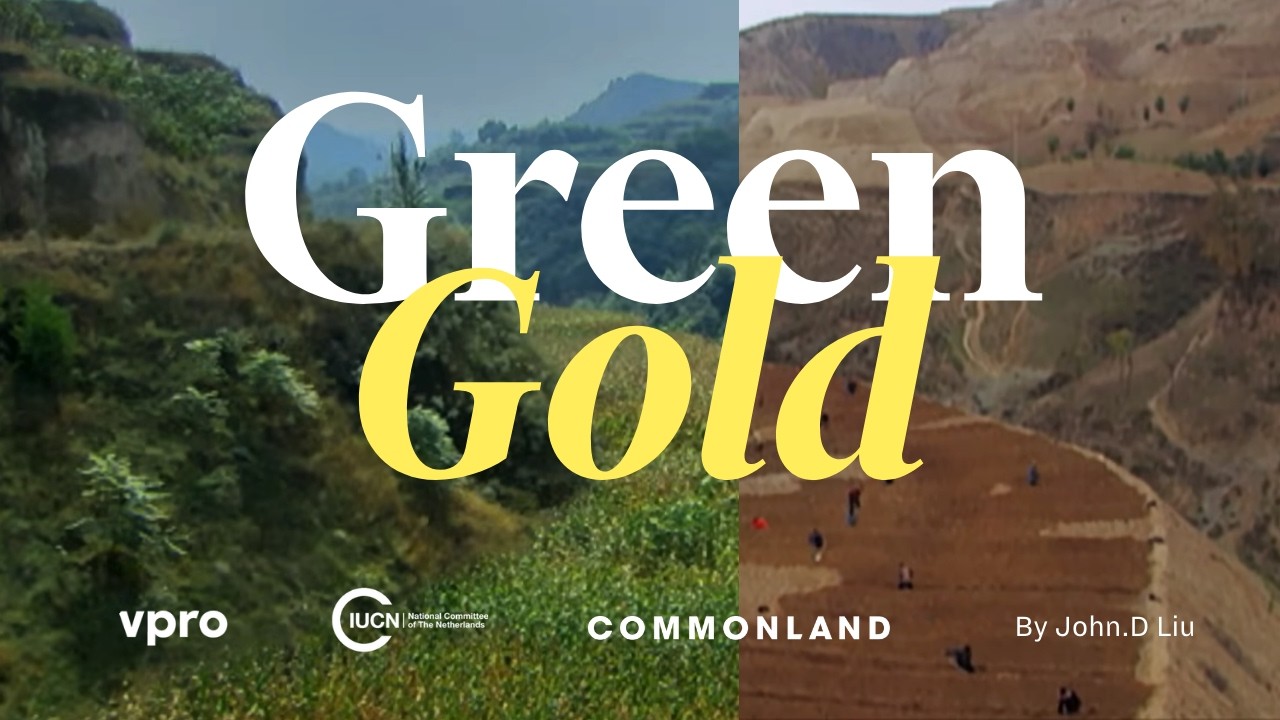
Ecologist John D. Liu documents ecosystem restoration across degraded landscapes in China, Jordan, Ethiopia, and Rwanda. He shows how the Loess Plateau project transformed 640,000 km² of semi-desert into productive land, and argues that restoring soil can sequester three times more carbon than vegetation alone.
Chapters
Welcome to the very, very real.
The story is getting old. Modern man is rapidly exhausting the planet. Deserts are advancing and water is becoming scarce. It all seems hopeless. And every 12 years, the world population increases by a billion people. Looking down Looking down on Earth from space, the scale of the destruction is astonishing. But one man has discovered how to make our deserts green and our planet healthy again. We are following cameraman and ecologist John D Liu, who sort of happened upon the solution and has spread the word ever since. This is what you can expect.
It's possible to rehabilitate large-scale damaged ecosystems. So if we can rehabilitate rehabilitate large-scale damaged ecosystems.
Why don't we do that?
The world gets more and more complicated all the time, but the solution to fix the major problems of the world's ecosystems remains reasonably simple.
You are watching Backlight. Welcome to your green future. It all started in 1995 when John D Liu, as an ordinary cameraman, got an assignment to film the Lush Plateau in China. He saw how the local people transformed an area almost the size of the Netherlands from a barren, exhausted desert into a large green oasis. He was baffled. From that moment on, Greening deserts became his goal in life.
The more I learn about it, the more I become interested in how this might relate to other parts of the world. And it looks like the history of the Chinese in the Loess Plateau is not simply about the Chinese. It's about what happens when human beings don't understand how ecosystems function.
Liu used his camera to record the virtually superhuman efforts of the Chinese. He made a film about it, "Hope in a Changing Climate," that he posted on the internet to distribute it worldwide.
China's Loess Plateau is a region that stretches for 640,000 square kilometers across north-central China. Unspoiled valleys in neighboring Sichuan show us how it might once have looked. It's the sort of natural abundance that is necessary to support an emerging civilization. How could a landscape with such potential have been reduced to this? When Chinese scientists and civil engineers began to survey the area, they realized that several thousand years of agricultural exploitation had denuded the hills and valleys of vegetation. The relentless grazing of domestic animals on the slopes meant that there was no chance for young trees and shrubs to grow. The rainfall no longer seeped into the earth, but simply washed down the hillsides, taking the soil with it. Over millennia, this progressively destroyed the region's fertility. When this happens over an area as extensive as the plateau, millions of tons of silt are swept down into the Yellow River, which gets its name from the color of the fine, loess soil. The mounting quantities of silt clog up the river, impeding its flow, contributing to the floods that give the river another name: China's sorrow. In some areas, creating floating mud mattresses that attract passing tourists. A local problem becomes a national problem. In the dry season, the light, unprotected soil is swept up in the winds, causing the dust storms that are blown over China's cities and beyond its borders.
The Chinese have meanwhile solved the problem. The way they have has become John D Liu's mission.
The first and probably one of the most impressive of those findings from the Loess Plateau is it's possible to rehabilitate large-scale damaged ecosystems. So if we can rehabilitate large-scale damaged ecosystems, why don't we do that?
Ever since, Liu has been invited all over the world to assist government leaders, policymakers, and villagers with his knowledge and experience. We follow him in Jordan, where the desert is advancing and water is becoming increasingly scarce. He is here at the invitation of the Jordanian royal family. Princess Basma bint Ali wants to stop the desertification of Jordan and has found an ally in Liu.
Welcome to the Botanic Garden.
Thanks very much.
I'm glad you were able to make it today.
We'd like to look around and learn as much as we can about the botanic garden and also to learn how the concept of this fits into a larger thought about restoration for the whole country.
I mean, he is someone that is well known. I'm very impressed by the work that he's done and the amount of influence he's been able to have on governments, for example Rwanda, and that's something we can learn from and benefit from. And if we can do just 1% of what he's done there here, that would be amazing. And I keep on saying natives, natives, natives because they're the ones who are well adapted. To our area with the encroaching climate change and desertification. We really need to rely on our native plants. As you can see now, we're not a classical botanic garden of the colonial era or relics of the colonial era, but we're trying to teach everyone, regardless if they're in Jordan or otherwise, that you can very easily restore an area which was degraded.
Well, this was the land of milk and honey. This was the promised land. These are the, the places where historically people have done agriculture and done animal husbandry for thousands of years, but the lands are exhausted. They allow hundreds and thousands of sheep and goats to walk across here, and anything, any green thing that sticks up its head is food, and they're just walking around here getting everything. Well, you can't let them do that anymore. They'll have to stop. They've been doing that since thousands of years, and that's what's destroyed this area. So if that doesn't stop, you won't be able to fix this.
The way we've done it is We excluded grazing for the first 3 years and that worked out very well. And in that 3 years, this is when we discovered the species that came up on its own, which were thought to be extinct and was last recorded in the 1800s. It just came up on its own. So we allowed the land to breathe, to take a breath and to see what's going on. We didn't interfere, we didn't do any planting at the time, just to see how it reacts. And that gave us gave us a lot of feedback of how we can deal with or how to rehabilitate areas. So it was very efficient for us. And as you can see here, it's very overgrazed, it's very barren. This is outside our borders, and then within here you can see the difference.
Just by making a fence around this place, you'll get back grasses. That's what's so extraordinary. Now, when you get back grasses, that means each year— first of all, you have perennial root systems, and they'll spread out, and you'll have microbial communities living and growing in this microclimate that's created.
So then you won't have direct sunlight hitting.
You won't have UV radiation irradiating and sterilizing this— microbiologic habitat. So everything will change. Then you're in an accumulative situation. Now you're in a disaccumulative situation where there's always less vegetation, always less organic matter, always less biodiversity. That's exactly wrong. We need to shift that to always more organic matter, always more biomass, always more biodiversity.
I cannot stand and watch our land be degraded and ignorant people abusing it. It's my duty to take a stand to make things better. And I've carved out my world in the environment. Other members of the families have taken on various different topics, but this is my little niche.
So now it's been really a long time since I began, and so I'm far down the path. And I think if you go down this path and you start to look and you say, well, that's an interesting phenomenon, You can see the relationship between hydrology and vegetation and biological life. And you realize that, well, actually that's the basis of the air and the natural water system. And it's how it was— how the atmosphere and the hydrological cycle were created and how they were constantly renewed. And then you come to places like this, which are massively degraded, and you realize that people aren't thinking about this ecological function. They're ignoring the science that we, we know about this, and they're believing that what's important is to produce something. But actually, That's not what's the most important thing right now. The most important thing for survival and sustainability for humanity is that places, not just individual places, but the entire planet is functional. If we understand how the natural evolutionary processes work and we emulate those and we don't disturb those by our behaviors, We can live in the Garden of Eden.
Another example from Liu's film, Hope in a Changing Climate, is Ethiopia, where he also took his camera to investigate. Ethiopia is the perfect example of how vulnerable man is to environmental catastrophe. The problems in this country are only intensified by war wars and civil conflict. And now the man-induced climate change seems to increase the misery even further. As on the Lush Plateau, centuries of agriculture have destroyed nearly all natural vegetation. The dry gullies are marked by heavy floods.
These gullies are evidence of the enormous power of runoff during the rainy season. Without vegetation cover on the hillsides, when the rains come, the water doesn't soak into the ground but flows away in a flood. Then it's not available for agriculture during the rest of the year. This leads to drought and, famously for Ethiopia, famine. But just as I've witnessed in China, there is hope that the situation here can be reversed. That root could survive?
No?
No?
In just 6 years, Professor Legesse-Nagash and local villagers have transformed a severely eroded terrain by planting indigenous trees and plants. Almost miraculously, a clear flowing stream has emerged where once there was a muddy trickle. How is it that it's possible possible for you to get the stream to flow throughout the year.
It is because of the vegetation cover which has been regenerating on this mountain. This water is maintained in the landscape because as soon as rain falls on the canopy, on this vegetation, that rain then infiltrated gradually into the ground, ending up with this steady flow of this river. Water is life. Without water, nobody can do anything. I'm amazed, as short as 5 years, 6 years, you get clean water like this, provided you work hard for restoring this degraded landscape.
About 1,000 kilometers further north, in the village of Abraha Asbaha, another near-miraculous phenomenon is occurring. Farmers are finding water at the bottom of their wells despite the poor rains this year. The famine of 1984 struck the people of this valley very hard. Many migrated, many died. Now the people are returning. The village chairman, Gabr Gede, remembers well how life used to be. With government support, they applied the same principles as the Chinese, setting land aside for natural vegetation to return. In the ravines, they built small dams, which are now fed by underground springs. And like Professor Laguessa's stream, Rain that fell weeks ago now slowly seeps through the subsoil, replenishing the supply of water.
The most important issue for Africa, and I consider this Africa's 21st burning issue, is restoration. No matter what we do, we might be good at rocket, rocket rocket science, I mean, if we are nuclear science, but the environment, restoring this huge vast landscape, you know, degraded landscape is critical for Africa, but also for the entire region. Consider Egypt, look at the Sudan where 86% of the Nile flows to these countries. How can you support life in Egypt without restoring Ethiopia's mountains. So this is regional, national, and international.
Liu's typical working method is to share all his footage and documents with those asking for his advice. In this case, the staff of the Jordanian princess.
Well, it's videos, but it's also a lot of documents. There's There's studies on hydrology and studies on the relationship between soil organic matter and moisture and, you know, the type of strategy documents that governments need to see what they're going to do. So they have to have a strategy that everyone can see.
With the Jordanians, he shares the documents on Rwanda, one of Liu's success stories. His proposals there were welcomed by the Paul Kagame administration and yielded stunning results, as we can also see in Liu's film.
We had to take careful look at what had actually been happening that damaged this system and therefore had to reverse that again with human action. And this is why it is important to look at how human actions can destroy or can reverse what has been destroyed or even protect our environment.
This tiny country is grappling with the problem of a growing population trying to eke out a living on a finite amount of land. As in China and Ethiopia, overfarming on the hillsides caused serious erosion and a decline in fertility, forcing poor farmers to move into protected areas such as the Rugezi Wetlands, a wildlife site of international importance. When farmers drain this marsh to try to grow more more food. They not only damaged an important wetland ecosystem, they also had a significant impact 3 hours' drive away in Kigali, the capital city. The water that pours from the marshlands is a vital source of hydropower for Rwanda's capital. As the wetlands began to dry out, power stations below couldn't generate enough electricity. The Rwandan government rented diesel power generators to make up the shortfall. So government policymakers focused on how to restore the Rugezi wetlands. If people were the problem, they could also be the solution. The government decided to help the farmers. Leave the wetlands and to restore the degraded slopes above them, improving their croplands and encouraging trees and shrubs to grow back, capturing the rain. The wetlands are now recovering. Great volumes of water once again cascade down to power the hydro stations. Carbon-free electricity is replacing the diesel generators. Electricity prices have stabilized. Restoring and preserving natural ecosystems like the Ruggesi Wetlands benefits everyone. So we think we want a lot of manufactured goods and more and more and more. This is a wasteful and not a very effective and certainly not a sustainable way of life. And especially with 7 billion people and adding a billion people every 12 years, it's not possible to do that. So we need another model. And here's a model, a model which can restore the function. It's been proven to be able to restore hydrological function, to restore fertility. So we have vast areas of degraded lands. There's plenty of room for opportunity. And this could employ millions and millions of people. And their work wouldn't just be about themselves. Their work would be about ensuring that future generations can survive. What the Rwandans recognized is that the marshlands are far more valuable as a natural system providing water for energy than as farmland. This principle is the same for the remaining hillsides and ravines. What we're seeing here is very interesting because it's, it's a line between human activity and natural systems. And in the human activity, we've been able to value the productivity from agriculture and give it a monetary value. But in the natural systems, we haven't been able to value the trees, the biodiversity, the water that's absorbed into the biomass and into the soils. And there's another vital service that trees and plants provide: photosynthesis. Vegetation reduces the greenhouse effect by taking carbon dioxide out of the atmosphere.
Climate change is better withstood with trees. You know, humans, no matter how intelligent we are, no matter how capable we are with all our technologies, we are helpless in the face of climate change. We have not yet properly understood the miracles performed by trees.
Based on what I've seen in different parts of the world, it seems to me that whatever rainfall comes down needs to be infiltrated and retained into the system. If it's lost, through runoff or through excessive evaporation rates, then it's going to gradually degrade the system. And if this goes on for hundreds and thousands of years, the ultimate outcome is collapse.
Petra in Jordan is one of the Seven Wonders of the World. Almost all of the buildings that were once there are now ruins. And the landscape has turned into a desert. Millennia ago, the builders of Petra used their knowledge of water management to create an oasis, and hence the conditions for Petra's prosperity and growth in those days.
This would have been a busy street once.
Yeah.
Actually, full of commerce. Here we are in a situation where, uh, The heritage of all that is an attraction and curiosity for people to come and visit.
This is where Liu first met the Australian Geoff Lawton. Lawton specializes in rebuilding functional ecosystems from the ground up. Liu immediately recognized his soulmate in him.
We're in a, you'd say, a quite severely degraded landscape.
Do you think that over historical time or somewhere back in the past this had a different look?
Oh, most definitely. I think you'd look into the landscape that's more or less bold. It's eroded down almost to the bones of the geology, and this was a landscape full of life. And even top predators. There are still leopards here now in some of these valleys, remnants of top predator habitat that had a whole ecological range of diversity and abundance.
So in fact, we're in the land of milk and honey.
Potentially we are. That's right. But it doesn't look like it.
So what do you think is the potential potential for areas like this?
Oh, there's absolute potential for an abundance, an absolute abundance of life, of water flow, of climate moderation. So you'll get microclimate and regional climate moderation. Completely different hydrology. And the interesting thing there is that then you get the potential for, for well-designed productivity leading to permanence in human culture.
When you have these types of degraded states, people are in a cycle of poverty and ecological destruction. And they just continue to be poor and they pass this poverty from one generation to the next generation. Now, when you get on a process of restoration, you can see that the next generations will have much better lives. So they'll be able to participate in a much richer social life. They'll have different cultural changes. They'll have increased wealth. They'll have better diet and healthcare and educational opportunities. Everything will be different.
In the vast lush plateau, Liu had already seen how much persuasion it took. There, they had to make 2.5 million people understand that it would be best for now to keep their cattle indoors and not to make optimum use of their land, to give nature some space. But how do you tell that to the locals who depend on the cattle and the produce of the land?
What eventually convinced the local people was the assurance that they would have tenure of their land, that they would directly benefit from the effort they invested in the new project. Hills and gullies were designated as ecological zones to be protected. Farmers were given financial compensation compensation for not farming on them and keeping their livestock penned up. When I first filmed Mr. Ta Fuyuan and his colleagues back in 1995, I had no idea this initiative could achieve such dramatic results.
In the middle of the Jordanian desert, Jeff Lawton has created an educational vegetable garden to show the local people how to grow vegetables in the desert.
The food here is very expensive and they can't grow much and they are home gardening and their kids go back to their parents and we have a ton of food.
Like, how you do that?
Like, what, what the secret on this?
How long does it take to bring back a system to some sort of functionality?
I, I think it would We're finding surprisingly quick, if we apply the best design we can and go straight into earthworks and water harvesting and mass species plant out, within 3 years, you're starting to see dramatic effects, recharging of the water cycles, rehydration, diversity starts to increase on its own, all kinds of optimistic things happen. And when we're talking Jordan, this is It's the Middle East. Jericho's just here, 10,000 years of permanent occupation. You can't really have a test case anywhere with a longer human effect on the landscape, let's say.
Lawton operates demonstration projects all over the world to show his students how to build up an ecosystem step by step into a self-sufficient system. Here in Jordan, he has also set up a demonstration project. Within 3 years, the garden will work as a fully self-sufficient ecosystem. Irrigation will no longer be needed. The land even supplies water, and the people can eat from the land all year round.
But lots and lots of different herbs in the understory, and here's a carob. Which is a chocolate-type substitute. So there's this massive diversity all interacting together so that we end up with a productive ecosystem assembly.
The system used by Lawton, which was conceived in Australia, is called permaculture. The goal is to design a working and fully self-sufficient ecosystem where man and nature share the center stage. The low-maintenance system produces fruit and vegetables without any use of artificial fertilizer. This technology is now used by millions of people worldwide.
So in 2.5 years, you've gotten this kind of vegetative cover now. What kind of thing are you imagining for 5 years and 10 years?
What's—
In 5 years, we'll be starting a closed canopy. So, a lot of trees will be touching each other. We'll be producing all our own mulch. We won't have to bring any organic matter in from outside. Everything will be produced here. So, it'll be, it'll start to close as a system. It'll cycle its own nutrients within the 5-year cycle there, and then it will just go on from there with more and more organic matter, more and more biomass, and more and more diversity as it goes.
So in 3 years you can, you can get something which would feed a family and begin to move toward a functional system?
Definitely. We've already had a date harvest. Our olives are flowering very well now, and the vegetable garden is producing quite well already. They're all bush tomatoes here. There's a decent tomato there.
And the compost doesn't actually feed the plants, it feeds the soils.
Mm, it feeds the soil organisms. So the largest diversity of organisms in the known universe, the soil organisms. 50 million genus of bacteria and 50 million genus of fungi. And you're feeding the organisms and their exudates and their interactions are feeding the plants. That's how it works with natural systems and that's how it works with organics.
A measure of what What restoring nature can do has been shown here on China's Loess Plateau, where farmers have continued to prosper despite the worst drought in decades. Since the beginning of the project, the soil that nurtures their crops has been accumulating organic material from plants and animals. This holds the moisture, and contains carbon. What's interesting about this is all these root materials, all this other stuff, this is organic material. And this organic material is mixing together with the lus, the geologic soils here, and it's making a living soil. This is where the moisture resides. Yesterday it rained and there's still moisture in the soil. This is where the nutrients are recycled so that each generation of life emerges here. And this is where the carbon is. What's interesting about this, they made this field.
This is new.
So they're helping to sequester carbon. Living soils like this retain on average 3 times more carbon than the foliage above the ground. If we were to restore the vast areas of the planet where we humans have degraded the soils, just think what an impact we would have in taking carbon out of the atmosphere. As much as a quarter of the world's land mass has been degraded, and much could be rehabilitated in the way we have seen on the Loess Plateau. And we've only just begun to recognize the real value of natural capital. Surely investing in the recovery of damaged environments is a cost-effective way of solving many of the problems we face today.
The source of wealth is the functional ecosystems. The products and services that we derive from those are derivatives. It's impossible for the derivatives to be more valuable than the source. And yet, in our economy now, as it stands, the products and services have monetary values, but the source, the functional ecosystems, are zero. So this cannot be true. It, it's false. So we've created a global institution of economic institutions and economic theory based on a flaw in logic. So if we carry that flaw in logic from generation to generation, we compound the mistake.
On the lush plateau, they have understood the message. The lives of 20 million people across China have been directly improved by applying the lessons of the Lush Plateau.
The changes are not simply on the hillsides. On the plains, you can see greenhouses that are filled with vegetables. This extends the growing season. It's very high-value produce. The abundance and variety of new produce can be seen in the local market. Follow-up studies have shown that incomes have risen threefold. Wealth is being happy, living in nature, listening to the birds, breathing clean air, not having chemical pollution throughout everything, not having these horrible problems. So, you know, we need to redefine and revalue our belief systems. We need to understand that money is a belief system. There's nothing wrong with money, it turns out. The problem is that what is money based on? If money is based on functional ecosystems, then the future will be beautiful. If money continues to be based on production and consumption of goods and services, we'll turn everything into a desert. What is the future for our children and our children's children and generations to come in the future?
Liu also did research in Bolivia, where biomass is burnt to make room for agriculture.
Here in the foothills of the Andes, Slash-and-burn agriculture is taking place today. The people who are doing this think that they are getting some short-term economic gain, but what's the loss to biodiversity, biomass, soil fertility, and hydrological function?
Biomass in a functional ecosystem has economic value. Why destroy it when you can also use it to restore or landscapes elsewhere.
The idea is that there are different biomes on the Earth, and some of them— I mean, there are many, obviously, but two that I've noticed also both have problems. There are areas which are brittle and fragile and arid or hyper-arid, like here, and then there are areas which are able to create huge amounts of biomass, like in the tropics. So what about linking these two areas together? What about generating huge amounts of organic material there and moving it here, or at least a percentage of it? You don't want to deplete the fertility there, but a small amount of that could come. If that came here, you'd create an industry there instead of them using slash-and-burn agriculture to grow crops which they can't even feed themselves and destroy what is the most valuable thing about their system. They would have money and a job.
And they—
and then here you'd have another industry to do restoration. So this would create two huge industries, employ untold numbers of people, and put us on a pathway towards sustainability that's constantly sequestering carbon, infiltrating more and more rainfall, giving us food security in places that are now experiencing famine. It's extraordinary.
Well, you can see, considering we're in desert, we've got kind of a lush herbaceous growth growing at this time of year.
Well, I just saw off the site there were people who were dumping crop waste somewhere else. They don't understand this.
Principle.
No, no, a lot of people just think they've got to tidy up and take out all the organic matter and burn it. A lot of it is wasted and goes on to be a pollution. So we're going in a negative direction rather than coming into a positive direction. And it's really that simple. You can, the world gets more and more complicated all the time, but the solution to fix the major problems of the world's ecosystems remains reasonably simple. And it's kind of ironic.
But we have to act as a species on a planetary scale. We can't simply do this one backyard at a time because we have— the problems have now reached this crisis point on a planet all over the world.
Yeah, not anymore. I think we've got to go on a major scale now. Everybody can do their backyard as well. Yeah. But we have to change the major eroded landscapes into the functional ecosystems they should be. And then we've got the foundation to just continue. There's not too many people in the world, in my view. They're just, most people don't realize they're acting in a very negative way in relation to the environment. We have to turn everything around into into a functional relationship. And then we need all the people, we need as many people as we can get right now, and they have to go into action. We have to go into service, and that's what we're finding, people want to go into service to kind of save the world, really, to save our present existence.
If we continue the way we're going, then we're gonna reach a crisis point where it's impossible to feed everyone. And at that point, then all bets will be off because you'll have millions and tens of millions and hundreds of millions, maybe billions of people who are migrating to survive. Now, in— if you're in the first world and you think, well, that's okay, It's not me, it's them. Well, this isn't going to save you. You can't shoot them down. They're too many. There are 7 billion people on the Earth and we're adding a billion people every 12 years. It's not going to be possible to suppress humanity when they can't survive. They won't go gently into that good night.
Mervet.
Stell' ju' Fragen in 'nen Live-Videochat mit John D Liu. Hanne unsere Website dechenlichtbünd.wpe-open.nl.
More from John

John D Liu & Chris Henggeler on Kachana, China & A Blueprint For Restoring Earth



From Despair to Collective Action: John D Liu on Community, Survival, and the Path Forward

Restoring Degraded Land for Economies, Communities, Farmers, and Health with John D. Liu



Webinar: When life springs up where we tread - Partnering with soil biology in ecosystem restoration


