Best Tools to Use With Virtual Assistants in the Philippines
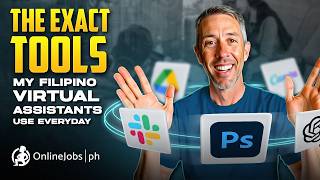
A guide to tools for managing Filipino virtual assistants, drawn from 20 years of experience. Start with Google Drive and Slack, then add project managers like Basecamp or Asana, screen recorders like Loom for training, and AI tools like Claude. The speaker recommends hiring from OnlineJobs.ph.
Chapters
The best tools to use with virtual assistants in the Philippines. VA's love tools. It makes their work more simple, it makes them more effective, it makes keeping things organized much easier. And there are some specific tools that VAs in the Philippines especially love and they're very proficient at. And there are others that maybe aren't so great. Today we're going to go through a huge list of the best tools to use with your VA's in the Philippines. I've been working with VAs in the Philippines for 20 years now and we've used a lot of tools over the years. Some have stuck, some have fallen by the wayside. Today we're going to talk through the ones that stuck for me and the ones that stick for other people. The ones that make you more productive, the ones that make them more efficient. And we're going to cover this by categories. So I'm going to start with communication tools and training tools. Then we'll do project management, then file sharing and collaboration, screen recording tools, and then some random tools at the end. And actually one of the random tools at the end is really one of the best ones and the easiest to implement with your team. So let's start with communication tools and really kind of training tools also. Look, everybody understands the importance of communication. It's how that communication happens though that really makes a difference in what tools you're using. And we've broken this down into kind of three different groups. Real time messaging, video conferencing, and then email and calendar integration. For real time messaging we have three things. Number one Slack, number two Google Chat and number three Facebook Messenger. So my team uses Slack. They use it because it allows them to separate into multiple different chat rooms. We have a customer support chat, we have a devs chat, we have an all team chat. And this allows people to access other people instantly. The conversations always saved so it can always be referenced later. You can immediately open up one on one conversations with other people. Slack is really great for communicating with your VAS in an Instant messenger style fashion. If you want to take Slack even further, it has a whole bunch of other uses including file sharing, project management, audio and video. Now my team doesn't use any of these things. We use it for instant messaging style chat, which it's really great at. But all of these other things are really great with Slack too. Next in real time messaging would be Google Chat. Now Google has a whole suite of things. We're going to talk about them a whole bunch of times. One of those comes up in the next we're to going which is Google Meet, which is audio and video conferencing. Google also has obviously docs and slides and photos and Drive. Google has a full suite of communication tools that are really, really good. We use a bunch of them, but specifically we're going to talk about Google Drive later. And then last there's Facebook Messenger. Facebook messenger is actually very popular in the Philippines, so it's an option for you if you're not going to use Slack or Google Meet. Next, Video conferencing Almost all of these tools have video conferencing included. With that we would include Zoom in the mix. We used to include Skype, which we used for years. Skype has since shut down and been rolled into Microsoft Teams. So Microsoft Teams is another option. Along with Zoom Teams in this space also has a whole suite of tools that you can use similar to Google Workspace, similar to Slack. Now, what would be my most recommended in this group? My most recommended will be Google Workspace. And the biggest reason for that is that most Filipinos are familiar with They've used Google Workspace at their university. They've used it in their first job. They've used it all over the place. They're very familiar with it. That doesn't mean you can't use Microsoft Teams or Slack. Obviously we use Slack, but they're all going to make your communication much easier. And again, some of these tools are going to come up in later conversations. Specifically, we're going to talk about Google Workspace again. Next category of tools is project management. I'm big on a project management system. We've been using basecamp for almost 20 years now. It helps us keep track of tasks and projects. It helps ensure that things are completed on time, on budget and on spec. It allows us to easily track the quality of work that's going on to give feedback. Basecamp also comes with instant messaging, which we use in addition to Slack, and a really easy way to ask for the Daily Report, which is another big factor in working with virtual assistants in the Philippines. That Daily Report is really important in Basecamp and includes that automatically in all of their account. Now we use Basecamp because it fits my personality and my workflow. Maybe it doesn't fit yours. There are lots of other project management systems that you can use and lots of other really good ones for working online. Specifically, I'm talking about Asana, Trello, Notion, or anything else that you're familiar with. It doesn't really matter as long as it allows for multiple users. Your Filipino vas will appreciate Using a project management system, so they can easily keep track of the work that's assigned to them, so that they can easily report back to you on things. They want to complete the work you're giving them, and they want to complete all of the work you're giving them. It's a lot easier if they can track it with you. The next category of tools are file sharing and collaboration tools. So for file sharing, we use Google Drive. It's simple, has an online folder set up, it's ubiquitous, everybody has it, it's included with Google Workspace. Very, very easy to use. Other options include Microsoft Teams, Dropbox and OneDrive. There are probably others, but these are the best. Then for collaboration, we use Google Workspace, specifically Google Docs, and an example of how we do this. So someone will write a piece of content, they'll write it in a Google Doc, they will share that with other people, others will read it, check it, make comments, make corrections, you can cross things out and others can see, okay, I agree with that, or I don't agree, and you can make a comment. We go through this every single day where content's being written, whether it be for blogs or newsletters or articles or social media, Content gets written. It gets checked by someone else. Sometimes it gets checked by me. And in a Google Doc I know I'm seeing the latest version, and it's super easy to just make edits. They immediately get those edits. It's easy to make comments and questions and have them answer it and solve the problem. Google Docs has done a really great job with allowing for easy written collaboration. Google Sheets is another one. If you're using spreadsheets, it's a super easy way to collaborate things. And we use it this way all the time. The other great thing which I've already mentioned is that almost everybody in the Philippines already has experience with this. They understand how it works. It's super easy to implement with your team of Filipino VAs. Now, along with that collaboration, I want to move into the next category, which is screen sharing. And this includes collaborating with people, but also giving training. So let me give a little bit of background. It was around 2007 when I had multiple people working for me. I was approaching my limit of how many people I could manage. And then I found Jing, and Jing was screen capture and screen recording software that you would drag it out on your computer and it would record that section of your screen and you could use your mouse, you could use your voice, you could talk to it. It was going to record all of this, it was going to record what's going on on your screen. And I just found such an easy way to give exact, detailed instructions to people where I was having them do work online and I was giving them feedback on how they built this website or this piece of content that they wrote. And I wanted to go through it and say, look, I like how you did this, but I want you to fix this more like that over there, where typing that out and giving those instructions is really difficult. But when they can see your screen and know exactly what you're talking about because you're pointing at it with a mouse, it makes a really, really big difference. What I later found out, an added benefit of this was they were hearing my voice, and hearing my voice taught them to trust me. And getting their trust in you is a really big deal. When working with three Filipino virtual assistants, well, Jing shut down a few years later, but they made an even better tool that I still use to this day, which is Snagit S Nagit. It's made by TechSmith. It's the same style screen capture, screen recording app where you can drag it out and it'll capture your screen or it'll capture a video, you can annotate it. I use this every single day in communicating with my team. I use it to train them on things. I'll record my screen and go through a full training of. Here's how I want you to do this. Go here, take this piece of data, add it here, then analyze these things, put it into ChatGPT. Here's how I'm doing, and I'll show them the exact process while recording my screen. And then the real magic of any of these tools is that you click stop and you click upload it uploads it to a server in the cloud and gives you the URL. There's nothing else that you have to do to make this work. All you have to do is click paste of that URL into an email to them or into your project manager system, and they have access to that video or image that you just took. So, like I said, I use Snagit for this. There are a whole bunch of others you could use Loom, which is very popular, or Tiny Take, which is free. There are others that I haven't used, like lightshot or Go Full Page or screencast. O Matic. There's a whole slew of these. Doesn't really matter which one you use, but it does matter that you use it. I already mentioned that it helps build their trust in you. What I found for myself was it just makes it much, much easier to give instructions. And what I later learned from them was they love it because they can watch those instructions multiple times if they need to, rather than if instructions are just given live. Then they have to catch everything all at once. And often I talk fast. And so if I'm talking really fast, they get to go back and listen to it again and watch it again so that they make sure they get it right. Using a screen recording tool is a game changer for most people working with VAs in the Philippines. The last category I want to talk about a couple random tools that we use that have been really effective. Number one is Grammarly. Grammarly helps your Filipino VA check their writing, it checks their grammar, it checks their spelling, it gives suggestions, it can help them through writer's block. They have an AI tool built in now. It has been very effective for my team to use Grammarly. Next, obviously ChatGPT, now this is 2025 that will change. There'll be more AIs that come out that are publicly available currently. Right now we're using Claude AI. And then the last one I want to mention is Canva for doing any SoR lightweight design work. Not Photoshop style, but creating marketing pieces or creating graphics or social media things. Canva is really, really great for almost anybody, whether they're a VA or not. My team uses Canva all the time. They pass things back and forth with it. They design, they give feedback, they create. It's been really great for us as a business to have access to Canva for making any sort of creatives that we're doing. And then last on the dev side, we use figma. Figma makes designing easy and sharing with developers easy. It's a really great tool. So what do you do with all of this? Because this is a lot. Well, I recommend you start small. Start by integrating Google Drive into your process where files are being uploaded to the drive rather than sent as attachments to email. Start by chatting inside of Google Meet or inside of Slack. Start by chatting inside of Google Chat or inside of Slack. Start by setting up a project management system, whether that be Basecamp or Asana or Trello. Start with just one of these things and see how it goes for you. We have been doing this for almost 20 years. Tools have changed. The ones that we're currently using are ones that have stuck around for a long time with the exception of the AI tools. And what you use in your business will be different than mine. What makes sense in yours is not necessarily what makes sense in mine. Last do you have tools that you use that I haven't mentioned? Comment below. I'd love to hear about it. Also, if you're new to virtual assistants, OnlineJobs ph is the largest job board for finding virtual workers in the Philippines. With over 4 million Filipino profiles, it's super easy to find any talent that you want to find. There's no salary markups, there's no added fees other than just a cost to access the database. No contracts required. Cancel anytime, and once you've found your person, you just pay them directly. You don't pay online jobs anymore. If you've thought about hiring a virtual assistant before, head to OnlineJobs ph, do a quick search for the skill you're looking for, and prepare to be amazed at what you find.
More from John









Stop Being the Dispatcher, Start Being the CEO: How to Scale Your Field Operations 🛠️

