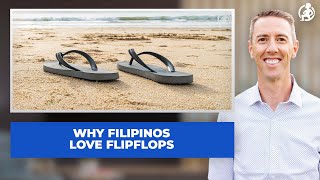
Short video/monologue by John Jonas (Ep. 110) explaining why flip-flops are beloved in the Philippines. The host reads and comments on a first-person account from his colleague Julia describing Filipinos' habitual use of slippers (called cinelas/senelas), multiple pairs kept for indoor/outdoor/guests/driving, practical benefits in a tropical climate, many creative re-uses when worn out, and dress-code norms that ban visible slippers in formal settings while permitting under-desk use. The piece mixes anecdote, cultural explanation, and light praise.
Chapters
Why Filipinos Love Their Flip Flops so I grew up in the beach. I grew up in Southern California. I went to the beach a lot. I grew up wearing flip flops. Sometimes we would walk around barefoot and carry our flip flops with us because we spent so much time at the beach. But it wasn't a cultural thing like it is in the Philippines. I mean, like me and my friends did this, but it wasn't so much cultural like it is there. Filipinos love their flip flops and I got the full story about it from Julia, my ofs, and she so here's what she says about it. I'm going to read this because it's, it's really kind of entertaining, she says. Like other Asian countries, we take off our shoes here in the Philippines before going inside the house. Once we're inside, we use slippers, AKA cinellas. And we love, love, love our cinelas. This is the cinellas. They're also called sandals, flip flops or thongs in other countries. And I hope you can see this picture of these flip flops. Most Filipinos have at least two pairs of cinellas, one for indoor use and another for outdoors. But it's not unusual to see Filipinos have more than two pairs. In my house, we have slippers exclusively for the toilet and bathrooms. I also keep extra pairs for guests to use when they visit, not to mention the going out pair we use if we want to wear something dressier. And even though it's safer to drive using shoes, some people keep a pair of driving sonellas in the car. We love our senelas because it's so comfortable. They keep our feet cool in this tropical climate, which let me just pause here and say, it's hot in the Philippines. I always have sweaty feet and I hate it. And if I have to wear shoes, if I had to wear shoes in that, man, that would be so painful. She continues. It's easy to clean and dry off when it gets wet. We're so used to cinellas that we can hike for hours through rough terrain and not develop any blisters. We can bike and swim in them. We even have uses for senellas when they wear out. We use worn sonellas for art and crafts as cockroach killers. Toys. Our version of Nerf toys. Door stops, makeshift swimming paddles, pool and bath floaties or DIY bike breaks. Here's a this is probably from Facebook. She gives me this image that says, believe it or not, this Hulk doll is made out of recycled Cinelas. That's Tagalog for flip flops. Elmer Padilla made this one for me, so I just wanted to give a nice shout out. Not only is this inventively creative, but it's sustainable and just pure awesome. It's a. It's a pretty cool Hulk doll. She continues. When we travel, we always make sure to pack a pair. In offices, people will slip off their shoes and wear slippers under their desks. When I was in college, my go to outfit was a T shirt, jeans, and a pair of Cinelas. Cinellas, though, are really informal. Most schools and offices with dress codes ban them, but allow under the table slippers for comfort. And you know how fancy restaurants have a no shoes, no shirt, no service policy. Here in the Philippines, the sign often includes no slippers because of the loophole that slippers are technically shoes. Super entertaining to me. I love it. I love the culture. And I'm always thankful to Julia when she writes something like this and lets me have an insight and you have insight into, into a little bit of their lives. These people that we work so closely with and like, they do so many good things for me and for my business, I love learning about about their life and their culture.