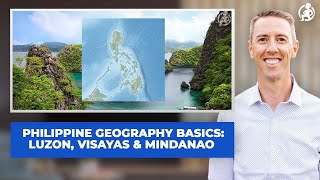
John Jonas breaks down Philippine geography for outsourcing managers: the country splits into three island groups (Luzon, Visayas, Mindanao) across 17 political regions. Knowing where your remote workers live matters for disaster preparedness, regional culture, and showing you actually care about their lives.
Questions this video answers
Episode 187.
17 political regions (numbered 1–13 plus several unnumbered regions).
Regions 1 to 5 are in Luzon.
Regions 6, 7, and 8 are in the Visayas.
Regions 9 to 13 are in Mindanao (plus the Bangsamoro Autonomous Region in Muslim Mindanao/BARMM).
Chapters
Welcome to the Secret Sauce of Outsourcing podcast that's dedicated to making you better at outsourcing to the Philippines. This is episode 187, Philippines Geography Basics. So if you're watching this on YouTube, we're going to show you some maps in this episode because I'm going to talk about the geography of the Philippines. This has taken me a really long time to learn, and hopefully this will be helpful to you. If you're not watching it, I'm going to try and describe it in the audio on this podcast. So here's a quick lesson in the geography of the Philippines just to make it easier so that you can identify what part of the country your OFS is located in. So the Philippines is divided into like 17 political regions, and they number them 1 to 13 plus. Then there are four other regions that don't have numbers in their name. Region number one is the northernmost part of the country, and it goes down to Region 13 is in the southernmost part. The regions are distributed among three different island groups. So you have Luzon in the north and the Visayas in the center, and Mindanao in the south. You can tell what part of the country a region is in based on the number. Regions 1 to 5 are in Luzon, which is the biggest island group in the Philippines. Also in Luzon are three of the four unnumbered regions. So I'm going to read these to you because I don't remember these, but there's the Mimaropa region, there's the National Capital Region, ncr, which is also called Metro Manila, and then the Cordillera Administrative Region. So the Cordillera Administrative Region is way up in the north of the country, Metro Manila, also called ncr. You'll see this abbreviation made kind of regularly if you go there or even working with your team. NCR would be National Capital Region. They also call it Metro Manila. So that would include, like, at least I think this is Manila and Makati and Quezon City and a bunch of other cities that are like, really, really big cities. So that is an unnamed central region. All of this is in Luzon, in the Luzon region. And Luzon is also the name of the island, this really big island at the north where all of those cities are. Then you have regions 6, 7, and 8, which are in the Visayas, Western, central, and Eastern Visayas. So let me just tell you some of the cities and islands that you might recognize the names of. So in this region, you have Iloilo, you, you have Negros, you have Bohol, you have Bacolod, you have Cebu, you have Leyte, so. And Samar is another one. So these, this is like the Visayas region. At onlinejobs ph, there are tons of people that live in this region. I don't know what happened. I don't know if it was a word of mouth thing, but we have, I would say 800,000 people from this region, which doesn't have the biggest cities. But so many people are here. And I would say probably half my team lives in this region, which is definitely smaller than the northern region. And then let's talk about the last. The last region, which is Mindanao. So Mindanao is in the south. It contains regions 9 to 13, plus the extra unnamed region. Now this is going to. This one's interesting to me. So this is barmm, which is the Bangsamoro Autonomous Region in Muslim Mindanao. So that Muslim Mindanao region, it's autonomous and it's heavily Muslim populated. A couple of the cities that you might want to know about in this region are Davao and Cagayan de Oro. Those are the big ones. And a lot of people are in Davao, I would say at onlinejobs ph, we have a lot of people, a lot of profiles from Davao and the surrounding areas. It's also been a very popular place for Filipino workers to post their profiles on online jobs. So why do you need to know these different groups? Well, you'll see them reference their region like, this typhoon is hitting the Visayas and it'll hit all of those islands in the Visayas, the central region of the Philippines. So for natural disasters, it's important to know. Also, they'll talk about, I'm from the Visayas or I'm from Mindanao or I'm from Luzon. They'll talk about that. And so then you have an idea like, oh, north central, South Philippines. Learning about the culture also lets your team know that you care, that you care about them. You care about their lives, you care about them as people rather than just as employees or get my work done for me. If you want to know more about the culture, you can check out my book, The Outsourcing Lever, outsourcinglever.com It's free if you'll just pay shipping and I will ship it to you. And it'll help you a lot with, with hiring people in the Philippines.