Gentle Yoga and Conference Q&A 2026

The video combines a 25‑30 minute guided gentle yoga session with a comprehensive orientation and live Q&A for the 2026 Neuroscience and Yoga Conference. The yoga portion, led by two instructors, walks participants through breathing, sun salutations, standing balances, bridge, cobra, spinal twists, and a final relaxation, emphasizing mindful attention to body parts and breath. After the practice, the conference organizer—a neurologist and yoga practitioner—introduces the event’s mission to bridge scientific research and yoga practice, outlines the conference’s history, and highlights its featured speakers and media coverage. Detailed information is provided on registration options: a free presentation pass, a subscription pass ($30/month, customizable duration, includes all prior conferences and an AI chatbot study‑plan tool but no CE credits), and a lifetime pass ($199 early‑bird, $249 regular) which grants perpetual access to all conference materials and 30 hours of CE credits from Yoga Alliance, IAYT, and the American Yoga Council. The organizer explains sponsor contributions, translation services (Spanish, French, Chinese), and the extensive support team (including Ashley) with rapid response times. Logistics are covered: a member portal with calendars that sync to personal devices, time‑zone‑aware schedules, daily email digests, 15‑minute reminder emails, and a conference guide with challenges, bingo, and a sharing‑rewards program. Session types include live presentations, yoga workshops, Q&A panels, discussion groups, pre‑ and post‑workshop experiments (e.g., anxiety, interoception questionnaires), and a poster session for short research videos. The conference is primarily virtual with one optional in‑person brunch/yoga class in New York City. Community engagement tools such as a Facebook group, workbooks, quizzes, and a rewards system for sharing the event are also described. The Q&A segment addresses common attendee questions about pass upgrades, access, certification timelines, career paths at the intersection of neuroscience and yoga, and the availability of sport‑performance content.
Chapters
Hello everyone.
Today we have a gentle yoga practice that will last about 25 to 30 minutes, and then we'll have a Q&A about the upcoming Neuroscience and Yoga Conference. And if you have, you know, questions, we'll be going over all your questions, making sure everyone has everything they need. And during the yoga class, Please make sure that you have a good space to practice yoga, so clear of furniture, clear of things that might cause injuries. And if there's anything that is not working, just let me know. You can raise your hand or wave. I can see everyone, and then I can give some modifications.
All right, welcome everyone.
We'll get started now.
So you can come to a comfortable seated position. Adjust so that you can sit up nice and tall, shoulders back, eyes closed. And as you inhale, imagine the breath moving from the center of the chest all the way up to the space between the eyebrows, and exhaling down center of the chest. Inhaling up, space between the eyebrows. And exhaling down, center of the chest. Inhaling up. Exhaling down. And continuing this breathing on your own for half a minute. The next time you exhale, you may conclude the breathing, resuming normal breathing, keeping the eyes closed. And we'll chant one loud, long Om together. So sitting up nice and tall, shoulders back.
Om.
Aum. May all beings everywhere be happy and free from suffering, and may they enjoy this practice through our senses. Okay.
Coming to stand up and coming to the top of your practice space, maybe a mat. And we'll start with sun salutations, hands in a prayer position.
And let's begin. Arms with the ears reaching up, arching back. Forward fold, chest on the thighs. Right foot back, knee down, look up. Left meets right, plank pose. Knees, forehead down, brush the nose, cobra. Downward facing dog. In the downward facing dog, you can take any variations you like. Some people like to bend one knee at a time. Some people like to lift a leg up. So any variations you like. And now right foot between the hands, left knee down, look up. Left meets right, forward fold. Arms with the ears reaching, arching. Hands in front of the chest. Again, reaching up, arching back.
Forward fold.
Left foot back, knee down, look up. Right meets left, plank pose. Knees, forehead down. Brush the nose, Cobra. Downward Facing Dog. Again, any variations. And left foot between the hands, right knee down, look up. Right meets left, forward fold. Arms with the ears reaching, arching. Hands in front of the chest. Take 2 deep breaths. Let everything normalize. Separating the feet, turning the left foot to the left, right foot turns in a little bit, arms one straight line, and reaching out over the left foot. The left hand comes down towards the shin The ankle. Some people may be so flexible it touches the floor. And then right arm up, gazing at the right thumb. Wherever the body is, is perfect. Let go of all expectations. After a few breaths, you can spin the right shoulder back, pulling the right shoulder back. And slowly releasing, coming up. Switching the feet so the right foot turns to the right, the left foot turns in a little bit. Arms one straight line, reaching out over the right foot. The right hand comes down, left arm up. And slowly releasing, coming up. Turning the feet to face forward. Stepping the feet together, hands in a prayer position. Take 2 deep breaths. Let everything normalize. And now for a balancing posture. The right foot comes on top of the left foot, and then you can keep the hands in a prayer position.
If it's a little easier, you can keep The hands on your hips.
Some people may want to bring the arms up, and then fix the attention on one point and stay. Concentrate on stillness. And if you'd like a challenge, you could even close the eyes. Very good. Slowly releasing. Shake everything out.
Don't take it too seriously if the balance was difficult. And now the other side.
Left foot on top of the right.
Hands to the hips, maybe a prayer position, or arms up.
And again, fix the attention on one point. Maybe close the eyes. And slowly releasing, shake everything out and finding your way onto the mat, lying on your back. Soles of the feet on the mat, hands just touching the backs of the heels. Setting up now for the bridge pose, pressing into the feet, pressing into the hands, lift the pelvis up towards the ceiling. And we'll stay here for about 5 slow, deep breaths. Last breath, come a little bit higher. And slowly lowering down, letting the left leg stretch out onto the mat, hugging the right knee in towards the right shoulder. And you can make small movements with the legs side to side. Some people like to make circles. With the hip joint. And some people still may like to unbend the knee, hold behind the calf or the ankle, and hug the knee in towards the shoulder. And slowly release the leg. Bring the leg straight up in the air, and right leg comes down to the count of 8. 1, 2, 3, 4, 5, 6, 7, 8. Now bending the left knee up, hugging the left knee in towards the left shoulder, making small movements side to side, maybe circles. Again, if the body feels Like, this is the next move. You can unbend the knee, holding behind the ankle or the calf. And slowly releasing with the hands, legs straight up in the air. Left leg coming down. 1, 2, 3, 4, 5, 6, 7, 8. Resting for one breath and rolling over onto the abdomen.
Setting up now for the Cobra Pose. Hands underneath the shoulders.
Forehead on the mat, and we'll come up together to the count of 8. 1, 2, 3, 4, 5, 6, 7, 8. Shoulders are down, chest is lifted. If you'd like, you can roll the neck out a little bit. And to the count of 8, coming down. 1, 2, 3, 4, 5, 6, 7, 8.
And up.
5, 6, 7, 8. Coming to sit up, legs out in front, and setting up now for final spinal twist. Right sole of the foot outside the left calf, right arm back, left arm up, and twist, gazing out the right shoulder. Every inhalation, push the lower back in, elongate the spine, and exhale, twist a little bit further. Slowly releasing.
Switch everything.
Left sole of the foot outside the right calf, left arm back, right arm up, and twist, gazing out the left shoulder. Coming back to center, releasing, and the torture is over. It's time for final relaxation. So you can come to lie down on your back. Arms and legs far away from the body. You can shake the limbs out, let them land in a natural resting position. Roll the shoulders back, adjust the head. Once you've found a comfortable position, close the eyes. During this practice, we're going to be guiding the attention. Only the attention moves. When I call out a body part, all the attention there. Let's begin with both of the hands. All the attention, both of the hands. Feel them. Tingling, loose, heavy, dead-like. Both of the wrists, forearms. Upper arms and shoulders. Concentrate at this moment. Only that part exists. All the attention now. Both of the feet, toe by toe, tingling, loose, heavy, dead-like. Both of the ankles, calves, knees, and thighs. The left hip joint region, the right hip joint region. The left buttock, the right buttock, the lower back loose, the upper back heavy. The abdomen loose, the chest heavy, sides of the head and ears, top of the head and scalp. The forehead now. Feel the eyebrows separating from each other. The eyelids. Left cheek, right cheek, upper lip, lower lip, and chin. Now the body is completely relaxed. For just a few moments, leave the body by itself and go within. All is within. All is within. Begin to return the attention to your breath. Let the breath. Fill the chest, wiggling the fingers, wiggling the toes, reanimating the body. And slowly, however you like, without disturbing the mind. Find your way to a comfortable seated position. And as you inhale, imagine the breath moving from the center of the chest All the way up to the space between the eyebrows, and exhaling down, center of the chest. Inhaling up, space between the eyebrows, and exhaling down, center of the chest. Inhaling up.
Exhaling down.
Inhaling up and exhaling completely and inhaling to a quiet Om.
Om.
Shanti, shanti, shanti. Shanti just means peace.
This concludes the class. Thank you all for coming. Thank you, everyone.
Okay.
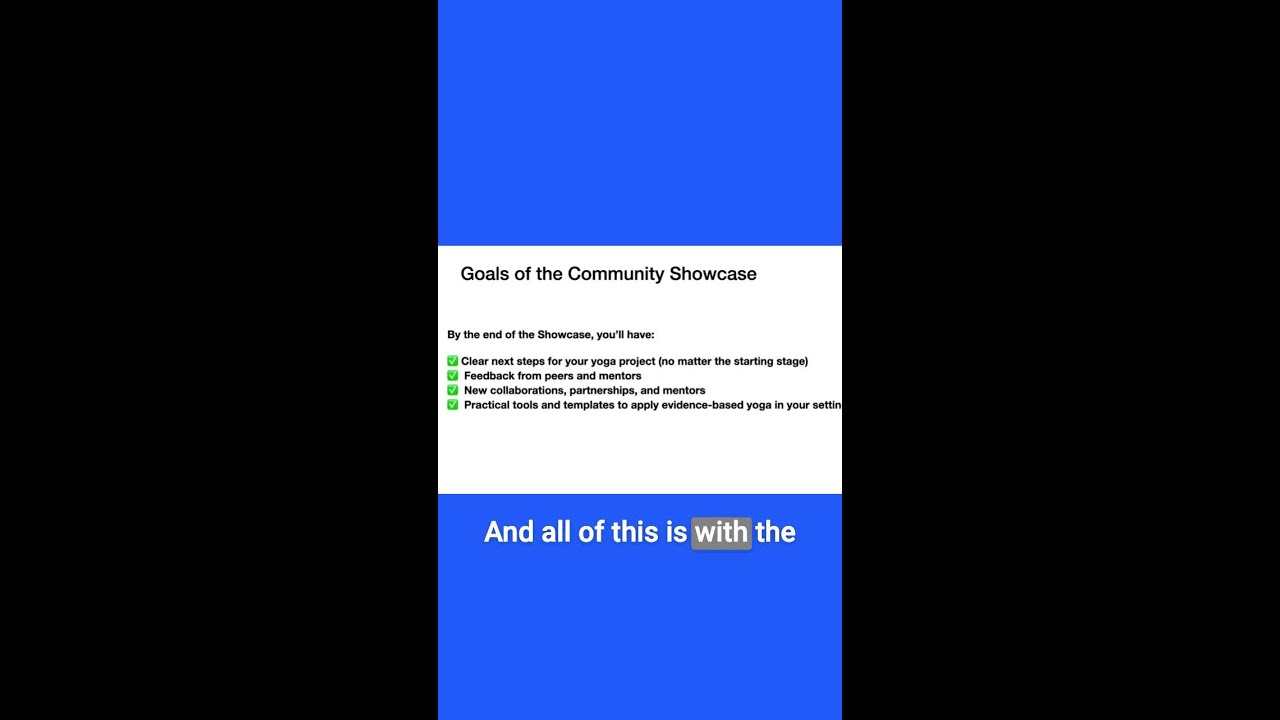
Everyone ready? Awesome. Okay. So let's get started. Thank you all for being here. Again, like I said, this conference is my passion project. So I'm very happy to see that people are interested in this and that people care about this. I genuinely can't even tell you what it means to me. So thank you for being here. So we're gonna go over some of the orientation slides. And this should answer most of the questions. So we'll go through this first, and then if there are remaining questions, please don't hesitate to, you know, you can even put them in the chat as we're going if you think of questions. And at the end, we'll go through them and make sure all of your questions are answered about the Neuroscience and Yoga Conference. There were also many questions about neuroscience and yoga in general, really interesting questions. And I don't think we're going to be able to answer all of those, but that's what the conference is for. The conference is really to ask all the researchers and scientists around the world the answers to those questions. Okay, so let's get started. I will just quickly introduce myself. I'll introduce myself more during the conference, but I really want you guys to know about me that I am serious about yoga. This is me with my teacher in 2013 and again in 2025. And I've been practicing yoga since I was a teenager. It's a huge part of my life. And I really think that yoga is the kind of thing that can change someone's life as it did for me. And I imagine for many of you. And so with this conference, I really want to bring yoga and scientific research on yoga to more people. And the reason science is so important to me is because I'm also a physician. I'm a neurologist. So I focus on brain, spine, and nerve disorders for people. And so my passion is really bringing neuroscience to everyone. And this is from the conference last year where I actually brought a brain that someone had donated for research, and we were using it to learn neuroanatomy, which was really cool. So yeah, I— again, this is my passion project. I really want everyone to be excited by learning, to recognize that science has so much to add to understanding yoga. And so that's really the mission of this conference. And it's been going on for a long time. The first event was in 2014. It became a conference like this in 2021. And so these are just pictures from all the different years and more pictures and more pictures and more pictures and more pictures and more pictures. So there's a lot of history to this event. And I know many of you have attended in the past as well. And if you're joining for the first time, welcome. So, in addition to all the amazing people who attend and the incredible community that we have, there are also just incredible teachers and speakers in the conference, and you're going to meet all of them during their sessions. So I'm not going to introduce them now, but I can't emphasize enough how much I look up to them. They have been featured in all these major publications, journals, news sources, things like The Lancet, Neurology, The New England Journal of Medicine, Annals of Internal Medicine, the New York Times, NPR, TED, Scientific American, on and on and on. So these are really accomplished presenters, and I'm super excited that we're able to host them. We also have another group of people to introduce you to. So, as you know, the conference has a base pass that is free, and that's made possible by sponsors. So each day of the conference has different sponsors this year, and I really encourage you to check them out. They're They're not sponsors just because they were like, you know, take this money. They're actually all really good people. So many of them are hosting extra trainings in the areas of schools and neurodiversity, migraine and headache, brain longevity. And we also have the American Yoga Council and Jade Yoga. So we'll talk more about all of the sponsors, but I just want to emphasize that they have great offerings that we can feel really good about recommending. There's also a ton of staff, a ton of people behind the conference. So the main staff people who you'll interact with are me and Ashley, who's also on this call. And we are the people who kind of like set things up, set up the technology, handle all the support. So you'll always be hearing from us. And I just— listen, I don't want to brag about our support, but I like— I think you guys probably have participated in so many programs. I think we have the best support. Okay, we answer you so quickly. We get back to you in like— 5 minutes, we always solve the problem. So please don't ever hesitate to reach out to us. We're happy to help. And then we have a bunch of people who help make all the workbooks and quizzes and people who help set up some of the in-person things, some of the documents that we use. There's, yeah, a lot of hands on deck. Another thing that we have that's part of the staff is we have translations of every event. So every event this year will have translations in Spanish, French, and Chinese in case you're joining from, you know, having that as your native tongue. Okay, and so the topics this year— I saw in the comments some people are very excited about the topics this year. We're covering migraine and headache, schools and neurodiversity, and brain longevity. And the goal of this conference is to help you transcend misinformation and learn the actual science of how yoga affects the brain in these areas. So that you can improve how you practice, teach, and advocate for yoga. And I really believe that this mission is like the kind of thing that can change the world. So taking this scientific knowledge and going to a school, a healthcare organization, a clinic, a hospital, a prison, and, and saying, here's the evidence, I believe I should teach yoga to your population because this is the scientific evidence. Can make such an impact on bringing yoga to more people. So that's what makes me really excited and passionate for this conference. Each day of the conference, we'll have presentations, yoga workshops, Q&A sessions, discussion groups. There's also going to be neuroscience experiments before and after the yoga workshops. And there's no prerequisites required. So if you feel like, I haven't taken any science classes since I was in high school, and I didn't even like it back then, Don't worry, that's fine. We have the introductory day just for that, to go over some of the basic terms and anatomy and physiology that you may want to know. But also, many of the presentations start with background, so you don't have to worry about prerequisites at all. And then the next thing to know is just to go over the different passes. This is where a lot of questions came up in the form. So before we go over the schedule, before we go over anything else, I just want to go over the passes because this will clear a lot of things up. So there are a few registration options. The first is the presentation pass, and this is the one that you sign up for right when you land on the homepage. So you enter your name, you enter your email, that registers you for a free presentation pass. And we have a free pass, like I said, because we want this information to be available to everyone around the world. So this gives you access to all the presentations from the expert MDs and PhDs. for 24 hours. So whatever time zone you're in, you know, you have a 24-hour window. It's even more than 24 hours, honestly, but we say 24 hours just so that we under-promise, over-deliver. And then, so anywhere you are located, you can access within that time frame. We also have the Facebook group with this pass, so you're welcome to participate in group discussions, meet people, connect with people, and build your network and community. Okay, so then the presentation pass, one other thing to know about it is it does include live presentations. So even if a presentation is happening live like this one on Zoom, you're still able to join that live. And if you miss the live, you can catch the recording during that 24-hour window. So you get the best of both worlds. Again, thank you to our sponsors for making the free pass possible. And now we'll talk about the 2 upgrade options. So there's the subscription pass and the lifetime pass.
Those are the 2 upgrade options.
I'll start with the subscription pass. This is the pass for people who want longer access and a more immersive experience, but they want to customize the amount of time they have that for and the cost. So if you get a subscription pass during the live conference, you'll add all of the live work— yoga workshops with top teachers, discussion groups, Q&A sessions, workbooks, and quizzes. So really a fully immersive learning experience. And then as long as you maintain that subscription, that's how long you'll have access for. So if you pay for 1 month, if you buy 1 month, that will be $30. And that's, and then you can cancel it right after that. If you wanted to do longer, some people keep it for a few months and then cancel it. So you can really customize how long you have it. The other thing to know about it is that the subscription actually includes all of our prior conferences too. So some people get the subscription because they want to access everything we've ever done. So all of our conferences going back to 2021. Okay, so what does the subscription pass not have? The main thing it doesn't have is continuing education credits. So that really comes with a lifetime pass. And so how do we get around that? Well, the subscription pass can be converted into a lifetime pass. So it's kind of like a way of spreading out the cost if you want to as well. So you could get a subscription pass, keep it for a few months, check it out, decide if you, you know, want to keep going with it. And then you can take the fees that you've paid and apply it to a lifetime pass. And then one really cool thing that I haven't mentioned that's included in the subscription pass is this AI chatbot that can help you customize a study plan. So you could say, I'm a yoga teacher interested in learning about how to teach yoga for police officers who undergo, you know, who experience a lot of trauma. What should I watch? And it would say, okay, how much time do you have per week? And how many weeks do you want to do this? And it'll build a whole learning plan for you. So that's a really cool feature of the subscription. Okay, so that is the subscription. Any questions, again, please put them in the chat. Finally, I'll go over the lifetime pass. So the lifetime pass is for lifetime learners, people who want to turn this into kind of a virtual mini teacher training. So instead of picking and choosing what they want to go through in the conference, People who do the lifetime pass are like, okay, I want to do everything in the conference, in this conference. I want to cover all the material. I want to know it super well. So during the live conference, you'll get access to all the yoga workshops, all the discussion groups, Q&A sessions, workbooks, quizzes, everything we talked about with the subscription pass. But you pay once and you get it for life. Okay, because the idea is if, if we're going to certify you as someone who's completed our training in this, we want you to have access to it forever. So you can always go back to it. You can always refresh yourself, basically showing that, like, you are continuing to maintain this knowledge. So what do we offer for continuing education credits? We offer 30 hours of Yoga Alliance, International Association of Yoga Therapists, and American Yoga Council CE credit. And we can also provide letters and certificates for other professional societies. So if you are a speech-language pathologist or an occupational therapist, we're also able to provide letters for that, and some people have successfully obtained those credentials in the past.
Okay.
One more thing that's new this year to both of them is we plan to have monthly meetings going forward, just because I want to continue the momentum that we generate in this conference and continue people learning and implementing everything we learn. So as long as the subscription is active, you will have ongoing access to that membership, and with the lifetime pass, you'll have it through December 2026. Okay, the other thing to know is if you upgrade, a lot of the material for the conference, like anything that's pre-recorded, is already in the member portal. So if you upgraded like already or plan to sometime this week, you would get access to everything early. And then the last question that we get a lot is, if I buy a lifetime pass, does that give me access to future conferences? And the answer is no. This is a lifetime pass to this conference, so you'd have forever access to everything in this conference. But not past, not future conferences. Those are separate, and you can add those on at checkout, actually. Okay, and then you can upgrade passes at any point, but I highly recommend that you think about it, you know, this week, because the early bird offer for the lifetime pass is going to end on Thursday at midnight. Okay, I should say Thursday at 11:59 PM, to be clear. It's the end of Thursday. Not the beginning of Thursday.
Okay.
And you might also be wondering, like, you know, why do I have to pay for this? What does all this money get used for? There's a lot of technology, a lot of stuff going on on the backend. All the speakers and people who contribute to the conference are paid. So, you know, you're basically supporting everything that makes this conference work. If you're not sure about which upgrade option is the best for you, Right when you go to the upgrade page, there's a little quiz now. So you just say, you know, it says, want help deciding which upgrade option is best for you? You click here to start. It asks you a few questions. It takes less than 5 minutes, and then it will tell you, I think the best option for you is this. Okay, so that's another thing that might be helpful for you to decide, and you're not obligated, you know, whatever it tells you, you're not obligated to pick that. You can change your mind, but it just gives you some advice. Okay, so that's everything about the different passes. If you have questions, please put them in the chat. Is it a— is there a price list? Yeah, so if you go on the upgrade page, it will show you the prices, but I can just tell you the subscription pass is $30 a month. You can cancel anytime. The lifetime pass, the normal lifetime pass is $249, but the early bird is available $199 until Thursday, so $50 off. Does the lifetime pass have the AI feature? It's a great question, Kirsten. It does not right now. I've been, I, I was just thinking this week, like maybe we should add that. But the idea is like the lifetime pass, you're supposed to complete everything. So it's, you know, you don't necessarily need the AI cuz it's gonna, you're supposed to do everything anyway. Okay. All right. So another huge question we get is like, how do I access things? Like, you know, someone just emailed today, like, when does this conference start? So if you go to the schedule page and you've received probably a few emails with links to the schedule page, everything is in there. So the website will actually recognize who you are and show you your schedule. So it'll either say presentation pass calendar if you have the presentation pass, Or it will say upgraded pass calendar if you have a subscription pass or lifetime pass. And there are a lot of cool features on this page. So the first thing, if you— okay, so that's the thing that tells you which pass you have. If you click here to sync with your calendar, everything in the conference will sync with your personal calendar and it will stay up to date if we make any changes as well. So it will have all the links you may need. How to access events, descriptions of the events, the time it's presenting, and it will adjust to your time zone, which is really cool. So I highly recommend this click here to sync with your calendar button. And then within each event, you can see it'll tell you it's live, what it is, a yoga class or a presentation or whatever, and then it'll tell you the title and the presenter. And you'll notice on the bottom that it has a time zone. So I'm in New York, so it shows me that time zone, but whatever time zone you're in, it will show you that time zone. So it adjusts the calendar for you on this page. And if you want to, like, let's say you're planning to be somewhere else during the conference, you can just click this little dropdown and change the time zone to whatever you want. Okay. So that's an overview of the schedule and how to access things and stay organized. Cause I know that there's a lot in the conference. The schedule page and conference hub is like your go-to. That's how you're going to know where to find everything. Okay, so the other thing to know is just below that on the schedule page will be a schedule formatted like this. This one is good if you want to click one of the events and you can learn more about it through its description. So this is the description for the orientation on Thursday. However, there's not going to be any links or anything like that in here. This is just informational. Okay, so it's really in that calendar you saw before. Where all the links and everything you need will be. Okay, the next way you'll hear about the conference is through emails. Now I know not everyone likes emails, and I know sometimes people feel like we send too many emails, and I apologize if you feel that way, and I have a few things that will help with that, but the emails are the best way for us to communicate with you, especially if there are changes or anything, you know, going on. So every day, we'll— throughout the conference, we'll send you an email at 6 PM Eastern Standard Time with the events for the next day. The only exception is on the first day, we'll send you an email at the end of the orientation with everything you need for that day. Okay, and in the emails you'll find everything you need. They're super organized. It'll say presentations, pre-recorded presentations with the links to them listed, And then if there are live presentations, it will say their times, the link, and you just click it and you can access it at that time. Now all the times are in Eastern Standard Time, so unlike the calendar, it doesn't adjust to your time in the email. And then if you want to access the recordings, there will also be a little thing that says to access the recordings, click here, and you just click that.
And then the Yeah.
The next section is going to be upgraded events. So if you have an upgraded pass, it will list the links for all of the different yoga classes, Q&A sessions, discussion groups. And same thing, it'll have the live link and the recording, so you can access both from there. And if you don't have an upgraded pass, it will show you what they are and say, if you want to upgrade, you can click here and upgrade.
Okay.
And then the last section is like what to do next. So it'll say check out the conference schedule, sync it with your calendar, join the Facebook group, play our bingo board, which I'll tell you about on Thursday. We don't have to worry about it today. Ask questions in this form, share the conference with your friends, and if you have an upgraded pass, how to download the workbook. So everything you need is right there in that section in the email. Okay, so these are what the emails will look like. There are also emails that you'll get if there's a live event. It'll be 15 minutes before the live event, just with the link. These are the emails that I think maybe about 10 to 20% of people are like, this is too many emails, leave me alone. So there's a link in there now that says if you don't want to receive these 15-minute emails, just click here and we'll stop sending them to you. We'll only send you the day emails. Okay, so if anyone ever wants to do that, you have that option. Some people, I would say most people, like getting the 15-minute emails because it's like Here's the link. We're starting in 15 minutes. You know exactly where to go. So if that's you, you don't have to click, you know, stop sending me these emails. You'll just keep getting them. Okay. Okay. This year, new, we also have a conference guide. So I'll tell you more about this on Thursday, but it has everything that you need. We have challenges in there to help you consume the material and make the most out of it and apply it to your own personal, professional path. That was a lot of Ps. And then we also have the schedule here, so you can see the schedule. And if you click this link on the schedule, it will take you to the conference hub. We also have bingo, which I said I'll tell you about on Thursday. And yeah, so the conference guide is another way to help you stay organized and make sure you're doing everything you want to do in this conference. Presentation pages will look like this. They'll have the video of the presentation and a question form. And so as you're watching the presentation, you can submit questions to the researchers, and we use these questions in a lot of ways. So researchers might answer you. They— we have the questions featured in the Q&A sessions. We use them to figure out what we want to do next year as topics. So I highly recommend you submit as many questions as you think of. Okay, next, upgraded sessions. So these are the ones that come with the subscription pass or the lifetime pass. And so these include yoga workshops, Q&A sessions, experiments, and discussion groups. And so these events I highly recommend. I think the yoga workshops are really where you learn how to apply, like you see how other teachers are applying the yoga interventions to these populations. So how do other people teach for migraine? How do other people teach in schools? How do other people teach for brain longevity? Q&A sessions are where we answer all the questions, and everyone is present. So the research The researchers are present, the yoga teachers are present, and these are my favorite sessions of the conference. It's like really good discussion as people go back and forth between each other. The experiments are before and after the yoga classes, and then the discussion groups are at the end of the day with the goal of implementing the knowledge. Like, what steps are you going to take to really implement this knowledge? And this is just a photo of everyone being happy in a discussion group. Okay, question that comes up all the time in person. Is the conference in person? So we have had some in-person things in the past. We do have one in-person thing this year, but the vast majority of the conference is exclusively online. Okay, so you don't have to worry about, you know, am I signing up for in person? Am I signing up online? What am I doing? It's all— if you're signing up, you're signing up online. There is a special link wherever it says in person. If you click that, you can join us in New York City. We're going to do a yoga class and a brunch on Sunday, March 22nd. The yoga class is with Eddie Stern, and it'll be a good number of people really interested in this sitting together and hanging out. And that price includes like all the food, all the drinks, anything you could want during that brunch. Thank you for sharing that, Ashley. All right, and then everything from the online conference, if you upgrade, will be in this member portal. So to access it, you can always— this is the main page. If you scroll to the bottom, you'll see the menu bar, which is these 3 lines, and if you click that, there will be a thing that says login. You click login and you put in your username and password. If you ever forget, you can always do forgot, and then it'll log you in. Just a heads up, sometimes people get this error message: student was not enrolled in this course. It's a really bizarre error message that we've been dealing with, and they don't have a solution from support yet. The best way to get around it is to just— try in a new browser or do private browsing mode and it will work. Okay, so really easy fix, you just have to remember to do it. It doesn't mean that your thing was deleted or that something went wrong, like all your stuff is still there, it's just there's a weird glitch for some reason. Okay, and this is what inside the member portal looks like. So you can see all the conferences you have access to. If you click any of them, you'll be able to see all the presentations, all the yoga classes, the Q&A sessions, the discussion groups, the workbooks, everything is in there. And like I said, already things are being added. So you can, if you upgrade, you can start accessing things as early as now. At the bottom of the member portal is a section where you can manage your receipts, accounts, and billing info. So let's say you want to change your address on the account, you want to make it your business so that you can deduct it from your taxes, you can manage all of that right here. And then if you ever need support for any reason, and like I mentioned, we have the best support team, you can just click here, General Contact and Support. Okay. CE credits, we offer Yoga Alliance, IAYT, American Yoga Council, 30 hours for all. We really pride ourselves on good education, so we have these amazing workbooks that match every presentation, and so you can do the workbooks as you're watching the presentations. And we reward anyone who shares the conference. So you may have received emails with this where it says share the conference, earn rewards. So I'm not gonna go through all the rewards, you can read them, but if you share your personal link with your friends, your community, your students, and they sign up for the conference, even if they sign up for free, you can get any of these rewards or all of them if you want. So I highly recommend checking out this sharing feature. And this is what the webpage looks like for sharing the conference, and this is where your personal link is. So make sure this is the link you're sending. Okay, it should start with SparkLoop now, just a heads up. Okay, and then the Facebook group we'll talk more about on Thursday, but if you're in it, you'll see some conversations already starting. Feel free to start participating. We'll go over bingo on Thursday. We'll go over all the bingo prizes on Thursday, and that is Everything that I have to go over with you. We'll be able to go over the rest on Thursday. So let's dive into questions. Can you give an example of an experiment? Absolutely. So the experiments are, we've done many things in the past. We've done like heart rate variability. We've done different cognitive tests. We've done more like anxiety and mood measures. This year they're more anxiety and interoception focused. So they're standardized questionnaires about anxiety and interoception. And so after you take the experiment, it will actually email you your results so that you can get feedback and understand it a little bit. Next question is, will there be different types and levels of yoga classes? And yes, indeed there will be. We have all different levels, all different types. You'll see a very wide variety of teachers. I think in total we have about 10 teachers in the conference from totally different lineages and practices. Yeah. So someone's asking like, what if I want to attend or want to refer someone to attend just particular parts of the conference, not the whole thing? And there's no sign up just for one part. You sign up for the whole thing, but you don't have to watch the whole thing. You can just watch whatever you want. Same thing if you're looking to upgrade and you just want to attend a few of the upgrade things, the best would be just to get a subscription, do the things you want within the first month, and then you can choose to continue it or cancel it.
Okay, any other questions?
Is there a deadline regarding completion of certification? No. So we are still even approving people from 2024. So we, you know, you can take as long as you need to finish everything. And that's why the lifetime pass is great. It's because you have it forever. So whenever you finish, we'll submit it for you. What kinds of career paths exist for people who want to work at the intersection of mental health research and contemplative practices like yoga? This is a fantastic question. So we have a few sessions that show how different people have implemented this. And I think that that will be really enlightening for you as you think about, like, how you want to incorporate this in your career. One of them is Anne Swanson, who's going to be talking about yoga therapy. And I think you'll get a lot of insights from that one in particular. Unfortunately, Sayuri, we don't have openings for sponsorship anymore. We can't accept any more sponsors. But if you want to reach out to us about next year, we can talk about it. Any other questions? Sport performance. I'm trying to think what this year would relate to sport performance. It's really interesting you're asking this. So I didn't bring this up today, but during the conference we'll talk about it, that there's a poster session. The poster session is smaller research projects that are presented as a quick video, 5 minutes. And we're going to do that the following weekend after the conference. Everyone who attends the conference is invited. And there is a poster session, like a poster that someone submitted about this. During the conference this coming weekend, we don't have anything about sports performance. Okay.
But there's a really interesting one that weekend.
Does anything relate to neuroscience, yoga, and ophthalmology? Yes, there's someone who includes a lot of eye exercises in their teaching for this conference. So I think you'll find that one really interesting. And signups are very much still open. Yeah, so we don't— we actually don't close signups until the last day. So we let people even sign up during the conference because we know people find about it last minute and, you know, maybe we're being too accommodating, but we try to be very accommodating. If I didn't attend live, would I have a way to ask questions? Yes, that question form. So if you submit in that question form that I showed you on any of the presentation pages, that goes into the, the list to ask. Yes, we offer a lot of different internships and all kinds of roles. So feel free to reach out to me. Yeah, so neurodivergence is a focus of the conference this year. We really focused it on it in the context of schools and specifically ADHD and autism. So I think you'll have a lot of people that you can learn from in that area. Is there bingo this year? Of course there's bingo, Carla. How can I make sure that I don't miss the ophthalmology part? Let me just remind myself who, who is doing the eye exercises. I think it was Chris Chappell. So there's a yoga workshop, so it will require an upgraded pass, but there's a yoga workshop from Chris Chappell where he's doing eye exercises. Yes. So the Brain Longevity Teacher Training we have, there's a sponsor this year. So they offer a program where older adults can learn about maintaining cognitive health and teaching others how to maintain cognitive health through lifestyle practices. And they, so there's a research presentation from Helen Lavretsky who works with them. And then there's also a yoga class from Donna Noble who also works with them. And then what about yoga for people over 60? We have lots of sessions that accommodate people over 60, especially on Sunday, March 22nd. What else? Yes. So, Carla, we're using the same presentation about how to find and read a scientific abstract as we do every year, because I agree, I think that's the most important thing. Like, I think learning how to identify misinformation, know the sources for things, I think it's such a life-changing skill. OK, Susan, yoga for people with pain. So the migraine day, it focuses mainly on headache, but we actually do have a couple of presentations that are on chronic pain in general. So I think those will be very relevant. And that's Friday, March 20th. All right, if you don't— if you think of a question, you know, right after the session ends or tomorrow or anything, we're always available via email. Don't hesitate to reach out. Otherwise, thank you all for being here, for practicing. I'm really, really looking forward to this week, so let's, let's make it a great conference. Thank you, everyone.