Ep 08 - CEO Reveals Growth Secrets: From Engineer to SaaS Founder | Jonathan Brun CEO @ Nimonik
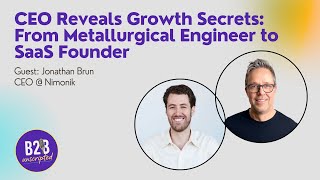
Jonathan Brun bootstrapped Mnemonic, a compliance platform for regulated industries like oil and gas and mining, to $10M ARR with 55 employees across four offices. He turned down venture capital after reading 37signals, built the company through inbound demand and word-of-mouth, and credits Quebec's entrepreneurial culture and a focus on authentic relationships over automation.
Chapters
Hello, Jonathan. Welcome.
Hello. Thanks for having me.
We had a chat before this podcast, and I wanted to ask you a little bit more about your background because I find it's very interesting. And how did you get to start Nanomic back in 2008?
So my background, I studied metallurgical engineering at university. It's something that's not very well known. It's basically the production of metals. So after you take the ore out of the ground, whether it's iron or copper or other things, and you want to create a product, it's sort of that process of getting the stuff out of the— after you've got it out of the ground, turning it into a product at the end of the day. So I studied this at university and I was in what's called a co-op program, meaning I would work and then I would study and I would work and I would study. And I did one of my co-op placements in China. I was working for a company that made equipment for the steel manufacturing industry. So I traveled all over China, visited a lot of steel factories that were in environments that were very polluted, a lot of environmental destruction, and also a lot of safety issues. I mean, steel plants are dangerous places with thousands of people working there at the larger plants. So when I was there, I kind of observed the environmental impact that this industry was having as well as some of the safety issues. After I came back to Canada, where I'm from, I decided to kind of change my path after university and go more into sustainability and environmental issues. So I joined a consulting firm and at that consulting firm, they had started building a database of all the environmental laws and regulations in Canada, because in Canada, we have a very decentralized system. Each province, there's 10 provinces, each province has its own regulations on environmental issues. So they built this database, but the product wasn't really working from a business point of view. They were losing money on it. You have to maintain the database, you have to update it every year. And so I was working at this business as an employee and a little bit on the product, but on other projects as well. I decided I didn't want to be a consultant. I just didn't like having a boss basically. And when you're a consultant, you know, you have a boss in the sense you're working for a company, but also your clients and your clients will say, oh, you know, we don't have a budget to do that. We'll do, We want you to do this. So I just didn't enjoy that. So I proposed to take this database they had built and try and turn it into a viable business that would stand on its own and be financially, financially viable. So that's what we did in 2008 is we took this product that was sort of a prototype, if you will, pulled it out of the consulting business, created a new corporate entity called Mnemonic, and then built it up. Since then. This was in 2008. So, so it was a bit of a weird journey coming through engineering and metallurgical engineering into environmental. And now the business does a lot more than just environmental law, but that's, that's how it started. One of these things, you know, it's just you're in a certain place at a certain time and it leads to all sorts of things down the road. That's it.
So you trust the process and it leads you somewhere.
Yeah, for sure.
But you're And you grew the company without external funding. Can you tell us more about this? Because I find this very interesting. You're a sizable company. I'm not sure if you can even give an idea of the scope to individuals listening. And why did you decide to keep full control in some ways of the company and not accept external funding?
Yeah, so the business is about 55 full-time employees. Broadly speaking, you know, it's a subscription SaaS business, sort of, you know, getting around that $10 million ARR type of area, not quite there yet. And, you know, one of the big influences I had when I started the business was the company 37signals. It's a company that produces a project management tool called Basecamp. And back in 2005, probably, they had written sort of a manifesto about building B2B SaaS companies. And this is when SaaS was really starting to sort of grow and take off. So I had read this manifesto in 2006, and that really inspired me a lot to keep the control of the business, you know, do it in an iterative process, not do the venture capital route where you have to raise money and then you sort of have to have this hockey stick acceleration of your revenues. So that the venture capitalist can sell the business or do a second round of financing and get their money out. And I had friends who went the venture capital route and it puts tremendous pressure on you and you end up having a boss, kind of coming back to what I discussed earlier. I didn't want a boss. So venture, if you take venture capital or other types of investors, you usually end up having a boss. They have board seats, they have rights. And if you don't perform, you don't hit your objectives, I know people who were kicked out of their own businesses. So I just didn't want that stress. I'd rather make a little bit less money but reduce my risk. That's kind of the way I think about it. I don't need a yacht. I don't need a private jet. I'm happy if the business is just healthy and steadily growing over the years. You know, and I guess to be perfectly transparent, we also didn't necessarily have a business that was ripe for venture capital in the sense that Even if you gave me $10 million, I'm not sure that we could have grown the business a lot faster. The buyers are such that the product we're selling is not something that improves their productivity. It helps them stay in compliance, but it's a bit like buying insurance. You know, it's a, it's not something you want to do. So you end up, you do it because you have to, but that makes the buying cycle longer. So it's not necessarily an attractive proposition for venture capitalists in the first place. So I think there's two sides to the coin, but that's sort of the decision-making process we took in those early years. And it's worked out, I think, relatively well. We still control the business. We don't have any institutional investors, and we've managed to grow it at a steady pace over the last 17 years.
That's amazing. And you're global, right?
Yeah, we based in Montreal, but we have an office in California and an office in Shanghai, and then we have some remote workers in Europe and the Middle East. And so we're pretty global. I was on the phone yesterday with some Australians. They said, you know, Australia is probably one of the places we don't have any, we don't have anybody. So we're getting there, but, you know, slowly sort of spreading out around the world. Yeah.
That's amazing. Going back to compliance, because that's your business, is this a big industry?
It's not as big as people think. You know, in the grand scheme of things, I mean, everything's relative, I suppose, but we are focused on Operational compliance, meaning, you know, is your factory in compliance with the laws and regulations where it's located? There's other types of compliance that we don't touch, you know, product compliance. We don't have a lot of impact there. Corporate, you know, financial compliance. We don't really work there. So compliance is a bit of a, you can put everything in it. If you put everything in it, you know, it's maybe like $10 billion industry, $15 billion industry, but that's all forms of compliance together. And we're really in a subset where it's around operational compliance and to a certain extent engineering and product compliance for the standards. But it's not a huge industry. I mean, you know, we're never going to turn into Facebook or Google or anything like that. But the, you know, the expression is the riches are in the niches, meaning, you know, you got to focus on a niche, do it really well, and that usually will lead to good things. And that's kind of been our philosophy.
For sure. So your compliance, you said at some point, isn't just paperwork, it's a mindset, right? When we were chatting earlier this week, and you said that there's different reasons why a company would start committing to compliance. So what's the— what pushes them to look into solutions like yours as opposed to do it the old way, manual way, and being exposed?
Yeah. So when we first started the business, one of our go-to-market approaches was to try and find companies that had been fined by the government. They had received penalties from the government. This is public information on the government websites. So our thinking was, hey, these people have just paid a fine, maybe $10,000, $15,000. So therefore they should be motivated to avoid another fine and therefore to put our product in place to help them reduce the risk of a non-compliance. But what we found when we spoke to these companies was that they had a company culture where fines were sort of a cost of doing business and they didn't really have an attitude of trying to be proactive about compliance. Therefore, they got the fines. And these businesses, we were not successful at selling our product to them. What we eventually figured out is we need to find businesses who had a culture of compliance or a culture of doing things well and being serious about their business. And the way we identified identify these businesses is, you know, do they have a corporate sustainability policy? Do they have a corporate compliance policy on their website? Are they certified to certain standards? So there are some ISO standards, 14001 and 45— there's a few of them, 45001. If they are following these standards and certified, and that's usually on their website, we know that they take compliance seriously and they are potentially a customer for us. So it's really about culture at the company. And it's not really about, I mean, size. Matters in the sense that bigger companies do tend to have more infrastructure to purchase our product, but it's not just the size of the company. It is really this culture, and you can pick up on it through these things on their website typically. Yeah.
Do they have specific roles as well that would indicate that they take it seriously and they want to do the right thing, like specific titles of individuals that they have in place that would signal that they do that?
Yeah, titles to a certain extent, but actually what's more relevant is their internal organizational structure. Meaning that you can have a director of environment in some businesses that don't take environment very seriously. They will place the director of environment underneath the engineering and operations teams. Now, the consequence of that is when you come to a decision, let's say you have to build something or have to change something at the factory, or, or, you know, you, you gotta You got to redesign part of the building. You, the environment guy or person is going to be saying, hey, we got to do this and this, and we got to protect the environment. But if their boss is the operations and engineering people whose job is to build something and to get it done fast and cost efficiently, guess who's going to win that battle? It's going to be the operations and engineering people. And so the environment person has less authority in an organizational structure like that versus a company where you have a vice president of environment that reports directly to the CEO. And if you have that type of organizational structure, it's the same job title potentially, like forget about the vice president, but director of environment. The organizational structure is just as important, if not more actually, than the job titles themselves. So, we sell to like environmental health safety directors, compliance officers, directors of engineering, these different job titles. but often the organizational structure will determine, does this person have authority? Do they have budget? Um, and can they get buy-in from the rest of the organization? So it, it's a very multifaceted sort of analysis. Um, if it were so simple as like, hey, this guy has the job title, therefore he's gonna buy our product, you know, that'd be awesome. But it's just not the case.
But the org structure is something you can't really find out until—
Not until you have conversations with them. Yeah. It's, it's, it's not public. Uh, so you, you talk to them and we've had situations where we sold our services to a company and then new CEO comes in or investor pressure to cut costs. They change the org structure and by changing the org structure, they kill our project. And so it's, it's significant, but yeah, you have to talk to them. It's rarely public information.
So your best fit client would be in what industries?
I mean, we're pretty wide for sure. Industries with more risk are the ones that we look at. So you can think of oil and gas, mining, extractive industries, industries that are producing products that are highly regulated. So pharmaceutical, medical device companies, cars. So these are products that have a lot of risk for the consumer. And so there's a lot of regulations, a lot of regulations and standards that apply to them. If you're just running like a retail store, or a bank, typically that's not an ideal customer for us. So it's basically, do you have big physical operations? Are you producing complex products with high risk? Those would be customers for us. We work with airlines, but we do work across pretty much every sector. Yeah.
So your platform, when I get on board, what does it do for me? Like, it's— it gives me not only information and allows me to centralize all my documentation. And is there like a two-way sync between the two that gives me like, am I compliant or not? Or gives me information about, hey, this is coming or this is new in this jurisdiction, you need to take care of it.
Yeah. So when we sign up a new customer, we will typically run them through a questionnaire to understand what operations do they have, which products are on site, like chemicals. Do they have vehicles? Do they work at heights? How many people are on at the company or at the operation. So the answers to those questions will help us determine which laws and regulations and standards likely apply to them. So we build a list of, hey, here are the standards and laws and regulations that we think apply to you. Here are the requirements within those laws and regulations that likely apply to you. That's kind of where we stop. We do have some AI tools that allow us to say we were pretty sure this is going to apply, but ultimately, It is the customer's responsibility to validate that it applies and that they're in compliance or not. We have partners that will go on site and do audits and inspections, but we don't, we're sort of an information provider with these workflow tools. And then when new laws and regulations come out, which happens every single day, or changes happen, they get alerts in our system. They say, here's a new law. We think it applies to you because it's about oil and gas. You work in oil and gas, et cetera. So they get alerts, newsletters, and they have workflow tools to manage that data to say, hey, Christian, can you go take a look at this? Can you follow up with Bob? Can you put in place a procedure? And so that sort of workflow is in the platform. But yeah, to your point, it's about centralizing the information, about organizing it, and then basically about controlling it, controlling it in the sense of making sure we've gone through everything, that we've put in place procedures, that we have deadlines in there. And that we're reducing the risk of being out of compliance. I mean, no company is 100% in compliance in the world. It's just, it's an impossible task. But you know, if we can reduce the risk of non-compliance by a substantial margin, then, then generally, you know, our clients are happy and, and we're happy.
Does your platform also help, helps the client to take action on some of those and, and manage that workflow and the next steps?
And, uh, yeah, up to a point. I wish we could do, we, we want to do more, but right now, you know, if you have, let's say you get an environmental license from from the government, which you typically have to get if you're using water or doing or emitting water or air emissions. Those licenses will have renewal dates. They'll have deadlines to submit reports. So those deadlines and actions can be put into the system and it'll say, hey, don't forget to send your quarterly report to the Minister of Environment. And they'll get reminders to do that. It's not fully automated. I mean, I wish it were where you could just sort of click a button and it populates all your actions and all the deadlines, all the responsible people. So there's still a bunch of manual work that has to happen. You know, maybe one day we'll get it to be more automated with AI and other tools, but there is an action management feature within the platform for sure.
Yeah. So, so you've grown mostly through word of mouth, I guess, and inbound requests so far.
Yeah. I'd say 90% of the requests we get are inbound. We don't do very much outbound. It's not a product that is sort of sexy or that helps improve your performance. So if I'm calling you, I'm in many ways, we're actually selling them a product that creates additional work for them. So it's not very compelling because let's say you're doing nothing today, which is the case for most small and medium businesses. You have no process in place to ensure compliance. You kind of are very reactive. You're doing things as they come up, as you get problems. So if you're If you're doing nothing and I come to you and say, I'm going to sell you Mnemonic, here are 100 regulations and 1,000 requirements you now know you need to go and evaluate. That's a whole bunch of work that you weren't doing before. It's not, doesn't make for a great sales pitch. So outbound rarely works. The company that comes to us, they need to be ready to buy this. They need to understand that this is a good business practice. And when that happens, you know, we obviously go through a sales process with demos and proposals and what have you, and then eventually make the sale. The other way we've grown is through acquisition. So we've purchased 5 companies so far, and that's been very helpful as well. And that's mostly moving all their customers to our platform and getting some economies of scale. But, but I'd say acquisition and inbound is, is basically the vast majority of our clients.
So I guess I'd like to ask you this question because you have quite a bit of followers, I noticed, on LinkedIn. You have almost 20,000 people look at you. What have you learned about building trust online, especially in an industry where accuracy and credibility really matters? Like, what's your take on this and how do you balance the online versus offline? You mentioned at some point in our prep conversation that you are a big believer in relationship one-to-one live meetings.
I think a lot of it boils down to authenticity. We had used a strategic consultant a few years ago and he said, you know, if you want to be a thought leader in a space, doesn't matter which space, there's kind of two things you gotta look at is, is A, do you have interesting thoughts? You know, interesting. That would be a good starting point. Interesting and novel in the sense of new and different. And then if you look behind you, are people following you? And so I think when it comes to online presence and online sharing things, you need to have some thoughts that are out of the ordinary. And today with AI-generated content, the amount of the volume of stuff that's going through these social media platforms and emails and whatever is just astronomical. So I think at least what I try to do is the things I put up online are no AI. It's, you know, honest opinions and thoughts on issues that obviously are in my little niche and try to do something that stands out a bit, you know, that, that's a little bit out of the ordinary. If you just do a copy paste from, you know, some report that Deloitte put out or whatever, I mean, it's not really need to get you very far in my opinion. And then, yeah. And then, you know, people need to be kind of like following you to a certain extent. So honestly, I just try to be myself. I try to read a lot, books, scientific papers, you can get a tremendous amount of interesting insights by reading a scientific paper. And with AI, I get all these— it really annoys me. If you load up like a PDF in a PDF viewer or other tools, it now proposes to summarize. Everything's summarized. Everything's summarized.
Everything's summarized.
And I don't believe in summarization. Well, you can do some summarization, but the real interesting nuggets of gold you have to read the whole thing. You need to load the context. If you wanna take the AI analogy, you need to load enough context into your brain to be able to recognize that this idea or this thought or this piece of information is very valuable, either valuable to me, to the organization, to the broader audience, you know, depending what it is. But you gotta read the whole damn thing. You can't cheat. I really do believe that. And so I read a lot of books, I mean a lot, it's all relative. And and often it's like one thing on one page in that book that resonates with me, and sometimes I'll share that, uh, with others. Um, so, so you got to do the work. I mean, you can't, you can't cheat. You can't just go to ChatGPT and be like, hey, give me a great LinkedIn post that's gonna resonate. At least that's the way I do it.
I mean, I won't speak to other people, but no, but I love this, um, your point about summary. I find the same thing. Like, uh, I signed up for a book summary app a few years ago called Blink.
Yeah, I tried that too.
It's pretty good, especially when you're on the go. You can listen to the audiobook or summary, audio summary, I should say. But I always end up buying the book.
Yeah.
So it, it's, uh, it's interesting because to your point, I think we go through a process, a creative process or, or a, a personal process when you, you take the time to read. There is a, something novel to your point about sitting down and listen and, and taking a, a hard copy book and read, taking the time to read it and make your own interpretation of it, which I, I think is, is the edge, right?
I think, yeah. I mean, I did try that Blink app as well when it came out a number of years ago. I was like, that was an interesting idea. And I read a bunch of summaries of books and they were good, but I think when you read a book, a few things happen. One is it takes time. And during that time, you have the ability to kind of digest and really absorb the information. If you're reading a summary that maybe takes 15 minutes to read, it's sort of in and out of your brain so fast that I don't think it really kind of gets registered in a deep way.
Yeah.
The other thing with, you know, about reading books is, well, I mean, I guess it gives you that time to digest, to find information, and then often I'll have it sitting on my bookshelf and just looking at the book sometimes ideas come back to me or principles or thoughts, you know, depending what the book was on. And then the third thing that I like to do when possible is pair a book with other resources. So sometimes it's like a book with a movie that went with it. You know, maybe somebody made a movie out of it or a podcast and you get this multifaceted take on an idea because maybe the people who did the podcast have a bit of a different take. And then I find it really registers in a very, very deep way. And sometimes it's the inverse. I watch a movie and I'm like, oh, was this movie based on a book? And then I go find the book. And of course the book is always much more detailed, much richer, and much better. But it gives you a sort of these different angles 'cause every idea Every concept is multidimensional. There isn't one thing. And I'll give one last example on this topic. There's a Netflix documentary, or it's not a documentary, sorry, a Netflix miniseries on the creation of Spotify, the music application that really created streaming music. And so it's 6 parts and each episode is the same story, the story of Spotify from beginning to sort of end, if you will, but told from a different point of view. One is told from the founder. One is told from the CTO, the chief technology officer. One episode is told from the lawyer. One episode is told from the artist. One episode is told from the music studio executive. And I thought that was a very fascinating way of telling the story. And it is based on a book. So I watched this miniseries because our industry has some parallels to the music industry. I watched the miniseries, thought it was fascinating, and then I went and I got the book. And of course, the book is great too. But again, it's just this point that everything is multifaceted. And so sometimes reading 2, 3 books on a topic really gives you a rich understanding of an item, an issue. And I can guarantee if you read 3 books on a topic, you'll be more educated on that topic than like 90% of people. You don't need a lot to be more educated than the average. It really is not that tough.
So true. Especially in a world of summaries.
In the world of summaries, in the world of, you know, Gurus and TikTok and et cetera, et cetera. It's, yeah, yeah.
Interesting. Thank you for sharing that. It's a good segue to rapid-fire question. I have 3 questions for you very quickly. The first one is related to what you mentioned. Is there something you do on a daily or weekly basis that really keeps you focused when things get a bit more chaotic as a CEO?
I'd say I'm a pretty calendar freak, so everything's in my calendar. My calendar's booked solid. If it's not in the calendar, It doesn't exist. It's not happening. So I'm pretty regimented that way. And then I have like a to-do list on a piece of paper and I just cross things out as I go. And that's it. It's pretty simple tools. I don't have any sort of fancy thing. I don't have a secretary. I don't have a virtual assistant, anything like that. Yeah. Just steady discipline every day, get stuff done. That's it.
How do you know if your day, you accomplish what you wanted to do for that day? Because that to-do list in my case, and I'm sure in yours as well, it keeps growing. Every time I cross something, there's 3 more items added. How do you pick the 3 items that you say, you know what, no matter what today, I'm going to do those 3 things?
I'm not going to do anything. I don't really do it that way. So I don't have like, these are the 3 things I have to do today. I have a long to-do list for sure. And one that kind of keeps growing. You know, the famous exercises you say list the 10 most important things you need to do in the next year, and then, okay, now cross off 9 of them, right? And, and, and so what, and usually that one thing, it, it becomes self-evident. And then sometimes stuff just keeps coming back in the sense of like people are asking for something or, you know, something's happening. But you want to leave enough. My philosophy is you, you discipline and rigor is great, but you also need to leave room for for unexpected things, for new information, and then take rapid action on it. I mean, I think speed is a superpower and I think my colleagues at least sometimes say, oh my God, like you're so fast at getting stuff done. And so I'm a big fan of speed and I'll just give one example. I know this is rapid fire, but you know, I'm on a phone call with somebody 2 years ago and they say, We work with company X, Y, and Z. I knew all the companies they mentioned except for one of them. Google them, find them, send them an email, say, hey, I'm interested in buying the company. Who do I talk to? We start having a conversation and 6 months later we've bought the company. So it's that hear something, that's the nugget of gold, act on it, follow up, get it done. And it was a life-altering acquisition. So you want to have that. Sort of when you find those nuggets, you gotta execute fast. I mean, I do really firmly believe that.
To your point, it's a rapid fire, but let's keep going on this one. I think most people act quickly, but they don't follow through. You know, they keep going to a certain point. It's too easy to get distracted. For some reason, life gets in the way, you know, and you, we just lose sight of that initial kind of goal or desire. What's something about, to your point, you're Montreal-based, like what's something about Quebec culture or business mindset that's shaped the way you lead your business?
Yeah, I mean, growing up in Quebec and in Montreal, it's, we could obviously talk about that for a long time. It's a unique culture within, well, it's a unique culture, like many cultures are unique, but unique within the context of Canada. Unique within sort of the North American and sort of the US mentality. I think Quebec mentality in many ways is actually more American than it is sort of English-British. The rest of Canada, to make some generalizations here, the rest of Canada sort of has a bit of a British type of attitude around business. It's a bit more conservative, a bit slower moving. Whereas the Americans, you know, they tend to say when we say go, we go and it can be very fast. I'm not saying Quebec's exactly like the Americans, but there is that. And then, you know, the Quebec, because it's a small island of French speakers within this, you know, 400 million person US and Canada together, 420 million people, there's a bit of an attitude of, you know, Asterix and Obelix, like you're fighting sort of a large empire and, you know, you really gotta stand up for yourself and stand up for your identity and for your businesses. And we constantly get, you know, approached by Americans who wanna buy the company, a private equity who have very deep pockets. And I do have a bit of a nationalistic side to me in the sense of like, I wanna build something that is independent, is strong, and can last for hundreds of years. I have a lot of respect for businesses like that and create, you know, create jobs here, create jobs elsewhere too. But that's sort of the goals. It's a longer discussion. Quebec is a very special place, and if you're listening to the podcast, you've never been here, I highly recommend coming to Montreal, coming to Quebec City and visiting. It's a great place both in the summer and in the winter. So yeah.
So true. So true. Lots of resilience from Quebecers.
Yeah.
I find it's deep in the culture. So if you were not running Nanomic tomorrow, what kind of problem would you want to solve next?
I don't know. I mean, there's so many problems out there. I think the problem that I think we have as a just broader problem is improving the quality of the operations. So whether this is public service, government, other businesses, you know, we are in the private sector, very competitive environment. If your product is not built at a certain quality level, You know, you get destroyed by competition. And so I think increasing the level of quality and rigor, the seriousness of your work, if I could contribute to that in the public sector, you know, one day I would like to. I've done some nonprofits, I've done some other things, but I think just increasing our seriousness. And I travel a lot in China. China's built unbelievable things, infrastructure, high-speed trains, et cetera, and we can't seem to get that kind of infrastructure built in North America. And so again, I think that's the public service needs to sort of get a bit of a kick in the pants and really trying to increase the level of seriousness. And that a lot of it comes from the political class. Some of it's from the public service. No one person is responsible for this situation, but I think we need to We need to get back to what we were doing maybe in the 1950s and '60s and just building large-scale projects at speed, which we haven't done at all.
Speed, I was about to say. Yeah. Not projects that takes years just to show up. You think of Singapore, which is very innovative in that way. They can build what we build in 3 years, they can build it in 3 months. It's unbelievable. And to another quality. But that's a very, very interesting point, especially very timely right now with what's what's going on in Quebec with the public sector and—
Yeah. Yeah. Everybody has problems. There's light rail problems in, you know, Toronto. They've had a project that's taken 12 years and still doesn't work. You know, it's insane. It, to me, it's insane. And so if I could—
You would do this in the private sector, you'd be out of business in no time.
My, I was having beer with my colleague, not my colleague, sorry, a friend a couple days ago. He is a patent lawyer. Okay. Patent. He files patents, defends patents. The Patent Office of Canada has had their IT systems down for 6 months, so people cannot file patents. They can't get the paperwork coming after the patent. So he basically can't work because a lot of his work— I mean, it's insane. We're talking about being competitive, about building a more resilient Canada in the face of the trade winds that are happening. And our patent office is basically nonfunctional for 6 to 7 months. If your business didn't operate and didn't produce goods for 6 or 7 months, you'd be out of business. I mean, it's insane. It's insane. And we see this, it's not just in Canada, it's not just in Quebec. We have this in all sorts of countries. I mean, don't get me wrong, but improving the quality of the public service to me is something that we need to really do. Yeah.
End of the rapid-fire question, by the way. If another founder, uh, in 2025 was thinking of buying a company, because you've grown through acquisition, um, to grow faster, what would you tell them, you know, to think about?
Well, I think acquisitions that work, and there's academic, uh, research that supports this, to my knowledge, is you need to really have two things. One is the corporate culture needs to be very similar. between the two businesses, you know, the acquirer and the company that's being acquired. So corporate culture needs to be as close as possible. As soon as you have divergence on that, it creates just a mountain of problems. And then the products, where I'm a fan of what we do are roll-ups, or basically buying products that are competitors and rolling it up. So putting all the customers up. So the products need to be as similar as possible. As soon as you have a divergence on the products, you end up having a divergence on the buyers. Integrating software is almost impossible. So that's really what we look for. And I would recommend sort of the same optics for anybody who's looking to— who has a business and is looking to acquire another one is you want to make sure corporate culture is as close as possible and that the products are as close as possible. Because if the corporate culture is not there, I mean, you're— it's like, it's like oil and water. I mean, you have so many problems.
How do you, how do you feel a culture from an external point of view when you are in the process of acquiring a company beyond speaking with the C-suite? Like how do you feel the culture?
I mean, I think you can actually usually take it, get it from the C-suite. I mean, I'm a big believer that it's all about leadership at the end of the day. You know, some people might disagree with me, but I think leadership determines almost everything. The public sector stuff we just talked about, it's a failure of leadership. It's a failure of accountability. So the tone of an organization is almost always set from the top. You talked about Singapore, you know, uh, president there, unbelievable leader. So you can usually tell the culture by the leader, um, in almost all situations. Um, now it's if you have the opportunity to meet You know, staff lower down on the hierarchy, that certainly helps contextualize, but often you meet a leader and within 2 to 3 minutes, you know what type of person that is and if it, there could be a fit or not. And one book I recommend on that topic is The Captain Class, which is a very interesting book on elite sports teams that dominated their sport for a prolonged period of time and how did they do it. And the summary, if you will, of the book— we talked about summaries— is it's all about the team captain. It's not the coach. We often think it's the coach, it's the management, it's the budget, it's the money. The book's conclusion is it's all about the captain. And so, you know, who's the on-the-ground leader on the hockey rink, on the football pitch, you know, wherever it might be. So, the leaders usually like right away you can tell the culture pretty quickly.
What are those 3 top principles or values or philosophies that you feel are— that you own, you want to own it, you know, that you, you believe are the most determined in, in the success of your company, that you would not compromise for?
So at least for our company, and I think you can have successful companies that have very different cultures, so I'm not saying that one culture is the right culture. There are very successful businesses that have completely different cultures from each other and sometimes they end up serving different markets or different buyers. At least what I lead with or I try to lead with is first and foremost transparency and honesty with everybody. I really try and treat everybody the same whether they're an entry-level person at the company or a senior person, whether they're a big account, a big customer, who would get more revenue or a smaller one. So just transparency, honesty, lightness. I do think, you know, there's an expression which is manners maketh man, you know. So basically it's somebody's politeness, their manners are highly indicative of their— how that you're going to be treated. And so very simple, very simple principles. And yeah, I mean, that's, that's kind of it honestly. And, and just making sure you work as hard as everybody else, if not harder, you know, lead from the front kind of stuff. And if you read that Captain Class book, a lot of these captains are not the best players on the team. You know, we think of the Michael Jordans, we think of these guys, but in a lot of these situations, the best, the captain is not the best player. He's the person who can sort of bring people together, support the best players who have the most talent, but who's the hardest worker and who will, you know, winning is all that matters. I mean, that's sort of the attitude you have to have. And that's really kind of the attitude I have is it's winning is all that matters. Not in the sense that you should compromise your values or things like that, but you have to be focused on winning. That's it. I mean, it's all about winning. It is a competition. It is a sport. And so it's, you gotta be competitive.
Yeah. That's a very good point. I don't want to get into stereotyping of generation, but I am facing sometimes that younger generations might be at loss here in terms of wanting and wanting to be engaged, being on the court, winning, wanting to win, give the extra push, and they have goodwill. They are well-intended. But it's simply not ingrained in them for some reason. And that's something I'm trying to pass on to my kids, especially my son who just started high school. I was listening to a podcast the other day and I told my son actually on my way to school this morning, 'cause I drove him, it's the weather permitting with his outfit for Halloween. And this podcast was talking about like, What are the key principles to tell our kids or, or try to educate our kids in today's day and age where everything goes fast and we think we need to be super knowledgeable around AI and all those things? And the, the gentleman said, there's two things. Back to fundamentals, like you said, communication skills is number one.
Yeah.
And second, not in specific order, but don't be a jerk. You know, don't be a jerk. Be a good person. Simple manners such as I try to teach that to my kids. When you see someone that you know, call them by their name, you know, and say, hi, uh, Jonathan, how are you doing? Not like, hi.
Yeah. Yeah.
You know, very different. But I, I love what you're saying and it's going back to the fundamentals of, uh, of how to be a good human being, you know, at the end of the day, uh, in a rapid pace where they don't have the models that at least I think I we had. You look just around these days on the media, it's crazy how we are transgressing those good principles on demand. There's no line of ethics anymore and good manners. It's really difficult to follow, and it's tough to witness, to be honest.
Yeah, I think there's a lot of sort of— there's many issues. I try not to say, oh, the younger generation does this or that, or, you know, the generation of 1740. I'm sure that, you know, the generation that was right after them was like, that those kids from 1740, though, they don't, they don't know what it's like. So I think you have this dynamic every generation. You always think the next generation is falling short in some way. But to your point, I think communication skills are extraordinarily important. I talked about speed being a superpower, but to be able to clearly communicate and particularly clearly listen or listen attentively to what people are saying, that's a superpower. And I see a lot of people struggle with that. When I'm in a meeting with someone, a customer, a prospect, what have you, I'm really trying to listen because it, you get those nuggets. I mentioned about the acquisition earlier and then yeah, not be a jerk, you know, be a good person. Think about others. And part of the challenges with TikTok and all these things, you know, you have these get-rich-quick schemes and, you know, people are under, kids are under tremendous social pressure. The girls with the whole like beauty stuff and then the boys with like various things. So, you know, there's all sorts of schools of thought on this, but, but, you know, pushing them to take life seriously, I guess, is, is the way I would, I'm, I'm thinking about it. You know, you've only got one life. Don't screw it up. Like that's, that's, that's like, that's one shot at it. Yeah. One is not the expression I heard, which I really liked was this is not a dress rehearsal. This is it. You've got one shot. It's one show. You don't know when it's going to end. Big decisions. Make sure you're prepared. You know, what's the most important decision in your life? Most people don't necessarily give the same answer. The answer that you should give is your partner. You know, the person you marry, the person you end up having, if you decide to have children, that you have children with. You pick the wrong partner, it's not good. You pick the right partner, it can be fantastic. And obviously there's many other decisions in life, but that one is foundational. So just take life seriously. Doesn't mean you don't have fun, but just take shit seriously. It's not a dress rehearsal and you gotta prepare to seize an opportunity in 5 years. You gotta be preparing today. That's kind of the way I think about it. It sounds very kind of like, it's very traditional. I'd give the same advice 200 years ago.
And it's a process too, right? Because we sell the mirage of the outcome all the time, right? It's all about like, hey, here's the carrot, you know, but we never really work hard on defining what is the process. Trust the process. Consistency wins over time. You know, that's how we reach goals. It seems all very cliché as saying, but the process— I was reading something the other day, process over outcome.
Yeah, for sure.
This is fundamental.
I answer every email. It's tough to teach. It's tough to teach, but it's like I answer every email. I mean, aside from the spam stuff, but you know, every— everybody that emails me gets an answer. And I think that is part of its politeness and respect, part of its process and just having that habit. So yeah, trust the process, you know, and then leave enough flexibility that when that new opportunity appears out in the right-hand side at the corner of your eye, you can still catch it and do something about it, right? So it's a balancing act, but show up every day. I mean, that's it. There's no shortcuts. It's just day in, day out. Yeah, I mean, again, simple, simple stuff. Simple but hard. I mean, it's hard to do it, right?
That's it.
It's simple but hard. Yeah.
So going back earlier in closing, you said like talked about the fact everything can be summarized, automated to a certain degree. You may be getting a lot of automated email from this AI SDR all the time or even predicted, you know, where do you think the durable edge, like anyone listening right now who are thinking of starting a SaaS business or already or they have one, where do you think is that durable edge for SaaS companies to, you know, truly stand out?
Yeah, so we had colleagues who wanted us to do these AI email campaigns that, and I, and they grab stuff from the internet and they kind of personalize the emails. And I get like 5 of these a day and I, they're all marked as spam. And they're all blocked. I think you, again, it comes out of this idea. You can't cheat. You're not going to do these emails at scale and build a great brand. I mean, nobody wants to be spammed. So our philosophy is quality over quantity. Spend time with people in person whenever possible. Obviously we have a global business, so it's mostly virtual, but any opportunity we have to visit a client in person or prospect in person, even if it means just driving for a while, taking a flight, it makes a massive difference. So I think you've got to do those types of things because at the end of the day, even if you have a software business, you're selling to people. You know, people are the ones ultimately that are deciding whether or not to buy the service, and you need people to like you. It sounds like a bit like in high school, you know, the popular kids. But the reality is, if you're going to be selling something, people need to like you. And one way to get people to like you is obviously doing all the things we spoke about in terms of being a nice person, not being a jerk, knowing your material, but then showing up in person and spending time with them and taking an interest in their problems, in their business, in their situation that builds a relationship. And I have lots of stories around that, but fundamentally that's kind of the way I think about it. It might be a little bit less scalable than sort of some automation and emails, but it's a bit of an old-fashioned kind of way of doing things.
But which becomes more new fashion now.
Yeah, I think so.
Nowadays, right?
Yeah, yeah. With the AI stuff, if you want to stand out, you got to do something different.
Yeah, absolutely. I agree. Jonathan, it was a pleasure speaking with you. Thank you for your insight, your journey, and most importantly, thank you for the wisdom. That was really, really good.
Hopefully it's helpful to someone. Thank you for having me on the show.
Thank you.
More from Jonathan
Building a Sustainable SaaS Business: Insight from Jonathan Brun, CEO of Nimonik