Preserving Heritage Trees: Sustaining Living Landmarks in Historic Landscapes by JP McDonnell
JP McDonnell explains how to identify, assess, and protect heritage trees, large culturally or historically significant specimens like the 400-year-old Kyle Oak in Indianapolis. He covers detection methods from decay testing to ground-penetrating radar, real interventions like cabling and soil remediation, and policy wins including D.C.'s tree-removal ordinance and Tennessee's heritage-tree registry.
Chapters
Thank you. As most of you know, I'm a new member, first-time conference attendee, and I actually found the Alliance by chance online and enjoyed how it promoted the interdisciplinary nature of this work. And my passion is managing and preserving Mature historic heritage trees, and I think that aligns with historic landscape preservation. So today I'm excited to talk to you all about heritage trees and hope you find this insightful and relevant to the work that y'all do. So when I say heritage tree, what words come to mind? What do you guys think of?
Old.
Yep. Big. Yep. Significant. Rare.
Great.
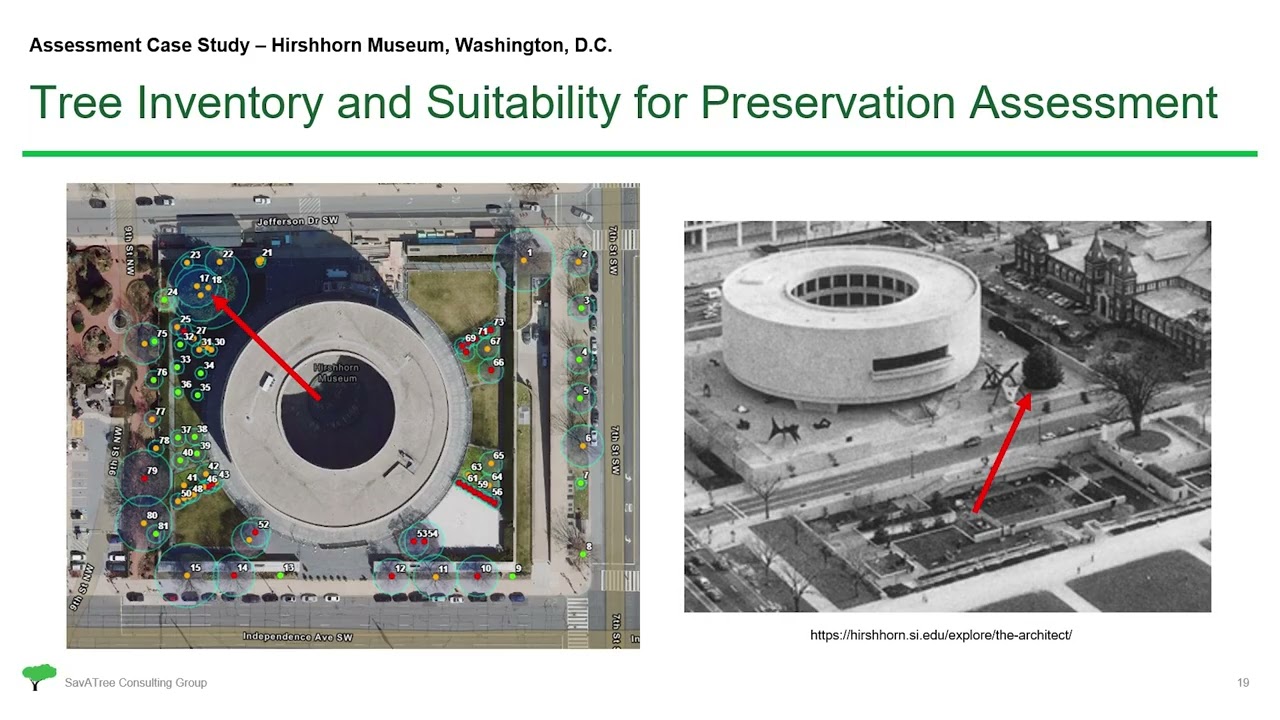
Yep. That's— So there's no industry-accepted definition of a heritage tree, and it varies by municipality, state, or country, but I put this all-encompassing definition together. So in general, it's a tree, a significant tree due to its age, size, species, cultural, historic, or ecological value. And I post— I posted the Indiana Department of Natural Resources definition below, which is very similar. And these trees are important for a myriad of reasons, but larger trees ecologically, socially, and economically are exponentially more valuable than smaller trees, um, in the— because of the, the benefits that they provide in the form of carbon storage and sequestration, stormwater management, cooling, shading, air pollution mitigation, wildlife benefits, and so forth. And from a historical and cultural perspective, these trees offer a bridge between a landscape's past and its evolving future. And so I just wanted to note the, the wide number of significant trees, the terminology that are out there. So depending upon your municipality, it might be defined in ordinance. And there's no, as I mentioned, industry-accepted definition of a heritage tree. So for simplicity's sake, I'm kind of referring to all of these types of trees within this presentation because a significant tree could be significant for any reason to someone. But I will note that a champion tree is well-defined in the United States. It's the largest tree of that species in that state or this country. So I wanted to share a few heritage tree examples. This one is local, a few miles east of us in the Irvington neighborhood. It's a historic neighborhood. This is the, the Kyle Oak, 400— approximately 400-year-old bur oak named after the first owner of that property, Reverend Oliver Kyle. And this is one of the largest oaks in a metro area in Indiana. And there's a common theme with these heritage trees that there's typically a champion. That if there's no ordinance protecting it, a champion or champions ultimately come together to help preserve this tree. And this is a great example. Reverend Oliver Kyle's daughter, May Kyle, actually championed this tree while she was alive. She passed, and then the Irvington Historical Society took over and ultimately bought this land and saved it from development. And she, she actually kept a guest book for visitors who came and visited the property, and there were international visitors who came and saw this tree. And there was a story that the limbs were touching her house, and instead of pruning them, she put rubber tires to protect the house from, from any tree damage. This is another one that isn't particularly large or big, but there's a story behind it. Has anybody heard of the Moon Trees? Couple people. So on the Apollo 14 mission, a few hundred seeds of trees were brought to the moon. And there was a— there was research— they were interested in learning if the zero gravity environment had any effect on the growth of these trees. And this sycamore at the Indiana Statehouse was one of those trees.. And ultimately every single tree grew as normal. So there was no effect from zero gravity. Here's another one, not local obviously, but in the news recently. The Jackson Magnolia at the White House, formerly one of the oldest trees on the White House grounds. Andrew Drac— Andrew Jackson brought these seeds from his home in Tennessee at the Hermitage. Planted them in honor of his late wife, Rachel. These trees were designated as witness trees by the National Park Service in 2006. And famously, this specific magnolia was hit by the Cessna airplane crash in 1994. And if you see that trunk leaning to the right, that trunk was removed during Trump's first term. And recently, this tree was removed. You can see on the left that a pole was basically holding it up because it was so decayed at this point. And the useful life of this tree ultimately was done. And the tree was removed, but somebody had the foresight to take cuttings of the tree about 12 to 15 years ago. And you can see that tree on the right that was planted in place of this tree to keep that— keep those genetics going at the White House. So theme of the conference, Navigating the Crossroads. Has anybody heard of dendrochronology? A lot of people. So it's the study of time using tree rings. Tree rings are the QR code of history, and they vary, their width varies based on the climate that that tree experiences. So in drought years or stress years, the rings will be shorter in width, and in good growth years with high precipitation, the wings, the rings will be wider. And so these Rings can be traced back to specific dates in time. And so, uh, in these heritage trees, their rings link us to stories, places, and people of generations past. But recently, we have a lot of threats to trees and heritage trees in general, and you all are familiar with a lot of these threats in climate change, development, urbanization, invasive species, even vandalism. And these threats are increasingly evident in news nationally and abroad. And so how do we deal with this? I'm gonna talk about some heritage tree assessment and management strategies that can hopefully prolong the life of these types of trees. And I first wanted to talk about industry standards and best management practices that we abide by. On the left is the American National Standards Institute A300 Tree Care Standards. ASLA is actually a voting member of that committee, as, as is Save-A-Tree. And on the right are the International Society of Arboriculture's Best Management Practices, a series of books that, um, based on science and research delineates best practices for pruning, risk assessment, soil management, root management, managing trees during construction, and so forth. So tree risk assessment is, uh, a popular method for assessing larger trees because larger trees have more significant consequences if they were to fail. And so, um, on the left is an example of an advanced aerial assessment with a climber using a resistance drill to quantify decay in the tree where there was a cavity visible. And in the middle, you can see the readings from that resistance drill, and it's read from, from right to left. Where this resistance drill quantifies the resistance of the wood. And so higher resistance, obviously better than lower or no resistance. And those top 3 readings, you can see that there's an inch or 2 or less of sound wood and the rest is hollow. Um, and on the right is a tomograph, which uses sound waves to assess the soundness of wood within the trunk., and creates a cross-sectional view of that trunk. And the dark brown, lighter brown, that's sound wood there. The blue is hollow, and the purple and green are decayed wood. And here's a case study about a heritage tree that we assessed in 2013, the Bedford Oak. It's a white oak in Bedford Hills, New York. That has lived alongside Native Americans, been through the Revolutionary War, the Civil War, and everything since. In the '70s, it was threatened by development. But as I mentioned before, there was a champion in the residents and the Bedford Historical Society, and they ultimately bought that property of land to protect that tree from development. And we, we assessed this tree, found it to be a moderate risk. Of failure and made recommendations to increase that soil growing environment by removing the turf, installing composted mulch, a prescription fertiliz— fertilization program, and reduce some of the tips and weight from those larger branches that you see to reduce likelihood of failure. And that tree still stands today. So now I wanted to move on to managing trees during construction. And I wanted to make a note that trees are threatened in every phase of development, even before anybody steps on the property, because if they are not accounted for in the planning phase, then they are more likely to get damaged or removed and so forth during, development. So bringing in an arborist in the planning phase is highly recommended if you want to assess trees and see which ones are most suitable for preservation. And an arborist does have a role in every phase of development. On the right is a flowchart from our, uh, standard for managing trees during construction, and it outlines an arborist's duties in every phase of construction. And here's a case study from the Hirshhorn Museum from a couple years ago. The Hirshhorn is going through a revitalization process over the next 10 years, and we were hired to do a tree inventory of the plaza, assess the suitability for preservation of those trees, and you can see the tree point color is coded based on its suitability for preservation, where green is high suitability, orange is medium, red is low suitability. And suitability for preservation is a combination of species tolerance to construction, size, and condition. And in that photograph on the right, you can see 3 magnolias that existed early on when the Hirschhorn was initially built in the early '70s. And that red arrow on the left points to those same 3 magnolias on the, on the tree inventory map. And so we were also hired to do a ground penetrating radar study of the roots, which you can see on the right. It's overlaid by red, yellow, and green, but behind that are color-coded triangles, which are the detections of roots. And we can detect the, the relative size location and depth of those roots. And this one was color-coded by size, and we developed an impact area to advise the design team on how close they could come to those trees in order for those trees to tolerate that impact. And on the left, those are that, that group of 3 magnolias and my colleague performing the, the ground penetrating radar assessment. Lightning protection is important to larger heritage trees. So there's a, there's a strategy to install a copper wire with an air terminal at the top of the canopy so it protects the tree from a lightning strike. And this copper wire grounds that lightning rather than the tree. Taking on the full brunt of that. And it can also protect nearby structures from potential lightning strikes or, or tree failure. And structural support systems are increasingly important with larger trees as their structure can become more compromised. And in the middle, you can see a cracked stem between that union. And on the right, it's hard to see, but there's a brace that ultimately braced that tree together. This was a special tree to this property owner. It was a live oak down in Florida. And there was also cables installed up above. Pruning is also an important strategy for maintaining heritage trees and, increasing their longevity. On the left is an article about arborists working on the Kyle Oak Tree here in Indianapolis. And the objectives for pruning mature trees are a little bit different than pruning other trees, as you want to reduce the amount of living foliage that you remove in order to maintain the health of that tree. And a lot of the pruning revolves around reducing the likelihood of limb failure by reducing weight and length of larger limbs. And a key point is retaining interior foliage, where a lot of somewhat maybe unqualified arborists may remove interior foliage of larger trees. But as trees grow older, they start to senesce, and so they kind of on their own bring the canopy to the interior. And if you remove that interior foliage, then that defeats the purpose of what the tree wants to do naturally. Soil management is, of course, very important to promoting the health and vigor of mature trees. On the left is an example of a root collar excavation, which uses a high-pressure air tool. Air spade, air knife to excavate soil that was piled up against the root collar of that tree. And then you can observe any girdling roots and prune those if, if they're— the middle photo shows an example of aerating the soil around this tree. This was on a campus in Florida, which was subject to a lot of foot traffic, which does compact soil. Using this air tool to aerate the soil promotes root growth and water infiltration, and often biochar is mixed in there as well as arborist wood chips. On the right is an example of a tree that senesced in that the outer crown ultimately was dying back, so it was pruned back, but it's an example of a really wide mulching, if you can see that on the bottom there, which is very important for trees. Probably the easiest and most important thing you can do for trees is provide a 2 to 3 inch layer of mulch out to the drip line. I wanted to touch a little bit on policy and advocacy. I wanted to highlight Washington, D.C.'s tree ordinance, which is one of the most robust for protecting heritage trees. So any tree over 31.8 inches diameter is not allowed to be removed unless it's deemed hazardous by an arborist. And D.C. has one of the strictest enforcement mechanisms. And if you damage or remove one of these trees, you can be fined, uh, I think it's a minimum of $30,000, and I've seen that on multiple occasions. On the right, Casey Trees, one of the best nonprofits for tree advocacy in the country. They every year put out a tree report card, which is a great community engagement and education tool which tracks certain tree canopy metrics over time and provides an independent assessment of how the city and its stakeholders are doing, uh, with regard to protecting trees and increasing their tree canopy. And for any, uh, people interested in case law, this was a recent case out of Canton, Michigan, um, regarding a tree protection ordinance that, uh, was ultimately deemed unconstitutional. Unconstitutional taking. So FP Development removed a bunch of trees on a parcel that they owned, and the Township of Canton mandated tree mitigation fees. And ultimately it was deemed that, that their requirement was not roughly proportional to the impact, and so Canton lost this case, and it's pretty important to tree protection ordinances and those writing them across the country to make sure that your mitigation requirements are legally sound, and you should show how the ordinance is tied to the real impacts in the landscape. And I'm not an attorney, but I'm just providing this as an example., for those interested. Another advocacy example is Tennessee Urban Forest Council, which has a great heritage tree registry, which is an awesome, um, community engagement tool. Anybody can nominate a tree, uh, which they think is a landmark, historic, or heritage tree. They have their own definitions of those.. But those that are accepted get their own web page with photos and a story about those individual trees, which I think is awesome. A few key takeaways for y'all. These special heritage trees have experienced history and witnessed generations. And heritage tree care and preservation requires proactive planning, collaboration, and advocacy. So I challenge you to be a heritage tree champion in your community so these trees can live to see the next generations. And I had a few questions for discussion that I wanted you all to think about. But in general, if you have anything that you're working on that involves the intersection of trees development or landscape preservation, I'd love to talk to you. And with that, I'll take any questions.
You said that when you're cutting the interior leafage, keep in mind that the tree is finessing.
Senescing.
Senescing.
Yeah. It's essentially the tree is due to old age, it's dying back. So, as a tree gets older, it has a harder time pushing the nutrients and water out to the outer edges of its crown. And so, it starts to bring that foliage— it's not actually bringing the foliage but the the outer parts of the tree are dying back. Correct. And so you can keep an old tree just tighter than the crown was previously. And in Europe, that's done a lot more effectively than in the United States. They have a much bigger emphasis on veteran tree management, they call it. But a lot of it has to do with the litigation-prone nature of the United States compared to the UK and Europe. But they also have less trees than we do. So just different cultures and different legal arenas.
Yep.
Nancy.
—in University of Virginia in '97 or something.
That's the Pratt Ginkgo right there on the screen. Yeah.
I was thinking about the collapse of the— one of the historic balconies on the lawn during graduation that killed several people and what happened afterwards. So I was working in props for an architect And all of a sudden, every tree on the lot was being examined with much tougher criteria about the possibility of having, you know, a catastrophic failure. And the number of students that are hanging out on the lot day and night, and what that might mean. My point is that the good news was that we in that office had already developed for replacing tree plant. So when the word came down that they were going to take down, I mean, a phenomenal number of trees in the lawn, maybe 10, 12 over the next couple of years, we were in a good place to deal with that immediately and get the program started. So as we work with historic properties, be thinking forward about that. The other thing I want to mention was Stumpy in Washington, D.C. So they are redoing the pool at the Lincoln Memorial, which is surrounded by cherry trees. Stumpy is a cherry tree that was down to really a stump and a branch, or maybe two tiny branches, that became a local hero last last year when it was clear that these trees were going to be removed and everybody went and had their picture taken with Stump.
I did that too. But yeah, they ultimately removed that tree. But I did want to note, when there is a catastrophic failure like that, there is a public outcry because people are scared. But because one tree fails doesn't mean that the other trees are more likely to fail. But having that inspection and risk assessment is, I think, very key to managing those trees objectively. Yeah, it depends. I had a slide on that. So urban wood reuse is an increasingly popular concept to give urban trees a second life and use them, for a higher use than just going to the landfill or mulch. So, uh, trees are being turned into biochar, which is— it sequesters carbon for much longer than mulch would. Or they're being turned into, uh, home products— tables, benches, or anything like that. And so it really— it depends on the market that you're in, if there's the ability for sawmills to take on that type of lumber, but there's the Unified Wood Economy is working on this. They're trying to grow those types of markets in various cities. I know Baltimore was pretty early on that. My director was involved in the Baltimore Wood Project, which involved taking historic lumber out of historic houses and also using urban wood and just reusing that rather than sending it to the landfill. Yep. You didn't talk about moving large trees.
I know it depends on the species and some are more resilient than others, but could you just spend a few minutes talking about that?
Yeah. You can transplant trees of any size essentially these days. There's big tree moving companies that— it takes a lot of time, money, and effort to move these large trees. So there's, there's tree spades where you can get up to a specific size. I don't know the exact size, 10, 12 inches maybe, but as you get larger than that, you have to preemptively cut the roots of these trees and pamper them with water and, and get those roots to be growing in that root ball before you even move it. So you might have successive years of root pruning to ultimately get it to the size root ball you need. And there's a couple of companies that have different strategies for this, but one of them is piling steel pipes underneath this massive root ball and then inflating bags underneath so they can use excavators to roll this tree across the site. And it takes a lot of manpower and resources to do that. And it has to be the right tree, the right site, because you have to grade the site in order to get that tree to glide right into the right spot. If you're moving it down streets, you've got to stop traffic. Power lines can get in the way. So there's a lot of obstacles to doing that. But it's increasingly being done in various parts of the country. Yeah, yeah, I think proactively inventorying and assessing those trees so you can start succession planning is key to that. So you'd assess them for risk, condition, any other factors you want, and then, um, based on those metrics, start in phases removing and replacing those. So you have those younger trees that can take over what those mature trees were doing in the past. And there are population sustainability metrics that we look at in species diversity, the 10-20-30 rule, if anybody's heard of that. So within a population, it's ideal to have less than 10% of any individual species, less than 20% of any individual genus, and less than 30% of any individual family of tree. And as far as size or age, you wanna, you wanna reverse J-population. So ideally you have a lot more younger trees to take over the place of those fewer mature trees over time. Succession planning is the short answer there.
Thank you. One more question. Yep. Thank you. This has been really interesting and useful information. I manage a park and we've lost a big grove and we're leaving a snag. For wildlife. And I'm wondering if you have any thoughts on that.
Yeah. No, that's increasingly done these days just to leave that snag up. And as it decays and wildlife is attracted to it, it creates habitat for all types of wildlife, insects, birds, small mammals. And people are attracted to that type of stuff. And so that's— many municipalities are doing that where it's appropriate because those snags can decay and fail over time. But that's a longer— on a longer period of time. Yeah. Yeah. Another round of applause for JP McDonnell. Thank you, guys.
