Agents: Hopes, Hype and Hard Reality | Gabriel Hubert (Dust) with Julien Bek (Sequoia)
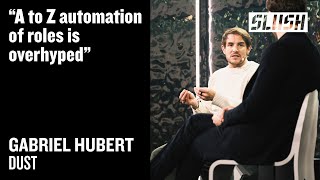
In this live interview at Slush, Sequoia partner Julien Bek talks with Gabriel Hubert, founder of Dust, about the company’s AI operating system that lets enterprises build custom agents. Hubert recounts his founder journey—from an early photo‑aggregation startup sold to Stripe, through a stint at French insurtech Alan, to launching Dust—to explain his motivation: keeping high‑impact employees productive as companies scale. He describes Dust’s mission to give every employee a “super‑power” by connecting large language models to internal data and workflows. Hubert outlines three pillars of AI‑driven productivity: doing things faster (cost‑effective), doing them better (higher quality), and enabling capabilities that were previously impossible. He shares concrete internal use‑case examples: a marketing analyst receiving automated code‑merge alerts about features for a target segment; people‑ops using voice‑note‑driven role rubrics to streamline hiring; and sales‑call transcripts being parsed by multiple specialized agents to surface actionable insights for engineering and product teams. The conversation shifts to the strategic choice of building a horizontal platform versus vertical AI products. Hubert argues that vertical solutions succeed when tasks are well‑defined and outputs easy to measure, but most enterprise work lies in the “messy middle” of cross‑functional coordination, executive‑function, and context‑rich decision‑making—areas where a platform like Dust can orchestrate many agents. He stresses the need for observability, guardrails, and real‑world evaluation of agents that call other agents and operate on ever‑changing data. Hubert identifies the most over‑hyped trend as the belief that entire roles can be fully automated from A‑to‑Z, while the most under‑hyped is deep collaboration through research agents used multiple times a day. He predicts the next frontier will be augmenting executive functions and that future org charts will reflect “agent density” per employee, with performance reviews rewarding agents built and adopted at scale. Finally, he describes how Dust adoption spreads like “heat‑seeking software,” empowering top talent and accelerating diffusion within companies. Overall, the interview provides insight into Dust’s product vision, practical enterprise agent deployments, the challenges of scaling AI in complex organizations, and forward‑looking thoughts on AI’s impact on jobs, structures, and productivity.
Chapters
Sam, Apparently it's finished lunchtime, so apologies for everybody who doesn't have food in front of them.
Yeah, we're going to try and keep it interactive and lively so you can go for lunch energized. Good afternoon, Gabriel. My name is Julian. I'm a partner at Sequoia Capital out of our London office. And today in the hot seats, I'm with Gabriel Hubert, the founder of Dust, which is building the AI operating system for enterprises to build custom agents and deploy them to gain productivity. Gabriel also founded a data analytics startup with his now co founder Stan. He sold it to Stripe and after a few years with Alan, the French insurtech, he decided to start another company, Dust. And so before we start, I noticed something magical about Gabriel. He can work the room like nobody else. Yesterday at the event, he's always in the corner speaking to the most interesting person and apparently he's been doing that for a while. So I wanted to start today by asking him for a tip for our audience on how to squeeze the most juice out of a conference like Slush.
He's saying that because I was talking to you in the corner of a room yesterday. No, but the fun story I did remember, which I guess for the organizers of the amazing conference that Slushes might not be the best advice, but definitely advice I'd give to founders. Thirteen years ago, this is dating myself, I was first time founder and our company was able to aggregate in real time a lot of photos that were being generated on social networks. So at an event I was able to see the VIPs and where they were taking photos, which gave me some hints as to where the speaker dinner was happening. And I also was able to track one of the speakers very publicly thanking the organizer of the event and saying, thank you very much, I'm back on my private plane, going to Dubai or wherever he was going next. And so I took my chances and went to the speaker dinner venue and looked at the very young lady from the restaurant holding the clipboard to say, on the list. I was like, I'm absolutely on the list. Thank you very much, I'm Eric Schmidt. He was like, yes, Mr. Schmidt, you're on the list. Oh, Mr. Schmidt, you're at the VIP table. We'll have to walk you to your table. And so I ended up at the right hand side of the organizer of the event who was like, you're not Eric Schmidt, but who let me sit down, have dinner with very interesting people at the VIP table there. So you should be attending more events that you do not have invitations to, especially if you're founders. And Eric Schmidt is definitely not at any of these events tonight, so take your chances.
Very good. We love the Hustle story. Maybe one day we'll have people pretend that they're Gabriel Hubert before walking into the event. So tell us. I was a founder myself, and it's a grind you've built. Not one, but now a second company. Why do it all over again? And how did the idea for Dust come from?
A deep, deep interest in pain is maybe an honest answer to why. I think what's always been interesting to Stan, my co founder, and me, and we've now known each other for two decades, is that amazing companies tend to do well. When they do well, they tend to grow. And when they grow, the amazing people that joined them tend to leave. And that's sad. I think it's sad. In my mind, there should be a way for individuals, empowered team members to continue to have tremendous impact even as a company grows and complexifies and tends to slow down. I think that the platform that a company should offer its employees to do their best work, be able to make the best decisions, know what's going on, and just operate at maximum speed is something that we really want to see become a reality. Stan was at OpenAI as a research engineer, and in 2021, 2022, became quite convinced that the models were going to get better, but that the complicated problems to solve were going to be around bringing them into the workplace with a few things that were obviously missing for them to get used a lot and help people do better, work faster. And some of those things were around the experience that people who did not have a PhD in AI would, would need to have, and the ability to connect to the way the company does things and the internal data that the company does not want to share. So building that product layer that connects machines that are able to do really smart things and team members and gives them superpowers every day became the obsession. I was getting married and so I asked Stan to take a few months so that I wouldn't divorce before getting married. And then a few weeks later, he was like, all right, I'm testing out other co founders. Let me know when you're ready. And that that was a good time to jump on. So that's why we're doing Dust.
Great, great. So I want to take a quick pulse before we dive in with the audience. Please raise your hand if you're using AI on a weekly basis today. Okay. Whoever didn't raise their hand what are you doing here? Who is seeing ROI from AI?
Okay, who's using dust? See a lot of progress, improvement. This is why I'm excited.
Exactly. Very cool. Who's not seeing ROI yet? Okay, so clearly it's going to be interesting because we're going to talk a little bit about some of the things that have worked with agents so far and some of the things that haven't worked. But I'd love to get your view. You're at the front row of how enterprises are deploying AI. Where do you see AI working today?
I think where it's working the most concretely is in single player AI based productivity with people who are quite willing to explore and to try things out. And to start by asking themselves, why don't I just try and work with a model on the first draft of this? So at a small scale, in teams that I'm excited to chat to, it's always an easy question because you know the answer and it's like, all right, who in the room is using it a lot? Who in the room feels like they start by going to an LLM to get like a first draft? Who feels like it's helping them and all of hands are still raised. And so whether it's code or generating content or translating from something you don't understand, something you do understand. I think the language example is very concrete, but it might also be translating a code base that you don't understand because you're not technical in order to draft a blog post, because that's your job. These are very concrete examples where I think ROI is easy to measure. When you think about productivity, there's really three pillars. It's doing something faster, which I guess from an investor standpoint is the same thing as doing something cheaper, doing something better, which I feel is really powerful for teams that want to provide a better experience to their users but don't want to put up with the cost of what that would represent before AI was available in this format. And the third pillar, which I'm excited about, which is doing something you could not do before. And on each of these pillars, I think that where we're experiencing ROI or where our customers are reporting ROI with us is that yes, we can do things faster, but it's not necessarily the only focus for them. Yes, we can do things better. And this is what's really exciting to me because it speaks more to what I think the future of agents might look like. We are doing things we could not do. We are having parts of the company collaborate that did not collaborate. We are having teams be able to make very contextualized decisions that they were previously asking to start a meeting or to get new people in the room to give them more information for. And I think that third pillar is increasing in importance in helping leaders at companies really try to start designing how they want to rewire the inside of their company. Because Dust focuses mostly on internal use cases. And so at a, at a, at a, well, at a satisfied customer, like a typical scale up, 700 employees will have 90% of the entire company using Dust daily. But they'll be using very different custom agents.
So what do they use for instance?
Well, so the example I gave around the code base is one that I know the marketing team of one of our customers came up with. I hadn't had the idea and I think it's brilliant. And so this person on the marketing team is responsible for some of the content that they send. On the segment that she was working on, she was working on the migmarket segment. She does not know how to read code, but basically decided to point an agent to all of the code merges that were happening and asked that agent to notify her when part of the merge was around a feature that might be interesting to a mid sized customer. And she detailed in a document, this is what a midsize customer is. This is what they might be interested in. This is the Personas that I'm talking to when I'm writing this content. And she started getting a steady inflow of notifications. You know, PR 125 has been merged to main. That's the bit she didn't understand. But then she was like, oh, I'm now getting an explanation of the code base without having to go and tap an engineer on the shoulder. On the people teams of some of our customers, we're seeing people, business partners be able to say, you know, I'm, you know, they're talking to hiring managers who want to hire 10 new roles but don't have the time of the day to give them details on what they're looking for. And it's like just throw in a voice note what you think this role should look like and I'll do the rest. And that voice note gets translated into a rubric which fits with the company's hiring policy. The things that might match in terms of level and experience based on the role in the department and a job description that's drafted. And these aren't necessarily like gains of like 2000% ROI for one single person, but they make a Concrete difference on two fronts. One, they actually do help them save time and get a better outcome. So I think the ROI is positive there. And two, they're onboarding on this long journey of using these tools day in, day out and upskilling on what I believe is a core part of how everybody should understand working with machines is going to look and feel. The last example I'll give, which also tries to bridge different parts of the company together, is sales call transcripts. Everybody is like excited about transcribing their calls. I don't know how many AI note takers you have popping up before a call. It's three, it's four, it's five. You don't know which buttons to click close on, but essentially that transcript lands in your inbox. I think that's a waste of opportunity. And so at a company using Dust, that transcript might be attacked by 10 or 20 different agents that have very specific goals of the information they might be able to peel off and then bring to another part of the company. So if I'm an engineer starting on a new project, I'll describe my project in layman's terms and an agent will then be dedicated to trying to understand every single call that's happening with customers or prospects at the company. Is there something that was said that I can put directly in the GitHub issue or the Notion page or the Google Doc of the engineers that are starting to design this feature and collaborate on what it's going to look like? Can I create a link to the part of the interview that so that I have a name, a quote, an explanation of how people are going to perceive value? I think this is more of what companies need to be thinking about the information that's already being generated in their companies and that could generate tremendous amounts of value if it was propagated to the right place immediately?
Yeah, you kind of hinted the answer to my next question, but I'll still ask it because it seems like right now there's a lot of hype around vertical AIs. I think we're running out of jobs to try and automate. First it was lawyers with Harvey, then it was customer support with companies like Sierra or Lovable for coding. So a lot of players have gone vertical and have done quite well. You've taken that approach to go more horizontal. And so help us understand a little bit what give you intuition that this was the right bet to make. And how do you think this is going to fare going forward?
Well, first of all, I think those are amazing businesses. And I think one of the reasons they've done so well on a revenue standpoint is because they have a clear buyer and a clear job to try and augment or replace. We can discuss the nuances. And those jobs tend to be quite formalized in how humans were interacting with machines with outputs that were well understood. So there's an easy way to define inputs and an easy way to measure outputs. And when you have people who are charging you thousands of dollars per hour to open a book, read what it says in the book, copy what it says in the book in an email, send that email to you to say, this is our advice, then you tend to be interested in seeing if software could do a better job of that. Same goes if you have emails from customers asking how they can reset their password and you've realized that day in, day out, you can say, just press the reset password link. Here it is. Let us know if anything goes wrong. These are very well codified verse. What I think the future of work is going to look like is much more of the messy middle, and not necessarily just these verticalized situations that are again, replacing single player situations, but more the multiplayer version of that, where the company has to coordinate and collaborate around the complex problems that might require days, weeks, months to solve. And that's where the productivity gains that I think companies are going to be excited by in the future are is. It's easy to measure the productivity gains of ticket deflection per hour, but real productivity in a company that's 2,000 people is making an important decision in March, not in August, or deciding to reallocate millions of dollars that have been put on a project to another project because the first one is going nowhere. I'm really convinced and excited about the leaders that are realizing this now and starting to deploy very horizontal solutions to allow their teams to start building those bridges. Because increasingly, the employees that are going to ask for those tools tend to be more curious and high performers. And I think that's one way to start building the future of work with your team members.
Yeah. Okay, so that's interesting. So is it fair to say that right now we've seen a couple of these companies grow from like 0 to 100 plus some 200 right. In a span of a year that are going after like very specific jobs. But it seems like some other jobs have not been seen this level of traction at all? Is it because of this lack of distinction between function that prevents companies?
From many companies, you have some people whose job is very easy to explain and many People whose job is actually a sum of things that are quite hard to explain.
That's right.
And they bring value to the company they work at, there's no doubt about that. But describing to a machine exactly how they bring value is sometimes a complicated task. So automating that person doesn't really make sense because if you automate the top three things they do every week, you might be missing out on a lot of the value that they informally bring. And so, yeah, one of the reasons I feel that we haven't seen the same level of penetration or the verticalized plays for a rev Ops person or a chief of staff or one of those super handy project managers that ends up always being in the know and always being ahead of the game or, or even to a certain degree, product managers that tend to spend a lot of their time coordinating very different teams is because they do a great job when they have amazing context. An amazing context at a company level is very hard to build and to maintain in real time. For those who've worked at a company with more than 50 humans in it, it's very clear when you start having situations where Slack says one thing, Google Docs says another thing, the code base says a third thing, and it's anybody's guess who's right and who's wrong. So I think thinking about machines that are going to be able to understand what these data sources are telling us, what we think is actually the truth, where we should replace the bits that are wrong, that's more of the work that's going to be useful to replacing these very transversal people. And I think we have a long way to go for that.
That's, that's interesting. Yeah. Because my next question was going to be which job do you predict will be the next power use case for AI? But it seems like, you know from your answer, it's less a job, but it's more these jobs that have messy definitions and that kind of span across functions. Is that fair to say?
I think the executive function in a company is the next frontier. Being able to give machines more insight and eventually more control on what we consider to be very hard to automate or really the CEO's job, or really the manager or the head of division's job. They're essentially synthesis jobs. They have to take in a lot of different parts and a lot of different constraints and make imperfect decisions that align with the company's strategy and take into account the latest data we have and aren't always correct. And I think that everybody that is Doing a job that isn't purely task based has part of that executive function in them. So I think that's an interesting next frontier.
And so now we just had Gemini, you know, top the benchmarks in terms of intelligence. I still can't reconcile how do we get PhD level intelligence on the one end, and then on the other, you talk to leaders like in the room, and they still prefer hiring human interns to perform certain tasks. What do you think is missing until we see that real transition occur?
Well, first of all, I think most people's jobs aren't really benchmarked on a test that looks like PhD level intelligence. I know a lot of people who have a PhD, but just trying to wire two pieces of code together most of the days they spend at work. So there's a bit of a mismatch for most people reading the news between a benchmark that somebody has scored first on and how their work is changing in real life. That's one consideration. By and large, I think the missing blocks that are critically needed to deploy more of this intelligence in companies is a set of observability tools on messy decisions. And I'm not talking about evaluations of LLMs on a single path and a single pipeline. I'm talking about evaluations of agents that might be calling other agents while the data sets that are below them are changing, while the customers that are telling them to do things might be wrong or ill intended. And it's really about getting closer and closer to reality on the sandbox, the playground that these agents are able to operate in. So observability, guardrails, and to a certain degree, the data, the context, the real live truth about what's going on and what we're trying to solve for.
I want to touch on jobs being automated and what that means for the workforce. It seems like there's been a fear that all the jobs will get replaced, but it seems for every job that gets deprecated, I think we see less developers, we see new jobs kind of rise. And right now, the title that's on everyone's lips is for deployed engineers. Sorry if there are some in the room. What do you think of that role and why do you think it's so prevalent in companies these days?
I think for deployed engineers right now, the glue between products that haven't quite found market fit and users that don't quite know how to best make use of them. And so in some cases, they're very justified. I guess there's a broad spectrum of FDEs. One distinction I Like to ask is, are they writing code on the customer's code base or are they writing code on the products code base? Because in some cases they're really just deployed engineers that are furthering the roadmap while spending time in a customer's office, which I think is great. And in other cases they're really trying to bridge the gap between a product and the customer's needs. And that sounds a lot more like the classical service models that we've seen. I think it's a fancy new way of describing the fact that you need help, you don't have the talent. We'll put the help and we'll get it done. What's exciting is when they actually do contribute to the central product by learning from customers concrete use cases.
Interesting. If you had to make a prediction, what do you think are the jobs that are overestimated right now? And what are the jobs that are underestimated right now? And how do you see that evolve over time?
Well, I think we're a little too gung ho on full A to Z automation of most jobs, but I don't necessarily believe that that means we're not going to see a lot of tasks getting automated. There's a bit of a difference between saying I'm going to automate a job and I'm going to automate a bunch of things. I think we're going to do really well on that and I think it's going to take a longer time to do that. And that's actually one of the reasons I'm really optimistic about the people learning about these tools more aggressively in their day to day. Because the best way to get promoted is to automate the tasks that a machine can already do. That's not going to get you replaced, that's actually going to get you promoted to being AI ops lead for your company. Because if you're a leader of a company, what you need to understand is what are my people doing, what am I paying them to do? And if the thing they're doing could be done by a printer or a machine or a piece of software, why are they not giving it to that? And so I think that the distinction between jobs and tasks is something everybody should be really spending time on and elevating their day to day to be the part of their job that cannot be done and reduced to tasks.
Yes, I think that's spot on. In a competitive marketplace, resisting change is the worst way to proceed. Leaning into it is definitely the way forward. And tell us a little bit, how do you Think the org structures of companies will evolve. I read something that you posted about agent density per employee being the best predictor of productivity inside a company as opposed to just pure headcount. How do you think that? Can you please unpack that a little bit and explain to us how you see the future organization look like in a human to agent world?
I think we're all going to be managers. We're not just. We're just not all going to be managing.
We're not the employees of the agents.
I still see us as doing most of the decision making but yeah, I think org charts will essentially reflect the fact that in more teams there's going to be a need to do the thing and a need to tell the machines to help us do the thing. And I really believe that business teams are going to get better and better at telling the machines how to do the thing themselves. So to me what that looks like is the trend we've already seen with software developments over the last 20 years where we have this one job that is really good at talking at machines we can start seeing happening to design or formal interfaces with software. We talked about the legal tech. I just think it's just going to go to all the jobs. So an org chart in the future might be that for a business team there's a certain level of seniority under which you're just doing the tasks and understanding the context and a certain level of seniority above which you're maybe still doing the tasks but upgrading the software that is helping everybody else do a better job. I really hope that performance reviews in a couple of years look like I built this agent. It's used by 200 people at the company. I'd like a raise please. Thank you very much. And mic drop. And I think that's going to get really concrete quite quickly in teams where obviously the value is very easy to measure for the company.
And so we partnered with you at dasceed and then at da and I remember vividly a call we had with one of your customers saying that once they implemented Dust, it starts spreading like wildfire. That reminded me a lot of the early days of Miro, the collaboration software tool. And so I'd love for you to unpack a little bit what happened with customers that where it does spread like wildfire? What can people here learn about adoption of agents inside their companies from your experience at Dust?
One of our customers said I love the quote is like Dust is heat seeking software for empowered team members. And I love it. I think it's Exactly. What we're trying to build is like, if you let something spread and the way people use it tells you about how iterative they are, how exploratory they are, how creative they are, how confident they are to try something generally that correlates really well with performance. So when I go and meet CEOs of companies that use dust well and I give them a list, I'm like, hey, what do you think about this list? They were like, those are amazing people. Are you going to try and poach them? I'm like, no, no, no. They're your top builders on dust. And I think it really matches the needs that leaders see in having the ability to retain top talent. What we were talking about at the beginning of our talk, keep the most impactful people who are generally really empowered, who know these tools can help them, who want to be able to use them and let them rip with what they can do.
Interesting. I want to ask. So it's very common for us to overestimate what can be done in the short run, but underestimate what can be done in the long run. Andrej Karpathy said that it won't be the year of agents, but a decade of agents. I'd love to have your take on that. And what do you think is completely overhyped right now versus the things that you think are underhyped and that people here should pay attention to?
I think the most underhyped part is deep collaboration. I think everybody should be using deep research agents multiple times a day and understanding how much they can get done. And I think the most OverHyped is A to Z automation of roles, because I think we're missing a lot on how people bring value to companies. So if I had to place my bets there, that's. That's what I'd end with.
Amazing. All right, Gabriel, thank you so much.
Thank you.