10-Acre Abundance: Permaculture Homestead TOUR (2022)
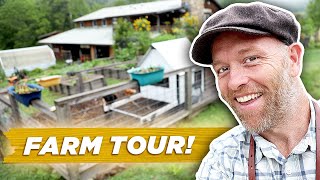
In this extensive on‑site tour, Victor Justin Rhodes walks viewers through his 10‑acre permaculture homestead, showcasing how he achieves year‑round food security and ecological resilience. He begins with a massive, multi‑freezer food storage system that uses a CoolBot‑controlled insulated box, extensive canned goods, homemade dairy, and frozen meat inventories. He then tours the front‑yard “bulletproof” herb garden, raised beds, mulching with grass clippings, and the principle of placing high‑use zones near the house. The narrative moves to animal integration: deep‑bedding chicken runs, rotational grazing of pigs, cows, sheep, and turkeys, and how animal waste is cycled back into the garden as compost. He explains water and energy infrastructure—including a central boiler heated by firewood, a Cummins generator, a Kubota tractor, and wastewater reuse for irrigation. The video details soil‑building practices, silvopasture conversion using pigs to underbrush, and the use of plastic silage tarps for weed control. Throughout, he emphasizes permaculture principles such as stacking functions, proximity, and zone planning, while reflecting on family legacy and offering a free Intro to Permaculture course.
Chapters
Let's start where it ends. Unbelievable abundance inside fridge, freezer, freezer, fridge, freezer, freezer, freezer, freezer. And that's not all— another freezer, well, just under the chicken mask, and a giant walk-in cooler. Shall we start here looking inside these things? We've got pasture seed, Rebecca's seed book, 5 inches, 6 inches thick of all kinds of seeds. We don't grow absolutely everything. An Azure Standard Hall cheese Summer sauce, jam. Look at this block of cheese. And don't forget the maple syrup. Lemons. It's hard to grow lemons in North Carolina. Kombucha. More cheese. This is homegrown milk. What we're standing in is a custom-built insulated box. We have a regular AC. Regular ACs don't go below 60, so you have to get this thing called a CoolBot, and it tricks it. It thinks it's at 60, but really it's 36 in here. Looks like we need to clean our filter. That was cold. All right, y'all want to see what's under the chicken mask? The chicken's breast meat that has been cut up. We have legs and neck for making stock. Whole birds— look at the size of these birds. We have some turkey. Oh, we have the dark meat cut. This 120 cubic foot chest freezer will hold about 100, 120 chickens. We normally eat about 200, 250 chickens a year. Some things of note that Rebecca has done: she has canned our own tomato juice or tomato sauce, and it can be stored at room temperature. Stand-up fridge, dedicated fridge, just thawing out meat for later use. We have our homemade yogurt in here. Next to the freezer, a bunch of Yetis. We're the crazy food growing people. When we travel, we take our food with us. Inside this freezer, Bandy on the top shelf, used sheep we had to cull, raw dog food. We got an assortment of meat. Do wish I was a little bit more organized about this I wish it was one animal in each freezer, but that's not the case right now. Pork, pork roasts in here, ground pork in this one, bones in the bottom, bones and fat. Boom. Like to think this is the assortment freezer. Ice packs for cooling off the milk and fish. Fish is the only meat that we do not grow on the farm. Otherwise, 100% of our meat comes from the farm, and that's all I eat, so that is saying something. We got several seeds being saved up here. Oh, we've got some colostrum frozen from the cows. Boom. Freezer fridge 4. What do we got? We got some frozen bananas, we got some broth, we got some— oh, we got some cubed steak from the farm. Cow's tail. Anybody like cow's tail? What's in the 7th appliance? I imagine you guys can guess. Chicken! Right next to the Legos, appliance number 8, freezer. Just harvested a beef, some of it's in here. All the steaks. We have more pork belly, fat, skin. More steaks down here. Beef fat, pork fat. Right across the aisle, looks like this is just our Azure Standard. This was the pork cut. It was cool because it was like the grocery store. You could come out and be like, go to the pork freezer, go to the lamb freezer, go to the beef freezer, go to the chicken freezer. I doubt this is just pork. Maybe it is. We've got fatback, pork skin. Oh, I gotta make pork rinds. More pork fatback. Okay, yeah, we're getting behind on our pork fat. That's the freezers. Let's go see where it all comes from outside. Wish me luck, Beck, going on the tour. You're gonna be great. Let me take the baby. Cousin Lauren's got the baby. Before we go, mucho potatoes, mucho tomatoes. That's just a remnants of what once was, and lots of squash, cucumbers, and a beautiful pepper. Bit of homegrown raw dog food right outside our door. Zone 1, the kitchen garden. Hey, get out of there! Get— hey, hey, hey, shoo, shoo, shoo! Hey, hey, hey, hey, no! Dang cats breaking the beautiful one's heart, taking dumps in it. Come on! Come on, this isn't just any old regular homestead. This is a very abundant homestead, and it's because we're using permaculture principles. The first one we're going to use is grow right outside your door, right here. What is right here? Oh my goodness, this is a bulletproof garden of herbs. I'm not even going to begin to tell you the names of them. Rebecca knows the name. You can see the garden tour in yesterday's video if you want. Just absolute abundance, very low maintenance. That's another thing in permaculture— mulch. If we look to nature as our guide, which is what we do, we understand that she is very modest and wants to be covered. And if we don't cover her, she'll cover herself. We've put down wood chips. As a result, there's very few weeds. It feeds these plants. This just jams right next to the Bulletproof Garden herb garden. We've got raised beds. Kind of ugly right here. Let's get this out of the way. This is a working homestead. We did raised beds in here because we're at the bottom of the valley. Not where we would build a house in permaculture. We would build a house 50 feet up so we are out of the frost line. This was already built, so a flood-ish area down here at the bottom of the valley, so we build raised beds, get the soil up off the ground. We got a heat-tolerant lettuce. We've got peppers. Notice we have grass clippings. There's a big hype around wood chip gardening, the Back to Eden method, but a lot of people cannot get wood chips. And wood chips don't break down very fast. Grass clippings— most people can get grass clippings. Breaks down really fast, turns into nitrogen really fast. Pleasure to use. It's easy to plant down in there, unlike wood chips are hard to move around. It just retains the moisture. I can't say enough about grass clippings. Most everyone has a yard and they can mow it and rake up the grass clippings, or they can get a grass clipping catcher on their mower. Notice the chickens right next to the yard. I'm gonna get to that in a second. Give me one second. That's the most exciting thing about this yard, I think, which— this is a front yard, y'all. Get the homesteads out of the backyard, get them right into the front yard. Another bounty. Here's remnants of what was in here. We've got, uh, we had cabbages, mucho cabbages. It's being flipped. I mean, it's spent. We'll be planting other things in here. Well, I think Rebecca's got something coming up. You can harvest and then just plant. All right, we'll talk about the chickens. I grabbed some weeds. Boom! It's never been more fun to weed. Notice the proximity of my chickens to my garden. They're right next to each other. So I can throw the weeds out, so I can throw the extra produce out right into the chickens. In turn, they can turn what they don't eat by stirring it, scratching it. And on— because they're on a deep bedding, they're on wood chip, they're turning, they're fertilizing on it, eventually turns it into compost underneath. And we can grab that compost and feed the garden. So the garden feeds the chickens and the chickens feed the garden, so we might as well put them right next to each other. Once a year in the spring, we'll go through with rakes and shovels and pull the wood chips harvest our compost in wheelbarrows, put it into our beds. They absolutely jam. More flowers. I like how she mixes up flowers with veggies. It just looks great. Persimmons! Unbelievable bounty on this persimmon tree. We pruned it for the first time this year, and buddy, it is thanking us for it. There's hundreds of persimmon fruits on here. Now this is a trellis, right? She's got her tomatoes and cucumbers. Coming up and over. Soon we'll have a tunnel. Let's dare us find a weed. Okay, let's call these some weeds because look, we skimped on the grass here for some reason. Pleasure. Easy to pick and just throw it to the chickens. You're welcome. I shouldn't forget what is now a morning glory patch, but I think some strawberries are in here somewhere. In its glory days, in the hot sun, it is definitely a thriving strawberry patch. The beautiful one tolerated my rudimentary but highly efficient chickshaws for years. But once we started doing this in our front yard, she's like, hey, you think you could get me a pretty coop? What do you think? You think we got her a pretty Shaw? Silver tin roof, black framing, chrome wheels, little window. They gusta? Well, let's see. Well, they like to jump in there and poop in there. They also like to give us eggs. Notice chickens in a stationary run mobile coop, they poop half their manure load. See, they poop half their manure load at night. So look, look, look where we were. So we're spreading the manure love. It becomes holy chick— it goes from evil chicken poo to holy chicken squat by just keeping it moving. They'll stir and till this in with the deep bedding, and that makes compost. Guys, I've seen too many chicken runs on just bare ground. That's nasty. Can you say that's nasty? Put some deep bedding in there— grass clippings, wood chips, wood shavings, leaves, coconut coir, anything that can absorb that manure, paper shreddings. And then your chicken run goes from a disease nasty fest to a compost fresh sanitary making machine. That is my 1,300 square foot yard. Remember, we start right outside our door. There's absolute abundance. And really the typical American front yard. Shall we walk down from our yard? Boom! Look at the greenhouse. You come down from the garden into the steps, but right here, zone 0, in the house, we store our feed for our chickens and our pigs. I think it's super important to have the barn, so to speak, right there, as close to the house as you can. In this case, it's in the house. Because there's no leaving the house, going to the barn, then going doing chores. There's just going downstairs to the barn and then going and doing chores. Not much going in the greenhouse right now. This is more for spring use, but we do have some, uh, squash plants we want to set out. Right next to the greenhouse, jam and comfrey, but a perennial asparagus. This is asparagus, mature. And strawberry garden. Those are companion plants. They do well together. These are always planted here. We don't have to plant them year after year. Yes, it's close to my house. For whatever reason, that, that area is neglected, so we put it in like a zone 2-ish, strategically next to the garden. Let's say you, you're cleaning out a bucket, all right, and you've got some wastewater here, some gray water. Just spin around with me and you've got water— well, you've got water for your comfort. You'll notice on the permaculture farm everything is connected. Everything tries to build off another. A garden next to a wastewater spot so that you can easily water it. We got the asparagus strawberry garden here, the greenhouse up there, the front yard up there, my house, my bedroom right there, and we have pigs. Some people grow gardens in the backyard. Well, those tend to be pretty. I put them in my front yard. My backyard, I grow pigs. These are our breeder pigs. They mostly live on skim milk, food scraps. We do supplement with some grain. See the food scrap in there? They've pushed this out of there. That's a mama pig, hadn't got pregnant yet. What's wrong with you? Why aren't you getting pregnant? You gotta get pregnant. She's got one job, and that's to get pregnant and have babies. Looks like they're about out of water in this nipple waterer. I use these Garden Rite hoses. They are lead-free. Stainless steel tips, and then I like these brass shutoffs by Dramm. Indestructible. A lot better than like a nozzle. Too many working parts in that nozzle. Let's get their water going while we talk. This is a pole barn. This is as close as I'm getting to a barn. Notice there's no walls. We don't need any walls. This is where the cows stay in the winter on deep bedding. And sheep in here. This is a mama pig that does her job. These are 2 of her 8 babies. Good job, lady. Good job. Since we got growing piglets in there and we had a nursing mom in there, we do put an automatic feeder in there, which it looks like it needs to be replaced. And let's check their water. Uh, it's 2 is almost empty. Pigs root up this deep bedding and quickly, more quickly make it into compost. We can spread this out on our fields. I'm gonna leave that water, guys. Remind me to turn it off, please. I have forgotten to turn that off and not notice till the next day. Oh, right here underneath our room, right next to the pole barn. Booyah! 100% of our heat in the depth of winter is from this central boiler and firewood fuel. From our farm. We need no fuel off farm to heat our house. Heats 2 hot water heaters and gets into the central system and heats our entire house through a vent thermostat adjustment. That's amazing. Right behind the pigs, the reason the roof is so tall, so we can have lots of hay storage. This area filled up is, I don't know, a year at rest of hay for the cows and the sheep. Let's talk as I head over to the crop gardens. There are only two ways to keep animals. If you're going to keep them in one spot, then you must do deep bedding. That's what Joel Salatin would call vibrant decomposition. The other choice is to move animals regularly. For cows and sheep, every day. For a goat, once a week. For chickens, once a week. For pigs, once a week. No other options. Sick, holiday, those are your choices. Doesn't matter. I think we're gonna get some scraps. Let's take those to the pigs in a minute. You want to be happy? You want to be happy? Let's take some food scraps to the pigs. I am so stinking proud of the beautiful one in her garden. And the winter, what was here, guys? We had chickens in here on the wood chips, on the deep bedding, because they were going to be in one place. They were out of the rain, out of the snow. A little warmer during the day because of the greenhouse. And then when they go out in the spring, we plant heat-loving, dry-loving crops like tomatoes. Do you guys see the bounty in here? This is absolute abundance. Push comes to shove, we can easily survive— not just survive, but thrive on our homestead. This is where the pigs were. We had a set of pigs over here, a set of pigs over here. The deep bedding in there was so compact, we just planted right in it. But it didn't seem to have no problem. Still grew. It was an experiment that worked. We kept our cages up for our pigs for next year. Why not just use our cages that were pig control for trellises? The tomatoes are climbing them now. All this stuff is super mobile. These— we've got these lines on retractable thingamajiggers, I like to call them, and you just cut it off and just pull out more next year. We got beans growing. She's gonna hit the roof. Did she hit the roof? She's gonna hit the roof with those tomatoes. Guys, this is a huge roof. It's probably 12 feet. Look at all these beans. Look at this bounty. The chickens and the pigs helped us do this. This isn't just the garden. This is an animal garden miracle. Oh look, we had some volunteer squash. Pigs love that too. There's our high tunnel. There's our crop gardens. To the crop gardens in a second. But I remembered, we're gonna go turn off the water and feed these pigs this. You can cut these big squash-like things up for them, makes it a little easier, but giving it to them round gives them a little something to do all day. Doesn't take them long to figure it out. Well, look, just in time to switch this out. Nothing more pleasurable than watching waste be turned into bacon and sausage, vegetables turned into nutrient-dense meat. Let's show you the crop garden while that fills up. And guys, we still, we still have Luchador mobile rampen, we have the sea monsters, we have the T-birds, we have the cows and the sheep. Still lots to go. Let's check out the crop garden. 1, 2, 3, 4, 1,200 square foot beds, almost 5,000 square feet. The sweet potatoes growing here, and I do proudly, proudly— I was hesitant at first— plastic silage tarp. We're using that to cover on a grand scale. Sure, it's going to be with us 450 years, but it's going to be with us 450 years, and this is food we don't have to truck onto our farm. You put down this silage tarp and no weed grows in the interim. You see, we have our compost down We have our beds built. Worms absolutely love it. There's our little tiller right there, our little tiller and fertilizer going to town. I was torn, is this the right thing to do, using plastic? Until the very first time I pulled it up, countless worms and worm casting, and I was like, plastic is my friend. Right next to the sweet potatoes. Hey, multi-purpose everything. I'm standing on mowed lawn. Can you see? It's not perfect. But it's keeping it at bay. We have a rabbit who loves to eat, eat, nibble on the grass. Look, she's doing it right now. She's being tractored around in this rabbit tractor every day and keeping weeds at bay around the garden. Multi-function everything. Another permaculture principle. The rest of this, our potato garden, we've planted our potatoes deep down. This is the second time this year. Weeds are coming up, mucho weeds. Because we just built these beds, disturbed the soil. Come on, come on, we got some rain. I encourage you, I'm cheering for you, I'm cheering for you. Why? Because I'm gonna burn it all, burn it all while the potatoes are still safe in the ground, beginning to sprout up, letting these weeds come to fruition, and then burn it with the flame weeder. Onions, mucho galore. Acorn squash, butternut squash, squashes that can be stored inside saved for 6 months, up to 6 months, just regular room temperature. Then to give you guys perspective of where we are: crop gardens, high tunnel, pole barn, house, side yard, and then up there, that's our front yard. That's where we started. So we've almost made a full loop. We can climb up these rocks. Aren't those beautiful? Pulled those out of a ravine up the mountain. And we have a nice front yard. Little side hustle here in the side yard. More persimmons. Oh, forgot that persimmon too. So we have 1, 2, 3 persimmons. They— those naturally do well in North Carolina. Also the pawpaw, native to North Carolina, really wants to grow. Raspberry patch. Not the prettiest sight. That is off-road diesel. It fuels our Kubota side-by-side. Our tractor, our Cummins generator. Oh, you want to see that? Backtrack a little bit. We love the grid right now. It's just super efficient. We're spending— if we were to buy everything that we needed, we would spend overwhelming majority of our money on food. So that's what we tackled first. We're getting off the food grid. But right now, we love the energy grid, and we love our Cummins backup. That thing will run the entire farm. Perhaps one day we'll be off-grid, but right now it's still super efficient. And this is our backup. This is our fuel backup for the generator. It fuels our Kubota tractor, and people deliver this fuel. We don't have to go and get it. And we're back at the Bulletproof Garden at the front yard. Well, call the Inquirer. Remember to turn this hot water off twice. Now notice everything— a lot of this is very close to my house. That's another rule of permaculture. We're thinking about proximity. You want to put the things that you visit the most close to your house. Why do you think the front yard has the kitchen garden, has a chicken posse? Because theoretically— and we don't because we bulletproof that fence— but you have to put out chickens, you have to put them up every day, you at least go check their eggs every day and feed them. Put them in the front yard. Put chickens as close to your front door as socially acceptable. Pole barn house right behind us. Small animal pasture. We have a little soccer field area. You can see our posts for when we have— guess this is our big soccer field. We have a little one behind the, the yard. But as Joel Salatin would call it, you want commas on your farm. You don't necessarily want to have to go somewhere to have recreation and fun. Why not— why join a soccer league? Why put your kid in an individual soccer league so they can go be by themselves with other, uh, friends away from the family? Why not the entire family play soccer together? Pop's tree, my late father, what is it going on, 3 years gone? Well, we have that tree and remember it's in him. And thankfully it's jamming. Guys, I've been on this farm, it gives me chill bumps already just start talking about it. 90 years. We're 10 years away from 100 years. I'm tearing up just thinking about it. I didn't know my grandpa, but I'm communing with him right now because he walked and worked this land. My dad is gone. I commune and fellowship with him as he walked and had cows on this very land. They saw the sights, they heard the sounds, they had the frustrations. I'm fellowshipping in that right now. And we have a tree planted in their honor. This land is more than our Mother Earth. It is that, and it is precious for that, because she is providing for us. She is providing for us, an ever-consistent mother. Is she a mean old— sometimes? Yes, she can be difficult, but the beautiful thing about Mother Earth is that she was here before we came and she'll be here after, and she'll nurture us and care for us, and that is beautiful. This land, not just Well, not just causes us to survive, but to thrive. And secondly, if you hang in there, and if you get rooted, and many of you, you're starting anew. You are being the change. You are leaving the city and going to the land. You are my Grandpa Henry. That is a very special place to be. You are starting the legacy. It begins with you. You don't have to look at me and say, oh, Justin's a unique story. He's the third generation, his kids are the fourth generation on the farm. No, you are the unique story because you get to begin anew. You get to start afresh and create something that wasn't there. The land is special in two ways, and that's why we want to take care of it and nurture it, because she is our provider. We want something better for our children or even the people that come behind us. These turkeys aren't just anywhere. They certainly aren't on the most productive place of our farm. They are in a pasture that for whatever reason struggles to keep up with the rest. It just doesn't grow as fruitful, although that's hard for you to believe because you see all that clover in there. This is, this is some of the richest pasture I've ever seen, but still we put them on the worst parts of our land, and they move around in here. Look at this manure load. Look at this manure load. Beat turkey or not, these guys are making your farm better. These fat T-birds don't need much for protection. It's just a pig net. You step right over it. Open walls. The turkeys— this is a shade cloth. Lots of manure right here. Just move this a length. Spread the love. The house, the T-birds currently, the sea monsters currently. We'll go there in a minute. Let's go to the luchadors next. On to the most underrated homestead animal on the planet— the sheep. 3/4 of an acre right here, one 16x16 pen. Easily raise 4 sheep a year without hay. Maybe a little bit of hay. 2 sheep without hay, 4 sheep, a little bit of hay. They are moved along. Every single day, everything they need in here is here. They have water, they have shade, minerals, they have protection, they have this cage that's on wheels that can be moved every day. You guys happy? I guess you're happy. You guys want to see something special? Okay, this is where they're going. They haven't been here in a while. This is where they've been. Look at how they mowed this, this strip going down through there. And then this is where they've been recently. Isn't that beautiful? You can't see it from here. But over there in the woods, a creek, so we can easily fill the water. Luchadors, sea monsters, here we come. Like the T-birds, sea monsters. Sea as in Cornish Cross, uh, monster because their incredible growth rate. They are in the fertilization plan for the cows. This is where they were 2-3 days ago. It's disturbed. But look what happens when it recovers. This is a week ago, a week and a half ago, 2 weeks ago— you can't tell— 3 weeks ago. Then you can start telling because this patch here where they've been is greener than where they haven't. Mobile waters are key. Mobile feeders. Mobile housing. No walls, no floor. They're protected by this shocker knot net from predators, land predators. The guard goose— look, she's guarding, she's looking up, protecting them from aerial predators. They got lots of room to roam. This is easy to move. You don't need any dollies or anything like this to move this. We move it 3 spots inside this net, and then we move the net. Run Garden Right hoses from our water supply line. Water sources are at every 100 feet. On the T-posts. Water is key. And a lot of times people would ask me, do you have any regrets? And for the longest time, I really didn't have a regret. The only regret I had was that I didn't start documenting earlier. Guys, we've been doing this 15 years. I've only been documenting for half that— 6, less than half. The other regret is water. I didn't prioritize the water off the land. Guys, I just found— where is it? I think it's up this ravine. I just found a spring way up there, a spring that starts on our property. I could have been gravity water feeding our livestock— well, even our house, we're on a well— for years. But I can't look back with regrets. I have to say, what's the best thing I can do moving forward? Another thing is access. I didn't establish access. You want to be able to access your entire farm. You want to be able to see what is available, because it turns out I've been sitting here thinking, oh, we don't have enough pasture. But it turns out on top of the mountain there's a nook up there, over above our— the old barn. There's a cranny over there. We can have nook and cranny pastures all over this farm, especially if we're willing. Oh, I should show you what we've done with forests to turn them into pasture. Let's go see that next as we go talk— let's go talk about pigs and how they're helping us create more pasture. See, we haven't seen them yet, but cows are the centerpiece. Everything else is working to support the cow. So we're going to go show you what these pigs have done. Our biggest need for cows is more pasture. We have— we have to import hay, but maybe one day we don't have to because we can have more pasture. Let me go show you how the pigs are helping us with that. Pigs, you aren't just for bacon and sausage. Ask yourself, where can plants and animals do the work of the farm? This is where they can do it. Look at this disturbance. Yes, it's disturbed, but it's time. We're going to be moving them on, so it's not going to be too much disturbance. But look what happens. Look what happens just right next door. What was not here— I swear, what was not here is here now. Grass, mucho grass coming up. They have tapped into the ancient seed bank, and because they underbrush in there— who needs goats when you got pigs? They taste so much better, they're so much easier to keep in, they're so much more hardy. Look, look at the underbrushing these did. You don't need no devil eyes, we got pigs, we got grass coming up that wasn't there. We can actually walk through here, and we've had the pigs on a weekly rotation through a 1-acre paddock. Look at this. We're going to come through and get these little trees. We'll keep that beauty. We'll keep that beautiful oak tree. That'll be a rub for Stud Muffin, our bull. That will be shade for our mama cows. That'll be something we can milk under out on pasture. Okay, so this is then 2 weeks ago. We can actually get in here with our chainsaws and machines to clear these less desirable trees. Oh my wordness! Oh my goodness! 4 weeks, boom! Look at this, look at this! So imagine what's gonna happen when we clear in here and the sunshine hits. This is gonna explode with growth, and we haven't planted a single seed. I can actually see through this. Do you guys see the potential here? This is acreage that we did not have. If you guys cannot see the potential here, I'm gonna show you the potential. I'm gonna go to a place that was this, that we used pigs, and then we cleared, and now it's a silvopasture. I can't wait. I can't get there fast enough. Hang tight. We're revealing these beautiful rocks up in here. Where's the dramatic music? Cue the dramatic music. Where we're going was once this thick. See the vision? I've kept the more desirable, straight, hardwood, fruit-producing trees, nut-producing trees. This is just amazing. All the animals like it better. The cows like it better. Pigs, sheep, chickens. Everybody likes it better. There's some shade, but the grass still thrives. 30% in trees. All along this, this used to be thick, thick forest. Now it's lush silvopasture. As Joel Salatin teaches, foresting our pastures. So we will plant trees where we don't have in our pastures, and then we are pasturing our forests. What it is now, what it will be. And for any of you carbon junkies, "Oh, you're destroying the environment. I can't believe you're taking down trees." There will be more carbon produced under this tree now that those trees are gone. Why? Because this grass grows, the cows cut it, it decomposes, it feeds the soil. More carbon will be released over time. Because of the cycle. Why do you think the prairies are so rich in soil? I've told people, hey, I would keep pigs even if I couldn't eat them, which is coming to fruition. I'm like getting nauseous when I eat pork these days, but I would still have pigs because I love cows. There's nothing that beats a family cow. Raw milk on tap every day. All— it's in season all year. Beef. They produce a beef calf every 11, 12 months. I would use you guys to clear, to underbrush for the forestry workers, to be for the clearing, to bring up weed seeds. And that's what we've done with these guys. No way can we possibly eat 10 pigs, so we're sharing the abundance. That's another principle principle of permaculture— share in the abundance. So we will market these pigs, sell these pigs, share them with the community. How y'all doing on water? I can't tell. Not good. It's not coming out, but it's full here. Shoot, why is that? Hey, don't nibble on me. Probably very thirsty. I can pull the plug and get some coming. All right, speaking of cows, let's go now to the climax of this tour— the family milk cow. Milking time! First, let's get the non-milking cows to the next paddock. Got my cousin Grace here with me helping with this milking today. Not you, Phyllis. Not you. Last year's bull calf Joey. Come on, Joey. Come on. All right, stud, you know what to do. The big bull, he's ready for fresh grass. That's a good sign when they stop right inside the door and grab something to eat. Look at this view. We're in the top of our pasture. Cha-ching, cha-ching, cha-ching, cha-ching. Phyllis, let's go back. We're gonna come milk near a tree. Come on, come on, Phyllis. Fosse is due probably in just a couple of weeks, so she's dried off, putting all her energy towards the next calf. Let's see that Nebraska cowgirl go after it. Nice. The grass they're hitting is super prime. I'm gonna call it ice cream grass. It's gonna give a lot of cream, which makes ice cream. We're hitting it a little late to textbook perfect. Out of 10 clovers, 2 of them would be brown, have already fruition and gone, gone brown. We might be there. We're more like 50/50 here. It's still precious, precious grass. You got a lot of give and take with grazing and in nature. I don't know if you ever hit it perfect, and if you did hit it perfect, you wouldn't know it because it's hard to know what perfect is. But there they go. I will say this, that grass is recovered. The blades are fully formed back, and this, what they hit yesterday, will not be hit again for probably 60 days this time of year. It'll fully recover before we hit it again. The advantage of a silvopasture is we can milk in pasture. We don't need this, the milking sled. We don't need this, this, the, the shade. They have these trees And we can milk her right here. What do you say? You'll notice we're using sheep net on the cows. Definitely overkill for the cows, although it does help keep the calf separated at night. The calf can't get through the net, and we separate the calf. The calf's over there, so mama's milk built up overnight. And we keep this fence up and the sheep will come into it. Then we build another fence for the next day. So we only do one fence and two species go through it. Keep licking your nose. Let's get a little off the tree because we don't have a pan. I want to throw it on the dirt. We're done milking. I'm going to show you the trick for getting the calf over. You want to bring the alfalfa, Grace. Sheep, Sheep. Sheep, Sheep. Sheep. Sheep. Sheep, Sheep, sheep. All right, now we can herd this calf over. You want to herd the calf? Up, up, buddy, buddy! Keep herding the calf, keep herding the calf. All right, and now the calf will have mama all day. Put the calf up in the afternoon so that milk builds up for tomorrow's milking. We used to have to bring them down the lane to the barn, separate them in a stall, feed them hay. Now we just move them right next door. Super low stress for mom, super low stress for the calf. They're still very close to each other. Up here, scat! That's good. Milking for me is serene. It's the calm after chores, after projects. This is my sanctuary. This is a close second. Lift that fence up and call sheep, sheep, sheep, sheep, sheep! See this? Yeah, the sheep are now working with the cows. They're gonna eat the things in here the cows didn't eat and therefore make it a better pasture. Furthermore, cows and sheep don't share all parasites, and so they end up being vacuum cleaners for each other. The cows pick up many parasites that would harm the sheep, and it dies in their system, and vice versa. How are you guys this morning? You okay? Did they pick up any alfalfa we might have spilled? See this brambly patch? Multiflora rose. Cows didn't touch it. Sheep are gonna crush it. We got one more amazing thing to show you. That was the sheep, but on below them is the chickens. You guys have got to see what this pasture posse has done. Explosion, explosion, explosion! Was once a cow patch. Fertilizing a very small area is now spread out and fertilizing a much bigger area. This mobile chickshaw, we can move it by hand or we can hook it up to the Kubota and pull it by machine. I mean, look at this, they've absolutely destroyed that. Even if I weren't going to eat these chickens and their eggs, which I am, would be amazing because it would be improving this pasture for our beef and raw milk. You're dairy farmers. Yep, you and the pigs, chief dairy farmers. Not only do they spread the cow's manure— well, think about it, what are they doing? Why? Well, there's fly larva in there at the 3-day mark. They're 3 days behind the cows. Cows are there, they were there yesterday, there the day before, and here the day before that. That 3-day mark, the fly larva hasn't developed into a fly and flown away. They eat it, so free food for them, and they break the pest cycle. Here we have a tree. We only protected it with 3 pallets. We've learned our lesson. We need 4. But we're foresting our pasture with a fruit tree. We're not doing an orchard. Why would we do that when we have cows? When cow is our number one, our centerpiece? We're gonna put our orchard, our fruit trees, in a savanna-style fashion throughout the pasture. So that our animals have rubs, they have shade. That's another pest cycle break. Did you guys know trees are your number one defense against flies? Why is that? Because flies are eaten by spiders, and spiders love trees. Birds love trees too. That is my 10-acre permaculture abundant homestead recession-proof, 2020-proof homestead. If you guys want to learn more about how to do this yourself, I've got a free resource. I've got an Intro to Permaculture— I better not leave you guys back out here. I've got an Intro to Permaculture course. I'm gonna give it to you for free with your email. It's basically a sampler from Abundance Plus. So if you guys are in Abundance Plus, our streaming platform, just go there and go to Intro to Permaculture. For those that you aren't You want a sample, you maybe can't afford it, take my Intro to Permaculture course and we go over all this. We go about having a goal, making a plan, we talk about the proximity thing, we talk about the different zones, where to put things. I would encourage you to check it out. I'll leave the link for it down in the description.
More from Justin






If I had to start my Homestead all over again, it could only pick one animal… 




