10 Mistakes Homesteaders Make (In The Winter)
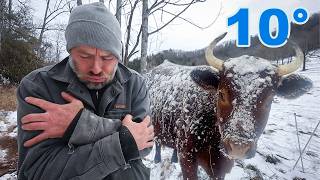
This content was created by Victor Justin Rhodes. This content was uploaded by Victor Justin Rhodes. This is a YouTube video titled "10 Mistakes Homesteaders Make (In The Winter)" (created 2026-02-04T22:26:46+00:00). The clip is an English-language homesteading vlog/educational video in which a primary host (Speaker A) and family/helpers (Speakers B and C, with children referenced by name — Austin, Jonah, and other boys) walk through common winter mistakes and practical fixes. Topics covered include clothing and layering, dripping faucets and frost-line knowledge, animal placement and care (calves, cows, chickens, pigs, ducks), water and heating redundancy (wood boiler, wood stove, generators), feed and hay planning, coop ventilation and winterizing chickens, battery/storage tips, and general preparedness vs. living in abundance. The footage mixes how-to advice, farm chores, and family vlog banter.
Chapters
In this video, we are thriving in this epic snowstorm. The coldest of the season, the coldest in a long time, and I'm sharing 15 common mistakes homesteaders make. Let's start with number 1. I got long johns on. Very common mistakes that can be easily prevented. Number 1, don't— they don't dress in enough layers. You know what they say, there's no bad weather bad clothing. Except in Minnesota, there's definitely bad weather. Mistake number 2, one we actually made this season, probably the only— I think the only one we actually made. Otherwise, we're thriving. We're not just surviving, y'all, we're thriving. We've been at this a long time. Roll that the other day, Austin, where this wasn't working. Shoot. This, I don't know, maybe because it's on the exterior wall. So what we should have done and what we did last night was is in extreme cold, just drip our faucets. A lot of times people don't drip their faucets, right, Austin? Okay, I feel really attacked. It's still snowy. That was quite the spill. I think it's gonna— well, it's gonna warm up today. I'm gonna share these mistakes as we go about our day. You get a little taste of the glory, what homesteading's really like in these vlogs. But I'm gonna try to teach you as we go, right? Looks like the door came open and they don't miss a beat. While we're here, another very common mistake is placement of the animals. I made this early on. I placed the chickens right there. They are going— and that's smart to have the chickens as close as you can. I put them in the bottom, which is a barn, and that part was smart. But right there, that's the— this is the north side, so that means this where the chickens are In the winter, the sun goes across the sky lower and you don't get any sun here. This is the last to thaw out. This might be a good idea in the summer, but definitely not in the winter placement. So now our chickens are far enough away that the house isn't blocking the sun. So you want your animals as close to the house as socially acceptable in the sunniest, flattest spot. You don't have to run the heat as far to keep the water hot. You don't have to run— move the water out there as far. It's just overall much better.
Harriet is not like as vigilant about it as I thought. Her udder is definitely not as swollen. I'm concerned she's not going to give as much milk as we think.
Well, the calf may be drinking it all. She doesn't give— her milk hadn't come in yet.
Her udder just doesn't look like she's going to give a lot.
It is 36 hours old. Calf? Yeah, I don't think it'd be holding its head up if it wasn't getting good nutrients. I think that it's just hunkered down in the warmest spot. Look at all this wood. That might have been a little bit of overkill, but I didn't want to make that common mistake of not processing enough firewood for the storm. The last thing you want to be doing is chopping and working up firewood in icy, windy snowstorm. While we're on the subject of heat, don't make the mistake of not having any redundancy. Might not all happen at once, but you want to have backup plans. It's why so many of us have moved to the country, isn't it? We want security. If you're in town, you're dependent on so much more else. You're dependent on Well, and only one single thing, really, just electricity. The electricity goes out, your heat is out, your food preservation is out, transportation oftentimes. All these things can go out, and that's why we moved to the country. So don't move to the country and not have some redundancy. Our wood boiler here, during a really cold spell like this is our main source of heat. Now, I didn't always have a wood boiler. We always had a furnace, but as soon as we could— probably the first step for most homesteaders— is a wood stove. See, our wood furnace. Pretty boring, huh? Well, I hadn't had to kick in this entire snowstorm in the single digits thanks to that wood stove. Our electric bill down 25%, our propane bill down probably 75% or more because we're only using it to cook now. And not to heat, it's good to have this as some redundancy. The fan does engage, so we need the grid. We'll talk about the grid here in a second. The fan from the furnace is pushing that wood heat. That wood heat comes in from the boiler down into this radiator. It pumps it through— water through— and the air goes through that warm radiator and heats our house. Glorious wood stove in here. If the power fails, the generator fails, the wood boiler is not working, this is just a fire in a cast iron stove. Josie, how'd you do on milking? Good. Dang, one cow, a gallon and a half? Yeah. In this cold? That vanilla, she's a winner. We're gonna go check on Harriet and try to milk her for the second time. We'll see how that goes. Mistake number whatever we're on. Inside water. We get this 5-gallon carboy with this cardboard carrying case handy. We also fill up a tub for flushing toilets. Here's another case for the country. Say, say your water's not running, you didn't save any toilet water, you didn't, um, you don't have a 5-gallon jug of water. Well, guess what? You got a creek. You got some buckets, you bucket inside, you boil the water, and you got something to drink. Okay, now that's a happy day right there. Gotta get this for Beauty. She's so nervous. She's nursing. If heating redundancy is the second most important thing, the first is water. We already talked about water inside. Oh look, you don't believe me? I got a video for you if you don't believe me. Happy now? 36 hours.
Uh-oh, it seems like Harriet just kicked her off.
She was letting her. We go through this every time.
I know you get upset that I care about the animals.
No, that's not right. That's not it. I just don't want to interfere with nature.
Well, sometimes nature does need—
I wanted nature to work it out because this isn't natural. Well, it's happening right now.
Yes, but in it, enclosing an animal into a deep bedding isn't natural.
Outside water, you gotta have systems. I told Jonah, if we're gonna leave our hose out here, you gotta drain it. And I'm afraid there's a little dip right here, Jonah. You start at that end, walking it up, or you roll it up and put it inside. Either way, it's a pain. It's a pain, but so is hauling water. Yeah, look. I mean, the water is blocked. Jonah? Yes, sir. You got to do like this all the way. Huge mistake leaving this connected. Okay, notice that we, we took this off, leaving this disconnected. It was 1° out here yesterday and this was working. If you leave a hose onto it, this frost-free hydrant will freeze. I don't know, the water doesn't drip. What happens is you turn that off and it shuts off for us a foot and a half under the ground. For us, you got to know your frost line. Know your frost line, homesteaders. Foot and a half down, it's not going to freeze in North Carolina unless it's super extreme event. Minnesota, 6 feet or something crazy. 6, 9 feet, just ridiculousness. Is that enough till this afternoon? Yeah, we don't want our, our trough heaters getting exposed.
Yeah, it'll be plenty. They're drinking nothing because it's so cold.
That'd be the other part of the water system definitely coming in clutch. So very, uh, properly installed frost hydrants turned off, unhooked, buckets for hauling, hose, plenty of hay. You cannot wait till the looming storm to get hay because everybody's going to be after it. Feed, always just make it a habit to be always in feed, to not get below 50, 40%. Feed check. We can't get feed right now. Tractor trailer is not going to drive on this road because we just stay on top of it. We're good. And we, you know, we have redundancy if we were to run out of chicken feed back there. They can eat pig feed. So, and vice versa, pigs can eat chicken feed, certainly in a pinch. Let's do Harriet. And a little later, I don't think you want to miss this, the boys are going to build— after we go through this checklist, the boys are going to build— you're going to build a snow fort and attempt to sleep in it for their video. Okay, she is fine, man. She's got colostrum poo, man. Now if that won't make Mama happy, I don't know what will. We should name him Dookie. No, should name her February. Help us keep track of our farm journal. Just start naming the calves the month they were born. We can also name her an old school name, heritage name, like Harriet, so that we remember who— what line she's from too. That's a trick. With Honey, we'll stick with sweet, sweet themes. Vanilla will stick with ice cream themes. We get enough hay for an entire year. My mentor Joel Sellerton likes to save up 2 years. I would eventually like to get to that. Because you never know, you might have a completely disastrous year. I think hay gets rained on, you have a drought. What?
I think we might have enough.
We might have 2 years. Oh, well, that's good. Well, we have to do February, March. We got 60 more days at the end.
Yeah, I think that top half, I think we can save.
Are you going to be more difficult, the same difficult, or less difficult? Yesterday, first time we milked her, wasn't too bad when we got her in. Once we got her in the stanchion— look at this cat! So happy. Look at this. Should I take a picture for Mom? Come on, just a little bite. Oh, close. Yeah.
She's really close.
Just— I'm having a pull.
Just come grab the alfalfa.
Just grab the alfalfa and shake it for her some more.
I had to sit down to hold it, but Yeah, getting used to it.
So what do you think that was, more difficult? Less difficult or same difficult?
I think that was a lot easier.
Really?
She just went right in.
We didn't have to hook a leash up to her. Got what I could after the calf nursed. Calf first. We'll keep the calf on her for 24/7, at least for 2 weeks. Uh, got a little bit. It's not nearly as mastitis-y as yes— or not mastitis-y. Colostrumy as yesterday. Plenty some, uh, colostrum. It's gonna have some colostrum for it and for us. I left half, estimated half, for the calf.
You're gonna eat or sell it?
This one's gonna be for sale. It's a heifer. I'm gonna link this for you guys in my Shopify. First come, first serve on this calf. Gonna be a good one, it's gonna be a good hearty calf. I'm gonna put that up to Abundance Plus members first. So, and then to you guys second. First come, first serve. She'll be ready in 6 months, and I'll give you a lifetime tech support for as long as that little calf lives. What?
She'll be hardy. She'll be more hardy, but oh, um, she won't give as much milk. Yeah, more American.
She'll make a great family cow. Yeah, very little problems. Gonna have babies with meat constitution. They wouldn't even let me help them. It was so strong.
It will be very—
you wouldn't even let me help her. All right, sure.
They're a cow as soon as they have—
no, they're the second calf before they're a cow.
So we have—
not crazy. We have a cow, we have two cows, and yeah, I think you'd call it a first-time heifer. Another half.
Well, I guess you consider this a heifer too.
Yeah, that's definitely a heifer.
So it would be hard to consider her a heifer all the way till she has a baby immediately, but then they're considering this a heifer with a cow that's already had a baby.
Yeah, why are I don't know. Okay, boys think the cows could— should be mixed together. I say we give it one more day. I tend to be more conservative than the kids in my farming practices. Let's, let's ask Mom. I bet Mom will say a week. Mistake numero— not being prepared. I know someone. Don't worry, Austin, it's not you. You're doing good, Austin. Good job. I know someone who literally, day of the storm, thought they, they could call and order propane. We ordered diesel for our tanks that we were just below 50% on Tuesday. It came Friday before the storm. The storm happened Saturday. The gas stations are crowded, this and that. Be on top of fuel, 50% or more, just always on farm. And if you do hear of a storm, it's not a bad idea to go tap them off. Go right away. Or it's going to get crazy. This is my— people will ask me, am I a prepper? Okay, because I live a life of abundance, and that's what we're focused on. And I found, I found during Hurricane Helene when we were suddenly without power for 15 days, living a life of abundance lends itself to a life of preparedness. We're not doing all this to be prepared, we're doing this to live in abundance. Healthy life, and then we're prepared if things do hit the fan. Don't be without alternative power. You see, we love the grid. We love the grid. You can, uh, be a huge big-time homesteader growing most of your food and love the grid. That'd be the second question people ask— are you off the grid?— after they find out I'm a homesteader from meeting somebody out in public, behind do you have goats. No, I don't have goats. Goats got devil eyes. And I love the grid, and that's okay because I did the math one day. When we first started growing food, it was to save money, and it still is. It's that combo of saving money and optimizing health. I added up our grocery bills. Our grocery bill was way more than the power bill. We just kept the grid. I mean, look at your goals. Now, if your goal is to be sustainable, stick it to the man, environmental, whatever, reasons, then you might want to go off-grid, get you some solar. We don't— why do we not have solar panels? Well, it takes a long time to recoup the cost of solar panels, plus all the EMFs. So we just haven't done solar panels. We've been focusing on our food systems because that's our goal, is to save money, grow optimal health. And so we just buy the grid, we just get on the grid. And so we have a diesel generator. By the way, you might notice I've been posting more. Guys, I love to make films. I love to post. I miss you guys when you don't. So I'm just trying different things like this vlog. It's sort of an educational video with a vlog mixed in. I'm having fun. Hopefully you're learning something. Hopefully you laugh at something. That's been my goal since the beginning, that you learn and laugh at something in every episode. We love the grid so much. We have a diesel tow house generator plus a regular generator. Make sure when you're not using this, you start it up, you turn the gas line off, and you let it run until it runs out of fuel. That way there's no fuel in the line that can clog up or anything like that, because this could be sitting here for years. But it's nice to have that. We told Austin he could use it if, if he needed. And so this can also be a gift to the community. For many of you, and for when we just started out, it was first just the mobile generator. Let me show you something over here. Yeah, I don't want anybody to get discouraged by this. This took 20-plus years of accumulation, of doing something on the homestead, of advancing 1% a day for 20 years. You start compounding, guys, and before you know it, you got 2 generators. Now they're big. Probably the number one mistake people make, especially with chickens, is they over- Fortify. Listen, unless you are -20 consistently— if you're -20 consistently, why don't you have a greenhouse? Get them a greenhouse. You just need 3 square foot per chicken. Sometimes in the single digits like us, oftentimes in the 20s, more often than not 30s. Take your chickshaw. It could be outside, preferably on wood chips, preferably maybe where you want to garden, or uh, where you want to make some compost. Turn your, turn your coop around. I'm turning it towards the south. This is it. This is how you winterize your chickens. Orient the coop to the south, open side to the south. Open. There's a book called Open Air Chicken Coops. Oh, but just great wisdom. You don't want to insulate your chickens. You don't want to run heat on your chickens. Moisture from their breathing and then staying warm It's moisture is what's going to get chickens. So you want to keep things aerated. Look, all I would do if I was consistently in the single digits at night, I would just put some plastic over this. I've done this before, and you can do it in this cold climate. It won't— even in this warm of a climate, it won't matter. I'm in zone 7. Zone 7, if you're feeling saucy, you want to be kind to your chickens, just put some plastic over the opening on the chickshaw. You need this ventilation. Don't seal it. Don't, don't put insulation in it. Don't put— guys, you have wild— if you have wild birds where you are in the winter, you can have chickens. There's plenty of ventilation. The trick is ventilation so air can get in above where they are. So you have this wind blocker. And if you are in single digits or lower, park this on some deep bedding, have them in a net with some, a wood-chipped run, and put hay bales around the edge to protect wind from going up under there and getting on them. But that's it. Don't overdo the chickens. It will backfire. They'll get moisture on them, then they're going to get frostbit, and then they're going to go from a warm setting out to the cold. That's like you wearing a coat inside your car or inside your house and then going outside, you're not acclimated. You want to wait till you go outside to put your coat on. So you want your temperature similar inside and out. That's one reason the greenhouse is so good. It gets cold at night, sun's not shining, it gets cold. But it does keep the wind off of them. Have a wind block with ventilation above them, you're good. Winter chickens, if it does snow like this and you're feeling saucy, chickens don't like to come out in this, throw down some hay. They'll come out and, and step on top of that hay, and they'll thank you for it. Oh, it's a snowman! Oh shoot. All right, well, I just made a mistake. I got those off the shelf the other day, and I sat them there for some reason. And forgot all about it because hopefully it's not too late. That'd be a mistake, storing your batteries outside. We had these batteries on the shelf. Well, batteries can freeze. I guess late is better than never. Let's get these inside and hope, hope, hope we didn't ruin them. Well, that's not going to work unplugged. They have gotten rid of all their snow. Nice having the creek right by the animals too. Let's water them first. I think they'll go through their water quicker than their food. Finish up our chores and then go see if these boys can build a livable igloo for them to camp out in tonight. That's going to be interesting. Really? It's that thick? Well, hold big Papa. Kayak's lodged. If you're going to camp out on the ice, you have to do it right here. Shallow. They talked to me into it right there. They can do it on that bank, also shallow. Scraping it off the dock. Just looked at the weather, it's not even gonna freeze tonight and the high is going to be 42. I think if you want to be sure, you might want to put it on the dock. I want you to look, it's already slushy where we were. Lunch break. Hopefully it doesn't solidify too much during this A little duck soup for lunch. Eh, I'm a little disappointed. I'll be okay if I don't ever have it again. I was hoping— is it melted yet? It's not melted yet, still frozen. I'm out at the pigs. Their water is still, still very frozen. We got you some. Are you hogging it, beefcake? Here we go, pour you some. Good boy. Okay, just in time. Get in. Oh, we got to clean this one out too. By the way, he's taking a little break with the boys, regrouping. Gonna go back at 4. They're gonna make their own dinner.
Puddle where it was supposed to be.
Good call. Well, that could have been you guys in the middle of the night. Look how wet that would have been, y'all. That would have been a miserable waking up in the middle of the night. Well, hey, hey, are cooking their meal out here. That's their, uh, setup. Good thing we didn't go in there. That's a pond in here. The floor is wet. Oh boy. We'll see if they make it. Tomorrow's another day. See you then. Happy day.
More from Justin






If I had to start my Homestead all over again, it could only pick one animal… 




