100s of Farm Animals and NO Vet Bills | Joel Salatin Explains
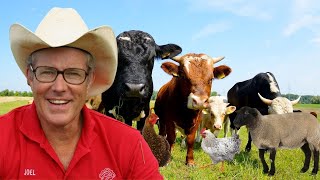
In this presentation, Joel Salatin explains how small‑scale and homestead livestock operations can achieve near‑zero veterinary costs by focusing on preventive sanitation rather than disease treatment. He outlines two natural sanitation mechanisms: (1) "Rest and Sunshine," which relies on rotating pastures and providing host‑free periods (typically at least 21 days, twice a year) so sunlight and time reduce pathogen loads; and (2) "Vibrant Decomposition," which uses deep‑bedding compost systems beneath housed animals. Salatin details the microbiological basis of each method, offers practical rules of thumb (maximum 21 days on a single spot, carbon‑to‑nitrogen ratios of ~25‑30:1, minimum compost mass of 1 yd³, bedding depth of 12‑30 in), and discusses design considerations for barns (avoid rot‑prone post‑and‑beam structures, use replaceable walls, store carbon under roof). He emphasizes using mixed carbon sources (leaves, hay, corn fodder) rather than pure woody material, monitoring ammonia odor, and maintaining moisture. The talk also covers the benefits of multi‑species stacking, which confuses species‑specific pathogens, and the use of small "sacrifice" areas for animal exercise and garden production. Overall, Salatin argues that combining pasture rotation with deep‑bedding compost creates a self‑regulating, low‑pathogen environment that eliminates the need for veterinary interventions.
Chapters
Sanitation. What a topic. I've been on some really nose-curdling, unkempt homesteads, and I'm not trying to be condescending. I'm just saying that again, some of the, some of the poorest sanitation situations I've seen have been in backyard, backyard situations. So just because we're small does not mean we're immune to basic sanitation hygiene procedures. The reason sanitation and hygiene are so important is because, as you know, most of the homestead livestock books spend a great deal of time talking about diseases, toxicities, pathogens, all sorts of things like that. Vet bills, when to call a vet, those sorts of things. My goal, my goal in this book has actually been to get you to create a habitat, a situation for your animals that— I'm not going to talk about diseases very much. I'm not going to talk about pathogens very much because in our experience, like, I mean, we're, we're running 1,000 head of cattle, you know, 800 hogs, 10,000 chickens. I mean, we're not a backyard operation, and yet We basically don't have a vet bill. I mean, no drugs, no vet visits, nothing. Okay. And so I'm just, I'm just, I'm just crazy about trying to get us all to do preventive, preventive sanitation and hygiene because those are the keys. I mean, along with diet, mineral. I mean, there are other things, but But to me, the most foundational thing is keep the animals clean. If you, if you keep them in a clean environment, they're not going to be as prone to disease and pathogens and all those kinds of things. How do we create a sanitary hygiene situation for our animals? To my knowledge, there are only two basic ways that nature sanitizes. Nature sanitizes either with rest and sunshine or with vibrant decomposition. We're going to zero down on both those. I just want to get them out as we get started here. The first one is rest and sunshine, and the second one is vibrant decomposition. Let's take them one at a time. Rest and sunshine. That's the pasture approach. All right. So, so we're running these animals through the, through the pasture, and from the time they vacate till the time they come back, that, that environment is at rest from that animal. Now, there might be a different animal because most of the pathogens don't cross-speciate. So it's fine to run, for example, chickens behind cows or pigs behind cows or sheep and cows together and chickens behind them. I mean, there's there's any number of these combinations that you can do, different species. But what we're talking about is the same species across the land and then with rest. So there's no host there. And then during that rest period, the sun, you know, which is the greatest sanitizer in the world, the sun then breaks down pathogens and kills microbes and things like that and recreates a balanced ecosystem until that species of animal comes back onto that area. By that time, those pathogens have decreased in their virulence down to a place where they're not a problem. We're not talking about sterilization. We're not talking about annihilation. We're not talking about, you know, worming and, you know, aggressive toxic drug interventions. We're simply talking about how do you maintain ecological balance so that on the— in the battle, in the microbial battlefield, the good guys win and the bad guys lose. That's the idea. Rules of thumb are 21 days host-free at least 2 times a year. Okay, so, and this doesn't— this, this is the same whether it's a dog kennel, backyard, chicken yard, whatever it is. Okay. You want some, some host-free days, at least 21, 2 of them per year. Another rule of thumb is you never want an animal on a, on a given spot more than 21 days. If you think about it, like, you know, if you, if you buy a calf at the stockyard, bring it home, the typical kind of, you know, quarantines for new stock is always 21 days. And in our experience, the incubation time for most of your, you know, respiratory illnesses, things like that, and you get an animal in, it's 21 days. If you, if you have an animal and they've stayed healthy for 21 days, chances are, you know, they're good to go. So this kind of 21 days is just, just remember that that's kind of a a bit of a golden rule. We're going to talk about moving animals way more often than 21 days. I'm just suggesting that a 21-day period is at the extreme. It's out there at the extreme. So you never want to leave an animal in one spot. That includes a dog kennel. It includes everything. Never want to leave an animal in one spot more than 21 days. The reason is because the pathogens, you know, their life cycle is really fast. You know, they can double. I mean, their whole life cycle is literally in hours. A microbe can be born, breed, you know, go to the nursing home and die, you know, in 4 hours. And so the generations, the pathogenic generations are extremely rapid that are going on. And so if they always, if those pathogens always have a host there, then their virulence is going to gradually, you know, increase, increase, increase because they don't have to work hard to get to a host. And then that's where you get your parasites and you get all these, all these issues. So rest in sunshine. That's, that's the first critical factor. Now, the second sanitation system, vibrant decomposition. We all know that we're not going to have these animals out on pasture, not necessarily all the time. There are times, there are definitely times when you want to house animals, you know, inclement weather, you know, maybe they've just, they've just come in and you want to get them trained to electric fence. You want to make— you want to quarantine and make sure that they're, you know, healthy, that everything is okay. You know, there are times when when you want to house them. And sometimes we want to house them just because we don't have enough pasture. If you've got a postage stamp yard, you don't want pastured chickens. Your children will be tracking in chicken poo on their feet all day. That's not going to make mama happy. When mama ain't happy, ain't nobody happy, right? And so there are times and conditions when housing animals— I mean, if you've got a very small place, you might not want to have the 2 pigs you're going to butcher for your family, you might not want them, you might not have enough acreage. If you've only got half an acre, you might not want those pigs in lots running around, you know, tearing up your real important place where you've got, you know, maybe a vineyard and some bramble bushes, some elderberry bushes and squash and cucumbers, right? And so you want those pigs in some sort of a, a corral, but you don't want them to stink because you don't want everybody walking around with pig smell on. So there are definitely times when you want to house animals. How do we— and this gets to be the problem. This is where the sanitation really hits the road, doesn't it? Because, you know, as soon as we house animals, again, they're not potty trained. And so we've got manure to deal with. And, you know, you can't teach them how to, you know, go to the toilet in the right place. We've got to figure out how to house animals in a way that there's no smell and that there's vibrant decomposition. What I'm talking about when I say vibrant decomposition is a compost pile. You know, you can put— you can put antibiotics in a compost pile and the mold and fungi break it down. You can put herbicides, pesticides, um, through the alimentary canal of a worm and it comes out detoxed. I mean, this, this, this decomposition thing, uh, which digestion is part of decomposition, it's a marvelous thing. Essentially, I want you to think about how do we— if we're going to confine animals, we're going to put them in a, in a shelter situation How do we keep them on a compost pile that functions? To have a functioning compost pile, we need vibrant decomposition. If a compost pile does not vibrantly decompose, it's not a functional compost pile. So what do we need for that? Well, we need the right amount of carbon, the right amount of nitrogen, the right amount of microbes, moisture, and oxygen. Those are the 5 key ingredients for compost, and they have to be in the right relationship. Carbon nitrogen needs to be somewhere about 25 or 30 to 1 CN, and all the different manures and different carbon sources have different relative amounts of carbon nitrogen. If you want the most complete table that I know exists in the world, at least, you know, for the layman farmer, if you want the most complete table in the world exists for this, get the old, you know, 1950s, '60s complete Rodale Complete Book of Composting. It's literally got pages and pages and pages of different kinds of material and their carbon nitrogen ratio. So you can actually, you know, kind of see what you're, what you're getting, what you're doing. So the other thing about a compost pile, in addition to these ingredient ratios, is that it needs mass. And this is probably the, you know, the key of this whole deal is the mass. So if I told you, well, let's build a compost pile, but we don't have very much material. So we're going to build one 12 inches by 12 inches by 12 inches. If you know anything about compost, you'll laugh at me and realize, well, you obviously don't know anything about compost piles. What's the problem with a 12-inch by 12-inch by 12-inch? When I, when I have school kids at the farm and we're doing, you know, this, I say, you know, why is that not enough? And, you know, of course they hem and haw around. And I tell them, well, the answer is it's not a big enough geography. It's not a big enough place for all the community of beings in the compost pile to build their roads and schools and libraries and movie theaters and all the things that they've got. They need room. They got to have room to build, you know, houses and parks and libraries and things. And, and generally that takes roughly 1 yard, 3 feet by 3 feet by 3 feet. That, that gives you enough core mass that you can maintain this community of microbes internally. It'll actually— that's the minimal size. All right, so if we're going to put these animals on a functioning compost pile We can't put them on a little skiff of wood shavings 2 inches deep. There's not enough thickness there for the beings to make their highways and roads and libraries and skyscrapers. They can't build community in 2 inches thick. They need at least 8, 9, 10 inches thick, ideally 12. Goodness, ideally 24. All right, the point is the deeper the deeper, deeper, deeper this bedding is, we call it deep bedding, otherwise known as a carbonaceous diaper, but this deep bedding, the deeper it is, the more functional it is, because it gives room and mass and opportunity for all of this microbial life to actually live vibrantly and fulfill its function. Now, as soon as you start thinking about, okay, I want to be able to have 30 inches of bedding under my animals, pigs, chickens, cows, goats, sheep, whatever it is. Well, suddenly you start having to think about building design. How do I— how do I make a building that has nothing rottable within, you know, 30 inches, 36 inches? Of the floor. This is the problem with old iconic post and beam barns. And of course, you know, I get a lot of pushback. People hate me because I say, if you've got an old post and beam barn, don't use it for a barn. You know, use it for a miniature golf course if you want, a restaurant, you know, steward housing, a wedding venue. Don't ever use an old post and beam bank barn type of arrangement for animals. Why? Because all those sill plates, those beautiful big old timbers are going to rot as soon as you get some bedding. And, you know, those things are made, they're usually sitting on some, you know, rock foundations or something. And, you know, they're up, you know, maybe yay high. And you'll notice the problem with them all, you get an old one and it's got rotted out sill plates. Where, you know, bedding has come up and touched them. So we've got to think about, about structure design in order to accommodate this, this deep bedding. I don't care whether you're running a brooder, you know, if you got 2 pigs, whatever you've got, when you're, when you're running that system, you need to have that deep bedding so you have So you're, you're, you're, you're creating a vibrant decomposition habitat underneath your animals. That's going to take carbon. Where are you going to get carbon? So first thing, you got to design your structure so it can accommodate that. So you got to have some sort of a wall. Now, on our, on our hay feeding sheds, again, talking about walls and functionality, we use just old, you know, pine. For our walls, and that holds in— because where we feed our hay, we let it get 4 feet deep. So imagine 4 feet deep, you got heavy cows on it. There's a lot of side pressure, you know, pushing the material out to the edges when you get, you know, 4 feet deep and cows on it. And so we just cut these pine poles, put them on. Guess what? They rot in 10 years. Well, we just pull them off, put on a new set, Put those in a hugelkultur bed and away we go with a new thing. Didn't cost us anything but a little bit of time. So you don't think this has to be some forever thing. In fact, I think in some cases it's good not to build forever buildings. Most of the time a forever building is obsolete in about 30 or 40 years. I think the Native Americans were really smart. My favorite thing visiting Williamsburg is actually Just as interesting is the Powhatan Village next door. And you go in and you see these, you know, these bison hide huts with bent-over saplings. And they say they lasted about 10 years and then they would, you know, decompose. You think about the cycles of a person's life, that's about right. You get married, you want a little one, you get some kids, you want a bigger one, and the kids go, you want a littler one again. So I think this idea of a 10-year cycle on a house is actually probably pretty smart. And so don't think this has to be a forever structure. It can— if you build it functional and cheap enough, you can throw away some of these, some of this wall material and scavenge in some others as you proceed. We've got our structure. We can go deep with our bedding. The question is, how do we know how much bedding to give? Because remember, if we put in too much carbon, we're not going to get decomposition. And if we don't put in enough carbon, we're not going to get decomposition. Each— either extreme is a problem. And so here are some rules of thumb. First, let your nose be your guide. As soon as you start smelling nitrogen, which is ammonia that's vaporizing at ambient temperature, nitrogen wants to vaporize. So when you smell, when you smell poop, All right. What you're smelling is not poop. You're smelling the ammonia vaporization from the poop. All right. So if you're smelling that, add some carbon. Let your nose be your guide. Another one is look at the cleanliness of your animals. Are the animals clean? Are your— are the chickens' feathers carrying, you know, manure and grime? Are the cows You know, where they lounge, do they get up and they're all, you know, got manure on their side? Pigs, you know, pigs are actually fairly fastidious. They pick a toilet spot and then they, you know, they root around every place else, but they, you know, they don't mess with their toilet spot. But, you know, are those pigs, you know, can you rub the pigs and then, And it doesn't smell bad. All right. So, you know, are they clean? You know, pigs are actually fairly fastidious that way. Another rule of thumb is to, is to not use 100% woody material for your carbon source. The reason I'm bringing this up is because woody material is so far out on the carbon nitrogen ratio. So for example, sawdust averages about 500:1 CN, carbon nitrogen, 500:1. Leaves, leaves average 35:1. That's why you can take a pile of leaves, soak it with water, and it'll start to, it'll start to heat up and decompose. Sawdust, it's real hard to get it to heat up. Because it's, you know, it's 500 to 1. So, so different materials have different amounts. And what we've found is that by putting in some old junky hay, some corn fodder, some more kind of forage-based, lighter carbon, we can actually keep our carbon from getting too high. So that's just, that's just something to remember, you know, you could use dried lawn clippings, you could just use some rained-on hay, just anything to kind of break a little bit of that, that woody material. If you're using sawdust and wood chips, I mean, we use a lot of wood chips because they're accessible. We can get them from, you know, tree trimming crews. We give them a Thanksgiving turkey and the crews drop their, you know, chips at our place. Another just rule of thumb is to store your carbon under roof. Remember, especially if you're, if you're under— not, not chicken so much because chicken manure, you know, chickens don't pee. That's a good little trivia thing you can play on your friends. You know, chickens don't pee because they— it all mixes. And that's, that's why chicken manure is so hot. But pig, cow, their you're getting a lot of the nitrogen in the urine. And so, and that's of course real liquidy. So what you want to do is you want to store your carbon under roof so it goes in dry and therefore the pores, the pores in the, you know, in the wood chip, in the straw, in the hay, the porosity of the carbon is absorptive for the urine. If you store your carbon outside and it sits in the rain all the time and you're putting it in wet, You've already filled the porosity of the material with water. Now you can't— it won't absorb urine. Well, now you're going to have to use twice as much material because the absorptive capacity is out. You know, the whole thing starts to, starts to break apart. So, so store your carbon under roof. I mean, it could be under a tarp or, you know, just a piece of plastic or whatever. But, but roof storage for your carbon is, is really important. Final rule of thumb on this carbon is just to remember the deeper your, your bedding, the deeper it is, the less carbon it takes. Here's what happens. You start, you get up there about 12 inches and you think, oh my, Lance, I'll never be able to keep up with these. I can't get enough carbon, you know, and you just takes it and takes it, takes it. Well, then once it gets up there, 12, 14 inches, guess what? That decomposition really starts to kick in. And the microbes to grow all that decomposition, it takes moisture. Just like, you know, a compost pile tends to dry out over time. And a lot of times, you know, your backyard compost pile actually stops not because it quit decomposing, but because it ran out of moisture. All right. Ran out of water. So you got to sprinkle it, turn it, sprinkle it, that sort of thing. So in this condition, in this situation, a lot of times your, you know, your, your, your deep bedding as it develops and as it becomes a deeper sponge, it gets all that manure, that urine going into it, and it's feeding the microbes. The microbes now, they're beginning to use up that urine, use up that moisture. And so the deeper it gets, the less and less carbon it takes to get the same, to get the same function. And so as it gets up there to 24 even 30 inches, you'll start realizing, well, goodness, I'm using half of what I used, you know, when it was 12 inches. It's because you got all this microbial activity. They're all in the gym sweating, and that sweating is using up the moisture in the pack. When you're housing animals, a lot of times you might want them to have a sacrifice area, a place they can go out and get some sunshine. Stretch their legs a little more, that sort of thing. We call that a sacrifice area. It's going to be a place that they— yep, they tear it up and it just is what it is. But a lot of times the animals like to get out in the sunshine. It helps, you know, it's a nice thing. So we don't have a problem having a small sacrifice area. That's a lot better than having the whole pasture torn up in the early March thaw from winter when everything is wet and it's so heavey and thawy that you don't hardly, you don't even wanna walk across the field. And the cows, as heavy as they are, they're sinking in 2 inches deep and you start tearing up your pasture. So confining them to this little small sacrifice area can be actually a good thing. Well, what can you do with that? Well, obviously you can, you know, as soon as they're off, remember they're not going to be on it that long. As soon as they're off, it's going to come back in weeds and all that stuff. But we use the sacrifice area as a garden area. I mean, they've already got it tilled, it's heavily manured. And so you can grow pumpkins and squash and whatever in the sacrifice area. So, you know, you can use these microsites, you know, as salvage behind the animals. So that's a, you know, that's a really good thing. Finally, when you're housing animals inside with the deep bedding and maybe with a sacrifice area, maybe not depending on what it is, you may— you'll be strategically encouraged by having multi-species. The more you can have multi-speciation— of course, this is kind of a permaculture concept, you see it in stacking, for example. But when you stack animals and you really diversify that housing space, you create confused pathogens. So here's my way to explain a scientific principle in a story that kind of is beneficial. So imagine here's Harry and Matilda, you know, they're, they're chicken pathogens, right? And so we have this rack and we call it the rack and house rabbit chicken rabbits up above chickens underneath Harry. You know, he's a little microbe, little pathogen, you know, and he gets born and goes through, you know, grade school and into high school. And, you know, he gets out of high school and boy, he starts to, you know, realize Ooh, boys and girls. And he spots this hot Matilda over here and says, "Hey Matilda, let's get married and make babies," right? And so these two microbes, they get together and they say, they look over there, it's like 2 millimeters away, right? On this hill, they say, "Eh, it looks like a good house site over there." So they start their trudge over there, you know, and it takes them about 5 microbe years, which is, you know, maybe, 10 minutes, you know, to get over there to this hillside. And Harry says, "Oh, Matilda, I'm so sorry. I'm so sorry. It wasn't a chicken turd. It's a rabbit turd. And rabbit is— Ah! We can't live here. It's a hostile environment. And we can't go to another place because, you know, your biological clock is ticking, you know, and 2 more hours you're not going to make babies anymore." Oh my, and they die. And Harry and Matilda just die. And that's the story of confused microbes. Remember, most microbes are species-specific. And so if you bunch up, and we now have hoop houses where we have rabbits, pigs, and chickens all in there together, and so So all these microbes are completely confused, but none of the animals is at a single animal density to create virulent pathogens. And so we're getting actually more production per square foot than, than a, than a factory farm with a single species, but without any of the negatives because we're only at, you know, 50% on the chickens, you know, 40% on the pigs and 30% on the rabbits. Well, that's 120%, see, of total production, which is higher per square foot. But because of the stacking and the confused pathogens, it all works, you know, hygienically and sanitary. So those are just principles. But I hope that that underscores the two potentials for sanitation and hygiene. It's rest and sunshine in the pasture. And if we're going to house them, we need to house them on this deep bedding with the CN ratio enough and the depth enough, the mass enough that we get this wonderful, basically a compost experience under our animals. And if we do either one of those two things, and usually it's, you know, throughout the year, it's a combination of both, but either one will work and maintain sanitation hygiene and keep the disease and the pathogens away.
More from Justin






If I had to start my Homestead all over again, it could only pick one animal… 




