15-Acres Abundance | Ultimate Homestead Tour (Spring)
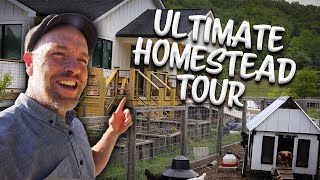
In this unedited, on‑camera spring tour, Victor Justin Rhodes and Rebecca Rhodes walk viewers through their 15‑acre permaculture homestead, illustrating how they are transitioning away from grocery store reliance toward self‑sufficiency. The video begins at zone 0 (the house) and moves through zone 1 (kitchen garden and raised beds), the high‑tunnel greenhouse, the compost corner, chicken and goose brooders, a mobile chicken coop, a pig port, pasture‑clearing projects, beekeeping, and a woodlot. They discuss specific plant varieties (lettuce, basil, artichoke, tomatoes, peppers, zucchini, watermelon, beans, peas, onions, garlic, strawberries, calendula, sunflowers, etc.), seed‑starting methods (soil blocks, silicone trays, Silly Seed stainless‑steel trays), and livestock management (chickens, geese, Cornish Cross broilers, pigs, goats, sheep, cows, a breeding boar, a ram, and a steer). Throughout they share practical tips (grass‑clipping mulch, compost building, mobile feed sleds, electric fencing, water gravity‑feed), reflect on 19 years of trial‑and‑error, reference their upcoming book Homestead Builds, and emphasize the permaculture principle of placing high‑use elements near the house. The narrative blends instructional detail, personal anecdotes, and a broader philosophy of building legacy, abundance, and resilience for their family and community.
Chapters
On this spring Abundant Permaculture homestead tour, we're starting at zone 0. The ultimate homestead house remodel is nearly done. We come outside into zone 1. This is our view. We're going to give you the ultimate tour, spring tour, of what it's going to take. We're quitting the grocery store. And most of our food source is then coming off of this land, right?
I mean, right away it's not gonna because we're not that ready, but eventually it will.
Yep. You know, so we're working towards that. We got 30 days. Let's start.
Killed my lettuce. Somebody—
what happened?
Probably a cat killed my lettuce. Okay, they put the— they, they scratched in here.
And how are we going to keep cats off?
I don't know.
There's never No problems. Okay, give us the tour of the raised beds, spring.
Yeah, so this is my kitchen garden, and this is more of like a beautiful garden next to my house. Not super high production, as in like— I mean, it's going to be high production as in we're going to get a lot out of it, but it's not like where I planted 2 rows of 50 feet of onions. So this is more like pretty stuff and fun stuff. Like, I've got holy basil here. I've got one artichoke plant, so I'm only gonna get one artichoke. I'm gonna just let it bloom into a beautiful flower. We've got lettuce, and so I'm doing succession plantings of lettuce. So we've got some lettuce here. I've got more lettuce in the greenhouse. I'm gonna get a lot of food out of here, but it's not necessarily what I call our crop garden. I like this garden because it's close to my kitchen, and so, hey kids, we need something from the kitchen garden, go get me some bunching onions, or go get me some lettuce for dinner, or I can come out here and get it myself. We grew 4 lunchbox pepper plants here. I've got 4 celeries. Um, I've grown celery before and I didn't love the taste of it. It was a very strong celery taste. In fact, it ruined my broth. So I'm gonna try some other techniques and see if there's some way I can make celery palatable, less intense. I don't know, we'll see, we'll see what happens. We've got some sweet alyssum. I can't— I don't know if I'm saying that right. We've got more pepper plants, we've got a couple sweet peppers. I have more sweet peppers growing in the greenhouse. I've got some jalapeños, and then I've got 3 tomatoes, so 2 Sungolds, 1 yellow tomato, like a a bigger round yellow tomato, and then 2 Sungolds, which are cherries. Hopefully, you know, they're gonna grow nicely up this trellis and be beautiful. Over here we've got snap peas, and then we've got some herbs, so tarragon, sage, and these are all herbs that are perennials. So I'm going to hopefully just transplant them into a different spot when I finally figure out exactly what I'm doing with this front yard over here because we're in the middle of the remodel.
What's up with this long-haired party going on?
I know, it's just natural. It's just we're going all natural for right now. I just— so much of it has gone into the remodel and so much is going just into what we're doing that, I guess.
How are you— how are you able to continue on this year and have a garden and do a remodel at the same time? Well, hopefully this is almost done, which included moving.
Hopefully this is almost done. It's been rough. It's been a lot. So then I've got— I've got a lot of this seeded in the greenhouse, but, um, there was a plant sale, and so I bought some already very mature plants so that we can start having some of this now. We've got chives, cilantro, dill, parsley, and weasel down there. But I've got more coming, so I'm assuming that besides the chives— I don't know, I don't have any chives coming, that's the only chives plant I have. Um, I'm assuming that these will grow up, we'll replace them with new plants later. And then I don't have anything in here, I don't have anything planted on the trellis yet. I want to do some cucumbers, um, maybe more tomatoes, I don't know. We'll just see what happens. I've got a lot in the greenhouse that needs to be transplanted.
When people ask how long I've been on this farm, I say 92 years. Of course, I haven't been here in 92 years, but my family has. And Granny can remember seeing the very first car coming down this road. They were horse and carriage. Well, I can remember seeing the very first Rivian Amazon. There it goes. Delivering. Rebecca, you've heard it before, it's so important. If you're gonna have— come on now— if you're gonna have a garden, you might as well have chickens, and you might as well have them right beside the garden. You got any weeds, Rebecca? Get some weeds or something. Well, I just took off that clean— well, weeds or extra produce.
Well, we just did that. We just weeded.
Can you weed the, uh, the—
we just weeded.
Wow. Okay, we'll get some, uh, Tall grass, I guess. Or what about this? What about this? Is that— is that free?
That's gonna be my mulch.
Okay, so she didn't talk about that. We love using grass clippings for mulch in our garden. We're the advance. Let's say we had a weed in here. We pick up the weed, we throw— let's pretend, pretend this was in the garden. Okay, did you find some weeds? All right. Oh, look, and then the garden The garden feeds the chickens. You want to put wood chips in here, okay? They scratch it, they manure, nature rains on it, that creates compost. You come out here and you rake this to the side and you harvest the compost underneath with a shovel, put it in a wheelbarrow, put it in your beds. Notice this is 52+ inches tall. We started out smaller and the chickens would jump over even if we clipped their wings. I found though, if you do a 52-inch cattle panel and then frame it— oh, frame it with 2x4s, we use cedar. I call this the compost corner because they're here always making compost. Plans for that are gonna— are coming in my book Homestead Builds. I'll leave a link for resources down in the description. I'll have a lot of resources throughout this video. The pretty shop. Hey Rebecca, your new pretty shop, it's gonna have an overhang And it's gonna have a black to match your roof. It's gonna have black shingles.
Oh fun!
Yeah, and so it's gonna match your house. Look at that, isn't that pretty?
Yeah, that'll be nice.
Get your chickens out of the backyard. Get the homesteads out of the backyard. Get them in the front yard where they belong. You want to feed in the garden? Let's see the abundance in here, huh? We gotta— we got a, uh, we got a molten or broody chicken.
Self-cleaning nest boxes.
I think we got 2, 2 broody chickens. Mobile coop even inside the permanent run, because who wants to clean up manure? Don't— if you're cleaning up chicken manure, you're doing something wrong. You can do something better. We just moved the mobile coop. It's got 1-inch slats, poop just falls through, and there it sits. We spread that manure love in the compost in the chicken run.
I would like to do a pergola of some sort over— yeah, this, either on this side or I think maybe down there. And I want to grow a vining Climbing rose.
I like it.
Up over, it'll be beautiful.
Zone 1 garden right outside our door. Something you visit a lot walking down to the garage or whatever. You can see if the garden has any weeds. Persimmon trees coming in nicely. We're gonna get a lot of fruit of it this year.
So this is my greenhouse.
We're growing raspberries. For transplant.
So we had some raspberries here, and I guess they went out of the pots.
Raspberries want to grow, and they just want to grow.
So one of my ideas is to put— so we used to have a patch of elderberries, and I'm thinking maybe— I never— I just never worked out with the elderberries in the bowl. He went through them many times and ripped them up nicely. So I'm thinking I might want to do some raspberries on that, like a raspberry trellis. Here is my greenhouse. We are starting a lot of seeds. Last year I didn't— in the last couple of years since I had Henry, I didn't really start a lot of my seeds. I was buying a lot of, um, seedlings. But this year I wanted to.
No shame in that.
No, there's no shame. But I wanted to get back to it because I missed it. I, I do enjoy it.
And we have so many. Yeah, how many plants you have in here? 300? A lot. So 400, 500, a $3 piece, that's like $1,500 plants.
I have like probably like a lot of tomato plants. I have a lot of tomatoes.
So that'd be, you know, that'd be $1,500 if you had to buy those plants.
And then like this, like these are leftovers which I'm giving to a neighbor. Well, she's gonna see if these are beets.
Just go down and then I've got what things are.
So I've got tomato large reds. Then we've got some tulsi, cilantro, basil. I've got a little bit of that coming up. Dill, Italian parsley, and then these are peppers. I'm trying a new tomato. I got some seeds from a neighbor down the street, another homesteader. Tomato Mountain Fresh. So I've got 2 of those that popped up. They were old seeds, so I was happy to get 2. And then more of this tomato, Carolina. I don't know how to say it, but This is like an oxheart tomato. It's the first time I'm ever trying it. I'm all in on them. I got them from Johnny Seeds, and they're supposed to be like a really great meaty pasta sauce canning type tomato, which I would like to can a lot of. Watch this.
But, but, but tomatoes aren't good for you. They're nightshades.
I don't care. I enjoy them immensely, so I don't really care what your people say about that. Um, and then I've got, I've got some more sweet peppers because I would like to make my own paprika. Um, and I needed a sweet pepper for that. And then I've got more. I'm hoping that these pop up. I'm like getting a little nervous about it.
What do you do when they don't?
I'm just gonna have to reseed. I mean, we have a long growing—
some of these did not pop up, and so you just bought plant starts, which is a method.
Well, but like this, these took forever to pop up, and but now here they are. And I worried. See, these weren't popping up and I worried, so I went and bought more seeds.
And, and you ever lose sleep?
No, I don't lose sleep. I just am sad. So these I'm super excited about. I just, I just take action.
Have you forgiven me from that time I watered the tomatoes very early in the morning on a frosty morning?
Yeah.
And they all froze.
This is why, because again, we have such a long growing season that you just restarted them from seed and we still got a good tomato.
Have you forgiven me for Skipping a day watering these and they almost died?
Yes, because they lived. So I have seeds from Floret Flower Company, I guess. I don't know what you call them.
Flower—
these are seeds that she sent us from her breeding them. So a Dahlia, Zinnias.
Where are you gonna put those?
Yeah, I don't know. We're gonna find a place.
Are you the crazy plant lady?
I think so. I really like plants. I really do. So these are flowers, and I'm really excited. I've never grown these flowers besides zinnias before, but I've never grown Victorian wedding flowers. Um, it's just the color of them. I'm very excited about that. Then I've got some more peppers because I would like to have a variety. So we have yellow, orange, and red. So we've been gardening for 19 years. We did not have this set up 19 years ago. We were starting seeds under light seats in our hallway, or we had the $50 greenhouse. We did that, and, um, we had just these PVC pipes.
Yeah, bent into an arch.
It was rough.
Slap together plastic. We had to slap together greenhouse ones too, like windows.
Like, if you see this and you're like, oh man, she said this also—
this is 5 years.
This has been here 5 years. I have, I have a design in my head that we're changing this. I like from here down I like this design, but from here up I want to change—
there's not enough ventilation options in here. It gets too hot.
I want to change the roofline and I want to change the ventilation options. But what I'm saying is like, this has taken us a long time to get here. We didn't just get here overnight. It's taken us 19 years. So when you see this and you're overwhelmed and you're like, oh, I'm so far behind, you're really not. Because if you saw us at year 3 or year 4, you would be like, oh, they were just like us. Okay. So these are sunflowers. All of these are sunflowers. I love sunflowers. They bring me great joy. So I just have a lot here. This is all calendula, and I am wanting to save the flower heads. They're all diff— there's 3 different varieties in here. I don't need to know them because I'm just saving the flower heads. Um, and then what I want is for these flowers to self-seed, or these yeah, these, these plants to then self-seed and bring calendula up again next year, and I don't have to plant as much. So I just love it. So I, I take the flower heads and I soak it in olive oil, and then I strain it, and then I use that in my body products. Or as Kaylee taught me, with my beeswax that I'm gonna have eventually, I can make like a calendula salve. Um, but I love calendula oil. Um, so that's why I have so many. My next tray is watermelon. I did the Moon and Stars and I did Crimson Sweet, and I have these— this is the Moon and Stars up here, so I'm having good germination. I'm very excited about that. And then this one's Crimson Sweet, which my kids love watermelon. They're very, very excited about this tray, and I hope that it produces something. I think I'm gonna put the watermelons right here in where the horses were in their like run, because I'm pretty sure that it will grow there. Next Next up, I have a zucchini. Very excited about my zucchini.
You know, zucchini wants to grow in North Carolina.
This is the CocoZelle. I— it's okay. So when you're gardening, you're gonna find, one, the varieties that your family likes to eat, and two, what grows well at your homestead or farm, whatever that is. So my varieties— what do you need? You want the chicken? Could you take them in to see the chickens?
Which we need to see those next. Okay, Rebecca, yeah, I'll give a tour of those next. Guys, hang tight, we're gonna see the baby geese. They're only 2 days, 3 days old, little chicks, 2, 3 days old, and some chicks that are 2 weeks old.
So very sweet. Okay, so going back to that, these are varieties that I know work well here that my family likes to eat. We've grown things that my family didn't like to eat, and I don't grow that variety again because That doesn't work well for us. So just because I'm growing Cocozelle does not mean that you should grow Cocozelle unless it works for you and that's what your family like. I like them because they can grow larger than, uh, like the dark green zucchini. I don't remember the name of that variety. I will never grow that variety. It's like what you can buy in the grocery store, and I'm like, I don't grow produce that I can buy at the grocery store, or I would just buy my produce at the grocery store.
We don't get excited about the exotics. No, no, the exotic vegetables.
No, I don't. But if you do, that's okay. Italian zucchini, again, that's why I like— what?
That Italian zucchini doesn't get mushy.
It does. It's amazing. I just love it. I just love it. It's just delicious. So my favorite pickles to grow is the homemade variety.
Still not as good as Bubby's. Um, there are some Boughten things that are— you can't beat—
he doesn't want me to make my own pickles, my own fermented pickles.
Can't beat it.
He wants me, but I think I'm gonna make vinegar pickles this year.
How are we gonna get Bubbies? Because does Bubbies ship? Yeah, we could— the grocery store, we could get Bubbies through Azure.
Okay, I can buy Bubbies, don't you worry, baby. I got my ways. I'll get, I'll get, I'll get someone to pick it up at the grocery store for me.
No, no, that's cheating. The, uh, you know, there is something to be said about There are some things that you could leave up to the craftsman specialists, like cheese. People can make some cheese.
You liked my pickles that I fermented one year. You liked my pickles. But I don't even care if we pickle these. I just want to eat some cucumbers.
Yeah, okay.
I miss cucumbers. I have not had cucumbers in a long time. Um, so then I made some cantaloupe. I got some cantaloupe and they're finally coming. The kids will be so excited. I don't like cantaloupe, but my kids do, so I'm growing it for them. More sunflowers. And And this one is the Blue Lake bush bean. And so I have 150 plants here, as opposed to the stringing bean. Yeah, so these don't have a string on them. They're not pole— you can buy this variety in a pole.
I have done it, but I love it not doing the poles, not having to string them. I mean, this is where it's at.
Well, see, I was using the vertical space in the high tunnel, but then I just— it's just— I just went back to bush green beans.
Want to grow in North Carolina too.
Green beans.
This is again Go ahead.
A variety that my family really likes. I've grown it for many, many years. Find the variety that your family likes. I just can't stress that enough. So this is fine.
Did you avoid talking about your woo-woo sticks? No, this is the first time.
This is my lecture.
We've been gardening 19 years and we still got something. Yeah, new to try.
Trying something.
I mean, you have to step over the edge after doing it 19 years.
Yeah, you have to try some woo-woo stuff, as Justin says. It's not woo though.
It is.
It's not. If there's historical backing behind it So now I have this— more flowers, hollyhock and snapdragons. Um, I'm gonna thin these out probably because this is a lot of—
those look like weeds.
They're not weeds, snapdragons. Um, and then marigolds, my absolute favorite, which I'm getting a little concerned I might need to sow more of my Lemon Gem. I have another one coming up right there. Lemon Gem, absolute favorite. Well, so Elliot Coleman, this is where we found out about soil blocking. So this is a soil blocker.
This is a big one, but he's gotten old school.
He is old school.
And there's new tools now.
Well, I mean, there's something to be said for this technology as well. I mean, there's no plastic involved if you don't want plastic involved. So then this is where we have— I mean, obviously, look, we're not getting rid of it. Um, we still are storing it, but here's our—
see, they dry out so fast.
But they do, they do dry out. There's some cons.
And then we tried these, these, these you can just transplant them as is, biodegradable. I liked them. Did you?
I didn't like them because the cost.
Yeah. And so then we've moved on this year to—
so we're trying Silly Seed. Silly Seed. So these are stainless steel trays. So that's what caught my eye. These are silicone, um, so we can look at this. So these are silicone, um, trays. Basically you can stick your finger in there, pop it up, and then—
have you liked them?
I have liked them.
Are you gonna use them next year?
Yeah.
What about these? This is what all the market farmers are using.
So this is the Never Sink Farm wind strip.
Is that what Casey Aleswich uses?
I don't know what he uses, but Nick uses this.
Yeah, and he's a very efficient gardener, and he is—
he was a proponent. I did text him and I said, Nick, what do you use? And he said, this is what I use. I said, okay, I'll buy some. So I bought those. I like the Silly Seed because the stainless steel, um, but these plastic trays If you go to Windstrip, they have them like running over— a tractor running these over and it doesn't break them. So that's good. So like, they— it's an investment. This is an investment. Again, you guys just have to remember, like, we're on year 19. We've done a lot of things. Yeah, I like—
one year we didn't have these in place and we put them in place. This is so nice.
So if no bug net, or if it's cold, if it's a cold spring like 2 springs ago, 3 springs ago, I feel like it was hanging on. Spring was trying to be spring until like mid-May, and we're like, no, we're ready to move on. So we were having to— this is it, look, I had my space heater in here. I had Agribon going on because I had to keep it warm in here to keep my tomatoes and peppers from dying because they're cold sensitive.
It snowed.
Yeah. It snowed in May. This is what works for us. Some people like make their little pots out of newspaper. Some people use the red stuff. Solo cups. It's okay if that's what you want to do.
But it's also okay to be you, Rebecca. Just be you, babe.
No, this— I'm just giving you— I'm just telling you what I'm doing. But what I'm trying to do is I feel like so much in today's influencer world that people are saying like, oh well, this is how I have to do it because this is the way the Rhodes do, or this is the way that person does it. But no, y'all, I did that with homeschooling 10 years ago. And it was a nightmare, and that program didn't work for me, but my friend had told me about it and was basically like, this is the gospel, you have to do it this way. I did it that way and it sucked. And so then I was like, forget that, I'm not doing that. And that's when I realized like, I can take her information and say like, okay, I'm glad that works for you, but I don't have to do it.
Are you gonna use Silly Seeds next year?
Yeah.
Are you gonna use Never Sink?
Yeah.
Next year? There we go.
Yeah, that's how I'm not gonna use— am I gonna use soil blocks? Probably not. Okay, so Jericho lettuce is a summer lettuce. Then I've got some romaine that I want to transplant out, so this is my next transplanting, and then Jericho is my next transplanting, and I'm looking like I might need to add some more seeds to that. Here's some more, um, uh, Florette flower zinnias. Unicorn Mix, Precious Metals, Little Girl Flower, and Dawn Creek Brush. I'm very excited to to see these come to fruition. I've got some more lettuce that— this is iceberg lettuce that I'm trying. I'm really excited about it.
It's a little late for that, isn't it? May?
I don't know, we're gonna find out. I'm always about pushing.
Add a stick to it.
Oh, I tried the wood stick. I found these, um, they're called Homestead tomatoes. I'm super excited to see how those turn out. We're doing okra for the first time. I've got shishito peppers. I've got Roman chamomile. Um, and then more tomatoes because you can just never have enough tomatoes.
I didn't see any collards in here, honey.
They're already transplanted to the crop garden.
We done? We gonna get you out of here before dark?
I guess we have to be out of here. This is so much fun, it's the best.
I'm giving you context here. No cuts, no edits here. Lily's horse operation feed setup.
Boom!
They're the bulletproof brooder, totally rat-proof. Half-inch hardware cloth all around, storm doors 18 inches up off the ground to accommodate deep bedding. This bedding's about to need to be flipped out. 3-day-old geese. Rebecca, get them some greens.
I will, I will get them some greens. Oh, I'm sorry, sorry. It's okay.
People think they want to be picked up. They don't want to be picked up.
They love They're animals.
They love different than humans. Remember that, they love different than humans. They've eaten, they've eaten all their grit. We get, uh, fine creek sand from the creek for grit for these guys. Jonah, can you replenish my feeders? They've got the feeders inside a dirt trap. Plans for the dirt trap and this whole brooder setup in Homestead Builds. So this is designed to catch the shavings and keep the— and it keeps the water and the food clean because they jump up here and the food falls off. Hover brooder— is that even on? They probably don't need it. They're 2 weeks old, it's pretty warm. We've got some soaked feed in there, some fermented feed, just to give them a health boost where they start out. The geese love the grass. They can eat mostly grass. That's what's cool about them. If you want to have a grass-based poultry you need to go with geese above everything else. You can probably get away with feeding them only maybe 20% of their diet in grain, whereas the chicken would need, uh, 90% of their diet in grain. We have 2 bays, 4 foot by 6 foot each. Why 4 foot by 6 foot? Well, that's how many you need to accommodate 100.
We need a bigger waterer. Because that was dry.
Okay, or put two, or two.
I'm looking for a second one. I'll find it while you talk.
You need, uh, 4 chicks per 1 square foot. So we— for 100— I call them sea monsters. Sea for Cornish Cross, monsters because they just grow so fast. Look at all that. You can see right below their beak, just— they're so full of food. They just pig out all day. One bird, 4 to 6 pounds in your freezer in 8 weeks. So 100 birds, that's like 400, 600 pounds of meat in your freezer. It's absolutely incredible. A steer would take you— one and a half steers, 2 years to get that much. Yeah, it would take you 2 pigs 10 months to get to that much. See how that feed trap, it's letting mostly everything fall through.
Is that enough?
2 brooders. Uh, it needs to be turned around too because the, the, the outlet needs to always be downhill. That's probably not enough for tonight. I'll just get more, being warm like it is. So we're transitioning them. We've turned off their light, their heat, because they're going out in a week. They need to harden off. These guys just came. We've got a little bit of heat over their feed to encourage them to get out, and then The Hover Brooders mimics Mother Nature. Those are from Premier One. Just check out the description for just a gigantic list of some of these really cool resources we're using.
This was my strawberry asparagus bed that I gave up for Lily's horses, but since they're on pasture right now, I'm gonna plant our watermelon in here.
Cool. And it was wood chipped and manured with the horses, so That's gonna be a good little watermelon patch. I'm gonna keep the camera rolling.
Some good watermelon finally.
So you can get context, you want the things that you visit the most close to the house. That's a permaculture concept. That is literally our bedroom. Oh look, one of the pigs got out. That's our bedroom. Um, let's go see the piglets in one second. We got 5 new piglets. Experimenting with a mobile feed sled. It's ridiculous, it's way too big. Tomorrow I'm cutting it down. It's for when the, the chickens are on pasture and you want to move their chickshaw, their water, feed, and minerals. Well, when they're out on pasture, you don't use a feeder, you just take a bucket of their, their ration for the day and you put it on the ground. The water is going to be generally empty, so really we only need to accommodate two of those things. We have a gigantic compost pile. Where did that come from? We had a deep bedding, this pole barn for our cows. Take the walls off your barn, make your roofs high. You just need a pole barn. The animals are enduring to it. Put down wood chips and just keep adding wood chips as they manure and urine and keep it smelling fresh. We have wood chips out here on the Chickens, you, you have two options. If animals are static, they need deep bedding, they need a diaper. And if they're moving, they need— if they're out and moving, you need to move them regularly so they're not overgrazing. So chickens move once a week, cows, sheep once a, once a day, devil eyes, goats, uh, once a week. Jonah. This compost pile is about to burn, so 140 would definitely be that mark. It's almost there. Jonah, can you turn this pile and the pig port pile? Chickshaw mini me. This is a 4x4, hold, hold the, uh, 2 dozen birds. It's going to go out in pasture following the cows. It's about time. We're waiting for the flies to be active. It might be a week or two, um, then the flies will be active and then they'll be stirring the cow's manure, eating the fly larva. That'll be— that'll come in the summer tour. We got the old Chickshaw 3.0. The chickens are hard at work. They're eating, they're eating microbial life in this compost. Looks like they've made a nest. They're also turning it. For compost, you need 4 things. You need carbon, which is the wood chips. You need nitrogen, which is the manure. You need oxygen, which is the chickens turning it. We'll bring the machine and turn it. It used to be we had smaller compost piles, about 2 pallets. About a pallet bin size is what you need for critical mass for a compost pile. And to turn that by hand, you can do it in 20-30 minutes, and you can do that every other day for 2 weeks and you have compost. Or you can do it once a week for 4 weeks and you're going to have compost. Is somebody spraying me? That's the other ingredient. It was first Oxygen, the chickens turn in the machine, and then water. This is finished compost that we just— Jonah, next week, manure spreader. Let's put it out in sorry parts of our pasture to bring it up to speed and catch it up with other areas. Chickshaw 3.0, that's the earlier rendition. We've now moved up to the 5.0, so it's going to be a 5-foot by 5-foot. It'll hold 36 birds. We're getting dozens and dozens of eggs. So we're having quiches and scrambled eggs and anything we can think of to eat these eggs. This is our breeding boar. People sometimes ask me, what are you doing to prepare? Well, I'm living in abundance is what I'm going to do to prepare. I'm going to create abundance, but I'm also going to have a boar, a rooster, a ram, and a bull, which is breeding stock. So, you know, good times and bad, abundance or scarce. These animals don't watch the news. They just keep producing. They don't care what's going on in the world. They don't care who's president. They just keep making and reproducing. Okay, you crazy plant ladies, we're coming to the crop garden very, very soon. Let's go look at these piglets. We'll also talk about the pig port, the successes of that, and how it's helping the garden over there. How that guy helped us garden. Give us your lengthiest tour you got. Go! Uh, here's the pigs.
Here's our breeding pair.
There you have it, folks. No, the cows were in here, now the sheep— now the pigs have been moved in. They're on deep bedding, they're on wood chips. Big boy is separated. We don't want fall piglets, so we don't want them to breed. We want spring piglets. We harvest in the fall. We're trying to decide if we need 3 or 5 pigs.
I think we just need 3.
We have 5 piglets. We just decided, hey, we only need 3, so 2 are for sale. Normally with that, when we have some livestock for sale, we go to our family first. Abundance Plus members will be offered 2 organically raised, never had any vaccines, never dewormed, nursed piglets. Mama, you do good. While she's in, in milk, she's got all she can eat. Plus I give her 6 pounds with skim milk in the morning. An abundant homestead is a lot.
Well, we've also been doing it a long time, so when you do that and you just compound and compound and compound, this is what you get.
Shop in the basement, plenty of stalls. We live in a horse barn. So, so when these kids say— when somebody says to them, what's the matter, baby? What are you, raised in a barn? You leave that door open, they can say, well, yes, actually I was raised in a barn. Rebecca, what do you want to cover first? Your high tunnel?
Yeah.
Or your spring crop? Guys, hang tight. 2,400 square feet of spring garden just jamming. We've had to this wonderful rains, wonderful warmth. When it hasn't rained, we've had an ideal spring.
We really have. Okay, this is my high tunnel. The chickens overwinter in here. We used to do pigs too, but I got them to stop doing that, and you'll see that was terrible. In here, in the past, I've grown tomatoes, peppers, green beans, cucumbers. I might put some squash in here.
Heat-loving crops. Yeah, so it's dual purpose. In the winter it's got chickens. Actually, this winter we don't need it all, so half of it's going to be winter harvest garden.
And I want to see how long I can keep peppers and tomatoes alive. Maybe some cucumbers, see what happens there.
Okay.
And then do some other things in here. So we'll have chickens because we don't have this many chickens for this big of have a greenhouse.
Um, so yeah, okay, that's all you need to say about this.
That last one is crooked.
It is. I guess we got lazy. We got— we got tired.
But this is amazing. It's never looked this good.
I worked hard on it, Dara, for you. Just for you. For 4, 2 days, 4 years?
No, I think we got it.
Well, we got real serious when we decided we needed to quit the grocery store, when we found out the peel that they're putting this wax on produce, even organic produce. Whole Foods is doing that.
Yes.
And then finding out that, like with tomatoes, you've lost what, 85% of its nutrients before you eat it? And gone. She's weeding. We need to put a couple pigs in the pig port, Rebecca, for that reason right there. A couple of those little pigs.
Yeah. I also need to get some some hay on this. Here we have garlic. We planted this last October from our own seed. We did not have to buy garlic. That is huge. I've never been able to do that. This is the first time, and it's going wild. It's going fabulous.
Like, can you harvest this in one month?
And we harvest it—
it's gonna be ready in one month.
Last year we harvested it at the beginning of July, which I think was a little too late. This seems like you're gonna be on par for June.
Your hay mulch was okay.
Yeah, it was kind of questionable, but it really did a good job for the most part for keeping— I'm gonna come down here and harvest a little bit, or not harvest, but pull some of these bigger weeds. Okay, maybe remulch it. So then we've got 4 rows of russet potatoes. So you can see my woo-woo sticks, as Justin calls them, electric culture. And we're just gonna see what happens if we get a better harvest, a more abundant harvest.
Well, how do you know if it's not the wonderful sunshine and the lots of light rain we've been getting?
Well, we can compare it to that, to other— I mean, that's all we can do. Here are my onions. I believe it's Cortland is what I got. I got starts. I did not start these from seeds. I would like to do, um, some fall onions. We'll see what happens. We're just gonna see what happens and see where this goes. I obviously need to get in here and weed.
This is clutch for organic gardening and brassicas.
So this is, uh, bug netting. and it keeps the cabbage moth or whatever it is that gets on the brassicas, it keeps it off. I need to lift these and weed and then put them back down, but this is a row and a half of broccoli. We've got beets down at the end of this, and then this row is cabbage and collards.
It got mixed in, they were in the same tray, and also subject to bugs. Just bug nets helps, then you have to spray. Everything is Organic here, beyond organic, no spray, not even organic sprays. Yeah, nothing. This is going to be so much more nutrient dense just because it hasn't set. If you're getting something from the grocery store, it was harvested and it sat before it went to the truck, before it went to the warehouse, before it went to the grocery store, it sat in the grocery store, then it sits at your— in your home for a week. This can be weeks old.
Yeah, so what my research— I found that the mineral and vitamin content of grocery store produce, whether organic or not, is— oh, that has lost 85% of its nutrients.
So that's one reason why we do this, is because you just can't buy this stuff.
But also, you also do the best you can. See, I'm a mom, so I know how hard— like, people are trying hard to provide for for their families. And if they can't do this, I don't want you to feel bad. This is the first time for us, we've never done this. We've never done this crop, I should say. We've used this before. Um, this is shelling peas. So I saw Ruth Ann Zimmerman had shelling peas, and then she would just like pull out these quart-sized bags of peas to add to her family's meal, like a soup or whatever. And I was like, that's what I want, I want to try that. So here we are, we're gonna see. We got like 25 feet of shelling peas. Well, I guess it's more like 50 feet because we've got 2 rows. Um, we're gonna see, we're gonna see what happens. I'm excited, okay, about this prospect of new, new, uh, endeavors. We already do have blooms which is exciting.
We are going to show them the pig port.
Okay, I'm gonna—
had a landscaper drop off a bunch of leaves. You don't want to deny free carbon. My idea was to— well, let's experiment, right? Right now we just compost this and we light cultivate every week, and that's one of the most efficient ways. That's the way a lot of market farmers do it. But I was thinking, well, what if we got some leaf mulch and did some mulching on this I just haven't got around to it. It'll be a nice experiment if I get to it. The pig port, one of the most things I'm most excited about this year. I think this is revolutionary because this structure was right here and we had pigs right here. That means the waste from this garden, all these weeds, all the extra produce, can go into the pigs and they eat it. It was right here. We put them on wood chips, and as they poop and pee, we add the wood chips. Now it was flat. This, this, this deep bedding was maybe about right here, all the way across it. That's a 10-foot by 12-foot structure. It had walls on either side. It was right here. We picked up those walls when the pigs were done. We moved them to the pig port. Then we just hooked up the side-by-side and pulled this out of the way. Pulled it out of the way. This is strategically right next to the garden. We mound this up. You could probably do this by hand in 30 or 40 minutes. Once a week chore for 4 weeks, that's not that bad to break it down into fine compost that you can use on your garden. You could use it like this in a manure spreader out in the field, but we wanted to break this down as compost to feed our garden. And then the garden's feeding the pigs, The pigs are feeding the garden. This is exciting. It's in proximity. It's the animals and the plants working together. We don't have the pigs over there and the garden over here. It's all one system. As a homesteader, you're a jack of all trades, master of none, except you can be a master of one, and if it be permaculture, and you learn how to make connections between these things and make them all work together. Super excited about this pig port. It will come in Homestead Builds Book Number 2. It's pretty perfected. My co-author, engineer, designer Chris Slattery, I'm sure will make some improvements. It's made to where you can put a lean-to on either side to protect your dry wood chips, to have feed. There's the lean-to there. We might make it to where it hinges and you can just have it on one or the other side, and then you can easily just hinge it up or down and then move this. It's semi-permanent wall that was just put up with T-posts, cattle panel, and tin. That was what's holding the material in. Yeah, there it got through the hay, didn't it?
Well, the hay got disappeared. Yeah, I think the chickens got—
I think we definitely need to some pigs over here in this pig port.
Yeah, they would love these weeds.
Crop garden, further from the house. Why? Well, you go out there and plant it, you go out there and water it, weed it once a week, then you go and harvest it. So not that many visits, as opposed to the kitchen garden that you visit every day. This is pasture. We weren't here too long ago, what, 2 weeks, 3 weeks? We rotate every day. It's spring, it's coming back fast. We are, as Joel Salatin would say, foresting our pastures and pasturing our forests. Down here low in the frost pocket, we have locusts. This will be the second year we planted it. Last year it's coming up nice. The sheep and the cows love to eat it. They have no delayed gratification. They have no internet. They're bored to death. They would love to eat that locust. They just love it.
So tasty.
Uh, we, we mulched, we put down some chicken manure fertilizer. Bees, new addition this year. As we walk, that's a locust tree. It's so good for a pasture tree because it has this dappled shade, meaning grass can grow just as well underneath it as anything else. It's still enough shade for the animals, but grass still grows underneath it. Locust can end up being a nice wood, you know. That's gonna— the, the bees are gonna love that. Not only are these shades, these are rubs. You can see where the cows rub and get their itch on from this place. I stepped under here and it just, it was just already a little cooler under this tree. They're also fly traps. I say they're fly traps because Spiders. Spiders and birds live in them and capture them. One day we're going to come out here and this is going to be a savanna of trees for my children and my grandchildren. There's nothing more loving than planting a tree because I planted that little thing. This last year, still so tiny. No, I think that's maybe this fact-checker ruining good stories, ruining good stories.
Maybe, maybe that is last year's and that's this year's and I just got a bigger T-posts.
And, uh, right now just, uh, what do you call this kind of fencing? This is woven wire. We also have to reinforce it with boards. These haven't been reinforced yet. We got to protect them hard from the sheep and the cows. And I'm doing all this work investing, protecting. Somebody else is going to enjoy it for the most of their life. Life, not mine. That's why it's one of the most loving things you can do. New addition, the corner of our farm, out in the open, facing south, near the creek. Here comes Henry. He's gonna need you, and I'm gonna walk away. Okay, so I don't know what to tell you. We're new to bees, we're learning. We got to get our bee suits here because we got to add stacks. We got to get in there and string trim. Are bees going to let me string trim? I don't know, but they're thriving. We got them local bees. They're mutts. They're not any kind of special breed. They're just local. So hopefully they're used to North Carolina, used to North Carolina winters. We're going to leave them enough honey so that we can overwinter them and not have to feed them sugar. Can we go show them the cows and the sheep and the horses? I am going to cut the camera because right now they're all the way behind The original farmhouse where we're staying while we have the remodel done. Hey girl, I haven't seen any coyotes since we got here, have you? I haven't seen any raccoons or possums or anything.
You're a good girl, and she protects us against people.
Rebecca, it was fun. She's gonna have to tend to the baby, he's not feeling too well. They're really Original farmhouse bought in 1932, 700-something-odd square feet. My dad was raised in there with his 4 brothers and sisters. We're now living in there while we build the homestead dream house across the street. Legacy house it has become. No running water, no electricity back in the day. We have it in there now. 75 acres bought in 1932. Anyone want to guess how much Grandpa paid? $500. He was making $1,000 a year. He put half of his income on it for 2 years. He paid it off. So imagine being able to buy this in western North Carolina for half a year's wage. Not happening. Not anywhere close. Then my dad bought it from his parents for $50,000— for $20,000 in the '50s. And then in the 2000 Uh, 2018, after the Great American Farm Tour, I decided to call this home and I bought it from my dad for half a million. Farmhouse. And we are literally grazing our backyard right now. Why not? We got Lily's horses, Peaches and Blaze. They've been a neat addition to the farm. They've been an organic manure addition to the farm for sure. They're a pretty sight. They do eat a lot. But what are we doing this for? We're doing this for our children, so we're going to pursue their interests. Our centerpieces, the milk cows. Well, one of those is a steer. That's one reason why the milk cows are centerpiece. They give us the dairy, they give us the, the beef because they give us a cow calf every year. We run them first in the rotation. They get the choice grasses. You are happy, aren't you, honey? Look at this, full rumen. You can look to their left side and see she's got a slick coat. She's very happy, very fat and happy. I'm very happy with her. The steer, we're gonna harvest him soon. We take some pressure off the land. We want some delicate beef. Uh, we're gonna wait till the grass does start slowing down, so maybe June. We're going to strategically harvest him. He's getting grass finished right now, and he has just spurred it up just since we came off the hay and into grass. We got a little bit of a flirt. We got the sheep, the flock with the herd, and they, they getting choice grass right now because they got little babies and they were nursing, and now they're gonna wean, and now they're shedding their coats. See, there's one nursing. So they need the extra support. Everybody looks in good condition. So they're St. Croix breed. I think they're going to naturally wean these ladies themselves. We'll see. We might need to separate them and dry them off, but I don't think so. Everybody looks pretty good, so I'm not too worried about it. I think they're going to naturally wean them and dry them off. He-Man is the new stud muffin. He is our bull. He will breed these ladies each About once a year, uh, we'll have calves from our two milk cows. He is an American Milking Devon. He's the cow choice of the Pilgrims when they came over. He brings hardiness and meat, meaty stock to the farm, to the breed. And the milk cows— there's Vanilla— they are Jerseys, so they bring high production milk. Their offspring will be together a mix of hardiness, lots of milk. Late Studmuffin bred them, and we're looking for A2A2 genetic. It's an easier milk to digest. It's a protein in the milk. Both these milk cows are A2A2. Now He-Man is A2A2, so now we don't have to get anybody tested. From henceforth, all the— everybody's going to be A2A2. Studmuffin was A1A2, so it was only 50 50 chance that they could be A2, A2. But happens that B, that Harriet was, and Stud Muffin's legacy will live on. We'll keep her as a family milk cow, so we'll have 3 cows in milk very soon. Tomorrow they will move on to down there. The steers will come in here. There's kind of a jump move today. Every day it's not always just move right next door to the other paddock. If I walk through the pasture here I got— I can show you these pathways that we built this year. I'm going to turn the camera around even though it causes a little backlight. We graded so that we have just an ever so slightly swell here. Water can still run here. We're climbing on a 2.5% grade, so water doesn't necessarily run, it catches. and it serves as a swale, but this is also a pathway on these steep slopes. The upper part of these pathways suffered in the grading, so we're going to scratch them again when, when we come in here grazing, plant some seed, hay bomb this, put hay on it when the cows are in it, and they'll fertilize it. Here we have fruit trees, so 50 feet above from the creek vertical, we can have fruit trees, and they're not as subject to frost. We're protecting them well. We're planting them sporadic. We do need these boards. This wire wasn't enough. The animals would push through and eat the trees. Notice we don't have a cute little orchard somewhere, something else to maintain. The cows are centerpiece. Let's get some scratches. Let's get them shades. Let that be multi-purpose. Let that be our fruit trees. And if we get fruit trees from it, great. But also there are shades, there are rubs. Stairs, they're here right now and they've mowed it down pretty good. And they'll come in behind the cows. We gave them a big enough paddock that the cows could come in, eat, and then the steers could come in and finish it off. Steers are castrated males from mama cows. They give us calves every year, every time they breed. You have to breed cows in order to— for them to have babies, in order for them to come in and to milk. It's a lot, isn't it? But it takes a lot for 7 people to quit the grocery store. This is what it takes. 2 more places I want to show you. Across the creek, we have our breeding ram, keeping him away from the ladies. A heifer, which is a female cow not old enough yet to to be pregnant. And but she is sexually mature, so she could get bred, but if she did, it would stunt her, and we want to keep her for a cow. So we want to keep her further away. She's across the creek in another fence system, so it's going to take a lot more for He-Man and her to get together prematurely, and it's going to take a lot more for our Ike, our breeding ram, to get together with these use these female sheep than it would otherwise. Hey Beck, I still want to show the clearing and then the, the 2 acres. Okay, do you want to go with us or do you want to stay here?
Yeah, I'll go with.
So you're drawing the bath?
Yeah.
So I do need to kind of hurry, huh? Then we'll put the hen Henry to bed after that. Yeah, she is gravity feeding. This is our redneck hot tub. She is gravity feeding water. This is actually our pig scald or our meat chicken bath to cool them off after butchering. Now, uh, firewood hot tub. We found these IBC totes with metal framings are really nice for just splitting and throwing wood. You can move it with the machine. The boys light a fire. We get this water to temp. Ideally we like 111 in our bath, so we get this to 120 or so, then we cool it off with the water hose. We get, we get water in these hoses, put it in there, and then gravity feed it down. If you're small scale or If you're just crazy plant ladies, you can have a green stock. This is 36 strawberry plants. We just saw some strawberry plants for sale and we couldn't help ourselves. This is just too easy. Johnny, you want to fill this up or you having to minister to Henry? Mom, you— oh, you got hot water. You just fill this up, it automatically waters all these plants. You can see these strawberries are jamming. What are we gonna have, 100 strawberries?
Here's one right here, like enough for our family.
There's like 1, 2, 3, 4, 5, 6, 7. That's just one part of this plant. There's gonna be 180 strawberries in 2 square feet. GreenStalk, I'll leave the link for that plus our code RHODES10 for $10 off on that. So many of you have already gotten that. and we've been using it for years. Love it. As with all the other resources, I'm going to put it down in the description. Back here at the woodlot, 2 acres that we cleared last year. Show you guys this real quick. Just 2? No, no, we don't have a whole lot of grass up here. It's not that great. We just put a few over here. Oh my God, actually we only have one steer. We have the heifer and the other one steer. He cannot breed her of course because he doesn't have any balls. And then we have the ram, and then we have Ike and his weather, which is just a buddy for him. The boys are experimenting with two-strand electric. I do hope it works. It's, it's a little easier to manage than net. It runs hotter because there's only two strands and doesn't hit as in many places. We've got the bottom one for the sheep and the top one for the cows at nose level for both. And they're grazing this down. This is the boys' airsoft field, and now they can get in there and play, can't they, Beck? Our woodlot, man. When are we going to rent that, uh, firewood processor?
Sometime this summer.
We need to run it before these things just go to rot. We are in need of more pasture. We don't have enough cows and beef to sustain us completely from our own farm. So like I said earlier, we are pasturing our forests. This looked like this just last winter. So anything under 35-degree slope we're clearing. Yes, that's even more firewood, and we're gonna get that every year because for the next 5 years we're clearing 2 acres every winter.
That's crazy, in a good way.
So we need a plan for that. Hey, Jonah could sell firewood. Oh yeah, that would be a good business for him. It would be, man.
This is beautiful out here.
And maybe he could get a firewood processor for his track litter. We got grass coming up.
This is gorgeous out here.
Isn't it neat to have new places on the farm?
Place of heaven. This, this is so nice. And the grass is coming.
It's just jammed all of a sudden, the grass.
Wow, it's about to jam too because we got 10 days of rain coming.
So we, um, gravity feed water from a a creek on top of the property. We have hayed. After we cleared, we put down grass seed, a Southeast mix, a dairy cow mix from Nature's Seed. It looks like grass is just coming up nicely. We've just put old hay down, and we're seeing new views that we've never seen on the property. Be. You've never really come over here since we've—
I haven't come over here since you hate it. Every time I come over here, it takes my breath away. I'm like, dang, it's our farm.
I know, this is a hidden—
this has been—
this is hidden. This is a hidden little place.
This has also been a dream for I don't know how many years too, of, of clearing more pasture. How many years ago 2, 3 years ago we cleared that down there, and look at that grass.
Oh, it's spectacular grass. Yeah, so you want to see what this is going to become? Because this was forest too. Our whole pasture can look like this one day. Our whole pasture is like 3.5 feet tall. You know, there it is now, but this is the potential everywhere. Everywhere on the farm, this is the potential. This is insane. This, this, this part excites and gives me hope for the future. If my future and my kids' future can look like this, what do we have to worry about? This is wealth. This is richness. This is security. This is legacy. I had done something right, right here, and I need to mimic that on the entire farm.
I need to clear this area, make it a— make it a picnic area.
Yeah, well, that's going to be more pasture too, so you can designate a picnic area there for sure. Most of our 75 acres is very steep and unusable and will remain in forest, so we're grabbing any nook and cranny under 35% that we can. All right, darling, got a question for you. What do we have to worry about with grass like that?
Not a lot.
Our future is bright.
It's very bright. I can't believe that just—
insecure—
3 or 4 years. Well, in that tall stuff, that's the new road we built, right?
Yeah.
So that's really—
a lot of that is topsoil, so soil pushed.
Yes.
Over there is why doing so well, right? That just means, hey, put compost on all these other areas and it will too look like that. We're gonna put hay on the banks. The cows will concentrate in that area. That hay will go into organic matter onto that soil. The manure will concentrate there. We'll plant— we'll scratch it. If you want some work, you scratch the banks and, and plant seeds before we throw down the hay. Okay, which will be a lot of work, bow raking 2,000 feet. Well, but you only have to do it one paddock at a time. You can come.
Well, you guys let me— you gotta give me advance notice.
This is the bank we're talking about for the pathway. You'll scratch this, we'll throw seed down, then we'll put down hay and, and hope the animals will concentrate there. Sound good?
I think it's a great idea. It's not that bad.
No, it's not that bad. It just will advance it faster if you do that, but it will establish on its own.
More from Justin






If I had to start my Homestead all over again, it could only pick one animal… 




