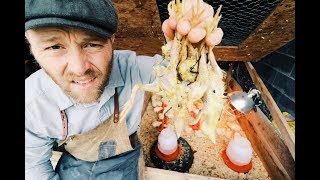
In this informal farm vlog, the narrator (Speaker A) and a child (Speaker B) walk through a day on their family farm, focusing on an unusually high chick mortality rate—14 out of 75 chicks (about 20%) died. They discuss possible reasons, including transport stress, hatchery differences, and timing of arrivals, while noting that other batches from the same hatchery survived. The family uses “magic water,” fermented feed, and warm brooding conditions to care for the remaining chicks, expressing concern over the loss both emotionally and financially ($2.50 per chick). The vlog then shifts to other farm activities: planting and monitoring potatoes, experimenting with mulch and cover crops, hoeing weeds, observing cabbage/kale growth, handling cows and calves (Bear, Violet, Josiah), and constructing a porta‑brooder ramp with nails, cleats, and L‑brackets. Throughout, the speakers maintain a conversational, narrative tone, showing a blend of worry about the chicks, pride in farm work, and collaborative family effort.
Chapters
Ready? Yeah, ready. Let them out. That was their mother. That little box mimicked their mother last night. Everybody made it. No heat lamp.
It's hot.
Warm little bird. They kept each other warm last night.
Wow, Papa, look at their big wings! Yeah, look how big they grow.
What's going on, Jonah?
She can't go. She won't go in.
You brought her all the way here, she can't get her in? Nope. Okay, come on, honey. Come on. Here, here, here. Shake off any ants. No, why don't you just put them in one at a time? There you go. See, that'll do it. Let's maybe cut that one in half.
Oh, Papa, she already ate it. Is she gonna be okay?
She'll be fine. Come on, hand them to me one at a time. Come on, come on. You guys want to shut the head gate?
Lily, no, I want out!
I want out! It's all right, it's been done. Give Bear a little bit of love. Look how big he already is. He's as tall as you almost.
He's almost as big as Gideon.
Yeah, he is. He's bigger than Gideon. Jonah, you got to move the reels out of the way first, honey, and then wash the stanchion for me, okay? Okay. Okay, while Jonah gets Violet out— yay for Jonah— I'm gonna check the sea monsters. Oh no, Mr. Brown! Oh my gosh, Mr. Brown! Hey! Oh my gosh, at this rate, at this rate, the question is how many are dead today. It looks like a lively bunch. There are 2 dead in the corner. These guys look great. All right, let's get their feed, Lily. At this point in the story, I want to say we've lost 14 sea monsters. 14. There are some um, more dead. We're having a problem in here. 1, 2, 3, 4, 5. 5. I've never had this bad of a mortality rate. 7, I would say, be normal. We ordered 75. I say 10% is probably a normal, unalarming rate. That's because I saw somebody sick, but hopefully this trend is over. Do you think it's normal to lose 14 sea monsters? No, we've never lost that. That's almost 20%. That's almost double what acceptable— what's what's acceptable. Here's what I think what happened. You want to guess what happened?
What?
Well, somebody said it's maybe they, uh, it may be the hatchery. This is a new hatchery for us. I'm not so sure because these guys came from the same hatchery and they're doing just fine. We only lost one. I think the difference is we got these in one day and we got the Sea Monsters in two days. There was one dead in the box. Have we ever had a dead chicken in a box?
Yeah, the other, the other batch we had, we had one dead one, I think.
Oh, did we? Okay, well, I don't remember. I don't remember that. You sure?
I'm sure.
Was that last year?
That was last year. No, that was it. That was going through the 100 days.
Okay, maybe we have lost one before in the box. But anyway, it— even last year we got those in one day. We got these in two days. So I'm kind of thinking that it was transport stress. I mean, we're doing all we can. They just warm. They have their magic water, they have their fermented feed, and they've stopped dying. Nobody is dead! Yay, Josiah! It's all part of it. When you bring in life, you run the risk that that life is going to end, that you're going to send life out before it's their time. Here, there's a little dirt in that. Hold on, hold on, let's clean it out. All right, fill it up again.
Fill it up all the way. All right.
It's a little bit of a bummer because one, it's alive. You never like to see anything die. Two, they were $2.50 apiece, and that's 14 less meat chickens we're gonna have in our freezer. Uh-oh. Do we have one? Is that one just asleep?
Oh yeah, that one's asleep. It's asleep?
We might have one dead in the morning. We'll see. Think it's just asleep?
Yeah.
I've been washing everything off over this potato row. We got potatoes planted under here. Do you see what's coming up? The potatoes are coming up. That's exciting. We actually have an experiment going on here. We did one row, planted potatoes, didn't even plant them, just put them on the ground. Okay, what we do just have— this is very anticlimactic for you for this, the mulch one. Okay, all you do is just a little bit, right? Yeah, put in that, put 8 inches of mulch. They're coming through. That was an advantage in the sense that it frosted a few days ago and it seemed to damage this row where the potatoes are exposed. But look, just Come here. Looks like it didn't hurt it. They're coming right back. Also, this row we were gonna hoe out the competing weeds. Well, they're not weeds, they're actually cover crop. You want to hoe out the COVID crops? And then this one we were gonna let the COVID crops go with them and see if they weren't too much competition. So let's hoe this one right now.
The hoe is like long, I think, kind of like this.
This is the hoe. This is the Elliott Coleman edition hoe. Just do a really shallow hoe. My assessment after hoeing, it only took about 3 minutes. I probably saved some of it, I don't know. We'll see, we'll see if it actually needed it. This row we're gonna leave, cover crops are growing. We're gonna see if it actually affects it.
Are these cabbages?
These are probably cabbages right there. Some of this coming up is weeds. Out here we have our collards, kale, whatever it is, cabbage. We have cover crops growing around it, and I'm wondering if the COVID crops had too much of a head start. What do you think, Josiah?
I don't think so. That one looks pretty good.
You don't think it's too much competition? I don't know, we'll watch it. All right, Josiah, let's go get the cows now. Coming out to get Bear. Unfortunately, we have to herd Violet in to get Bear to go in and then herd her back out. So maybe we can one day put double fences up on these lanes and then we can herd just Bear in. Okay, you can.
So close.
See, he follows his mama. Maybe just so I can sneak and grab him. Yeah, I got this. Okay, and then let's, uh, hold him. You got him?
You got him?
You got him? I will, I will. You gonna take him back? Yeah, and I'll move the cows. Thanks, buddy. All right, come on back, honey. Come back. Do you know where Josiah went?
Yeah, upstairs.
What's that?
Just a raft train wheelbarrow, I guess.
What are you gonna carry on that?
Maybe the watering truck if I can figure out how to hook it up onto it.
Jonah, let's go finish our ramp, our porta brooder ramp. Mom got us some nails. Hey Jonah, let's go finish our porta brooder ramp. Mom got us some nails. We can't let the chicks out. We couldn't have put the chicks out today anyway, it's too rainy, but maybe tomorrow. All right, that's all we lack right here, Jonah.
We can attach them up there. Can't we?
So all we lack are these cleats. What did your mom call them?
Steps. Which one do you want?
Get me the thinnest one we got. I'm gonna say these. Perfect. Look at that. Good job, Mom. You got another hammer? You can nail some. Pick it up, John. Let's see if it did it. Oh yeah, look at that. That'll do it.
Now we gotta put the L brackets on.
Yep, let's go upstairs to do that. As for the ramp, We totally— Jonas totally screwed it in. Uh-oh, you're missing a screw there, Jonah. I think that'll be okay. Yeah, I know, it's pretty secure. So this is the idea. You, uh, open up your hatch. Now they're gonna be outside. You hook it on there and then they can come out. You want to try one? Have you seen if it works? Good, it works. No problem. Can't wait till it stops raining. We can put them outside.