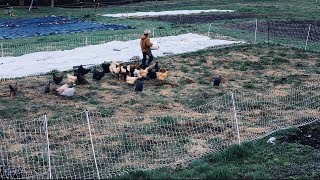
In this on‑farm instructional video, Victor Justin Rhodes walks his family through a two‑week rotational system that moves 30 chickens across nine garden plots to naturally till, fertilize, and weed the soil. He demonstrates how the chickens concentrate manure, how that manure can become overly dense and needs manual redistribution, and how compacted soil can result from their activity. The crew then spreads the manure, covers the beds with an agriculture‑grade UV‑protected silage tarp to solarize remaining weeds and allow the manure to soak in, and discusses the importance of using UV‑treated plastic to avoid plastic leaching. Cover crops such as rye, clover, and Agribon‑treated winter mixes are examined, showing how they respond to the tarp and how they can be cut and prepared for planting after the two‑week cycle. The video also includes a brief dairy segment where Rhodes milks two cows (Flossie and Phyllis), noting milk yields and cream collection, and involves the children in sandbagging and milking tasks. Throughout, the tone is informal, family‑centric, and enthusiastic, with occasional humor. At the end, Rhodes promotes a free sourdough and fermenting crash course by Jill Winger of The Prairie Homestead, directing viewers to a link in the description.
Chapters
We're gonna move them this morning. Johnny, you want to start doing the electric? Thanks, buddy. I'm so excited because this morning we're moving our chickens. They've done their job in here. They've tilled. So this was covered in cover crop. You can see mostly got it. I mean, from this distance it looks like they've got it. But if you look— if you do look a little close, there's a little bit left. But we want to be on a 2-week rotation. It's time to move them out. We're going to plant every 2 weeks on this rotation. So plant them out, move them on to the next week. They've fertilized. Check their manure load. They made light work of I do want you to see this, how heavy this is right here. Look at this manure load, okay? And that had been all over at night, every night, the night before, the night before that. Only a little bit, some residual left, manure right there in the middle. And of course they get out here and eat, and they've got some manure droppings there. So automatic fertilization. Automatic feed for the chickens with the COVID crop that had been rebuilding the soil. And automatic tilling here. This is garden 1 of 9 of my animal garden miracle. We're moving them on out and then we're gonna set— we're not gonna plant right away like we have in the past. There's a few issues here I'm going to talk about in a minute, but we're gonna try something new in here and see how it works. First, let's move them out. How's that going? You having a hard time getting the grounding rod out? Oh yeah, there you go. Now we just gotta move them from here to down there. There's where the chickens are this morning, coming right down to here. Miracle Garden number 2. Look, we've got some rye, we've got some clover, we have some weeds left over. We have some weeds. We have some weeds, but I think the chickens will also make light work of this. It's a big— bigger pot than up there, but I think they should be able to do it within 2 weeks. Let's get them down here. We want to milk in 1 hour at 9 o'clock. I think we can do this in 1 hour. I think we can certainly move them, but can we get, uh, the next step done? I hope so. We'll try. Jonah, you probably have to run that line more downhill. See how it's swinging back uphill here? All right, come on, just open it up. Oh no. Jonah put his handle down here so that he could carry it, but I guess the door can't open there, so we got to move it back.
Papa, more chickens could go up here and jump off.
Yeah. Good night, Gideon. Look at that. Look at the size of that already. A deposit this morning. Gideon's new gift, reward. You know, we thought we'd get them something, help ease their pain with selling the bus. They were a big part of that journey. They should be a big part of the reward. Uh, that's what Gideon wanted. He wanted it for months. You gonna help on the farm now? With it, you got a reverse on that thing?
Yeah, we don't need to smooth our gardens anymore because the pigs aren't here and they don't fluff it up.
That's right, the chickens did a smoother job. We do have some problems in here. In the past, we've just planted right behind them, and that's not the end of the world. We've been doing that for years. There are some problems though that we might can address. Let me show you, show you that. So we have a concentration of manure here. Now this was the day before. I don't know what happened to it. Don't ask me what happened to it. Just one day earlier. See the difference? Last night, the night before last. Chickens are probably a big part of spreading that around, so we need to spread this around ourselves. You wouldn't want to plant into that. That's just too much concentrated manure. So we're going to go ahead and spread that around. Also, it's a little compacted up here. Chickens can do that. They can go from tilling to compacting in very little time. And some of it can be compacted and some of it can be perfectly loamy. See, that's ready. Also, one more problem— there are weeds still. Look at that. That's pretty big. I mean, I could have left them in here longer, sure. But I want to keep on going in a rotation. Could get more chickens. They're coming, they're coming. We're going to get more in April-ish, but then they got to grow up and be mature hens. So anyway, what until then? Got an idea.
How much more time do we have?
Uh, about 15 minutes. I think that might be enough. To put this down, and then we'll have to weight it down after.
Yeah.
Oh, hey, Millie. You want to cut it open? It's the right width, but it's not the right length. Okay, we're gonna have to cut it. You want to start getting it open, unrolling it? I'll go get the measure. You got it. Unroll it, buddy.
Oh, perfect.
Yeah, set up right. Good job. This agriculture-grade UV-protected Uh, silage tarp is going to help kill off the remainder of the weeds, help give the manure time to soak more into the soil. What is it? Time, time to take a nap already? Don't use regular tarps for this. You need, uh, UV treated, otherwise it's going to leach plastic into your soil. You don't want that. Okay, ready? I'm gonna show you how far you need to go. While Jonah gets the scissors, let's look at this. So this was cover crop, covered in Agribon. Let's see what it looks like under there. It got its start under Agribon, it grew the entire time under Agribon in the winter. This part got— we pulled the Agribon off after it got established. It's here, it's here. It does look a little stunted though. Compared to what I see. This seems puffy, but let's see. Let's pull it up. Yeah, look, look, guys. Boom, boom! Growing better under the Agribond even after it's established. You want to cut it or me? Oh yeah, it's going to warm up real nice. Okay, do you want to go start laying out our plastic or do you want to go put this roll of plastic back? I'll put the roll of plastic back. Okay, go. Did we keep that box intact?
No.
You get that side, Lily. I'll get this side. That's starting to warm up a bit. Kids getting outside with me. Right here we have a concentrated manure load. Let's spread our manure load down through the center. Okay, guys. All right, let's cover it up. I got the plastic down. Yes! The kids will make sandbags while I milk, and then we'll hold this down for 2 weeks. I think this is gonna make a big difference for a while. As long as it works, we're gonna follow the chickens 2 weeks, and in 2 weeks' time we move this out. Than directly plant. Hey, you guys, uh, I would say— yeah, wait, we— they can be fuller than that, I'm pretty sure. Oh wow, good job, buddy! Good job! Oh, okay. All right, I would say— do we need— probably— yeah, but this is gonna be enough for the bigger plots too, guys. So I would say 40. I'm gonna leave you guys to it, Josiah. Okay, Lily and I are gonna go milk.
Papa, how do you make chocolate?
Well, it comes— it grows on a tree. It's cocoa bean.
It's a little bit like salt. Can we make our own chocolate?
Then you get cocoa powder and you grind it down into a powder, and then you mix that with honey to make chocolate. Oops, more poop.
Papa, get the horn. There goes— that's a big turd. That's a big turd, Papa. Oh geez, you make huge turds. You poop so much and you're a huge—
Oh my, boom! That's 2 gallons from Flossie, 2 gallons from Phyllis. Yeah, what are you doing? There's no more milk in there, man. I milked her for all she's worth. Looks like you're wrapping it up, honey. I am. You're just cleaning it out now, right? And you got— there's our cream. Those kids are amazing. They got a bunch of bags up here.
Let's put them out.
All right, we got it. I think this is very promising. For the rest of the day today, Monday, March 11th, my friend Jill Winger of The Prairie Homestead is doing a free crash cooking course online. Today is sourdough Bread Monday. But if you're seeing this tomorrow, Tuesday, or you want to sign up today for tomorrow, Tuesday— what's Tuesday? Oh, fermenting. Fermenting feed. It's the fermenting classes, guys. It's free. Check it out, link in the description.