$4 vs $5,000 Farm Animals
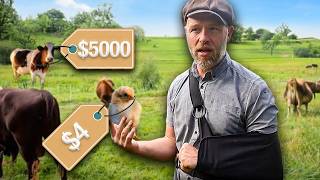
Victor Justin Rhodes and family compare cheap versus premium farm animals, walking through their homestead operations. They cover pricing for turkeys, pigs, chickens, and lambs, plus practical details on feeding, predator protection, and day-to-day care.
Chapters
Hey, this is not where you're supposed to be. Okay, take our food scrap bucket, pour half of it into that white bucket. One of John's work days. The neighborhood kid. Thankfully you're here, buddy. You can be my arm. Okay, something's got— something's gotten into these guys. Oh my word, it's on, but it's not blinking full on. Yeah, something's gotten them. There's one's head. Fence wasn't on.
It was.
Well, it might not have been hitting hard. John tells me when he came, when he went downstairs, Winnie came out. So Lenny was— Winnie was accidentally put up last night. We shut the doors at night and she must have been in the basement. Turkeys, $6 to $8 at the hatchery. These are white broad-breasted. On a homestead, turkeys can be more than just Thanksgiving. If you're gonna grow one turkey for Thanksgiving, might, might as well grow a couple of handfuls. Our goal is to have one per year, one per month. We're down to 12, so no more can go. Yeah, that's terrible. So lesson learned, we're gonna get them closer to the house because now the predator knows they're here. We're gonna make sure the fence is hitting hard, and we're gonna make sure Winnie gets out at night. They're similar to chickens, a bit easier. They don't scratch except for in the beginning. They're a little less hardy, so we have to put them in a brooder for 6 to 8 weeks as opposed to 3 to 4 weeks for chickens. And then when we set them out, we set them out in a chicken tractor to give them even more protection for a while, for a couple of weeks. And then we put them in this, uh, turkey shawl. We have redundancy on those turkeys. We have the electric net, we have Winnie. But in a rare event, both of those failed last night. And something got him. They're following it. See up there by the telephone pole? Put them up there. We're gonna take one pressure off. We're gonna get them closer to the house. We're gonna get their Energizer going better, and we're gonna make sure Winnie's out. We'll continue our animal tour in a second. I need to get prices from the beautiful one anyway, how much some of these animals cost.
Good morning. I am so excited. First tomato harvest. It looks so good. I'm so excited about it. I'm going to make more sauerkraut. I've got my sauerkraut in the cabinet. I'll show you guys this one. I actually got 2 of the purple cabbages in the, in one jar. Another day, another load of laundry. So I am, I've already got my sheets in here. And I'm gonna pick up in here a little bit too because, you know, when you design a home, you don't know what your family's, uh, habits are gonna be. And my family's habit is that they just shove everything in here because of the location. I'm like, it's not that big of a room, guys. I'm going to add a little bit of Borax. I like to wash my sheets once a week. I have not been in that habit, and I'm trying to get back into it. Fridays is our day. It's not Friday today, but it's needed, and I don't know that I'm gonna get to it tomorrow. Got these cars. These goggles go in the boys' room. They are that needs to be back in its place. And I've got some clothes that need to go into someone's dirty basket. I don't know where his toy button bin went. And I'm gonna put this back where it belongs. I did not pick up everything, and, um, that's gonna be all right. Everything should be where it's at. Let me see. We had crazy rain last night, and because of what happened with Helene We're always a little nervous when it gets crazy like that. It was, um, it was just nutso. Like the rain, it was just so much rain in there. Hi kitty kitty, yes, I hear you. I think when it rains like that, um, well, because they were calling for potential flash floods, and so I think for us, we've never— like anytime before previous to Helene they would, um, say that a flash flood was happening. It wasn't ever here. We get a little bit more anxious, I think. The kids, me, you know, I kind of like looking out, and it seemed like the creek filled pretty quickly, which is obviously very concerning because we're like, is it gonna flood? It was a lot less rain, but I think we just, you know, have that reaction.
Now.
So anyways, it poured. I wish I had a rain gauge. That's on my to-find list. I would like to find a rain gauge. I bought one. Anyways, I'd like to have a rain gauge just to see what was happening, like how much rain we got, cuz it poured. Update on my flowers: they're coming in nicely. Everything looks very nice. Over here, which is exciting. I'm going to pull this. There's a morning glory. Oh, I didn't get the whole root. Great. I'm very excited. Lily and I are throwing our friend Ashley Chaney, our editor's wife, a baby shower on Saturday. So we are very excited about that, and we have a whole menu. Hey, you need some help? No, I got it. You got it? We are getting ready for that. Today is Thursday. We're gonna prep tomorrow, and then the shower is Saturday. We went yesterday and bought decorations from Hobby Lobby, so that was fun. I think I'm gonna pull up some of these cucumbers that are dead and dying, and I'm gonna— I have more cucumbers to plant in the high tunnel. I mean, in the greenhouse. These turkeys, man.
Got our turkeys.
What happened?
Uh, something got in the fence.
Oh no. I think it might be— it's too close.
I'm gonna bring the fence— yeah, closer. We're gonna make— that's on my list now, to make sure Winnie's outside.
Lily and I are gonna weed in here. The first 50 feet of this tunnel was a garden bed, but then when Helene came through, it destroyed it, and we had to anyways, when we put the high tunnel here, we had to, um, we had to like make a pad for it. I will never garden without putting some sort of weed fabric down. We had not put that weed fabric down over there, it would be a nightmare. I think it is on this side, it's a nightmare on this side.
So we're gonna, uh, hopefully not have to harvest till Monday, kind of take a long weekend. Today's, uh, Thursday. I'm gonna get with Rebecca and help her weed this real quick before she has to go in. Nobody wants to weed by themselves, and I've got a whole posse. Those boys will take care of the turkey. Stir up the hoe with one hand. I don't think that's very useful. I'll do the weeding by hand close to the plants. Let's talk pigs. I don't know, these guys were maybe— we probably got a good deal 5 years ago. Probably $200, but you can expect to pay $200 to $600 for what you call breeder pigs. These are made for breeding. We're feeding them mostly kitchen scraps. You want to feed a full-grown pig only 4 to 6 pounds a day or they will get too fat. John, you kind of have to hustle before they get over there. They're in on deep bedding. The boys have got to get us some wood chips today, but I mean, you can keep 2 pigs on 10 by That's 60 square foot, 10 by 12. These pigs will give us 1 to 2 litters a year, 10 to 10 piglets— or not a year, yeah, 1 to 2 a year, 10 piglets each time. So 10 to 20 piglets, which we can grow up for meat. We'll talk about meat piglets here in a second. One set of theirs, um, or you can sell them as feeder pigs. And we do that, we keep what we need, and then we sell the other ones for $2.50 each, and that helps us supplement some of their feed. Hey, she got me turkey prices. Oh, babe, so I thought $8 a pulp. Really?
So it depends on how many you get. So you have to get a minimum of 6 if you pick them up at the hatchery, and that's $17. 6 to 15. Geez, 6 to 15, it's $17. If you buy 16 to 24, it's $15.
Wow. Then shipping.
Yeah.
So $20 a pole. So hey, do you, um, if you get 25 plus, it's $13. But here's the thing, if you were to sell a 12 to 14 pound turkey, let's say it's 15 pounds, how much would that be worth? How much is turkey selling for a pound? $12 a pound? No, $15?
Well, I don't know. I don't know. A $10 if you buy it from a farm. If you buy it from a farm, it's $10 a pound. Well, it was when I was buying it. It might be more now. It might be more now because I might have spent $12 a pound on our non-GMO pasture-raised turkey.
Yeah, so that's years ago.
Okay, hold on a second. So that's for the production— that's for the Giant White that we get. For the Heritage, it's much cheaper, so it's $14 for going to $19.
I must have said the wrong name of these turkey. What's the name of the breed?
It's, uh, I thought there was Production White, but it's Broadbreasted. Giant white. Murray's Broadbreasted is, um, $19, $17, $15, $13. So, all right, it's a, it's a range depending on, you know, what you want.
That's only 10% of what you would pay for it though. Of course you have to feed it, but still, it's not right.
Turkey Homesteader's Delight, let's see what that is. 10 chicks from brown eggs, 2 ducklings, 2 goslings, and 2 turkey pults for $160. So it just depends, it just depends upon what you're getting.
Uh, I cannot just pass that nasty weed. See this, about to go to seed. Pull that up. John's got gloves, let him pull that up. Grab these weeds, Gideon. That's pigweed. Go ahead, grab it, grab it. We don't want these to go to seed. Get in.
Papa, you want me to check if these potatoes are ready?
You probably have some. No, I wouldn't. You wait till the plants die. Okay, yeah, look, we feed them all our garden scraps, our weeds, extra produce, leftovers. So it's not that much expensive to— oh yeah, and an occasional dead thing. Pigs and turkeys down. We still got chickens, lambs, and, and the grand finale.
All right, breakfast is done for me. The kids are eating waffles that Lily has made them so kindly. Um, back to the laundry room to switch over sheets and then also, um, towels. Found a treasure in the towels.
Our compost posse helping to manure and turn this compost. We'll talk about the chickens when we get over to the pasture posse. I'm thankful they didn't get our chickens. All right, you guys check the water. Get in, check their nest boxes. You're going to need to be getting hay. Did you bring hay over here? Do that.
I did it yesterday.
Okay. I looked online at Craigslist the other day. You can buy layer and lay chickens for $20. Now these are probably older chickens, they're going to be half their production of what they were. They could be had. These would probably be more realistically $20 to $40. Yeah, turn the, turn the whole fence off. We don't need to be grounding that out right now. What you can expect from them is 3 to 4 eggs a week, so I say you figure out how many dozen, uh, get 4 chickens for every dozen eggs you want a week. Just go ahead and get 5 because you're going to lose somebody, you know. Well, like we lost the turkeys. And then how are we going to get to the sea monsters, the $4 chickens? I say $4. Austin, you're going to have to flash up the correct price. Did you check the water? What about their eggs? Yeah, and nesting material. You go get nesting material. And a thing to get their eggs. And John and I'll go look at the $4 birds. Actually, on our way to the $4 birds, let's look at the $250 pigs. You might be able to get feeder pigs, which you call feeder pigs, where you're going to raise them from 2 months old. You buy them from a breeder 2 months old and raise them till 10 months old. Oh, by the way, these are Gloucestershire Old Spots. We have them on a till job helping us rebuild the land after the hurricane. You get premium organic, non-vaccinated, not dewormed pigs, for me it's going to be $250. You buy that pig at 2 months old, it's been nursed. Yeah, throw them one of those turkeys first, maybe they'll— yeah, they have grain. Okay, Lily already did this. $250, raise them till 10 months old, you get about 150 pounds of pork in your freezer. That's easily worth $10 a pound easily. That's $1,500. And they— garbage disposals. They're showing so much interest, let's give them another one. Just don't want to give them too much and then they don't, uh, eat it and it rots and starts stinking. A pig over 100 pounds, you don't have to worry about a predator. Now I'm thinking about predators here. These chickens are good, their fence is on, hitting hard. We're having to cross the creek. The boys blocked our way. To get down in here. Okay, this is the closest thing we have to a $4 bird. We bought these as chicks. I wish they were chicks right now. Austin, throw up some shots of chicks. We're gonna give them all they can eat until they are 8 weeks old. It only takes 8 weeks. There's 100 chickens here, guys. You do them— this is ludicrous speed.
Ludicrous speed!
Go! You get 4 to 6 pounds in your freezer, so if you did 100 That's 400 to 600 pounds. Those 3 pigs will be 450 pounds in 10 months. 400 pounds in 2 months. Now, a lot of that is bone, not straight up meat, probably at least a third of it. So you're probably looking at 300 pounds still. It cost me about $3 a pound finished meat in organic feeds to do these guys. Organic chicken is $6 a pound. That's not even free range. These guys are free range. They're on, uh, on the pasture restoration project. Did you eat that chicken I gave you yet? John?
Um, last night.
Oh yeah? Yep. How'd you prepare it? Um, we just baked ours in the oven. Oh yeah? What seasonings do you put on it? Um, I do not know. I was— I didn't cook it. Who's the cook?
Um, my mom usually.
Okay. Boy, you think they were hungry. This was my job before I busted my arm, so it's fallen to the wayside a little bit. It won't kill them if they're not always in feed. They can eat you out of house and home, so it's okay that they ran out last night. John, when you were a little kid, You wanted to be a farmer. Still want to be a farmer? Um, I'm not sure. You, you, you can say no in front of me. I don't care. Yeah, I don't think— there you go. It doesn't matter what you— because what you're learning today, you're learning how to work hard. You're learning how to solve problems. It's going to apply to anything you do in life. See, we pulled up that wall. The temptation is to keep that wall because it's already there, but then how do you get the birds around it? So we've been picking up the wall even though we're gonna have to put it back, and we, we go ahead and make the other paddock, and they, they can only come so far. It kind of confines them better. So sometimes the obvious thing, like, hey, this wall isn't really moving, let's just keep it here, isn't the right answer. Gonna have to look outside the box sometimes. We're moving their whole system. They'll move 3 days inside of it. We'll move their meat shawl 3 days inside of it. Meet Shawl Plans at homesteadbuilds.com, by the way. My book— I wonder if we're on Amazon yet. We're at second printing with Homestead Builds. Austin, are we on Amazon? Oh wait, John, don't do that yet. Now set it down over there in the corner. Move the shawl. Try not to run over anybody. Now the trick to getting the rest of them over there is getting their home over there. Getting their home, their feed, their water, and then you're gonna back against that. Okay, I'm glad I moved this. I didn't want to move it. Here, no egg toss. Handed the eggs. Oh, beautiful eggs. We're gonna go check on those new turkey spot here in a second, but first the lamb. Okay, $250 to $400 per lamb. These are our breeding lambs. Relax, you sensitive ones, we're not gonna kill them. We're gonna kill their babies. There's 9 of them here. Our goal is to have, uh, at least 12 babies. One a month. We eat 5 pounds of lamb a month, and that'll about— or a week, and that'll about do it. So one, they'll give 1 to 2 baby lambs each of them every year, up to 2 times a year, once or twice a year. Their pregnancy is 5 months long, so technically if you breed back to back, which we have just started to do, we could have 2— I want to say litters— 2 runs in a season of lambs. Grow them up to about— we've been growing them up from the spring till the fall, so about 11 months. We've been timing birth to be January-ish and then harvesting them about November when we're out of grass. Get about 30 pounds of meat, lamb meat, in your freezer, and that's premium. I'd say that's worth at least, at least $15 a pound for grass-fed, unvaccinated, grain-free. $450 worth of meat. Off one lamb. So mama lamb's given us that twice a, twice a year. So each year she's giving twice her value. Totally underrated, the, the lambs. Easy to handle. They can survive and thrive on grass, unlike a goat who needs bramble. But the sheep also eat bramble. So if you need to get rid of poison ivy or kudzu, they'll do it. They eat a lot of things the cows don't eat. So you can have a cow and a lamb together and not need any more land.
Take this thing off so the cows can mow around it.
Maybe. I'm gonna maybe do it one more year, and then I think they will. That tree is planted in honor of my late father. We planted that in 2019. That's when we started planting trees to create silvopasture in our pastures. That's going to be our first successful one. We should also check our peaches. Get in. John, let's see what you've done with the turkeys. We'll have to fix the fence here in a second, but we've got to see this grand finale. Should I give it away now? As if you don't know— the cows. Protection number 1: it's close to the house. Protection number 2: we're gonna make sure Winnie is not locked up downstairs. Protection number 3: let's fix that energizer. Now that predator is gonna be hot for them, okay? Oh, and that'd be protection number 4: we moved them. So we're going to throw that Predator off. We'd pretty much be guaranteed another kill if we kept that out there. How is this electrified? Turn it on, right? It won't because this is not hooked up right here.
You need some extra hands?
Yeah, this is crazy. Feel it in your spirit?
What, this?
Your other half was struggling? No, life is a struggle.
I came to see—
with one arm. Well, you're here just in time to talk about the grand finale. Grand finale.
What's the grand finale?
We're going to talk about the cows.
Oh, okay. What you doing?
So I'm gonna connect into the electricity. I'm gonna make a loop so people can hook up something to that, and I'm gonna tie it.
Do you want me to do this while you hold the camera? No, I can do it.
This is years of experience, Jerry. Jerry-rigging. This is decades of jerry-rigging, darling.
I'm helping you by, um, what, by heckling you?
Yeah.
I'm getting wet.
Yeah, I don't know how to fix that.
He's got a little leak here. Oh, it'll be fine. The grass will just be greener.
We have to go turn it off. We'd have to go get our heat. We'd have to loosen that up and push it on and tighten it back up.
Try Sure, you go turn it off. I'll find Jonah. This is good. You did a good job. Did a good job. You push this down. Yeah, so, and that turns it on.
That turns it on down through there. Yeah, yeah, that connects it to this.
And you can get this at Premier One. Yeah, if you want to do what we do, which this is not the only way to do things. So I'm gonna go and I'm gonna look and see what I can find. First things first, I'm gonna look in the basement. I see Jonah's shoes down here, so that means he went in to eat. So I need a lighter and the torch in working order. So we'll see what they say. Look, I got zucchinis! I got 2 zucchinis. I was getting worried because I feel like my plants are going really slow and one's like not even producing. Hey, do you know where a lighter is? And I also need the blue torch. Just— I was getting the lighter. Thanks. All right, I think that's all I needed. We'll see.
Shall we talk about our prized possessions? The centerpiece of our farm. The sheep go behind the cows eating what the cows don't eat, getting rid of it, eating the weeds to better our life for the cows. They eat certain parasites that die off in the sheep's system. So they're vacuum cleaners for these cows. Everything complements the cows. The sea monsters out there, those meat chickens, they're rebuilding the land. The pigs rebuilding the land for the cows. Same thing with the chicken. Chickens behind us on the compost pile rebuilding the land for the cows. In return, the cows give 1 to 3 gallons of milk in my experience, sometimes 4 on 100% grass. These are Jerseys, and these are from a dairy that they weren't even for sale. I'm like, what's that one? Okay, and we paid $5,000, I think, for the last one. We've gotten cows as little as— was it $1,200, $1,800, somewhere around in there? So you can find cows for a good deal. They're good for about 5 to 12 years, 1 to 3 gallons of milk. They're pregnant for 9 months, but they're still giving milk while they're pregnant. They have to give birth to come into milk. They freshen, they give you milk, you get more and more, and then you start gradually getting less. But as soon as they freshen, they have that calf, 3-6 weeks usually for us, they're back in what you call heat, ready to be bred. We breed them right back, and so they can give birth at any time during the year. We milk them up till maybe about a month or two before they give birth so they can— we take a break then and give all that energy to the mom to be putting towards the end of her pregnancy. 1 to 4 gallons of milk a day. That's around here, milk is— let's, let's say it's 14, but let's say it's $15 a gallon for easy math. So 15 to $60 a day in milk. So let's say, let's go into the half of, let's say $30. In a month you've had at least $1,000 worth of milk. That's crazy. And then their calf— where's their calf? Yeah, look at that. Can you see her calf in the background there? They give you that calf to come into milk, and that calf can be raised to be another— to be sold as a heifer to become another milk cow. Can become another milk cow for you. We have a milk cow back there, she's 20 months old now, and she's one of those heifer calves we brought up that we're gonna now milk, that breed for milk. These 1, 2, 3, 4, 4.5 cow equivalents are in about— what is this, uh, 2,400 square feet maybe? This isn't going to quite be enough. This is some hurricane pasture here, so we'll supplement with a hay, but In general, a cow is going to eat about 40 pounds of grass a day. That's one little square hay bale to give you an idea of what they are going to need. But they're certainly the prized possession, the amount of milk they give and what you can do with milk. We drink the milk, we harvest the cream from it, we make yogurt from milk, and of course you can make all different kinds of cheeses from— we haven't gotten to that yet. Hopefully that's what This will do. 2 cows have done everything. Oh, butter. You can make butter. Have gotten us everything but cheese. So we'll start growing our own cheese once we get 3 or even 4 cows and milk for this big family that we are. The waste from it, the, the skim, you know, what's left over after we get the cream, is wonderful food for the pigs. Nothing fats and fattens you like some skim milk. Same rule applies to the pig. They're given about 40 pounds— or is that right? About 40-ish pounds of manure a day, I guess, between their— at least between their manure and their urine. And that's going a long way to mix with carbon and build compost in deep bedding situation, or putting it directly on the pasture just to improve our land and make it go further in the future.
Aha! I found it. Okay, there's that. Now I'll go into my Suburban. I think I know where the tank is. I think it's on this side.
Aha!
I think it's not in. All right, here we go. You guys are probably screaming at the TV, no, you were supposed to get one more thing, and whatever that one thing is.
Got the stuff. All right, thank you, John.
This is all I was supposed to get.
I wonder if that's the right kind of bottle. This was leaking.
Do you want me to do anything?
Yeah.
What?
You can unscrew this. Just gonna turn that back on and we're gonna hope it's not leaking. I think it's actually fixed. Nope, it's better. There's a little drip coming through, but we'll take it. It's not a spray. Let's go to bat for these turkeys. We're down to our quota. We got no more margin for error. That is why we get extra. Some expensive pig feed. We're gonna replace these batteries, get them charging. We just put a new couple of batteries in, plugged up the old batteries. Turn it on, John. Let's see what we got. Hopefully it's blinking green. It's not even blinking. Why is that?
I don't think they need it. They haven't gotten out yet.
Well, it's something getting into them.
Do you need to do anything, Justin?
Stand there and look beautiful.
You're funny.
That little tighter. That's definitely a little tighter. There you go.
There we go.
Okay, let's try it now, babe. Ready? I hear it. It's blinking green.
Yay!
Let's call it there, Beck. Happy day. $4 versus $5,000 animals.
More from Justin






If I had to start my Homestead all over again, it could only pick one animal… 




