$7.5k a Month Gardening other people’s yards
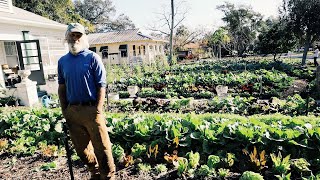
In this interview, Jim—dubbed the “Nomadic Gardener”—explains how he runs a high‑yield, market‑garden operation that moves between Florida in the winter and Maine in the summer. He builds fertile beds using free municipal yard‑waste compost, which he spreads while still hot, adds a woody‑chip mulch layer, and waters in to create a living soil ecosystem that suppresses weeds. Jim demonstrates his weed‑control method (especially nutsedge), dense inter‑planting and rapid succession planting that lets him harvest multiple crops from the same space within weeks. With a half‑acre plot he supplies a CSA of ~20 families and a weekly farmers’ market stall, generating up to $7,500 in a single month. He attributes success to low‑cost inputs (free compost, minimal tools), intensive labor, and a philosophy of local food resilience—showing that a small urban yard can feed dozens of families and inspire others to adopt similar practices.
Chapters
Here we are, an old friend.
Welcome back to Florida.
Let me see if I— yeah, no, it's cool. 4 years later, we get, we get an update with you. I, I called you the Nomadic Gardener because you are farming Florida in the winter and Maine in the summer.
Yep, and I'm still doing that.
What? It's been 5 years. Yes, you would fact-check her. Okay, 5 years, 5 years.
Yeah, we're both a little older, so Look at this.
Look at this front yard. This is in Florida. Are you making this more normal anywhere? Is there anybody on the street saying, hey, as far as— yeah, let's go, let's grow a few veggies in the yard.
But you know, it takes a lot of effort. So, you know, people that jump in and they just get, you know, discontented with all the work. And, you know, so I've been able to continue it, which is great. And I've been doing it for almost 10 years, so it's proven it's a viable way of making a living.
This looks like something out of a magazine. This could be okay on a Martha Stewart magazine.
Yeah, and that's the whole idea. You have it so beautiful into an urban landscape without having, you know, the permaculture police get called, you know, and say, oh, it's ugly.
Yeah, the neighbors aren't calling on you.
No, they come down here to buy the veggies, right?
That's cool. What is the trick? I see mulch. But you tell me what the trick is to keeping it beautiful like this.
Well, you know, you pointed and called it mulch, but you know, it's 3/4 finished compost from the city yard waste facility, right? So they pile up hundreds and hundreds of yards, 10, 12 feet tall, and so it goes hot. You know, it's 160 degrees when they shovel into it, so there's no weed seeds. And I cover it twice a year with an inch of the new compost. So there's a lot of different media in there. So there's wood chips, fines, and what I do is as soon as I you know, spread it out, it's still hot. So I'm considering that's like soil life, right? You know, and so I water it in because otherwise they die right away. But I kind of push it into the soil underneath, and the woody chips float to the top. So I've got a woody mulch that doesn't have splash for my veggies. Plus, I'm also— just think about what I'm doing there. I'm pushing water through compost, so I'm compost-teeing the ground, kind of preparing it for the next year. Yeah, I mean, it's not science, but it pretty seems to work good for me.
And that's, that's pretty much it. It looks good. Some of the more wood chippy stuff has risen to the top and it's going to keep your weeds at bay.
Well, and yeah, because there was no weeds brought in with it, you know, that's awesome. And then the whole idea that we want this perfect finished compost, okay, you know, the woody debris is going to have different stuff. You pick that up and I've had plants go right into that. Okay, so they're looking for stuff. We want to get rid of it because, oh, it's— we don't want that, but the plants are wanting that. And then a little critter will hide underneath that, right?
Yeah.
And so it'll be diversity in soil life because our fertility is held in the bodies of our soil life. That's a whole new concept for me. Yeah, you know, it's not a chemical thing. All those organisms are holding it— dying, living, pooping, having sex, the whole thing. And it's, it's how nature feeds, right? So it's, it's balanced. Different than when we even throw that, you know, 666. That's crazy. Even manure, we can overdo it, out of balance. Nature feeds the right way so things stay in balance.
You're just working with nature. I'm trying to find a weed.
It's very few, you know. My biggest weeds are See those things along the wall?
Okay, yes, these, these flowers. Yeah, I'm not finding any weeds along this way. I'm not gonna do it. That's not even a weed, is it?
That's a plant. Oh my gosh, all the weeds are kind of beneficial. The nasturtiums just come up.
So this—
yeah, that just, you know, sits outside.
Oh, that's not— that's your weed problem? A beautiful flower. I thought you were saying there might be weeds coming around here because the rock wall, the little micro the little, uh, no, it's—
that's what comes up. You know, I do have issues because then nobody's here for 5 months of the year.
Ah, okay.
You know, so there is some nutsedge comes in, the Bermuda grass will creep into the bed, but I can push it back, put the new mulch down, and the weeds are done.
So what do you plant for the 5 months?
So black-eyed peas and sweet potatoes.
Okay.
So if you look at any of Pete's videos, imagine a Perfect layer, the wall height, this whole thing. It's amazing. And then, you know, I come back to, you know, 1,500, 2,000 pounds of sweep a day.
You always stay in the good weather too, right? Great. So fresh here right now in Florida.
Yeah, and the veggies are loving it. It's been hot.
And this is how it feels in Maine in the, in the morning in the summer. It does. It's great. Summer in Maine, it's nice, brisk morning. I'm gonna find a weed and you're gonna show us how you deal with the weeds.
Well, here's the weed.
Okay, that's where we use Oh look, I know he knew right where one was. Is it bothering you?
But just think about it as a farmer, you don't have weeds. That's such a stressful thing that, oh my God.
So it is.
Here's something called nutsedge.
Oh, you found a weed, right?
And so the way to get— this is what you do, is to pop it like this and then trace the nut.
Oh, look at you. Look at you.
So they—
if I would have missed that, pulled it, you would have pulled this and you would have got your guy.
These two would keep coming up.
Wow. You've put down compost for how many years?
Well, this is, um, probably 12 years over there. This is probably 7.
Look how deep that is. How deep is that?
Well, look at Great.
How long till you get to the Florida shell?
It's not shell, it's the sugar sand.
Ah, get us to some sugar. Look at this, and it's turned into—
oh my God, see, it's turned into— there it is, dark sugar sand.
There it is. You're about a foot and a half.
Yeah, I mean, that's where there's so much fertility here, and it's all from my neighbor's yard.
My goodness. And you take your— you take— you take your little red truck and go get this compost?
Yep, it's free.
Or do they bring it here?
They will bring it.
Do most people—
I want to determine when it shows up, when I can use it. So if they just dump it in a pile, it's so much easier, um, you know, get it out of a truck.
Do most people have that available for free?
Yep.
Do they? All the public— all the— yeah, Public Works would have it.
Yeah, yeah, it's a big pile. Yeah, I mean, they get it, you know, 3—
like, I mean, in Florida, but what if somebody's in South Carolina or something?
No, this is a groundbreaking thing for a municipal government to do.
Okay.
You know, so they've got like probably 6 guys full-time running around the city picking up piles, taking it somewhere, and then they bring a company in to chip it, and then they offer it back to us.
What would you do if that wasn't available? We'll just move to Maine.
Um, you know, I couldn't see my— you know, I've seen how fertile it could be, so I might consider buying in. You know, I've got so much fertility here, I could bring wood chips in as a mulch and it wouldn't be a problem.
Okay.
Um, but I just like—
it's hard to start with wood chips, isn't it?
It is, unless you're willing to wait a couple years. Yeah.
Okay.
You know, but I've turned— I've turned— I used to tell people 3 years if you start from scratch with this yard waste for sale stuff. That bed is only a year old outside.
Okay.
I didn't plant that before, so that's pretty fertile. Not quite as good as here, but it's pretty—
yeah, you can tell. Let's look at the difference. So you got Some of maybe a hair scrawny.
Yeah, just a little bit.
Uh, that— is that the same plant right there? Is there your collard?
That is the curly kale. And there's some—
yeah, let's get some. Okay, so he's got a curly kale right there. There we go.
Yeah, but I've been harvesting it. Yeah, you know, pretty heavy.
You've been heavy on it. Yeah. So, oh, you got some starts here right along your— yeah, rock wall.
You kind of caught me in the middle of stuff because if you would have got here 2 weeks ago, this whole wall wouldn't have been full of seedlings. Okay, so they're all there.
Yeah. There, is this another trick, this, this dense spacing for one but also multiple species?
Well, I always thought that when I first started planting, instead of having a monocrop, you know, 100-foot row of collards is a monocrop.
Yeah.
I mean, even though organic farms don't consider it that, whereas if you mix it up like this, you know, if something gets a problem, it's not going to wipe me out because I can just get something else. Yeah, but it seems to work pretty good. And then the difference in, um, you know, minerals or whatever each one needs, it doesn't seem to be a problem. So I can continually plant stuff over and over. And then the idea, using that space, the space of this unbelievable fertility in the sunlight, so I interplant. So as I put these chard and cabbage in, I, I put blocks of the turnips Right, yeah. So as these go, these will finish in 30 days. Chard takes about, you know, 50 days to get to here. So I use that sunlight and fertility to get a crop out of it, right?
Yeah.
And then the other one fills in, and so I've doubled my production out of the space. Ah, double the size of my farm.
I see.
Think about that. Coleman talks about that a lot. And so, and I've also seen how I do that. I don't know, I mean You've been visiting all those guys that got the mini lettuces. Yeah, you know, and you know, they harvest the 30-inch bed microgreens. Yeah, well, not microgreens, more so that baby lettuce. Okay, but I can go through this. It takes time, but I can go through this like I did this morning and take these, right, and put it in my mix. And this isn't baby, this is crunch, this is adolescent greens, like Fallon talks about adolescent grass. Yeah, it's what we want. It's heavier. I can go through this and then 3 days later I can do it again. Yeah, and 3 days later I can do it again. It's more work, but I'm really increasing production out of this space. Ah, and now when I think about weight, I'm probably getting close to what they're getting out of it, because I mean, if they cut and come again with their little machine with the wall drill, I don't know if you get it again or not.
You have no machine.
No, everything—
you have no machine. You have no tiller. Nope. You have no tilther, whatever they call that thing.
All I got is a wheelbarrow and a shovel for the mulch, and then the soil blockers for making the seed.
Is this keeping you young, Jim?
I think so.
Or is it wearing you out?
Nope, not yet. You know, I have a tendency to— if some good, more is better.
Yeah.
But I think I'm in a, you know, really interesting space where I've been able to do this. And so I've got something going that nobody else is doing. So I think it's important for me to show what's possible. And guys like you and Pete have been making that— made that so much more valuable.
Oh yeah.
Because so many people are hearing about it. I got people coming from other states to come and see this.
Cool.
And then they go and start it again.
Yeah, well, look at this. I mean, this is a big story. You have your whole yard, this whole yard, and that yard. What happened over there?
That's mine.
Did you—
oh, that's your mom? There. Yeah. So, okay, um, and so I'll plant that in a succession.
Okay.
You know, and then go back and start planting here again. I've learned that I can, you know, ramp up production. I've doubled production every year since I've been here. I don't know if I can do it this year, but Nice. That's incredible.
How did you convince Mom to let you put a garden in her yard?
Dad to mow it anyway, right?
Yeah.
And so, you know, it was always a mess when they come back, and though, you know, because they're snowbirds too, and so that way they— I'd harvest the sweet potatoes. By the time she gets back, it's all clean with mulch and she's happy.
Yeah.
So she's eating good.
You said you're increasing production every year. What are you making a month now these days?
You know, I think I've made as much as $7,500 one month last year, but I had one day where I made $1,700.
$1,700 in one day?
Think about that.
At the farmer's market?
So I've kind of stepped it up again. So Tuesday is my farmer's market, so that's a good farmer's market. So I'll start at 4 o'clock in the morning with a headlight, you know, harvest for that. But I also got a CSA with like 20 people show up on Tuesday afternoon. Okay, so I do the farmer's market, get done at noon, come home, take a nap, get my CSA bags ready, and 3 o'clock they come pick up.
Yeah.
And then that day I ended up with $1,700 cash. I like it. And so I concentrated my workday too, so now I can go fishing.
So you're going fishing today?
I'm going fishing today.
I'm like, I know you're busy. I came here and I'm like, I know you're busy, Jim, we don't have to take too long. He's like, oh no, I'm going fishing. I like this lifestyle that you've created for yourself. A nap, a siesta, Like, you can't do that out the corporate office.
No. And you know, that's the nice thing about being your own boss.
Yeah, you can totally do that.
Yeah.
And guilt-free. I mean, you got up early in the morning when it was cool, and, and it's so unique seeing the garden with a headlight.
You wouldn't believe what the mulch looks like when the headlights flashes. There's all these little eyes that sparkle. There's little spiders. You wouldn't even see them. Ah, it's just, it's almost magical.
So there's some enjoyment there then.
Yeah.
It's not all just about practicality there.
No, you want to try to enjoy as much as you can. And you know, it's a challenge too. So that's some of my joy in the challenge of showing. And then the response to the patrons that come for your food. I mean, they almost bow to you. Yeah. Because it's so nutrient-dense. They taste it and they tell me how long it lasts. And so there's an appreciation feedback loop. And that's the cool thing. Anybody that's ever talked about being a market or thought about being a market garden, you don't have to persuade people. And sales is not like that usually because I wouldn't be a salesman. You just give them and they'll come, you know.
Has that increased since 2020, more respect for you?
Yeah, because it's continual. You build up, you know, uh, a following just like you have on your YouTube channel.
Yeah, but with what's going on with the pandemic and supply chain issues and stuff like that, yeah, any more respect?
I'd say, you know, people— I think more so that people are seeing what's possible in a small space. I mean, you could feed your family out of just this bed. Yeah, you know, that's true if you follow the same way I'm doing things, you know, using that space really smartly.
How many square feet is this? How big is your farm?
I think it's about, you know, right at a half acre, 20, 22,000.
That's pretty good. $7,500 on a, uh, half acre, uh, month. $7,500 a month. Yeah, you were making $5.8 when I came 5 years ago.
That was a really good year.
You were increasing big time.
And I think, you know, the— and yeah, it's spread out, you know, for that time. And, you know, I'm incorporating the, you know, the nomadic thing, so I'm bringing a lot of stuff still back from Maine and taking stuff up to Maine. So I've got patrons— wow— following me in both neighborhoods.
And then people are buying from the local farm, but they're getting Maine goods. They still know their farmer.
They're getting garlic.
They get— yeah, people in Florida are getting Maine-grown stuff, and they still know the farmer.
They're waiting for the apples.
Yeah, that's good, you know.
And, you know, it's a similar— it used to be better going north with the citrus, but that's all disappeared because of the greening.
Yeah.
Um, but, you know, they're still, um, waiting for me to get back. We got greenhouses up there, so I've definitely ramped up production there.
What would you want people to get out of this? What, what's the takeaway? I mean, look, look at this. I mean, they can see this, but in your heart The possibility that you can feed yourself.
We've lost that thing. We've got to go to the store to get our food. You know, great-grandma used to do this for us. You know, and great-grandma, the kids ate that food and they knew what it tastes like. You will not believe what food out of an organic garden can taste like. Even the industrial organic has nothing compared to what this is. The nutrient density is amazing. So that you can produce your own food, or if you're somebody that's interested in providing food for others. So I'm providing food for maybe 70 to 80 families their leafy greens, right?
Half an acre in a normal neighborhood using their yard waste, right?
But think about how many— 80, you know, 70 to 80 numbers of families are out in our— just this community. So we could support 50 farmers without any problem. Wow, doing this.
Isn't that something?
Yeah, I think so. That's the biggest takeaway I can get from this.
And then there's this yard, there's this yard, there's this yard. My goodness, you said how many families?
I'd say 70 to 80.
You've seen 70 to 80 in 2 houses?
Yep, between the CSAs and the farmers' markets.
So that's 40 families per house. How many houses are in— you'd be hundreds of people off the same property. But the thing is, it's like Daley Coleman talks about, eyes to acres.
Yeah, you know, there's only a certain number of size you could get, and that's the thing we need. We don't want bigger farmers, we want more farmers.
Yeah, but couldn't it be also that This guy had a bee, he could have some bees. This guy could have some chickens.
Oh yeah, because I don't want animals. You know what animals mean. Don't want animals.
Yeah, you, you'll do this guy. But that's the thing, they, they might not want this. They might would rather raise some rabbits or something.
And that's what, you know, the 1930s, '20s America was like. Yeah, you know, no deed restrictions.
You could trade.
Yeah, you could do what—
yeah, you could take some of your veggies and go over there and get some raw milk, right, in exchange. Yeah. All right, well, good. Thank you, Jim. Sure.
More from Justin






If I had to start my Homestead all over again, it could only pick one animal… 




