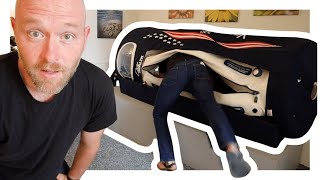
The video follows a patient with Bartonella, a co‑infection of Lyme disease, as they go through a typical treatment day. The routine begins with a Simple and Sinister kettlebell strength‑training session, featuring warm‑up moves (kneeling halos, hip‑flexor stretches, single‑leg deadlifts) and core kettlebell work (swings, get‑ups). The trainer explains that external loading strengthens joints and bone density, which is crucial because Lyme attacks joint tissue. Next, the patient enters a soft‑shell hyperbaric oxygen chamber, describing the pressurization process, ear‑popping similar to airplane ascent, and the ability to read or use a phone inside. Finally, Rebecca walks through a supplement protocol: organ‑meat capsules (beef organs, brain support), shilajit mineral resin, and bone‑marrow/liver capsules, noting that liver acts as a natural multivitamin and the regimen is intended to support overall health and cognitive symptoms such as chronic amnesia. The dialogue is conversational, with the patient asking why each therapy helps, and the others providing brief explanations.
Chapters
I've got Bartonella, a co-infection of Lyme disease, and this is my day. Good morning. Jonah, Josiah, y'all cover these— uncover these plants. Strength training with Simple and Sinister kettlebells. What should we do today?
So we're just going to do our regular stuff. So we switched our warm-up. We're going to be doing kneeling halos, hip flexor stretches, single leg deadlifts, and then swings and get-ups.
Why do you think strength training is so good for me with Lyme disease?
Well, so Lyme disease attacks the joints, right?
Yeah.
Yeah, so anytime that you're adding an external load to your body, uh, it is strengthening and solidifying the joint, right, and your bone density. So So adding an external resistance then helps to harden and strengthen your, your joints and bones. So I would say that it would be completely necessary for part of recovery for Lyme disease.
She's setting me up. I'm inside, got oxygen plugs in right here to a tank outside. We got a little— it's a little book light in here, and this is the inside view. We're not puffed up yet. She's going to pressurize and this is going to expand. This is a soft shell hyperbaric, so you can actually read books, be on the cell phone. I freaked out the first time I did this. You have to pop your ears like you're going on an airplane. Feels just like it. You can't do this if you're claustrophobic. Well, then they do have a window. Got a radio for her to give me updates how far along we are. Pressurization. Also have a pressure knob, pressure gauge.
Okay, so now we're at about 35-40%.
I can tell we're getting near the top because my ears are popping real good. The gauge is moving on up. I'm back. Yeah, Rebecca, can you explain my supplements? Why I take my supplements?
Yeah, I mean, I look like an old man.
Well, they're just— two of these are mine. They're only organ meats, I'm pretty sure. And then the shilajit. So this one is beef organs and then like a brain supplement for your brain.
Okay.
And then it's a brain organ supplement. So it's basically brain.
Nice.
And then this is like minerals. It's called shilajit. And then—
So basically animal and minerals.
And then this one is just bone marrow and bone— bone liver and then a bone supplement.
How does that help heal my chronic amnesia?
Lyme? Well, it's just a support. It's just like bone marrow and liver. Well, liver is like nature's multivitamin.