Animal Systems at ECHO Farm, Florida + Green Dreams + Farmers Market
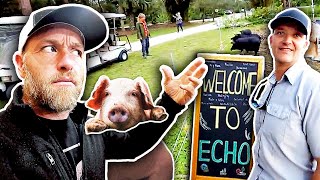
This content was created by Victor Justin Rhodes. This content was uploaded by Victor Justin Rhodes. This is a YouTube video titled "Animal Systems at ECHO Farm, Florida + Green Dreams + Farmers Market" (created 2023-02-14) featuring a tour-style, on-site farm visit and informal interviews/demonstrations. Victor Justin Rhodes is the host/presenter and converses with farm staff and owners (notably Elliot and Rebecca at Eco Global Farm/ECHO in Fort Myers, and Pete Kanaris of Green Dreams in Spring Hill), as well as other speakers and family members at a farmers market. The content covers practical animal-systems topics and demonstrations — chicken tractors, pig tractors and deep-litter systems, watering systems, banana-stalk silage, duck-tilapia integration, heritage breeds, mulching and large-scale compost/mulch management, nursery plans and local farmers-market practices — presented in an exploratory, conversational tour format.
Chapters
In Florida for our vacation. Being farmers though, we gotta experience some farms on vacation. Maybe you can too. On our way down there, Eco Global Farm in Fort Myers. Look at this. 2, 4, 6, 8. So you'll see the highlands, lowlands, semi-arid, monsoon region, uh, rainforest, urban garden, peri-urban. And I'm sure I'm missing one. First up, chicken tractor with Elliot.
Yeah, the idea is, is that we can have something that, uh, we can move to several different fenced-in areas back and forth. This is designed to have around 10 to 12 birds in it. Um, got it just up on a little trailer, lightweight trailer. If you want to pull, you can pull that, that bottom rope. You want to pull that bottom rope a little bit. So ideally this will be right up next to a fence so you're not going to have space to open and close the door. So we just have it from the back in there that you can, you can open and close, also collect the eggs. The nesting boxes will be up here. I can have 4 boxes there once the roof is on. Uh, on the front side, eventually, um, we'll have a barrel here for water with the water nipples, uh, watering nipples in it for the chickens. So they can just access that right inside here. There'll be a little rack, and the plan is, is to catch the rainwater and divert it into the barrel since we'll be in areas where we're not going to have a hose close. So you don't have to drag water out there. Both the front and the back, we've got doors that open mostly for cleaning stuff out. The feed will be in the back in there. Some roosting bars leading up to the nesting boxes. That's the idea anyway. We've had a lot of smaller ones over the years that kind of drag around, and they work. It's just they break down pretty quickly, and they're not quite as sturdy against raccoons and all those other things.
Pigs.
It's funny how close they get.
Oh, they'll test it constantly. Yeah. Look, kids, pigs! They have longer snouts, don't they have longer snouts? We have lots of pigs.
This is our pig tractor demonstration. These are North American guinea hogs, and one thing we really like about them is the fact that they do root up and dig for us. So they're prepping an area, and we've trained them on electric fence so that way we can move them around the farm. So just last week they were in that area furthest away from us, and they've been in here just a few days, and this was a buckwheat cover crop, and then they've rooted that up and they're prepping this for, for the next crop. North American guinea hogs are heritage breed, and they're— they do really well. They're slower growing, so we don't have to turn them over as quickly because we're a demonstration farm and we're not— it's not for production. They're a lard variety, so when we do harvest them, we do get a lot of lard out of them. And the meat is really good. It's actually very lean meat.
Come here and tell me about this waterer, because your whole thing is teaching people how to farm in difficult places. Sure. So different places. Look at this. This is different.
This is a watering system that Elliot helped develop. Uh, so this is Elliot. Oh, okay.
Yeah.
Uh, so he will put these legs on that you can attach to any post. We use bamboo because that's what we have available here. Um, and does this have a—
okay, I see it has a spike. Yep, yep.
So they still tip it, they still tip it. Um, but this is actually modified from a bucket drip system where it's just using a pig nipple.
So this would be a situation if somebody's having to haul their buck— their water, they're going to fill this bucket up. Yeah, once or twice a day depending on how many pigs you got in here.
Yeah, so we do a lot of cut and carry for them.
That's right, you've been throwing this stuff in here, I can tell. And, and how much you feeding them right now at exports or imports?
Very little. I mean, it's just maybe a cup a day. Uh, it's more to keep them addicted to it, so if they get out, you shake the bag and they come running.
That's some affordable tillers right there. Get him up!
Let's go!
Where you going, bus baby?
Come on, get up here!
Come on!
Looky here, I love this system. We did something like this with the pig port What if you don't have much room? You still gotta have pigs for everybody. Yeah, that's right.
You guys smell pigs?
Yeah, I should tell you the truth.
Yeah, we call it a smellless system because it smells less than other systems.
There you go, that's a good point. So it doesn't smell awful.
No, you normally— you can smell pigs before you see them, but this is not bad at all. So this is a deep litter.
I actually smell something sweet. Maybe it's your food that you've been giving them. No, it's okay. So you are using green material as your Um, as food. Or is there carbon underneath there?
There's carbon.
What do you use for carbon in a tropical environment?
Um, really anything available. So rice hulls work really well.
Okay.
Um, so saw— we have access to sawdust and coffee chaff.
Okay.
So we're trying using that. But rice hulls is generally in a tropical environment pretty widely available. So you put down a deep bedding of the dry brown stuff, and then you spray it down with IMO, indigenous microorganisms, or spray it down, inoculate the bedding with a bacteria, and they're going to break down the urine and feces. And so it's going to smell less, attract less flies, and then start composting. And so when the litter gets up to the top and Bertha's at eye level, you can harvest the pig and then dig out the system and start over again.
Nice.
So, so that way the farmer kind of closes the nutrient loop. Yeah, nutrient cycling of keeping the urine and feces compost harvests it, brings it back to his crops. He can even bring the crops to the pig for sure and just cycles it all back.
This needs to be in every homesteader's backyard or right in the middle of the garden. Oh yeah, just throw all the garden extras in there, grow some stuff for the pigs. You got a fan to keep her cool? Yeah, that's nice of you.
I mean, it's getting up in the mid, mid-high 80s some days, uh, even in the winter, but then, you know, get up in the mid-90s, mid to high 90s.
This is just rationing out food. You're not giving it to her all at once.
Exactly. It's just weeds. So the interns weed, maybe weeds here, and then to her.
Hey, you're the pig boy. You think we should put this right, right next to our crop garden?
There's no gate.
It's coming.
There's no gate.
It's coming. Pig port 2.0. There's no opening.
How are you gonna get the track loader in there?
Uh, they, they lift these off. You can lift these off one at a time. They're manageable. Not everybody's gonna have a track loader. You make silage for her?
Yeah, so this is banana stock silage.
So how do you make that?
So it's 94 parts banana stock chopped up. So, oh, right over behind you is a banana stock chopper.
Okay.
Uh, mix it with like 5 parts molasses and 1 part salt.
Okay.
And then just let ferment for 3-4 days and it'll last for a couple weeks. What's happening here?
Yep. And so you've just been digging this out? Yeah, look at that. That's what I was smelling actually. It's a real sweet smell.
Yeah, it's okay, it's good.
And so now she's gonna give up the weeds and go for that. Oh yeah, she says forget the weeds. I bet with all this you're not having to feed her much grain, or at all.
No, we don't. If you feed guinea hogs too much grain, their meat gets greasy, so you want to limit that.
Okay, and she'll get too fat and unproductive.
Exactly. And for breeding sows, you don't want them to get too fat.
All right, look at this hanging water. That's an excellent idea.
The key for deep litter systems is to keep them dry. Yeah, so roof over the, over the top, and then not a trough system but a nipple system like that.
Yeah, I like it. What's powering the water to get it in there? Uh, that is— that's on well water. Okay, so it's coming out here, coming up through there, down into there. I like it. Would you do this again, having the platform? Um, would you eliminate it and store carbon here?
North Carolina, what you do is you dig a meter deep hole by whatever size, and then you just put a fence up around that, the edge of that hole, and throw your pig in the hole. And then you can slowly bring them up out of the hole, and it's— you don't need all this infrastructure. So if we did that here in Florida, um, he'd be in a swimming pool, or she'd be in a swimming pool.
So because our water table is 2 to 3 feet below the ground, how do you get the material out of the hole then?
You gotta dig it out. So, so you're either going to spend the, the money on infrastructure and building it up above ground, or it's going to be under—
Is this some of the finished goods? That's from Bertha.
Look at that. So this is a sifted compost that we had from 2 years ago.
Wow.
So this is what it looks like when you—
when we pull it out.
Okay, nice.
What you'll do is you'll have 3 blue buckets down at the bottom, and you'll have someone shovel it in, and then as the person on the other side turns, the stuff will move down. So you can change the angle Yeah, to make it move down the column a lot more slowly, and then be able to— and then it can have more time to kind of break up. Or if it's real, if it's real dry, then you can have it go through real fast. If a farmer has a body of water already, he can incorporate ducks into it. And so what you do is you care for the ducks You're gonna feed them, they're gonna produce meat, eggs, feathers, and also manure. And so the duck house has slats in the bottom, so each morning when you come out and you let the ducks out, you wash all the manure into the water, and that's gonna feed the periphyton. And the periphyton are food for tilapia. So what you do is you manage the ducks, and as you're doing that, then you're providing food for the tilapia, so you don't have to feed them.
And then once you provide the periphyton—
no, the ducks provide that. The ducks feed it. It's kind of like an algae.
Happen anywhere in any climate? Wow.
Uh, and so any climate like ours? Yeah, in the summer months. So it's really algae. Um, so you can have surfaces— so tilapia are grazers more than filter feeders. So if you have a substrate, the periphyton algae can grow on they'll actually graze it off of that.
Could we have tilapia in North Carolina?
You could in the winter. You might have to—
would it work for all these kinds of fishes, or it takes the tilapia? You need a grazing fish?
No, you get— you would have to either— and most fish you can probably do filter feeders because there's going to be enough algae in the water. Anything that would be able to eat, eat the algae or parafiting.
Well, you don't want ducks in our pond. He looks at me like I'm crazy. You don't want to swim with the ducks? Ducks are nasty. He's like, you could swim in it, but don't open your mouth. Don't drink any. Look at these beautiful eggs.
So these are Turkins.
Yeah, why do you call them Turkins?
Uh, that's just the breed of chicken.
Oh, it's a breed?
Yeah, it's— they're not— they're not crossed between it.
I thought you were trying something funny on me.
And so there are naked neck chickens, which makes it easier to harvest. You can actually find their neck.
Yeah, nice.
And they have fewer feathers, so they put more energy towards meat and egg production. They do pretty well. They're not broody, so you do have to hatch the eggs, but they do really well with dealing with the heat here too.
Oh good. You have a similar situation that you had over at the pigs with your coop. You have a deep bedding down?
Yeah.
Do you inoculate it?
Uh, we, we did at one point. We don't do it as often as we should, but kind of the same thing, a deep litter system. So up in North Carolina where you're at, you would actually— it would start composting and producing heat in the winter.
Yes.
Where we don't need that in the winter here. It's like we bundle up.
It drops today.
Oh yeah, for you, you drop below 70, you grab a jacket.
You know, so I'm tobogganing on. What is it today, 50?
Oh yeah, it's probably— I think we got down to 46 last night. Oh yeah, freaking out.
Yeah, breaking out the down feathers.
Cracker sheep are Florida—
really?
Florida native sheep.
What?
And the Spaniards brought them over in the 1500s. But then when they went back, they had baggage limitations, so they couldn't bring the sheep with them and just left them, the cows and the sheep.
Wow.
So they adapted to South Florida, or all of Florida.
Isn't that something?
And so the noisy ones got all ate up, Miss Dot.
Come on, baby sheep.
And so the sheep tend to be quieter. So this is a silvopasture system.
Okay.
Our arboretum is our collection of avocados, and we have citrus, lychees, white sapote, black sapote, jackfruit. Fruit, longans, and mangoes. And what we do is we graze them underneath it and they keep the grass trimmed down. And if you move them often enough, they do very little damage to the trees. And so we're able to kind of have a synergy between the sheep and the trees where we won't have to mow and weed eat this, but they do that for us. And a byproduct is wool. So Cracker sheep actually have a good quality wool.
Wow.
May, June, kind of right at the beginning of hot season. And then we actually have some local ladies, they're called Lee County Spinners, and they get together and they clean the wool, they comb it, and they spin the yarn, and then they gift it back to us and we sell it in the bookstore.
Nice.
But then we also— they provide meat, but the grazing is phenomenal.
They're getting upset at you not paying them any mind. No, I want them to let me hold the baby. She's gonna try to catch the baby. You're gonna be able to catch it. She's gonna sneak and grab the baby. There you go. Now it's trapped. Oh, she got you. You want to pet sheep?
They're really soft.
And then when we arrived to the beach house, stocking up on groceries. At the farmer's market. This one was Bonita Springs. Can you go grab a thing of carrots? Yeah, you want one or two?
One's probably good.
That's what we're looking for. We are the farmers. It's interesting because you could totally tell there's a couple of booths here wholesaling, like buying wholesale and just retailing the fruit. It's not like what you think of when you think of farmer's markets. You think you're getting from a farmer. So they have to say that organic-fed eggs here. So we're getting 8 dozen. Our question was, how many are we allowed to get? Sometimes you have limits. Are you the dad? Oh yeah, the farm. Yeah, you're the actual farmer. I'm the actual— yeah, see the sign there? We are the farmers.
Yeah, we are the farmers.
Some are like, I don't know, I think you're buying wholesale.
No, so that's different than all the rest here.
So yeah, the way I—
the way we roll here is, is that we, we actually grow everything Everything here except the eggs is the only thing on the table that we don't grow.
So yeah, I noticed the kids. These your kids?
Yeah, this is my oldest, Simeon. Yeah, and he works on the farm. He does about 18 to 20 hours a week on the farm.
Nice.
And, uh, my daughter Annika is there. She's transporting something. Yeah, my youngest Benjamin over there. Yep, somewhere around.
How many?
It's 4 of them.
I noticed he's barefoot. Here in Florida, he probably never has to wear shoes.
Do you ever wear shoes?
Uh, yeah, when I have to go to the store.
The big issue down here in Florida is that almost everybody at the farmers markets are resellers.
And so, yeah, okay, there's a—
it's—
produce is really cheap because there's so many large farms.
Yeah, we have to really kind of like make a silly sign like this that says, I know, I know, right?
To like set us apart, you know, from the others.
Yeah, they don't do that necessarily in North Carolina. Everybody's a farmer, right? And that might be the rule, I don't know, but here is not the rule. It's true.
It's on the farmers market and we sell out of bins, plastic bins, whereas where you look under the tables is cardboard boxes. Ah, that's how you can know if people are trying to cue in on who's a real farmer. The real farmers sell out of plastic, plastic bins that we reuse.
That's right, because this was not shipped to you, right?
We pick, we pick in plastic totes.
Okay, that's good enough. Yeah, I'm not sure everybody knows that. I think they come to this assuming— and that's 12 Seasons Farm, Florida, for those that come down this way.
We're in Fort Myers.
Cool, Fort Myers. Yeah, and it's every day is bring your kid to work day on the farm.
Yeah, let's go.
Rebecca's like, are those people for real? And I said, look for boxes Look, there's boxes. I feel like this is an exposure. Like, I didn't know this, but I'm glad to let you guys know this. If you ever go to a farmer's market, now we know. Is that evil? No, but if you're going to the farmer's market to buy directly from the farmer, that's not the point, and you need to know that if that's what you're aiming to do. She's surprising her dad with a Florida key lime pie. He's a native Floridian.
So it's gonna be really special.
Here it is, Big Daddy's special treat. Hey, Big Daddy, I got you a treat. Oh, you got you a key lime pie, but it does have gluten in it. I figured you'd eat gluten. Yeah, I could eat it, baby. I'll put it in the cooler after your lunch. And lastly, a farm that is going to be amazing— Spring Hill So go with me right now with the Green Dreams founder Pete Kanaris and catch the vision for this farm. Look, Henry, the tractor! So Pete, what do you do with this loader?
This is a mulch-pushing machine right here. Although I have to say, this is a 13,000-pound machine and I want a 30,000-pound machine because as you can see, we've got a ton of mulch. Yeah, so this bucket, I probably get about a yard and a half, 2 yards. I've got a a 10-foot-wide root rake, I can get about 3.5 yards in, but still not enough.
How many yards of mulch do you get every day?
It averages 150 to 200 yards a day. When we cleared this property, I had hundreds of comments, you know, bring in a grinder, why don't you mulch all that stuff? Well, when you live on a highway that's this busy and these, you know, the trucks are coming by all day every day and it costs $5,000 a day to get a grinder out here, it makes no sense, you know, when they're They're bringing in the free mulch, you know. I'm getting the amount of mulch I would have ground in a day for free.
Yeah.
Um, so we've done a lot of burning out here with invasive species.
This would take 75 trips with this to keep up with your mulch every day. Oh yeah.
Well, now we're not moving it every day, it's more or less piling it every day.
Oh, okay.
Yeah, constantly just stacking it up into windrows.
All right, let's go see it.
This is Mountain Green Dreams. This is the largest mountain in Pasco County. Um, but this is our education center, I guess you could say my version of ECHO here in Pasco County. Education retail sales of nursery, produce stand, you know, kind of, um, what you saw at Echo.
And we are at square one.
You couldn't even see in here. This was all invasive species. We had a lot of cherry laurel, camphor, rain trees in this area. Couldn't see into the property whatsoever. And as you can see now, we have this giant mountain of mulch. Um, you know, people always ask me, if you want mulch, how do you get mulch? And I put a sign out by the road. I actually took it down a couple weeks ago that said mulch wanted. Started as one guy, now they've all found me. You know, like I said, we get 200 yards a day. I mean, this is just bottomless organic material.
Otherwise they have to pay to dump it. One man's, uh, waste is another man's treasure, you know, because they're out doing tree service. So then what are you going to do with all this mulch?
Well, so in our plan and the property, we actually— our goal is to have a large market garden in this area. So we have to get rid of this mulch to put a garden in here. Obviously there's going to be some really good soil underneath it. You want to climb on it?
Y'all go to the top, go climb the mountain. There you go, look, follow brother.
So obviously a large portion of this mulch is going to be used to develop the land, build soil, but we have more than we know what to do with. So we're going to be breaking it down for compost running chickens on it. I have a couple of different grades of mulch that we've gotten. I've gotten some stuff from the county that's already pretty black. That's what we're used to start our garden areas. Then I have some of these, you know, more aged piles that have kind of started to break down. We plan on running chickens over them, putting electric fences over the windrows. So the goal is all this mulch will eventually end up in the back of the property. Now fortunately, you know, I do a lot of big jobs. We've got mulch for jobs. I've been selling it at wholesale, and we estimate we have at wholesale, the cheapest you can find mulch right now is $12 a yard. If I was to sell this at $5 a yard, I mean, there's $50,000 in mulch right here that came for free. Um, you know, so this is either going to be a product to help us build revenue to build buildings on the property. I mean, just multiple different avenues, whether it's a, you know, a cash stream, whether it's to build soil. Um, I, I couldn't say no to these guys once they started coming in. Once you start getting a mountain—
um, what's up?
You want to climb the mountain?
You want to go up?
Let's climb.
Let's climb the mountain, dude.
So does it ever make you nervous, this much mulch coming in?
I was a little bit intimidated. Um, my biggest intimidation was I didn't have a space to put the mulch in the back. Yeah, you know, it got to a point where I was coming up every day and pushing and pushing and pushing them. Now we've coned them. Let's— we're not allowing them to dump here anymore.
We're climbing, climbing the mountain. This is a Florida mountain right here. Look, it's already starting to break down right there.
And you can see the part we piled first has already dropped down a pretty large bit. You know, it's already starting to settle, it's already starting to break down.
Pigs would be insane on this too, you know. You could layer corn as you go in here.
That's a good idea too.
They would be insane on this.
You want me to let you loose? You want to go?
They would turn this like crazy.
You want to let them loose up here?
You talked about chickens, but they'll just get the surface. But pigs would— pigs would deep, deep, 6 feet down in here.
So Nick's idea was as to finish the compost, to have pigs, you know, for like that finishing effect, taking it to the final stage before we put it in the gardens. Because, you know, a lot of these areas that we've prepped for garden areas, I used the oldest mulch I had, stuff I got from Pasco County, but it's still very woody. Ideally, I need to put some manure on it. We need to cover crop it before fall, and we're going to plant.
Yeah.
And I probably need to put some compost over the top of it, you know, if I, if had to buy enough compost to put 3-4 inches over the beds we have at wholesale, it's probably $6,000 in compost.
Yeah.
So ideally we make that compost ourselves.
Where's your— where are you going to get your nitrogen for this mountain of carbon?
Well, chickens. I mean, there is, there is a fair amount of nitrogen in here because this isn't pure wood, you know. We are getting the leaves, we're getting the twigs, you know. So as this stuff's breaking down, I mean, look at this.
Wow, we've already got soil here. Holy crap, at 12 foot. You mean 12 inches?
No, I mean 12 foot off the ground. It's breaking down this high at the top. Can you imagine what the bottom looks like?
What you're saying?
Yeah, it's even more broken down. And this isn't even the oldest. So the further we go that way, you can see how the pile gets lower because that was the initial piled one. So after we get over here, this will eventually settle to that same height.
Eventually this will— the nitrogen would just speed it up. You'll eventually have compost here.
Yeah, people don't realize that all mulch isn't created equal. You know, we go to a box store, we go to a landscape supply place, typically it's cypress which came from a swamp. We don't all live in swamps, um, and it's pure carbon like you mentioned. Like, what are you gonna do with all this carbon when you get it from the tree guy? You get the leaves, you get the twigs, kind of get that carbon-nitrogen ratio. We're fortunate enough where I'm far enough north we don't get a lot of palm we don't get a lot of those invasive species. So, you know, most of this whole area, the pioneer, that climax species was oak. So that means that bacteria, that fungi is present to break that stuff down. So when you put this stuff down, I mean, I was just working in the yard before you came over, Justin, doing some clearing, and I have places where I've been mulching, I could stick my hand in the ground, you know, to here, that was pure sand prior, and it's just, it's pure worm castings. Um, you know, so eventually, you know, the only problem I have is, you know a ton of good soil. I mean, it's a good problem to have, you know.
How did you decide which trees to keep?
That was pretty easy. You know, most of the trees here were invasive, so most of the trees were camphor trees, a lot of cherry laurel, a lot of rain trees. We tried to retain all of our cedar, all of our mo—
um, what's that tree? Oak?
Yes. And sadly, that was probably one of the only big grandfather oaks I had on the property. It was completely covered in vines. We cleaned it out. It's not looking very healthy. I'm really hoping this one comes back because a lot of my trees are laurel oaks and water oaks.
And there's a cedar, beautiful big cedar. What's that one to the right of it?
It's a magnolia.
It has a more smooth bark. That's another magnolia.
No, that's a, uh, water oak. And then to the right of it's another cedar.
Nice. Come on, Henry, let's go! Come down the mountain, man. He's a little Okay, so Pete, this is your first— this is Green Dreams gone public. Well, we kind of outgrew our neighborhood, and this is how the public can interact with you now.
Yeah, there's not a lot to see yet, Justin, but you know, next year when you guys come back, I think you'll be looking a little different.
I mean, well, you're opening the nursery March-ish. That's not long.
Hope to have a light opening here in March and then a grand opening this summer. So we'll at least be opening up with nursery sales, mulch, compost sales.
And the time I come back next winter, we'll have an event here. 2023, this will just be exploding.
That's it.
You see the tractor? Will you play on it? Yeah. All right, you guys take care of the tractor. Yeah.
This is going to be our shade nursery, kind of our main sales area, and it's going to kind of give people a spot where they can get out of the sun and shop instead of like the area behind you. We're going to have about 20,000 square foot of black mat with bamboo and eucalyptus and fruit trees on drip. Um, we'll probably have an overflow what's in this area, but kind of give people a, you know, a little bit of a rescue. Um, get out of the hot sun in the middle of the summer, give them a little protection underneath here.
And you already have plants for this, right, from your place coming over here in March?
Already got the weed mat. Um, getting a little farm office kind of going right now.
And this is Green Dreams. And tell folks what city this is.
So we're in Spring Hill, Pasco.
Are you on Google yet?
It says opening soon. Oh, opening soon.
People look up Green Dreams, it's gonna say future home Springfield. Where is it?
Spring Hill, Florida.
Spring Hill, Florida. They're gonna see you on the Google listing.
Yeah. Okay, Green Dreams coming soon.
This is what happens when they, they bring it. They just drop it off here. And you take your loader and get it out of the way.
Ideally, we're trying to make it look like that to the left, so a big windrow.
Oh, okay.
So yeah, and you know, as these get completed, the next windrow, the next windrow, and we'll hopefully get to a point where we're using this material as quickly as it's coming in and we don't have to turn them away.
Look how dark that's already gotten.
So this is the really good stuff that we put in the garden areas that I was telling you about. It has some bigger chunks of wood in it, but as far as like Soil life. I mean, this is like— it's got a lot.
You come and turn these windrows?
We're trying to get a program going where we actually turn them. Like I said, it gets hot enough, it does break down. But ideally, you know, we move the whole row a full spot to the left, we move the whole row a full spot to the right. So we're going to put electric netting around here, hopefully build a connection.
Chickens will help you do that.
Yeah, with a couple of restaurants, produce stands, you know, that are throwing out a bunch of edge. Get that material, stick it in here, and maybe every 3 months we rotate the chickens from windrow to windrow. And then ideally, finished product would be running the pigs through there, like you said, and we have our finished compost for our garden beds.
Look, this is what, a foot, 18 inches?
This is about a foot of that really good, um, Pasco County mulch that we got, which is probably the most broken down stuff right now. It's kind of drying out a little bit. Ideally Um, I just found a chicken farmer that's out in Dade City that sells dump truck loads for $150 a load. So wow, we're gonna buy 2 big loads of chicken poop, cover this entire plot, cover the other garden plot against the fence, and then we'll put beans on there. We'll put black-eyed peas, cowpea, whatever nitrogen-fixing cover crops. And hopefully after we pull the COVID crop, maybe just lightly coat it in compost and we're ready to plant here in fall. So Florida is a little bit different than the rest of the country is our growing season for vegetables. It's typically, you know, September through March, April. You know, in the middle of the summer, we're more focused on our perennial crops, our fruit trees, our food forest systems. So that's what a lot of the other areas on the property we planted out with was demo areas. We can show agroforestry, you know, we can show a food forest, we could show a butterfly garden. So most of this land that's not in production use will be in demonstration type use.
Time to go.
You ready to learn how to move some mulch, huh? He's ready, he's ready. Dump truck, dump truck, dump truck.
He sees the dump truck.
Oh, you can hold him.
Everything's a tractor. Big heavy equipment.
More from Justin






If I had to start my Homestead all over again, it could only pick one animal… 




