Assessing the Damage of Hurricane Helene
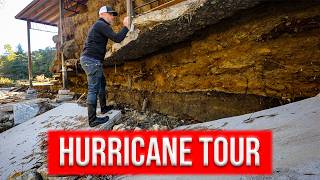
In this 45‑minute on‑site vlog, the farmer walks viewers through the extensive damage caused by Hurricane Helene on his diversified homestead. He documents flooded front‑yard, washed‑out concrete footings, collapsed culvert, destroyed high tunnel, loss of topsoil and hay bales, and a deep sinkhole that reshaped the creek bank. He notes the impact on livestock – chickens, geese, cows, sheep, and bees – and describes how some animals survived while others were displaced. The narrator details immediate repair priorities (re‑filling the creek, rebuilding fences, replacing concrete footers, acquiring fill dirt, chainsaw blades, and a generator) and the financial strain of lacking flood insurance. Community assistance from Reverend’s Farm (diesel, wood chipper, labor) and donations of hay are highlighted. He reflects on the broader lesson of living in preparedness, emphasizing continuous food abundance (eggs, milk, meat), backup power, spare tools, and a “Living in Preparedness” class series he plans to launch. The video also promotes his Abundance Plus membership and upcoming workshops on winter and disaster preparedness, positioning the farm’s experience as a teaching case for resilient homesteading.
Chapters
We were hit by Hurricane Helene. There goes the power pole. It's washed away concrete. Emergencies abated. It's actually time for a fall farm tour, but this is going to be a hurricane assessment tour. First of all, this whole front yard was flooded. Fence— this was all flooded. Water was coming through here. It actually was so large of a hole under here, chickens were getting out. We had to mend that right away. Right next to the chickens, always a good idea to have garden. Permanent chickens blew out the side of the raised bed. I think I tried to blow that one out. I mean, that is an advantage of raised beds. It's why we did it here, actually. We've had rain here before. I mean, not this far over— over there. We didn't lose our crops because we had raised beds. On the other side of the chickens, oh my word, I think wind actually might have gotten this first, but this is coming out of the ground. This is not long. This is gonna have to be fixed first. You know, permaculture teaches us start right outside your door. This is gonna have to be high on the priority. Our chickens were going to move to the high tunnel. We don't have a high tunnel anymore. You'll see that in a second. Out of our front yard, down to our driveway. Our driveway, which became a river. It missed our greenhouse, guys. It just— you could see water just coming right there. This little culvert here totally got filled with, with gravel and will have to be pulled up and replaced. It's just full of gravel. Gosh, it doesn't take long to get to some of the more serious damage. I'm thankful these chickens are still here. The geese were loving the storm. The goose is loving it right here. The chickens were not. Some of them even weren't in the coop. They were perched up on the compost around the side. We've got this fence Probably destroyed, maybe not. Certainly gonna have to be cut shorter. Premier One fence. The pole barn is still standing. There were times that we didn't think it would be. Digging stuff out like this is gonna move property lines, y'all. It's washed away concrete right next to it. The creek was way over there. This looks like a river here still, guys, but it's not. Some of the most devastating destruction because either we bring in a ton of field dirt, or we just embrace what it is and just bevel it. Oh my, look, it went underneath the concrete right here. It's probably 8 feet down. Damage is intense. It's washed away our metal platform. Some of our gutter drains are just out. It's washed away our concrete platforms. That's probably going to have to be broken off. Right there. We're probably just gonna do without. Although nice, wasn't absolutely critical, not with the cost of concrete these days, probably double what it was. You can see the history in the earth, the lines there. We had to shore up these two poles, they got completely washed out. We're thinking while we can, huge concrete footers. Oh my God, I'm sort of freaking out. This is not cheap. And of course we don't have flood insurance. Nobody has flood insurance. It doesn't flood here until it does, I guess. Hasn't rained like this since 1791. We lost a good corner of hay to the storm. I lost probably 100 bales right there, but from the crazy blowing wind, you know, for the blowing rain, normally we're just ready for some of the outer some of the outer hay bales to even just parts of them to be ruined, it's fine. But it was like a fireman came here with his hydrant and just hosed it down. I've been pulling off ruined bales. This isn't just wet right here, this is like soaked right here. And here it was flooded. It wasn't just wet here, but this whole hay bale got flooded. Thankfully, I think there is someone stepping up to the plate and delivering good hay to the area and is going to help us out there. From the hay to the garden, you can see the water line all the way up here. I mean, water was going down our stairs over there and over here. It just so happens that our house is just on this little knoll. We were completely surrounded by water, but it stayed dry. The high tunnel did not stay dry. But here, it not only took our high tunnel, which can be replaced, it took soil that we spent years building. Not only did it take our topsoil, like, it's getting in the subsoil here. Like, we're 2 feet— we're 2 feet in the ground here. You can sort of see maybe where there was, you know, the little rows. The sweet potatoes, albeit covered, are fine. We're going to be able to have a wonderful sweet potato harvest. And we'll remember— always remember Boots, my late dad. I'm glad those survived, although our curing place for those is right now being used as a solar-powered clothes dryer. We'll have to go show you that in a second. Oh, oh, we thought that was a deep crevice. I'm standing where the garden part— big part of the garden was. There's this huge sinkhole, comes up to about right here, so maybe 5 feet. I did see some fill dirt for sale up the road, a lot of fill dirt. The boys want to fill this in back all the way back to where the creek was. The creek was way over there. Guys, it was over there. Really all entails is just putting those rocks back over here. Thankfully we have some machines. That's going to take an ungodly amount of fill dirt. I'm wondering, what is nature telling us? What does fate want us to do? How do we roll with these punches? Because we don't want to afford 10,000 loads of, of dirt. Logs we already worked up, more trees to work up. We're fixing to go to a sad spot. Rocks washed up. Yeah, we'll take all the rocks that have washed up and things like that, and that can help build up the banks. Right here, the bees. Oh, there's something left of the bees. Some of the concrete platforms, we couldn't save them. There went the bees. These trees were swaying like crazy when we realized the water might hit the bees, and it was just too daring. One of you guys actually assured me they probably swarmed. You know, they have scents like the cows and the sheep did. The cows and the sheep went to the top of the mountain. I missed the bees. I missed seeing them out here on the various whatnots. We have stacked our brush directionally. Reverend's Farm, who has really stepped it up to do some relief work in this area, is telling us they're going to get us a wood chipper. Talking about building back soil, it's all this carbon. We've been blessed with all this carbon with these down trees. We're gonna have more than we're gonna know what to do with, so that will help us build back soil. I can replace a high tunnel. Our compost was on high ground. The animals are continually making it. I can build back a garden bed on top of the, you know, the ground there. But what do you do when it— you got a whole plot gone? What do you do when you have untold tons of land gone? Like, percentage of an acre, that's hard to rebuild. We came real close to letting you guys out. See the leaves? Water got up to there. I think it would have gotten to them and probably our house had not the water just started eating away at the banks. Pumpkins, not too heartbroken there. Garden beds certainly need to be rebuilt. The poor pumpkin trellis, nothing left of it. Oh my word, has this come in clutch! We fixed that Wednesday. The storm was Friday we hooked it up to our house. Reverend's Farm donated some diesel. We weren't sure if we were gonna be able to get diesel delivered. As of filming this, tomorrow will be 2 weeks without power. We got us a backup. Redundancy is key. I would recommend, folks, get a whole house generator. Work towards that. But in the meantime, this. I would recommend folks getting it to where they could plug in their well pump to a generator like that. And that was, that was $1,000 new. But if you can't afford that, you could do Craigslist. You cannot— you cannot not afford something, you know, go to Craigslist or something. This needs to be high on the priority. I feel like because we have that, we have a lot of meat, we're able to keep it frozen. I feel like, you know, I kept saying, well, there's nothing we could have done to prepare for this. But when you actually corrected me and said, no, you're very prepared, and I thought, oh wow, we are, and we, we live prepared. My drone pilot today, thank you for all the cool drone shots between, uh, spots. Get one of me going to the— from the house to Harriet. We're trying to give you perspective with the drone shot. All right, let's go see the other pasture Harriet had washed up to the— got blown up to the road. So Harriet, we've just having to run her a little higher up. We're losing pasture here, guys, because this would be on the rotation. And with losing hay and losing pasture, you know, talking with the neighbor, seeing if we can't lease something, you know, everybody's kind of chipping in, you know. People are bringing us hay, so I do think we're going to be okay. Let's go down and see the soccer field, what it did to our pasture, Lily's horse ring, the bridge. Oh my gosh, I don't even want to— I've been thinking about how I can help people achieve that abundance, which in turn prepares people. You live in preparedness. You're not like afraid storing up cans of food and things like that. No, you're, you're living about— you're in a continual flow of eggs, milk on tap, meat constantly and continually in your freezer so you're ready for anything. Here we had the blizzard of '93. You Northerners are gonna laugh at us. It was like 2 feet of snow. But for us, that doesn't happen. And so our infrastructure isn't there. We don't have the trucks to plow the roads. And we were up without power for 2 weeks. You couldn't drive on the road because of the snow and stuff like that. You just never know what's going to happen. And then with COVID and supply chain issues and things like that. This has kind of been a wake-up call to me. Let me tell you more about the wake-up call in a second. This was the soccer field. I thought we lost it, but once Josiah started digging things out, I realized it's still there. The soil is still there, the grass is still there. Look at this massive pile of just sand. So we can use that to rebuild some of our banks. We are going to leave the creek here. It was 75 feet over. It had a little turn, had a 90-degree turn, but we know nature is not going to allow that in the end. We kind of like— well, some of us like how wide the creek has become, therefore how shallow it is and easy to cross. This side, we're thinking, isn't, you know, we'll be able to graze it now. We couldn't graze the pretty place, it wasn't worth it before, wasn't enough. But we could graze this. Lily could have her horse ring. Let's go see what's left of Lily's horse ring. Oh my gosh, so glad we did not invest in like a proper ring with like proper material. We just did it on the pasture. We've got panels that are mobile and hopefully mostly not destroyed. In some ways, some things are going to be better in the end, but we got a lot of trees down on it. And one of my Abundance Plus members is saying, hey, I'm a disaster relief worker, I'm going to come down and help you, I've got a wheel loader. Look at all this material. Okay, but how do we get it up there where it came from? A dump truck would help us. We're putting out fillers there. We're putting out fillers for people who can build bridges, or more or less people who can design bridges. When I've gone out into the community and I see what we have here, a lot of it's so big. A lot of this, you know, littler stuff that folks can help with, although, you know, we can always use a good sawyer and a good support person for them to, you know, work up some of this stuff. I don't know if I can go this way. All right, let's try. A lot of material. Probably another pile there. Thanks for that, which stayed on our property. This is the old creek. Holy moly, I've not been here yet. See how far it's jumped? It used to come right there and come down through here. One thing I think I'm gonna do for folks, for you all, I'm gonna create a Living in Preparedness series. We were already going to do winter preparedness. I have that class all ready to go. That was going to be October 6th. We're gonna have to delay that one. Look at this tree though. Let me show you why I call this the pretty place. I mean, it's still pretty, right? It's still pretty. Winter preparedness, disaster preparedness, and that would be going over stuff like helping you guys set up with a generator, making sure you guys are getting appropriate chainsaws, and just some best practices that we've done right through this crisis, but also that we've learned through this crisis. So that would be another class. I'm where the bridge was. Yeah, thankfully we have the machines. One of our strong points, preparedness in other ways, you know, besides the event, is we've got eggs in continual flow, and we keep eggs going even in the winter. And some people struggle to keep— a lot of people struggle to keep eggs going in the winter. We've got that. Let me guys go show you one more thing. We also have meat in abundance. And so when this storm came, when we were going to get cut off from civilization, out of communication for 5 days, we were okay. We had plenty of meat, we had power through our generator, and we had salt. We're good. There are the cows. Here's where they're coming next, and then the day after. I'm creating a series of classes. Our power will be back on soon. Life will be back to normal soon. Living a life of abundance, that is. Living a life of preparedness. Continual eggs, milk on tap, meat in the freezer always, and disaster preparedness. A big old tree to pick up like today or the next day. Jonah's gone to town to see if he we can't get a chainsaw blade. And I told him, we gotta have— we're learning so much— spare chainsaw blades. If instead of waiting until our fuel's a quarter empty, half, you know, and then we're replenishing it, and then we're always ready. We just live in preparedness. Many of you have also said, well, how can we help you? Well, that's how you could help me. I mean, the membership is our business. It's how we, uh, live. It's our job, and we thank all the members who are out there in this. But we want to give back, and you know, we're going to create a series of classes that hopefully, hopefully will— I know that will help. So I'll leave a link for that down in the description. That's also at abundanceplus.com. We appreciate your support during this time, uh, but let us also give back because it's more blessed to give than to receive. A little energized that I could. We never hooked it back on. The animals sure do love their freedom. And they, uh, they figure it out. They jump the fence. Thankfully they just jumped into the cow. Come on, let's go back. Come on, they're gone. Hey, hey, hey, hey, uh, Ike, you missed it. Had a gravity-fed water system going to these guys. There's probably a dozen trees on it. It's not flowing that great. It's not flowing good enough, so we've just resolved to be on the well, which is on the generator. And you feel that when we're running it during power hours. Look at her. Isn't she beautiful? Look at that pot belly, short legs. Oh, that's gonna be our family milk cow. Oh, what? No, no, you stay over there. I want you to be with the ladies, okay, in case they need you. I think he finally did it. I think he finally bred them. It's been a minute. It's been like 6 months. Come on, dude. That's one of the tricks right there. You want to be in continual milk. Hey, all right, all right, you just spend time on them today then. Get you a bull. Or keep the people continually— sorry, that's not what I need to say. People for cows. Keep the cows continually bred, even if you have to do AI. Not artificial intelligence, artificial insemination. Keep those cows continually bred. It's urgent. If they don't get bred after, they need to keep on having calves so that when they have a calf, they freshen and they come in, milk them new, and you get a buttload of milk and again. Plus you have a calf to have as a female, to have an additional milk cow, to sell for income, to eat for meat. It's a little boy, you have a steer, you can, you can steer them, and then you certainly have meat, and that's part of your continual food program. I am going to do a basic class on keeping the family cow as part of that, keeping in continual milk and meat. Stuff. It won't be like preparedness, preparedness class. Save one, we'll do one on disaster preparedness, but the other ones are like living in abundance. Just keep it milk, let's keep it meat, let's keep it some meat, let's keep us an egg. Here's how to do it. I guess the, uh, the winter preparedness one is the prepared class, but it's not doom or gloom, guys. It's centered around abundance. Butter, continual potatoes, eggs every day, and abundance to take to our other family in town. What does that mean? Butter. Ah, I see. Thank you, Lily, for stepping up clutch in this critical time. We appreciate it. Oh, is this for me? Yeah. Thank you. We can teach you how to live this way. We can teach you. Live Prepared, link in description. Happy day.
More from Justin






If I had to start my Homestead all over again, it could only pick one animal… 




