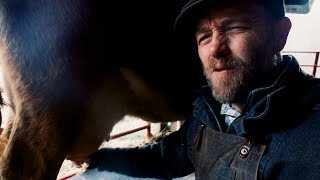
In this vlog, Victor Justin Rhodes (Speaker A) walks viewers through a day on the farm that starts with a tour of a makeshift blanket fort and quickly shifts to treating a cow named Phyllis for mastitis. The team—Rebecca, Jason from Sow the Land, and others—demonstrates a hands‑on milking protocol that uses a calf to stimulate milk flow from an infected quarter, applies injections and udder cream, and monitors milk yield, ultimately achieving a breakthrough where the infected teat no longer clogs. The episode also showcases farm infrastructure designs: a 36‑slot soil‑block tray, 4 × 8‑foot raised beds, and a chicken coop (chick shawl), all drafted in 3‑D CAD by Jason, who shares his background in computer‑aided drafting. The vlog blends instructional farm management, collaborative design work, and community engagement (Polyface Designs sale), ending on an optimistic note about the successful treatment and upcoming construction projects.
Chapters
So how'd your hay fort turn out yesterday?
Great. Good.
Okay. Let's see it.
Okay.
Do you want to give them a tour? Because I don't think I can—
Yeah. Yeah. The holes are too small.
Squeeze through that.
Here's the first hole. Just let me take the camera. Okay, then you come up the hole and there's this big room-ish thing. And there's 2 holes out of it. There's one down there and there's one over there. The little alcove right here. There's a hole that comes through here, and then you go up this over here. You can stand up, and then there's another hole that goes into that hallway.
Yeah. Day 2, treating Phyllis for mastitis. What we want is this teat not to stop up. So far so good. We want to be able to milk it all the way out. Without it stopping. Ah, really? Really? All right, I want to say that it's not as hard. Her udder's not as hard. I want like an unquestionable test, and that would be being able to milk her all the way out without it clogging like that. Hey, can you bring the apple cider vinegar for her? I'm just— I have this resolve that we're just gonna have to keep doing this no matter how long it takes. I mean, she's eating, she's drinking, she doesn't have a temperature. We're gonna milk her 3 times a day more if we have to. All right, Jesse, let's, uh, we've separated the calf at night so we can get the other milk from Phyllis. The idea of having the calf on her was hopes that she would drink from the mastitis teat, but it gets clogged and the calf just gives up and just milks the other one. So defeats the purpose of having the calf with her 24/7. So let's, uh, let's get— let's harvest some milk. That's the first round of milking there. That's not a whole lot. I mean, it's natural to slow down as our calf gets older, but maybe not that much. More now. Is that where you're supposed to go poop, Royal? Strawberry patch. Hey, you know what's interesting? She brought the milk down in this infected quarter and it's milking, so more came down. So we might not have been able to— we might not have been getting it all because we needed the calf. To induce it. So we're gonna, uh, I think we'll do that every time. We'll also use the calf to really get this down. Yeah, look how much more I'm getting. And it's flowing, it's flowing, it's not plugging up. Wow. Jonah came down with, uh, Flossie. I poured a bunch of her— buttered a bunch of Phyllis's milk in this reservoir. And then got a little bit more from Phyllis. Phyllis ended up probably giving us, I don't know, uh, over a gallon. So that's good. I got that much more out of her teat. That was her infected teat, so I'm encouraged because it's been a while since I've been able to milk that much without it plugging up, plugging up. So maybe we had a breakthrough. We'll see at noon. The infected quarter can go into the pigs. You guys are getting her trained pretty good.
I guess the handle is pretty fat.
Nice.
She wants to go home.
Hey, it's— she's almost— she's gonna be 6 months soon. You guys are gonna miss her when we sell her? Oh my, it's not a hay fort, it's a blanket fort. Morning round. We are gonna do an injection in the teat and then rub her teat down with an udder cream. At noon we'll do the drenches and maybe you'll have an empty-ish stomach. Jason is here from Sow the Land. I've contracted with him to help me with some more of my plants. You know, it's been 2 hours the calf's been separated from mama just to let that medicine kick in. Let's go ahead and get them back together. There you go. Interesting place for this. The chick shell plans are here. You know, Joel's builds and Polyface Designs are so popular by you guys. We're having that sale on Polyface Designs. What if I put some of my own designs to you guys as a bonus? You guys want that? I'm thinking, I'm thinking this amazing soil block tray that'll hold 36 planters, really simple. Really simple build with 2x4s and just ply, plyboard on the bottom. It fits 4 across perfect. 2-inch soil blocks is my favorite block size, and I think it's like 36 blocks. If you start plants in a soil block, you're going to want some place to end up transferring those plants, right? How about one of these handy dandy— or should I say nifty— raised beds, 4x8-foot raised beds. And then if you have a garden, you might as well have chickens next to your garden. You're gonna need a coop. So here we have a chick shawl not in use because everybody's in the greenhouse right now. So I think that what we're gonna do here is go over some and just double-check the measurements and update these plans and get them to you guys. What do you call these drawings that you do to turn this, this real physical concept into this?
Just basically 3D CAD drawings. Yeah, computer-aided drafting. Yeah, so we just basically turn a sketch and draw it nice and pretty.
Where did you learn CAD drawings?
I actually went to school for that, and I got my associate's in that, and I did 17 years of computer drafting before I moved here.
So do you like doing work like this now, or are you like so over it?
You know, before we moved there, I got burnt out at it. That's why, that's why I'm here, you know, 17 years of that. But, um, I enjoy it now because it's almost like I'm doing it when I want to do it.
Okay. You know, if I don't want to do it, I won't do it, right? Yeah, you've got to say no, I'm busy. Yeah, busy on Monday.
Yeah. And it's doing like fun things like doing this chicken tractor. Like, that's, that's not normal.
No, that's right. See how it's attached there, right? Because otherwise this would just be loose and probably too loose, just hang down. All right, said goodbye to Jason, good friend, does good work with those designs. Rebecca, you want to— hey, day 2, come on, halfway through here. Phyllis, let's, let's see if you'll milk all the way out without any clogs. So getting her head to the side here, hold it tight with a rope halter. You shoot this straight up in there. Nice. All right, Becky, what do you think the chances are?
I feel, I feel it's gonna be good.
I feel like the chances are gonna be good. I'm committed to do this for as long as we need to. You know, I didn't even bring any hot water down. I know, I noticed that. So I guess I'm hopeful or forgetful. One. Okay, it's going right now.
Yeah.
What? We did it! I milked it! No blockages. I'm telling you, it's a crazy day. We got the guys back for the pole barn, gonna put in some more poles so that we can hang our hay racks. So I'm gonna put a time lapse on these guys, they're gonna get it done. Those guys got it done. It's now the evening time and we're going to Treat Phyllis. Okay, milk's coming. I think, I think that's it. I don't think there's any blockage. There's not much milk buildup. You know what that's telling me? That, that the calf is nursing. Yeah, it's all getting out. Yeah, heck yeah.