Building a Homestead in 100 Days - Day 23
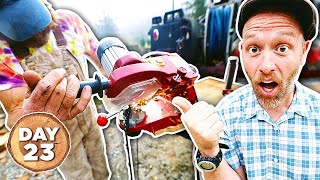
In the Day 23 vlog of the "100 Days Building a Homestead" series, Victor Justin Rhodes and his crew tackle a variety of on‑site tasks while celebrating reaching one million YouTube subscribers. The episode opens with a discussion about the difficulty of hand‑sharpening chainsaws and a trial of an electric chainsaw sharpener, followed by a detailed calculation of chicken feed requirements using a third‑of‑a‑pound per bird rule. The team debates whether to move lambs and sheep between paddocks, weighing factors such as water, electricity, and grazing time. Jeff, a local filmmaker, joins to film a short piece commemorating the subscriber milestone. The vlog then shifts to land‑clearing operations: deciding between using a track loader, backhoe, or manual methods to remove stumps and trees, and repurposing a mineral feeder as a pig port for composting. Throughout, Victor shares practical tips on chain maintenance, equipment handling, and animal feeding, while the crew reflects on project priorities, time constraints, and the overall progress of the homestead build.
Chapters
Day 23 of 100 Days Building a Homestead. It's hard to sharpen our chainsaws by hand. Today we're trying an electric chainsaw sharpener. Happy day everyone, it's the burning up cooking show. I heat all the time, that's good. Now you cook your eggs in that, keep these warm. Get in, bring your eggs, we'll get it from the high tunnel. We just ran out of chicken feed and opened up the next one. This is like— it's not ground up.
Oh no, I mean, it's— it's—
they could probably eat it if we soaked it. Okay, so you have— do you have enough for today?
Yeah.
So we have to count birds in each posse. And then we need to ration out the next day's food and soak it. Did you count them?
Yeah, 18. Okay, I'm gonna go check that.
1, 1, 2, 3, 4, 5, 6, 7, 8, 9, 10, 11, 12, 13, 14, 15, 16, 17, 18. Okay, so you got 18, I got 18. So 18 birds divided by 3 is what? Uh, 6. So they need 6 pounds of feed. Every day.
1, 2—
we're going to do a third of a pound per bird, so that's 6 pounds. I should probably concentrate. That's 6 pounds for that posse. That's 4. I already know what a pound— I already know what a pound looks like in this scoop because I've weighed it out before. And see, this is whole corn and grains, well, how are they going to break that down?
20 chickens and 1 gargoyle.
Oh, okay, so we'll say that's 21. 21 is easily divided by 3.
22 chickens because the goose eats twice as much as the chicken.
Okay, then let's say 24 then. Okay, now let's get for the other ones. This problem could actually be a solution because the grain's cheaper and the soaking it makes it go further. We don't have any chicks at this time, so it's not a problem.
Problem.
When you feed it tomorrow, put it in the— just put it on the ground and the water will just go in the ground and then the feed will be on top. Yes! No, no manure. One, one little turdlet. Only a little bit left, but tomorrow they'll have the soaked grains. We'll see how they like it. How they doing?
Good.
You guys see this? Do you see how much work they have done in here? You guys remember this was a jungle? Sure, somebody died, probably because they ate too many tomatoes. But if you're not going to be smart enough to not eat what poisons you— the smart and the strong have survived. Today I have a decision to make for projects. We moved the lambs up on the hill, need to be moved. So do we move them over. They've got one more paddock up the hill. Or do we move them down here on the acreage we're working to clear for the 100 Days of Building a Homestead? I'm tempted to skip that paddock and just move them down here because that's the focus of the content lately, this 100 days. But on the other hand, I have this holistic farm going on, and it makes— in that sense, it just makes more sense. To have them graze another week up top before we bring them down. You got good lighting, huh, Jeff?
Beautiful.
Jeff is here, local filmmaker, doing a story on our million subscribers. And what's your angle on the million sub story? What inspired that?
Yeah, so definitely a milestone for Justin, and looking forward to sharing it with everybody that watches them on YouTube. That does it, Lily.
Right there. A million subscribers! Thank you guys, thank you! We hit it last night as of this filming, so it was Sunday. A friend texted me the picture and he caught it at 1 million even. That was neat. 1 million subscribers! It's crazy. When we set out to do this, we thought 10,000 maybe. So thank you, thank you, thank you for everyone who has subscribed. Plus, you can behave yourself. We got one leash hooked up. Let's go get the other leash, bird, and the pans. Maybe we'll come get this with the tractor. We'll see if it's a lucky day. —If we're lucky. And if so, we could come get it. Hey Jeff, is this as steep as you imagined it?
It's a little steeper, to be honest.
It's hard to capture this on film. It's so steep. We got down the hill, mom's coming out and she's like, wait a minute, this could be the pig port. We were gonna come up this road right here and take it up to the top of that pasture over there, but Jonah remembered we've pulled all that silt out of the pond. I'm like, let's get the mineral— we have a sled that we could pull behind Sal. It's very heavy, we use it in our pole barn over the winter. I said we could do that, but Rebecca said, uh, yeah, let's do that for the cows and we just won't be under the milk sled anymore. We only need it for the minerals really. Now, could we turn this into the pig port? It's beautiful enough for her, it's beautiful enough for me. She has some idea for some remodel, but we could put this by the garden and begin having pigs make our compost. All right kids, let's get this over by the garden then. There's our mineral feeder. I'm actually about to run into it. Problem is it's a different mineral program. Hey, why are we bringing back back the pig port. We used to have a pig port right there. Why'd we get rid of it? Well, we were just importing our compost, and this year our source dried up. We got it from another source, and this compost just doesn't feel right. Smells— has like a rubbery smell to it. It was ugly, the one we had. So could we bring back a pretty one? We need to put it right there so that the trucks can come and drop off wood chips down the bank where there the pigs are making the material there Then we haul it, haul it slightly downhill to our gardens. We're wheelbarrowing the material down. Want to work with gravity. As much as I don't want to, we might actually have to run Sally into the garden to get this spot in place. It is 9 o'clock. That's one good thing about this fall back time change. I feel like I'm behind, and then I look at my watch and I have an extra hour, so it feels like 10, but it's actually 9. There's sheep net up there. Yeah, I did forget we need to move the sheep so we won't be able to jump right into sawing. I am having a problem with sawing though. I'm not— and they say it's hard to really get it right by hand, so I just send the sharpeners off to Mark again. Right over here is where we're building the homestead, so I'm tempted to put the sheep in there, but we do have one more paddock up the hill.
Oh yeah, they're out.
You guys out of food? We'll take them down the road there. We could bring the net down through here and around right through there. We could see if they even eat this savannah grass. I caught some. I don't know if that's what it is. We have a lot of this on the property, so it'd be interesting to see if they eat it.
There's nothing to eat up here.
Yeah, I'm having a hard time making this decision because we do have to encompass a big area to just buy some more time. Or do we start moving people now? Problem is we don't really have water down there, we don't have electricity down there, and if we move them here, we buy ourselves some time to get that set up. Here. Now that could be telling, guys. If Mark's here, I'm done messing with these sheep, I think, and we'll just throw them some hay and get sawing. Let's see if he's got a saw. That could be possible.
You can mark it so you'll know, right?
So I know when I get back around. How long does it take you to sharpen a chain?
Uh, after I get it off the saw, about all day. Maybe 10 minutes.
10 minutes. How do you know how much to do?
Well, you can set the depth right here, but I just know how far to go down. I just go down, you know, right to the bottom of the curve. You see, you've actually got a line on that tooth. See that line? That's your angle.
You think that angle's like 35 degrees?
Well, I do all mine at 35. Okay. Seems to last a little bit longer. A burr. You see what happens on the edge of that right there? Oh really? And you can put a sharp blade on there, it still will cut. Oh. It's catching. That one had a bad, that bar there had a bad burr on it. How long does the chain last?
How many fuel sessions?
I usually get a season.
It's according to how much wood you cut. You cut a lot of wood. Oh, you'll get a season out of one chain? Sharpen? No, if I don't put it in the dirt, I will. But you—
oh, you only sharpen it if you hit it in the dirt, right?
It won't dull unless you put it in the dirt. Well, you know, there's a little bit of dirt. That's part of the sawmill.
Yeah, there's dirt on the trees, right?
When— that's why they debark them before they saw them, because the bark dulls their blades. And then now spin it around.
Yeah, angle on both sides, otherwise you're going to cut crooked. Wait, right? Yep, which is what I was starting We just cut these this way.
Yeah.
And now it should fit. For doing the flat file for getting these teeth, you don't have to do it as often?
No, just maybe once. Sometimes you never do them, right?
Only if it's sticking up higher than your blade. These are a long way to go from sticking up.
Oh yeah, yeah. Okay. I mean, they'll wear— if they wear down, what that's for, that's called a drag tooth. Okay. And that keeps it— if you see a big, a big commercial saw like you see on these These hydraulic saws on these machines, they don't have drag teeth. They got a tooth there. Okay. But it's controlled by machine, so you don't have to worry about kickback. Good to know.
How tight do you— now you got that much spring in it, how much spring do you put in it?
Well, you want to be able to see two teeth.
You want to be able to pull up and see two teeth exposed?
But you usually— So you need to tighten it up a hair. Yeah, but you have to do it to get it just right. You have to get that on something and push down on it. Oh, you know, see, that's about— why is that? Why do you have— because as soon as you start sawing, you're putting pressure down. Uh-huh. Uh, if this blade was down when you tighten it up, it'll loosen up. That's my problem. If you've got it up, yeah, if you push down on it right there, I mean, you probably got a good tightness right there. Yeah, I'm gonna go a little bit more. You can—
you really can't— what happens if I run out? It looks like I'm about to run out of room to tighten it up anymore.
Uh, you still got— oh, you'll never get— you'll never run out of that. Let's see, that's about—
that's about right. Yeah, that's about right, right there.
Okay. And if you want to hold down on it— okay, all right, that's holding down. Put that on something to where your saw is off the ground, and you want to tighten it up while you're pushing down on it. If you know that trick, Jeff, just tighten it up with that.
My father-in-law taught me well.
Nice. Where'd you learn this stuff, Mark?
Um, my dad. Nice. Yeah, I cut wood all my life. That's where I learned to drive. I'd work all day on Saturday just to get to move the truck from one tree to the next.
Now what do I do if it loosens up as I'm sawing?
Just loosen these. You just got to turn them just like a half a turn, just loosen them up, and then find you something to set your blade on to get this off. Okay. And tighten that screw right there, you know, just tighten the chain back up. This is the most important part, is to set this on a log of wood or anything and push down on it when you tighten these two bolts. Okay, that's good to know.
I haven't been doing that right.
And that way you get it as tight You know, if you've done it with it sitting right there, you just adjusted it. Yeah, that blade bar's pushed down at all. Okay, then you start cutting, the bar comes up. Good deal.
Let's go try the sheep on this grass, see if they're even gonna eat that, and we'll make us a decision. Are we gonna saw or move sheep? Do they eat it? Looks like they eat it. We could figure out what this grass is. We could read the books. Could the sheep eat that? Or we could just test it. I say we come throw some hay in here. I say we move up and we go saw for the next hour. It's gonna have to be one or the other. Wow. What, Josiah, you are voting for sawing? I'm kind of voting for sawing. You know, it probably would be better if I would do one project for longer because there's too much. Transition stuff going on. So I don't know, I just don't want to move the sheep right now. I want to get some chainsawing done, but maybe tomorrow that's what we're just gonna need to do. It's not as fun, it's not as cool, but it needs to be done, and it'd be more efficient if I just— one project for longer. Now here's the thing about chainsawing. I don't know, but an hour you're pretty good. You're pretty tired. So probably don't want to do that more than 2 hours. And the kids get tired too, don't you?
Yeah. I've already— Do you like it?
I came this close to ordering one of those electrical chainsaw sharpeners. Now I'm like this close because I just need to get inside and hit order. That's the patch of savannah grass we need for the sheep. Is that worth it though? All that trouble to get them down here? We gotta get electricity over here. Water over here. You can mow it with your blade trimmer. And wait, you want to do that this morning, like 10 minutes?
Sure, I'll do it. You know what you could do? I think we should put them in Africa. There's more weedy stuff over there.
We used to have the camp that simulated what it'd be like to live in Africa, so we call it Africa over here. Well, if we're gonna get them there, we might as well— we're getting water down. We're getting electricity down, we might as well have the sheep do this too. Yeah. All right. Okay, it'll be better. It might not be the end of the world to have them come in stuff like this too tomorrow. We'll get on it, but today we're gonna have some fun and chainsaw. Now with a fresh sharpened saw, how far can we get on our little pasture here? Hey, do you think a track loader would push this stump? Yeah. And uproot it? Oh yeah.
A track loader? Oh yeah, it should. Yeah, the higher you keep them, the more leverage you'll have.
So how high would you keep this? Josh is also clearing land on his homestead. I think maybe that's maybe a hair short.
Yeah, it's a little short, but it should be thick enough it won't buckle.
So maybe one like this, keep it right here. Yep. Even—
yeah, yeah, a little higher.
It's good to have a filmmaker that is, uh, also experienced clearing pasture.
Uh, I've just been cutting these down to the ground, but just dig right out, no problem. Yep.
Oh, with the—
yeah, yeah, you just get some dirt, pull up the roots. I didn't think about that. Yeah, anything that small.
So maybe I shouldn't even be— yeah, maybe I shouldn't even be pushing this, cutting this down to the ground level. I mean, Joe, Joe cuts them down to the ground level, then bevels it, and that's it, he's done.
Yeah, yeah, you can definitely do that. Of course, then you have to worry, wait for decay, you know, for the root ball. This way you are disturbing more soil, but you're getting it going.
That's the drawback of the machine, is it would really tear it up coming up in here. But we reseed it, feed sheep hay on it, and restore it pretty fast, pretty quickly.
Yeah, I'd cut it right about here, get about 4 feet up, about 4 feet up, get a good bite of it with the front loader, and then just push it on over. The root ball should pop right up. If you have to, you could always dig around a little bit on the edges just to free up soil some and just push it right over. Another downside to doing it this way is you've got a lot of root balls to deal with, but I just burn it.
Yeah, do you fell the tree first or do you just push it with the whole tree?
So you can cut them down, that's probably the safest bet. That way it doesn't come— yeah, you know, hitting me on the head. All right, that's the safest thing, cut it down but leave enough.
Yeah, just push it over. I like that because whether we then decide to do the Salatin way or get a machine and push it over We can still work today. We still could do something today. We can cut this and then decide what to do with these stumps.
Problem with stump grinding is you've always got that root ball back under the ground there. You can only go a couple of sprouts up and it still could sprout up. This way you're taking care of business, you're knocking it all out.
Yeah, I should have left that a little higher, I guess. Yeah, a little bit. But this one's gonna have to be done. Fortunately it's not too— can you dig up, up with a track loader or you have to have a mini X for that?
So I've got a tractor and the pitch is okay so you can dig down in. I'm not—
but you don't do it with the loading bucket, you do it with the backhoe?
Well, you can do it with a backhoe. I've done that. I've got one tractor with just the front loader and it'll dig down in.
I'm a little nervous getting Lucky over here though because the slope. I'm afraid I'm gonna flip it. Dang, you got a big one there. Just the small stuff. And I got to be careful not to hit the ground. And it's going to dull my saw getting down close to that laurel.
Oh yeah, look, it's dirty.
Cut that down to the ground. It's just filthy. It's going to dull my saw. Dull my saw, put a chain around it, pull it up with a bucket, or scoop it up.
You've got some animals that can help you root all that out.
Well, yeah, that's because if it re-sprouts, I don't care because the animals just eat it and eventually dies because they keep eating it. A vision for today Now that we're down to like 30 minutes, I want to do something even if it's wrong. We're just going to— we're going to clip the tops of things. We'll leave that for maybe pulling it up later. Look at this guy, he's back from PT. Hey, did they let you walk without a crutch? Yeah, just a little bit. Look, not very much. You did it! Yeah, how's that feel after 8 weeks? Feels good. That's a long time for a 15-year-old. Get in, come help us haul brush, my man. Come on. Time's out. I'm happy. You happy, Josiah? Yeah.
Well, you got with it.
I tell you what, what we thought was just a little sprouty forest is turned into quite the project. Yeah, I'm glad we're getting the branches out of the way. These stumps, we'll be able to come in here with something, even if it's just to come back and saw them. The $200 is going to be worth it for that electric sharpener. It takes half the time to sharpen a saw and gets it done right. When I do it, the saw ends up being— saw's crooked and just isn't as, as nice. That was super nice. Big Gip's got me going for another PR. 4 of What is this? How much weight? 24 kg.
Yeah, all right. Let's do one short. Okay.
And then one more documentary style. All right, nice.
And I was thinking the short could be, I did it, I hit 1 million. Thanks, guys, we appreciate it. Uh, just more of the excitement. Make sure it's all plugged in tight. Yes.
Billy, your chocolate's done. Okay. Jonah, you crushed it, dude. The burgers look great. Mom, you want to be interviewed? It's a big milestone, guys. Million subs. Million subscribers. Congratulations. How does it feel to be a YouTube family? Good. Good. That's all you know. The Block's fruit cellar. Don't worry, the block layer is not here today. We're not going to see anything exciting today, but we're getting closer.
More from Justin






If I had to start my Homestead all over again, it could only pick one animal… 




