Building a Homestead in 100 Days - Day 11
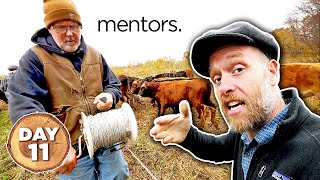
In this episode of the 100‑Day Homestead series, Victor Justin Rhodes visits the Doherty family farm to capture a hands‑on tour and extract practical lessons for building an affordable, small‑scale homestead. The conversation moves from a light‑hearted arrival (lost shoes, travel banter) to a deep dive into the farm’s design philosophy: keeping the operation under 5‑10 acres, using rotational grazing on steep, mixed‑species pastures, and capturing rainwater with a 1,200‑gallon French‑drain system that feeds a 600‑foot hose network. The Dohertys demonstrate livestock management for cows, sheep, pigs, chickens, and ducks, detailing feed choices (fermented wheat, turnips, buckwheat), egg production expectations, and herd sizing. Crop integration is shown through turnip and wheat production for multiple animal feeds and a root‑cellar storage plan. Infrastructure highlights include a DIY pizza oven built from a design in The Bread Builders, an IBC‑turned‑hutch for hay, and custom water‑distribution rigs for pigs. Throughout, the hosts discuss broader homesteading principles—grass as the most efficient solar panel, the importance of slope assessment (30 % grade as a practical limit), and the value of investing in ponds and springs over pressure‑based wells. The episode also teases upcoming educational resources: the Abundance Plus University, a documentary series, and a new course from Dan Doherty. The overall narrative blends informal banter with concrete, actionable advice for aspiring homesteaders.
Chapters
I kid you not, he's lost his shoe and we're flying today to the Dohertys. We found, we found one shoe. Didn't you set these out the night before? The ride's here.
I hope you didn't put it in Mom's room.
Oh, you can't blame me. Look in that survey plat. Did it get put in that? We found his shoe in my room.
And a sweater.
He lost his other shoe, but thankfully it's right there. Okay, put on your socks. You don't wear socks? No. We have arrived. Wasn't that far from Pittsburgh, 20 minutes. Watch out, get in. How do you like this trip so far?
Good.
Yeah, like, it's amazing how different they are in traveling. Do you know how different you are than Lily traveling?
Yeah, different, way different.
How so?
I don't know.
Well, when I traveled with Lily, one thing she didn't need to do was hold my hand when we flew. You didn't even think about that. I don't think you were scared at all or nervous.
I wasn't.
No. We are here and it is absolutely beautiful. A little past peak, just a beautiful little holler here. It wasn't always so. Their stick is buy ugly, so what you see here, they've made. Nobody else wanted and they made it work. Hey, how's it going?
Good, how are you? I didn't know that I've met Gideon.
No, I don't know if you've met Gideon.
Hi. So who am I? Am I Beth or Mrs. Doherty?
Whatever you want to be.
So I'm Beth. That's easier than Mrs. Doherty. Would you like to come in? We put the dog in the basement so he wouldn't intimidate. Hey, good to see you.
How are you? Yeah, you too. Good. Hey, Dan.
What's up, man?
Yeah, you doing all right? Yes, sir. Lunch over, we're heading to the guest house to where Dan has the interview set up. It's raining, so they're gonna knock out interviews today, and tomorrow will be more of an out and about on the farm, but we'll go see if we can get into something.
Is that the rental house?
Oh, they've probably got to do chores no matter what. This is the setup. We're in good hands with Dan. You flew in with all your equipment. So I flew in with all this, but the rest of it— You had it shipped here.
Yeah.
Okay, good. Do you look good on the screen? We're working on that still. It feels formal with all the lights and the cameras, but it won't look that way when it's— Relax. He'll, he'll mix this with out in the field teaching and stuff like that, make it really dynamic. You're just going to teach me like I'm the audience at Homesteaders of America.
Okay, so, uh, one of the things that we would say is the first step you got to do is get rid of the image that you already have in your head of what a farm looks like, because too many people are pursuing that, and we would say that's no way to pursue a spouse.
So, like, people have in their heads their Fisher-Price set when they were little, you know, it's like the little farmer and the cows and pig and the chicken and the big barn and a little bit of fence, and they think there's a farm, and that's what they go looking for.
Right, and we're saying get rid of that image, because the farm is going to teach you what it can do best, and So the best thing to do, a second step would be to downsize. So I remember my grandfather had a quarter section, so that's what a farm was, it was 160 acres. But we're finding that the 5 to 10 acre size is a great size. We like to think of people farming on the human scale. So not, you don't have to use tractors when you're on that kind of scale. And you can certainly grow all the food that you need on the 5 to 10 acre.
Right, there's room there for as much garden space as anybody could possibly use for a single family. And then there's that, you know, that 2 to 8 grazing acres that you need for keeping, say, a dairy animal, beef animal, maybe some sheep. And then some room for wild edges. You know, some, some untouched stuff. So that 5 to 10 acres is really a great— it's a very sweet spot. I got an ash— Ashley's just checking with Bud about what—
what are you doing with that glass of milk?
Uh, this is a jar for the chickens.
Is that some wheat too?
Yeah, so that's fermented wheat.
Okay, we going to the Sisters? Okay, all right, hop in.
School season grass.
Look at your— we were here what, a couple of months ago?
It was wild. We ended up clipping.
Did you— you must have mowed it. You brush hogged it up. Yeah.
Now some of that over there we didn't get to. This whole side over here we did clip.
Where did you get your— where did you get the machine for that?
Oh, that's Sister's House.
Oh, they have one?
Yeah, they have a nice one.
Yeah, that's good.
Partnering, right?
Right. No, this looks really pretty. But we clipped this whole thing over here.
Do you do hay or do you just, uh, stockpile?
Just graze it all winter and then we buy a little bit of hay in.
Okay. So you're collecting rainwater from the—
Right, so this is water that's coming off the roof of the convent.
Wow.
It's going down through their downspouts and then into their French drain system. And the French drain system exits the ground where that white pipe is coming.
How come this isn't overflowing?
Oh good, we're at half.
Oh really?
So this is 1,200 gallons worth of water and it's probably captured you know, like 6.
And this is what's watering your cows down below?
Oh, sweet.
Down this hose and all the way around. We can actually go down this way.
Okay, cool. Really long. This hose is— do you leave this here semi-permanent, or is it just dragging to the— you gather it up? How many feet of hose is this? We're looking at about 600 feet right now.
700, 700, 800 feet.
Okay. What's the max hose? What's the max hose you get it to before you have another hookup?
You go another 300 feet around this hill, so you have about 1,200-foot hose.
Okay, and then you just find a new water source.
That's right, there's a spring around there with 3 tanks off of the spring, so then we water from there. How's everybody?
Already I'm seeing them gather rainwater to feed the cows. Don't, don't know if we'll need to do that because we have a creek high above us on this 10-acre homestead we're building. Good afternoon, guys. It's your non-lactating cows, huh?
Correct, that's our dry cows.
What are you gonna do with all these cows?
Well, some of them we sell off farm. Uh, we eat the steers, and this year we have more steers, which we're very happy with.
And what I meant was the other one needs to overshoot that.
Oh, I know.
There you go.
Gotta watch him.
It doesn't matter what I do, it'll be the wrong thing.
Does that pony and ram stay in this one strand?
Yes, they do. And what we've done in the past is bring the ram home to breed the ewes. But this year we have 3 ewes, and we're going to bring the ewes up here, and we'll hopefully make that work. But if the ewes and the ram decide that they're their own little herd and they start taking off, then we'll have to take them all.
So that's the only reason you don't think he's getting underneath this, because he's got all the—
because he's staying with them, right? Oh, he could easily—
and they definitely want to get out.
That's right. And we're just hoping— now, the cat— the ewes have been with cows all winter long, so we're hoping that they're gonna just— I mean, all summer long, so we're hoping that they will want to stay.
You call this the Jobe float valve? Yeah, it is Jobe. And, and what about in the winter?
Oh well, we have to—
what do you do in the winter if you're grazing?
Spring over there, so either they have to go all the way back to the spring and come around, or we do have pressurized water up at the Sisters. Okay, so you run a lane, giant black tank, we'll fill it up They'll drink from it, then we'll tip it and fill the second one up so that we're going back and forth between those. But we only have to do that when there's no snow.
Okay.
When there's snow, they've got the water that they need.
Okay. They're ready. You can tell that by the bellowing.
Can I get a donkey?
Oh, you like that donkey, huh? Yeah, you'd have a better chance getting, getting a donkey than a horse, that's for sure.
A donkey could easily go with you.
Are you seeing that donkey over there?
No, that's my donkey. That's a horse. That's a pony.
What, what did you think to ask for a donkey? What, what made you think to ask for a donkey?
Because that horse—
all right, let's go look at it. Come here, get in. Look at this thing. I think that's a mini horse. What are you doing with that miniature horse? Kicks and giggles.
Give it to us years and years and years and years ago.
That's the mascot. That's the mascot.
Yeah.
Hey, what do the church bells mean?
Uh, it's 5 o'clock, I think.
Yeah, nice.
And they're going to prayer.
Folks, let's learn as much as we can out here. One thing you'll notice— look, don't be discouraged by your pastures. Don't say, I don't got any pastures. There's something growing. We learned that from them and their lesson. There's somebody there to eat. There's somebody who's going to eat it. In this case, it's cows. Sure, they're going for the grass first. Now they're going into the more brambly stuff, and they're in a small paddock, so they're gonna have to either trample that or eat it today because tomorrow they're getting moved out of here to here. Are you letting them backtrack to the water for a few days?
Yeah, so this is day 2, right?
Yeah, you'll do 3 or 4 days.
Right, tomorrow I'll jump them across and move the water too.
We can let them go about 3 days, but when this time of year, grass isn't growing back that much.
But when it's wet like this, I'm a little— yeah, more apt to object to the impact.
Okay, what I was pointing out there and asking about is water's right there, the back fence there. They were in here today, they just opened up that line. And the cows can come back, and they'll come back to their water. I'm gonna keep moving them, and she'll do one more day. They'll backtrack again, but then she'll cut it off because even though we're getting towards the winter and we have less light, grass is growing back. You don't want to mow that as it just starts to grow back. You want grass to fully recover before you hit it again. This time of year it is growing slower, so you can get away with that.
How much is a donkey and how much is a horse?
I'm pretty sure a donkey's a lot cheaper. Would you ride a donkey?
Yeah.
You measure this out, did you step it? So I just eyeball it.
No, I stepped it a little bit more than 10 paces wide. It's about 60 paces deep.
Yep.
So I'm— what I'm aiming to give these animals is about 700 square paces per paddock.
Nice.
Morphing a little bigger or smaller, but I know from long experience that 50 square paces on average for these smaller-bodied Jersey cross. Yeah, okay, Jersey, um, DEX crosses and their babies. There are 15 bovines in this group, and then the pony and the, and the ram. So if I just count them as 14 animals and give them 700 square paces, um, they're making good milk. The ones that aren't lactating show the body characters of a DEX. They look great, a beef animal. The ones that are lactating are gonna show more of the dairy side because they are lactating, right? But they're all in good condition. And then as soon as we move them past— this is like June forage, you know, started in June, maybe late June forage— and they get a little further over, then they'll start beefing out again as they're on more green forage. But the only way I know to reduce this in a way that's good for them and good for the pasture is to feed out. You can see there's lots of good green in here. But they're eating this stuff too.
The nutrients gone, right? The nutrients are gone on these, certainly, right?
Right. This is just fiber, you know. That's not true, but it's so clearly, you know, low in nutrients. Whereas there's fescue that's full, that's great. There's tons of orchard grass down here. You can see it's heavy.
And so out west, that would be their advantage over us, is these grasses would maintain nutrients for a long time, right?
And our cool season—
but these have gone through its cycle.
When you stockpile it The grasses stockpile really, really well. The nutrient level stays high the whole time. So these guys will go through the winter.
You started this in June. That wasn't too—
this isn't stockpile. This— they'll go over this. The stockpile, like that grass we were passing out front. Yeah, that stuff is all going to remain very high nutrients.
And that was last cut in August.
Um, no, it probably— when were you here?
You were here in June, weren't you?
I don't know when he was here.
I think it was June. It was June.
Yeah, okay, so that was when his last hit, uh, we got grazed and then it got clipped and that's all.
All right, I thought about grazing it again. When'd you clip it?
I probably— he— it was a little bit late but not very. He said, I'm gonna clip it as high as I can.
That's right.
So it's probably 2 weeks after it'd been grazed.
Next stop, chickens. This is all you feed them, milk and wheat? Well, no corn, no peas, no nothing.
No, right now there's mangals and turnips in this, in this garden, so So I'll throw mangos and turnips in and they'll eat that.
Yeah, how many eggs they giving you a week?
These guys are young. This is the replacement flock, so they're about, um, 4 and a half months old.
What kind of egg production can you expect feeding this?
Um, we can percent— we can expect 90%, you know, when they're in flash, and then 60% averaged out over the year for 10 chickens in a group, right? Oh, when they're really laying, they'll be giving me 9 eggs a day.
Oh, okay.
Well, that's still good production, but averaging out over the course of the year, it's going to be closer to 60. And I wondered if that was good, so I asked Joel one time about what his average— and he's about 60. Okay, that, that works.
That's good. You can't do better than that.
That were harvested, they're tarped because, um, these are for the pigs. Yeah, they are, but the chickens like them too.
Oh, they're just like that.
Yeah, they're tarp because Um, they're frost sensitive and we've had a couple of frosts.
This is a bed of turnips and you just pull them up and just store them on the ground.
Well, so no, bagging them and putting them in the root cellar. And you'll see them, you grew— we grew about 4,000 pounds of them. Most of them are already in the root cellar.
And you grew turnips for the pigs too?
Well, the turnips are sort of a multi-purpose crop.
This was potatoes.
Yeah, this year. So we just threw, um, turnip seed out when we harvested potatoes. And then you can see we planted beans in there too, and they grew fine and they bloomed fine, but then frost got them before they could— actually, deer got them and then frost got them.
So for the turnips, you're gonna eat them, pigs are gonna eat them, chickens are gonna eat them?
I don't know if anybody in my family but me would eat a turnip. Oh, but the chickens like them. The pigs are going to be in that pen right there where you can see the ABC. So the pigs will get them.
I was gonna say, why not put the pigs directly on it?
And the row—
um, because I don't want them chilling in your garden.
All right, they would compact the place a little.
Okay.
And then, um, the rodent and rats will eat turnips, but the black oster works well.
These guys were on what kind of— oh, nothing. They're just working in an old garden, right?
We'll see.
They're just tealing.
I guess we've had enough frost that— okay, you can only see a little buckwheat here and there, but this was a bed of buckwheat that they've gone over twice before. See the mangle that I gave them yesterday? And they've eaten about half of it.
Give them something to do, right?
They like that. It's entertainment.
Why wheat? Why just wheat?
Because that's what the neighbor grows. I mean, any small grain would do. My experience is that they don't just love rye, which I used to be able to get. I'd actually think oats might be a little bit better.
But, um, yeah, if somebody had to buy one, they would just buy—
yeah, what's important to me is it's local. I know it hadn't been sprayed, and, um, and I can, I can get it readily, you know. So here it is, and they'll eat it.
And that's soaked, that's soaked grain.
Yeah, it's been soaked for— it'll soak. We'll set a bucket soaking.
And wheat's smaller, unlike corn, which would be big and hard for them to digest.
You can see here what happens if you spill some Soaked weed in your garden, it comes up.
You didn't grind it?
No, the chickens don't need it to be ground because once it's soaked, it's soft enough, it's really easy for them to digest. Hey girls! So I'm going to give them a nice big bag.
Did you just talk to that chicken? Did you just say, hey girl?
I said, hey girls.
Yeah, do you have any names for these chickens?
Um, no.
Well, if you talk to a chicken, you might be a crazy chicken lady. Look at you in the coop.
If you get in the coop with the chickens, this will probably spend the winter here.
Nice. And what's their job there? They're going to turn in the garden where the Jerusalem artichokes are.
We're hoping that they're going to harvest those, and then we're going to rotate them through this Jerusalem artichoke.
And that weed bed up there is where the sister's garden was, only they forgot about it, so it grew weeds instead. And we'll probably take the pigs over that as I gotta see this pig water here.
Did you rig that up?
Yeah, our son Luke did that.
Wait, he— okay, so this— where did he get this hardware that the nipple's attached to? What?
Welded it.
Because my problem is we— our 600-pound boar, he's knocking over the 85-gallon tote, right, of water. Yeah, because I don't think he can put his head in there real good. This is better, but this couldn't be in the paddock net with him, I think, right?
So we have behind two strands of poly twine. Yeah, we could just rig that over the top. Okay, but you're always taking the risk that they're gonna knock it over.
Like, if they—
these are the little ones.
Yeah, so if the net ran right here, you could have that here, but then there's a risk they're going to pull it into the net, get shocked hard. And then maybe insulate it with plastic. Yeah, that's a good idea. Or a rubber hose. Oh yeah, yeah, yeah. IBC turned into a hutch, right?
So the hay is in there because I just stuffed it in there the other day, but the pigs will move in and tramp it down and make a bed in there.
Is this for a sow?
No, this is for 3 60-pound pigs.
Okay, we're only going to put them in here for—
we can't risk them being in each area for more than about a week. Yeah, maybe.
And this is your, your cattle panel? Yeah, cattle panel on T-posts.
Yeah, right.
And to keep from compacting, you just move them often, just keep them moving.
And also, you know, if you're going to keep them in a spot like this, what you have to remember is they're growing. It may be a lot harder to load them at the end of this time than it was to bring them here. So you want to know how you're going to get them back in the trailer, in the truck, to take them out.
Did y'all have to clear any of these pastures?
Oh my, it was briars everywhere.
It was briars. It wasn't necessarily forest though, was it? Look at this. Y'all don't graze that.
No, no, no.
Well, I asked them what's too steep and you said, well, if you fall down it.
Yeah, yeah.
But the sheep will graze this. The thing is, all that green you can see is lemon balm.
You rotate the sheep on this, right? How do you get a net on that?
We don't. We just turn them into— we put a fence across here. This is a bonfire pit. We'll put them in the bonfire pit and give them 5 minutes. That is, uh, yeah, it's steep.
That's at least 45 degrees.
Oh yeah, more. But they'll graze that. And actually, young, young cows will do fine in here.
And this steepness, it's, it's about agility.
Yeah, right. And also about weight, because if they're heavy enough and that lets go underneath them, they're going to fall.
All right. Hey, they're like everybody else. Cows got out.
They dragged it. Look at how they dragged it.
Yeah, I know. I can't figure out what happened, but they don't go too far.
Okay, goodness.
Okay, 30 degrees.
Are you good?
40 degrees.
Just beyond those 3 gate handles.
You guys are real So you're more concerned about the animal being able to reach it all than you are them damaging it?
Yeah, um, these are the biggest cows I have, and they're— we put them across this— this land had been cows for 7 or 8 years, and then it was just under sheep for about 5, and, um, you Just this year we brought these girls back and they are as big as I would want to put on this land. But you can see them going down. So look here, here's what she's doing.
Now it's now pretty wet and soft, so is this about the end of it? So would you do this longer into the season?
You mean let them go up and down? Yeah, that— you're— you called it just exactly right. Right now you and see that they are not doing harm. These, these divots aren't going to hurt anything, but if they had more of an impact, yeah, I would want to stop it now.
And they're about to be out of here, actually. They've got, what, 4 or 5 more days in here?
Just for the record, when we put them across this, this summer, they were tearing it up more than they are now.
Oh, okay. Well, we had some rains in the summer.
It was wet. And, um, I looked at their impact and, you know, sort of gauged it for the amount of time they were there and thought, okay, it's fine for the time they've got on it, they're not doing a lot of damage, but let's see how fast it recovers. Well, you can't see where they were. Turf grasses grow close to the ground. Cows like taller grasses. Turf grasses just aren't going to produce the biomass here that I might get from these bunch grasses. They come fescue and orchard grass. And so I wanted to take the heavy cows over those turf grasses, punch holes in them, because the holes will come in in forbs and, and the bunch grasses. And they have. So it's my way of kind of fighting the ongoing result of having sheep here. You don't have to. You could say, I like turf grass, it holds the hillside well, it produces enough forage for the sheep. But I want to see if I could add to it.
Oh my gosh, they're separating the calf tonight so that the milk gets stored up overnight. Let's go see if we can't calculate some of this grade. Got a new app on my phone. Let's see if it works. Huh, it's gonna be interesting. So I do it like— how do I do this? It's 45. We're working on a 45-degree slope right now. There's no erosion happening.
It was shale and clay and briars, and it's just moving down the hillside. If you tried to walk up it, it just slid under your feet, so you'd have to like hang on with your hands to climb up. And, um, we thought we'd have to get the rocks off first. It was just covered with rocks, but when we started grazing sheep over it, this is what happened.
So you're almost gonna hand and knee this thing.
Your Achilles tendon gets really long.
You recommend people graze hills like this?
Um, you know, it's, it's all a judgment call, isn't it? Um, I would say, what are you grazing? When I bring the Dexter crosses up here, I expect them. For example, see where the weeds are tall? Well, we gave the cows access to it and they didn't go up there, and there weren't enough sheep to knock it back the way it needed. So I'll have to side it this winter. Next year I'll bring the Jersey-Dexter cross second calf heifers up here, so the young cows. I'll bring two of them and their calves and put them over this pasture in small paddocks. And I want to see how agile they are. These girls are just a little big, honestly. Goodness, when I put them out here at night, I think you're afraid. Yeah, and Lord, let them be upright when I see them in the morning, right? Rose is 8, Delphi's 12. So by contrast, you know, like conventional dairy cows only live to be 3, 4, 5 years old because they're not efficient, right? And so they get turned into McDonald's hamburgers, new cows take their places. But Rosa, I would say at 8 just hit her production stride this year.
Did you finish milking?
Yep, all done.
How much you get? Uh, 9.
9 pounds.
What? How much did you get this morning? 9. Oh, so you do do pretty consistent. You do get double Double if you milk twice a day.
Yeah, right.
Do you milk twice a day every day?
Yes.
How did you get any milk from her if she had the calf on her?
No, no, that was the other calf.
Oh, okay. All right, let's go over just a few points from their lesson we did earlier, their class on how to find an affordable homestead and how to make an affordable homestead work for you. Find her. It might be on. Okay, good. We're heading right over there to that ugly patch. These guys were on point. Oh my word, they are experienced homesteaders, experienced teachers, creating some amazing content with them. I can't wait for you guys to see it. I've been homesteading for over 15 years and I wrote down a full page front and back and another. This is what you're coming into, say, well, you come in and say they, they taught me in there, if you have forage on the ground there's something that eats it. Something like this. And early on it was all like this, so they actually had goats. Beth had a really good point in there at the end. She's pointing to me because she's saying Justin, of all of us, has probably the most interesting perspective because I have come into this land. So that The point is, and I see what she was saying, because I have to make it work for me because it's not an option for me to move. I've thought about it, it makes me sick. I'm not moving. You bury me on that land. Um, and that's an interesting perspective because then I look at the land, I have to look I need to look at the land and say, okay, what can I do with this? How can I make it work? First thing you do is say, what's growing here and what eats it? Because something does. We also talked about grade. Oh my gosh, guys, this is probably 55, 55, 60. I would literally get in— would we have to get on our hands and knees to crawl up this grade?
Yeah, probably.
I would seriously— I probably should be holding on here. I don't know how many changes of clothes I have either. Let's get up to the top. And I said to them, how steep is too steep? And they said, well, if you had fall down it, it's too steep. So that's encouraging to me in the 100 days of building a homestead because I'm on the right track. 30% or less I'm recommending for pasture. That's because I think I have enough of it. If I didn't have enough, then yeah, I could be looking at more steep slopes. Pizza? Yeah, there's a pizza delivery. Hey, missed us! The other day I was walking one of our perimeters and I noticed a barbed wire going up it. Yeah, you can get over that, it's off. Here, I'll help you. Here, 1, 2, 3. I guess it might be on. Remember, I was going up stuff steep as that. And there was a barbed wire. I asked the surveyor, I said, what were they doing? Did they really have the cows go up there, or was it to mark a boundary? And he said both. Sure, it held a boundary, but with 3 strands of barbed wire, he said it was holding cattle. One thing they said was they petition their paddocks, some of the woods, because they get their medicinal plants there. It's mineral-rich plants. And here she has done it. They're not just paddocked into the pasture, they're paddocked into the woods. And that's something we can implement right away. And also, based on the history I'm discovering from our farm, we can tap into the woods, right, my man? That right there with that cow's eating— they taught me that grass is the most efficient solar panel in the world. A garden with exposed soil, not forage everywhere, and then just only a little bit of the plant you're gonna eat— not nearly as efficient as a whole area or pasture covered entirely in grass. The sun converting this grass into something edible for us, because the cows eat it, then we eat them or milk them. It's an incredible system. Water. She said don't put too much emphasis on pressure systems, meaning a well. I wonder where she's getting this water. Oh, they have some— they have a reservoir there. I see it at the top. So they must be running water off the top of the mountain above. It's coming down that hose. And they have here an automatic float valve waterer. The well system is vulnerable with power outages. Systems like springs and ponds and creeks— she said Joel Salton's building a pond a year. I believe it because one day I asked Joel, older mentor of mine, I said, hey Joel, do you invest in the stock market? He said, heck, if I get any extra money, I'm investing in a pond. The man's building at least a pond a year, and I imagine if you got more than that. He's putting back into the land. That's what he invests in. He invests in what he knows. That's just a few of the things that we've learned today. That's very helpful for me in the 100 days of building a homestead. What?
Can we get ducks?
What would you do with ducks?
I would— I don't know.
We've had ducks. We ate them. We—
oh yeah.
We've had ducks for eggs, but they're so messy. If you want to get some ducks and maybe let them go in the— but then they would want to get in our pond and poop all in it.
No, I'd have something like this. Yeah, we'll see.
Even though we're not at home clearing woods, finding the house site, we are covering our bases. He's learning. Getting content for you guys. November 1st, fall registration for Abundance Plus. We're launching Abundance Plus University. Got a little new videos out already. Doherty's course will be added to that as we, uh, drop, drip those out. Dan's doing a documentary on them that will be dripped out, dropped out. What?
Why don't I keep them in the silt pond and put a fence around the silt pond?
We'll see.
Free water, and I know where they could just go in there.
They'll eventually wear it out though.
They will?
Yeah, it'll get nasty.
It will.
And he's wanted a pony, he's wanted ducks. We'll see. Stay tuned for that. November 1st, we're launching that. This is a wealth of resources, guys, and I'm just so happy to capture it. All right, let's go have dinner. Did you build it?
I built it originally, and the inside is sort of all still there from the boys and I made it about 10 years ago.
You must be crazy for pizza.
Uh, we have 11 kids, and so you can bake bread in there and all sorts of other cool stuff.
So that's what we do. How'd you shove all the wood back?
I have this little—
in the ashes—
tool here with a brush on one end.
Nice.
And then the ashes you clean off with a wet rag, a damp rag.
Did you make this oven to perfection, or is there some—
there is a design that I used from Alan Scott. It's, uh, from a book called The Bread Builders.
Oh, nice.
Phenomenal. The guy was a welder and he would build forges for people, and then he developed this, uh, pizza oven. He went around Europe and checked out like the French ovens inside the grounds and stuff and developed this whole Nice.
And it turned out great. Yep.
He extrapolated from—
look how quick it's doing it.
Yeah, right away. Um, there's a ratio of oven size to door height. It's a parabolic arch, and he's got this ratio figured out. So if you follow that, you get really good airflow through.
Nice.
And it does a great job. And so it's the thermal mass that's cooking the pizza, you know.
Okay.
So the heat that's been sitting in there all day From the fire on the hearth, this, uh, it's just super hot on the bottom, and then all of this masonry on top is holding heat.
Did you have a fire going in the bottom too, or no?
That's just an ash pit. You see this hole? Okay, you can pull the ashes out if you're baking bread.
You drop them down there.
Look at that.
More from Justin






If I had to start my Homestead all over again, it could only pick one animal… 




