Building a Homestead in 100 Days - Day 60
In this 60th‑day vlog of the "100 Days to a Homestead" series, host Victor (Speaker A) coordinates a volunteer crew—including Lily, Mike, and their daughters—to tackle several homestead tasks. The group begins by preparing to milk a newly‑arrived, experienced dairy cow, discussing calf‑sharing, milking frequency, colostrum handling, and milk‑fever prevention. They review feeding strategies such as alfalfa limits for rams, mineral supplementation, and the use of leather versus rope halters. The crew then moves to a large land‑clearing effort, aiming to clear roughly 10,000 sq ft of brush using chainsaws, a peavey, and a jack, while navigating vines and safety concerns. Interspersed are practical tips on handling cattle (dominant‑cow tie‑up, collar choice, milking stance), sheep and pig care, and silvopasture tree selection (shaggy‑bark hickory). The episode ends with a light‑hearted soccer game, illustrating the balance of hard work and community fun on the homestead.
Chapters
Day 60 of 100 days of growing food. Correct me if I'm wrong, Dan, is 60 learning how to milk? They're getting a new milk cow. Plus a record attempt. Can we do 10,000 square feet? This whole shebang here from the right of the road over here. We got some amazing volunteers, some friends. We're aiming for the impossible. Let's see if we can do extraordinary things. It's 6:30. Everybody out. Mike will be here at 7. My friend Mike Bacotti and his two girls coming for two reasons: one, to look at the milk, and two, to help us clear. I'm super excited. Three very capable people. What are we gonna have them do? Keep up with both you boys? Sure, maybe while we're milking you guys can get the chainsaws ready. Jenna, I dulled your chainsaw yesterday. Yeah, hit the ground a couple of times. That's our buddy. He comes, I don't know, for our parties once a month. He's got all the girls.
There's two girls. Oh yeah, I know. Yeah, both play soccer.
Oh, interesting. Yeah, they like soccer. Uh, okay, how about we get our quota in and we will quit 30 minutes early and play soccer with them? Okay, we've got to start on time, 8 o'clock. Okay, that means little animal chores now, milking at 7, and that should be getting us started at 8. Get in, let's go do a little animal chores. I don't think you got eggs yesterday, so you need to get them.
Wait, I did.
I don't think you did. You need your pajamas pulled down? Yeah. Your long johns?
Yeah.
Went to pick this up, splitting maul, and noticed it's bragging that it's genuine hickory made in the USA. I'm learning about trees. Took a picture of a tree yesterday. And found out it was a hickory. Shaggybark hickory, to be a bit more specific. That was with LeafSnap, the app. I know it's not perfect, that identification app, but seemed right. I mean, it showed some pictures and it looks similar. But anyway, uh, gives off a nut. The Native Americans used to live off of that, or was part of their diet. Squirrels and other things eat it. You know what that means? Well, that means pigs will eat it. They're way over there, you can't see them. So that's going to be a use— oh, and I guess you make, uh, splitting maul handles out of it. So that's going to be a useful tree. We don't just cut it nilly-nilly. That would be a good silvopasture tree. We want to feed the animals from the trees. They're here, Gideon. Let's go, Mr. Brown. Keep up. Come on, we gotta go see our guests.
Could you carry this for Sally on the way there?
Why?
Because I want to play with it.
All right, I know now, with a 15-year-old son. So all 2 souvenirs over. Can I leave the quick, uh, the square here though?
Yeah.
All right, Sally's probably gonna end up Horribly. Hey, my man. Morning. Good morning. It's milking time. All right, although I have to find him a pan. Did you find one? Hey, where was it? You found one? Where was it though? Well, that was the cows. Okay, Mike, when's your family cow coming? Tomorrow. Oh boy, nothing like waiting to the last minute to learn a few things.
Yeah, thankfully she's dry right now.
When's she due?
She's due in 3 weeks.
Has she had a baby before?
Uh, she's had at least 2 before.
That's good. I tell people without any cow experience to get a cow with experience.
Yeah, she's about 5 years old and has experience.
Nice. Lily, do you know where another pan is?
Yeah, my sheep pen.
Okay. Are you training your sheep with alfalfa? So we kind of need to keep that pan there. I bet we have a bazillion pans in the pig forest. So I'm gonna write this down so it can be off my mind and I get it done this afternoon. Okay. I'm glad you have a mobile extension mic because it's a lot easier, I've found, to take all the supplies to the cow as opposed to bringing the cow to the house. Yeah, then you get manure everywhere and you got to manage manure. That's my peeve. I don't want to— I don't want to manage manure. All right, drop it where it needs to be.
Yeah, with our, uh, rugged terrain, it makes it easier to bring the supplies to the cow.
Yeah, I was just telling Mike the secret to a miracle morning is a miracle— a disciplined evening. And that is get all your stuff ready the night before. I did not do that because we went fooling around looking at Christmas lights. So we're paying for it, putzing around looking for alfalfa feed pans while we have guests here who said he brought his own tools.
Yep. My goodness, chainsaw, brush cutter, the works.
What? I'm so excited. Okay, we gotta get going. All right, let's go find this alfalfa bucket. Really? We used it moving the sheep, remember? Yeah. So you think maybe it's over there still?
Can you just close the tailgate?
Sure. Did you just see it?
I think I saw it.
Oh, I do. I think I see it. Okay, that makes sense. It's over by the pole barn where we put the sheep. Okay, what'd you learn about alfalfa and sheep?
I learned that you can, uh, if you feed too much alfalfa to rams, it can cause problems in their urinary tract.
I can't hear. What? Oh, you have a big pan? Okay. Urinary tract in the ram, huh?
Yeah, so that's the calcium-phosphorus ratio will be off. And it's kind of like a kidney stone.
Oh really?
Yeah, the, uh, North Carolina Agriculture Commission had a small ruminants class and they mentioned that. So I know you generally put a lot of alfalfa in with your sheep, right, to tame them? Because we do the same thing.
Not really. Oh, you know, we feed them maybe a scoop a day, everybody. Yeah, maybe a half a pound for everybody. Okay. And that's not even every day. I don't really, uh, I mean, once they're trained, they're trained. All right. And then I never really feed Nacho, not especially when he's in his, uh, pen. Not because I knew it was bad for him, I didn't. That's new information to me. It's just unnecessary.
Well, that's the only place I've heard the information.
I—
everywhere else I've researched sheep, and we've had—
hey, listen, everybody's looking for something to be scared of. Oh, I know, I know. So we'll take it with a grain of salt.
Exactly. I just thought I'd mention it.
The sheep don't read the books, Mike.
That's right, they don't.
They eat my dog food. Okay, they eat— yeah, right, they eat your dog pan full of grain and meat. They eat meat. Yeah, it's crazy. Hey, can we get around this fence if we go this way?
I think so.
Okay, thanks. Hopefully somebody turned that off this morning, or the cat— the cats are gonna be all up on them. Check on the piglets real quick. Man, they grow fast. Good job, Mama. We found a nice dry spot without manure. We get the bull over, the nets were set up. The day before in the afternoon when it was nice and warm. There it is, way up there. You want to pull it down so we can get stud through? Uh, you want to be careful with a tame cow. You said you're getting a tame cow? Yes, because it could be like a 1,000-pound puppy dog, right? And more dangerous than a wild cow. Yep.
Yes, can I go watch Henry? Mom's away.
You can go offer it and see. I don't think they are awake.
Look, Mama's light's on.
I think that's the closet light. No, you better wait.
Yeah, that's the closet.
So yeah, I always tell people with tame cows, very careful, right? We've had more injuries from tame cows.
They told us she's a gentle cow but not an in-your-pocket cow.
That's good, that's good. That's probably a good mix. And they breed them professionally. So yeah, so can you imagine if she came up and wanted to rub her head on you, right?
Yeah, we've been watching videos on that and how to make them respect your space.
Yeah, what'd you learn in the videos?
You can, you know, use your knuckles or use your thumb to kind of jab them.
Yeah, or smack them on the cheek. You have to get them right here in the nose.
Yeah, they were saying the nose and then just under the eye.
And you have to be boss. It won't hurt them, right? They got leather, they're huge, right? It may seem— same— may seem harsh for, for a human, but it's not. And then sometimes you're gonna have to bend down and pop them in the nose. Yeah, the good news about cows is that they're pacifists. They're not chickens, they're not violent. Gotcha. Or pigs. Okay, pigs and chickens are terrorists. Yeah, but we didn't fill this up. We got it, but we didn't fill it up. Okay, we're gonna go get more alfalfa. Was the— there was there another pan out here? Jonah indeed take it? I'm afraid he took it. If we're going back, we might as well double-check. He assured me he didn't take it, but it's gone. Okay, we need to find another pan. This is super frustrating. Okay, note to self: if you're gonna go out on the town, which we rarely do, get it all ready before you go out to town since you won't be here in the evening. Because I feel like I'm sitting here wasting perfectly good clearing time with a man who has brought his own tools and two very capable young ladies. Hey, what's going on? Okay, good, you're sharpening the saw. Pans. Do we have mucho pans up in the pigs' forest? No, we brought this all down. And you— where are they? And you said— listen, you said you got, um, the pan. You didn't get the milk. You didn't get the pan out of the cows, but it's not there. It was the pig's pan. Mike, you can pour some alfalfa in there. Don't use this bag. Yeah, it's open. Looks like you don't want to get this powdery stuff that I have. Don't think I'm, uh, putting my stamp of approval on it. It was an ordering mistake.
How much you want?
I like the pallet. Fill it up and leave the scoop out. No, I would just pour it out in the bag. Let's see if these pigs have any guts left over. Nope, just a bit of hide. Good job, pigs. Well, he needs, he needs 3 pans in there, honey, because he switches them out. 3 are in and 3 are out to be washed. He can use that purple and he just flips it. Oh yeah, wait, yeah, he's got, he's got one extra pan because there's a pan in the back. Just down on the other side of Sally.
Yep, I'm gonna go around.
Gotta get them tied up. You take care of your dominant cow first. Well, you're only doing one cow. Right, you want to take care of your dominant one first. Otherwise, if I tied her up, this one would come charge her and she would be tied up and helpless and just be getting attacked because she's looking— the dominant cow's looking for the other cow to submit. You can't submit if you can't run.
Okay, you like using these leather collars?
I love the leather collars. You don't want to use, uh, Remember what— remember what I said about everybody looking for something to be afraid of? Well, they say you don't want to use rope halters because one, they get them caught on stuff, and two, they go to scratch their head and then they get it caught in that rope halter and they break their leg. Then you have to kill them.
What about, uh, nylon collars? Collar like this?
Oh, that's fine, I guess. I don't know, I've never tried nylon collars. We've always just used leather. I don't— did you— is it a cow collar? Yes, that'd be fine. So that's a heifer's— never had a cow, never been milked. So where's our third pan?
No one's coming, brought one yet.
We never got one. Okay, all right, wait, wait, we're not gonna pick that.
You got two sitting there.
Oh, there they are. Lily, bring that other one over here real quick. So our attempt. This is a more prolonged attempt. If we get closer to birth and we come and tame this cow, we're gonna have to corral her into a stanchion and pet her, rub her, get a collar on her. But we're doing better than we were when we started. She wouldn't even let me bend over without running off. Okay, eventually, if I can do do this, and then eventually I'll be able to do this. Should be going so crazy for this alfalfa. See her pulling it away?
They've got a gift with taming animals.
Oh yeah? Yeah. Well, tell me a trick.
Lots of treats.
Lots of treats, she said. They got patience. I don't have a lot of patience. I'm surprised I've been doing this for 10 days. The old-timers would put them in a stall, tie them up, tie their head in a stall, and come clean, clean it up, come visit her 2, 3, 4 times a day. And that'd be the only food she gets is what the master brings. But she'll be like this. Eventually we'll have a collar on her. Eventually she'll come no matter what. Eventually she'll let us do the ultimate submission, milk her, right? If you're milking in the field, you can't just run up to the house, step in the bucket. Bring two, bring two buckets in case they step in one. And a reservoir so you can start pouring it out as you go. You ever heard the saying, don't cry over spilt milk? Right. This helps you cry less if you have some in that reservoir. It happens, guys, it happens. Every third day you're gonna spill some milk. So that's one reason you don't cry over it. That's an insulated tumbler, so that's got our warm water in it.
We're gonna give her a scoop.
Do you have a rubber pan or a plastic pan? Rubber. I like rubber better because they don't move it around as easy. So you go from the right side. You're gonna get kicked. You want to get kicked like this, okay? It's scary. Notice I went from the back. They're not likely, like a horse, to go like that, right? I've never even seen it. They're gonna go to the side. You touch them up here, see what they do, then you, you kind of work your way down. Okay, no matter what, you gotta— if you start getting— if you aim for something with a cow, you gotta end up getting it. To learn. Oh, he'll go away if I kick. It's like breaking a horse. You get thrown off, you got to get back on. Where's the— see how— what's he about to tell you? He loves to stand sideways on the hill. Everybody else loves to stand down on the hill, but she's starting to stand up the hill. That's not good because then her legs are going to be blocking the udder. Why is she wanting to do this? I don't know. Would you give her a scoop, Mike? So she's in milk, so I don't mind giving her all the alfalfa we need. She just stepped on me. That's gonna be your likely injury, getting stepped on. Who's the boss? Who's going to be doing this milking? Me. Okay. 7 days a week. It'll be your daily math.
When they have their calf, when do you start milking them?
Next day.
And then do you do twice a day and until a certain period and then go to once a day?
Always once a day.
Always once a day.
Never twice.
Yeah, I've seen all different ways people try to do calf sharing, so I was curious.
Okay, I can walk you through the calf sharing when I start milking. I notice how I'm always doing it on the right. You want to always go to the right of the cow unless you're left-handed, then you go to the left. We're gonna try to one more time to see if we can't get her to stand downhill. All right, now we give her a bunch of alfalfa. Reason we didn't give it all to her at first— this will be a tip for you guys— is you don't want her— sometimes they find their limit You'd rather struggle washing her than struggle trying to milk. So if you're going to run out of alfalfa, give her a scoop, clean her up. She runs out, get a little restless, you can kind of finish like I did. You don't want her getting restless while you're milking though. They have limits. If she— Flossy has limits. I don't know if this one has any limits. Show you all the alfalfa in the world, but Flossie will only eat so much and then get bored.
Did you see that?
I milked out every quarter 4 or 5 times just to get the— Mother Nature puts the bacteria plug right there, and that's where your bacteria is going to be, is in the tip of that first milk. So you were asking me about calf sharing. Yeah, when your, when your cow has that first baby Let's say it was today. We'll just milk tomorrow. So just start milking the next day in the morning, once a day. Now if you want to be a 2-day milk, then you start milking twice tomorrow instead of just once. But you can, despite popular belief, only milk a cow once a day even if it doesn't have a calf. Do you get double the milk? I don't know. Has anybody ever milked cow.
Yeah, but I think she's already milked.
Okay, who wants to milk? So with that little calf, you leave it on until— when you keep milking every day and the calf's on it 24/7 until you're like, oh, there's no milk in here, we got to start getting milk. We'll then start separating that calf. So like with Flossie's calves, that's been right away lately. If it's right away, we we still let the calf have it for 2 weeks. We still keep the calf on them for 24 hours for the first 2 weeks, and you just don't get milk unless you want some of that colostrum. You'll get some. She'll give more milk in the beginning than the calf can keep up with, so you'll still get some. Yeah, that's why— at least for the first couple days, and you'll get some colostrum.
I think that's the reason why some people will do like 2 days of milk, milk twice a day for 2 weeks.
At first, their milk doesn't necessarily come in. They're going to put out colostrum, so don't be alarmed if you're not getting a lot of for the first couple of days. And don't be alarmed if it's yellow and salty, that's colostrum. We, we, we make colostrum custard. I really cherish that stuff.
We plan on using it and also saving it for baby lambs or anything.
Yeah, just reach in and grab that one, I guess. This one. So where's my reservoir? Michael, you bring the reservoir right there. So what do you do if she's just kicking you while you start to milk? Well, you just stand up, stand on this side, you get in here with your, your left arm, put your left arm right there. Okay, that's why it's better to milk on the right, because usually your left arm's stronger. And that way, notice how you carry a baby on your left arm and then you leave your right arm to do specific stuff like riding or milking a cow. Then you have to just stand up, you, and you're milking one at a time. You just got to get it done no matter what. That's the fullest teat and the smallest.
She's looking forward to all the dinner benefits of having a milk cow, not necessarily the work.
What do you look forward to?
Ice cream.
Ice cream. Let me show you how to make ice cream. Keep going, you can't be scared. You guys are being very timid around this cow. You got to be very bold.
Go for it, Ashlyn.
This is not a goat. Are you guys doing goats? Did you do goats?
We've never done goats.
People do goats because they think they're easier than cows. They're not at all. That's a lie from the devil himself, from their king himself.
Separating the sheep from the goats, right?
You can keep a cow in with one strand. Yeah, I hope people don't see these nets and think, oh, I gotta have a net for my cows. Lord, no. It's worse because you can't keep it as hot. So you would do a single strand. The only reason I have these, I use these nets is we can do calf separating in the field.
That's what—
so for you, if your paddock— your paddock never needs to be this big. This is stupid big for one cow. You've, you've got— at this, this grass, you've got 2 weeks of grazing right here. 10 days.
Yeah, but my grass looks like your gravel driveway.
Well, you'll feed hay, but you'll still move her. Yeah, you'll move her and feed her hay in different spots. And, and, and that will bring that grass productivity up.
Yeah, that's what happened with the steers. We bale grazed them on the bad spots.
There's only one left, and that's how it always is. Always end up on this one going.
How much is she giving you?
Not much, gallon and a half maybe. She was, uh, my theory with her was she— I don't know if they milked her after I bought her. They boarded her for a long time. Because I was waiting for Phyllis just getting out of here. Yeah, see, the sheep are not going to get any alfalfa today because I'm using it all on her.
Oh, milk fever. Um, do you do any preventative?
Oh, that's a— yeah, so I forget what it— we always have to look it up. We wrote down in our notes, but you milk them halfway out, which you estimate to be halfway out if it's a boy. Rebecca might have it in her notes.
Do you ever give them CMPK or any of those formulas with the calcium, magnesium, potassium?
And, well, we have, we have a 16-mineral program.
Okay, so you count on your minerals to do essentially the same thing.
Okay, so if I were going to drench her, I'd get her on alfalfa, then I put a rope halter on her, and then I tie her head down close and I can Drencher. Okay, you're gonna have a stanchion, just put her in the stanchion. That'll work.
I noticed in the past you would put the drench on the alfalfa, and then I think you switched.
Rebecca doesn't like doing that. Okay. I don't know why, because it's like, you're gonna drench her after she's eaten alfalfa, it's all going to mix anyway. But she seems to think you gotta do it separate. So you know what it is? Yes, dear. It's the garden of peace. That's right. Yeah. And what if she's right? So who cares?
Some of them, you know, do say give on an empty stomach, but I mean, how do you do that?
Well, you probably could with yours. Yeah, she's really calm. A lot of the advice we're getting is from specialty market farmers. All they're doing is cows, so they're— they've got it dialed in and they're so good. And there's nothing wrong with that, but you're a homesteader. You have to go do the cows, you have to go do the sheep, you have to go to work. I'm not going to be an expert knife sharpener, chainsaw sharpener, because I'm not chainsawing all day, 8 hours a day. Just enough to— I just need to learn enough just to be able to get out there and do something, right? Because look at everything we've done this morning. We've looked at piglets that have been born, we've looked over the sheep, we're milking cows, and we're gonna go chainsaw, and then we're gonna go play soccer. We're gonna be a jack of all trades.
That's right.
Okay, for milk fever, if it's a heifer, milk her halfway out the next day and then all the way out the next morning, and then you're good. So it's only the next day, and that's if it's a female. If it's a boy, milk her all the way out the next day. Look who likes your sandbox. 15 after. I was hoping to start at 8, but We're gonna take what we can get. Where is Jonah? Does anybody know where Jonah is? Oh, that's right, he's setting up the net. So by the time we get out there, he'll catch up. Speaking of the devil, you guys catch us?
Yeah.
Mike's ready. Well, you got to gear up, but you can gear up there. Everybody ready? Yeah. Okay, let's go. Mike's ready. Mike is a great guy. Reason I'm stressing is because Mike's a great worker. His daughters are going to be amazing workers. And we're like, we gotta take full advantage of that.
Let's try to clear that whole peninsula.
You want to?
Yeah.
Should that be the goal?
Yeah.
That whole area where the sheep were?
Yeah.
Oh, I like it. An impossible goal. By 10:30? What time is it? Um, it's almost 8:30. Yeah, about 2 hours. So by the time we start sawing, it'll be 8:30. We might cut. This is what we did yesterday. Okay, how many feet is that? 100 feet? And you want to go all the way up to the top? All this? Oh, Winnie found the— that's why you haven't been eating. You've been eating the sheep. And there's our pan. She's been eating. That's why you haven't been eating your food. You've been eating all the Leftovers from the slaughter. On this side of the creek or the other side too? Look, we're getting a Suburban up in here. This used to be in the fire department. Yeah, did it really?
Yeah.
Oh yeah, here, I took a jack. I, I had a chance there. I might offend you, but I mean, look at this wind. And it's like fire truck, right?
It's gonna be loud.
Hold on. No, watch out. Get in. Watch. Hold it. Hold on. Hold Henry's ears.
Wait, I thought he was gonna—
I did too. What is it, a siren? That's cool. You gotta get that fixed.
Yeah, it was working 2 days ago.
Okay, we have an impossible goal. This whole little island of mess. What do you think? In 2 hours?
Oh, we can do that.
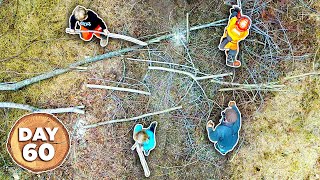
Now we're not getting the big, big trees. Everything a foot and under. We're leaving about 3.5, 4 feet, right? Okay, so that we can then later pull it up with the excavator. This is a good 6,000, 7,000. This is almost— I would say this is 9,000, 10,000 10,000 square feet. Okay, what do you think? Yeah, yeah, let's pick up the nets. Mike says we're gonna just do two chainsaws. He's probably right. It'll take all us to keep up with him. We got to get the net out of the way. Huge area, maybe 10,000 square feet. This is gigantic. We've got to do a before and after. There's a before. Our first problem: can't fell these little trees because they're getting caught up in vines, which is on this big tree. So watch out, watch out, watch out! Good. Here you can see on the left, you can see Mike Bacardi's truck, the red truck. More on the right, you see some of the sheds. There's a bit of a clearing between that red truck and the— a little bit above, you know, about right there. That's where we're starting, and we want to clear between that red truck and that shed, that patch there, all the way down to— I don't know, you see a tree there? Well, you can see the block building there on the left of the road, above that a bit. That looks kind of small right here, but that's huge given that there's a pasture we cleared. Probably took us 4 or 5 days there to the right of that truck. And here, that's— we've cleared a lot right in there. You can see some of the creek, you can see the rhododendron tore down, and these are some of the bigger trees that have been left. And then above the shed We just started the other day clearing maybe 1,300 square feet, and you can see our future here. Quite a bit there, quite a bit through there, but not too far, and we're gonna have 2 acres cleared today. Can we do this? It's worth a shot. Uh, no. 30 minutes in, we finally got the second chainsaw going. It was binding. We are not on pace. We are not a quarter of a way done, but we were out of chainsaw. Zakati.
It's a pick-a-roon.
Nice.
So if you've got a longer log or don't want to bend over and pick something up, you can just stick it in the log and then pull it out. And then when you pull the handle back, it pops right out.
So what?
Drag logs.
I like it. You could roll it up, roll over a log with that too, like a TV. Yeah. This is— show me your peavy style.
This isn't technically a peavy, but yeah, it's a peavy with a stand on it.
How's that better than the normal peavy?
It'll lift the log up off the ground.
Let's demo. Pretend that's a big log that you can't roll over by hand. Okay, it goes on like that. Oh, I see.
Then it lifts it up off the ground so then you can cut it without getting your saw on it.
Roll that back over. Pretend that's a peavy. That's all I figured out to do is what you've done there. And it— the, the Peavey just rolls it on itself though, is that right? Yeah, I mean, a Peavey's just—
the only difference between this and the Peavey is the stands that gets it up off the ground.
Yeah, a little bit higher. Okay, I like it.
Uh, you know, they make them in different widths too to do different—
that's not good if you're just wanting to roll the log to maybe get the back side of the cut.
No, you know, I just use a Peavey for that. I mean, to be honest with you, a lot of times I just kick the log over.
Yeah, but sometimes it's too big for that.
There's been some big logs where I just grabbed this and then I cut it up.
Okay.
Especially if I don't want to get my chainsaw in the dirt.
Okay, cool deal. How you guys doing? Okay, you're gonna be over there. Kind of hard to film everybody when we're all so spread out. So what's the vision here?
He chopped down the tree.
What? Put as much as you can. Okay, well, why— I don't hear any chainsaws going. I guess we can't keep up with the chainsaw. What's your vision, Mike? I think I'm gonna grab the brush. All right, I'll follow you. PJ's got all kinds of tools. You guys know how you know if you set your goals too low? If you arrive. If you achieve it. Yeah, we did it. You want to give me 5?
Yeah.
All right, look at this, look at this. 10,000 square feet. Sure, it could be tidied up a little bit. There's a— there's some things around the edges, but it's gnarly. It's gnarly. Look at this, it's gnarly. And over time, you know, water's consistent. That's its trick. It's relentless. It can be— this little stream eventually was up there and just started carving down, always finding the easiest route. And after— we could have gone for 30 more minutes, but what are we living for? We gotta have some fun together, right? Not that that wasn't fun. I mean, I made work my favorite a long time ago, but, uh, let's go have some fun. We work hard, we play hard, and therefore we sleep hard. Here we go, guys, soccer time! It is Josiah, yours truly, and Lauren on a team. Ashlyn, Mike, and Jonah on a team. We can't let him have the momentum here. Oh, oh, good block! Oh, there you go, now get in there! Oh, oh!
More from Justin






If I had to start my Homestead all over again, it could only pick one animal… 




