Building a Homestead in 100 Days - Day 84-85
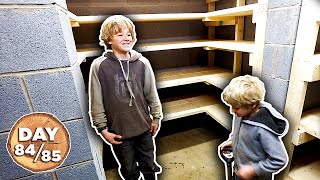
In this vlog, Victor Justin Rhodes (Speaker A) walks viewers through a typical day on his family homestead during days 84‑85 of a 100‑day build. The video blends real‑time footage of daily chores—checking on pigs and chickens, repairing fencing, troubleshooting water and energizer systems, and discussing animal feed—with casual family banter about teenage milestones, pop‑culture references, and personal health challenges. Rhodes reflects on pacing physical labor due to Lyme disease and emphasizes a balanced approach of half‑day work and half‑day self‑care. The vlog concludes with an embedded instructional segment from the Frugal Homesteaders (the Dohertys), who share practical strategies for acquiring affordable land: discarding idealized farm images, downsizing to 5‑10 acres, leasing, using goats for land clearing, buying “junk” or edge land, and conducting environmental due‑diligence. Weather updates and a decision to rest illustrate adaptive planning. The content offers both a personal glimpse into homestead life and actionable advice for aspiring small‑scale farmers.
Chapters
Pigs are out! Which pigs? Okay, are they out out or just in the high tunnel? Okay, did we put the pig panel back or the pig board back?
No.
Okay, man, you guessed the good stuff this morning. Audio was not working on the mic. Good morning, y'all. There was a shot of Jonah and I talking. We were talking about him getting his license. He's 15 now, he's going to be 16. I teased him about what's he going to get, a moped like Dumb and Dumber. And of course he's like, no, oh, you can get me a motorcycle or a truck. We're not giving you enough, you got to come steal the chicken. Come on, come on. This might be tricky with two out, one man. Oh, you're going back. You already know, don't you? She knows. Look at her going right back in. Okay. Hey, hey, hey, hey, hey, hey, hey, hey, hey, hey, hey, hey. Just as I suspected. Little carabiner to keep him from lifting this up. It's falling off. It's not on. Good call. Oh, they haven't been fed yet.
Will you put the water on your chicken head?
Sure. Where's mama and her chicks? Okay, are they, are they out? Mama and her chicks got out again. We patched this with zip ties. That did nothing. We need to take that board off and snap this back in there. I think it's as easy as I just spoke. This board is under all this. What I think we have to do is snap this poultry wire back and then put a hog panel over it so that they can't, they can't keep picking it up because they keep picking that poultry wire up. The chicks— chickens and chicks keep jumping right through.
What are they gonna do right there? They're gonna put something—
okay, let me show you. We're putting right here what you call a retainer wall. The retainer wall will go there and then upstairs will be on the other side of it coming down. And no, there will not be a window or anything in here. The whole point is to put earth over this, keep it at Earth's temperature, 55.
We're putting the rocks in.
Well, we're not gonna do rocks, I don't imagine. I bet it's gonna be a concrete wall. Yeah, like this, like the other side, beside the garage. Maybe it'll be block. I'd probably rather it be concrete though.
We could sleep in here.
Yeah, this could be your bunker. Be pretty cold at 55. Yeah, so when I'm like, wait a minute, you guys haven't seen Dumb and Dumber? Okay, maybe if it rains, you got an assignment this afternoon. Classic movie I grew up on.
We put our new handlebars on and hand grips.
Nice.
Oh no, what? It's throttle sticky. It just stays there. That's so dangerous.
You guys made this throttle sticky?
No, it just has gotten sticky.
Does it normally— it usually comes back. Yeah, it should. You're gonna have to have Mark look at that. Are we done with chores? Let's milk. I don't know, it's supposed to rain today. Gideon, thank you for being with me. Before that though, I grew up with willow, which scared the crap out of me. Don't necessarily recommend that one. Spaceballs, Star Wars, UHF. They haven't watched UHF, like Weird Al and early Michael Richards, which is Kramer. Did you get it? Yeah. No wonder you couldn't carry it though, you got too much. Oh, you spilled a lot too. Let's scoop it up. There's something special about introducing your kids at a point where they can understand your pop culture that you grew up in or nostalgic around, like movies and Music, for example, we have the '90s channel programmed in on our SiriusXM. And so Jonah, who's now 15— when I was that age, I was listening to Red Hot Chili Peppers, Nirvana, Pearl Jam, these— this alternative rock type stuff. Makes me wonder if they'll be nostalgic about that because they definitely aren't listening to like the top 40 '20s music, you know, modern stuff. Princess Bride is one we grew up on.
You can die too, for all I care.
As you wish.
Oh, my sweet Wesley, what have I done?
My sister loved Babes in Toyland. I couldn't stand that movie, but did anybody else have to endure Babes in Toyland? How about a quick Christmas pizza at Capone's before I drop you home?
Jack, I don't think I could eat 3 pizzas.
You said anything about 3?
Well, I got 2 other offers.
I don't know if you've ever heard me say this, maybe because I'm ashamed, but I need to get over that. We went too hard last Sunday. We went too hard a week ago. I did. If you remember, we cleared the pole barn. I thought it was gonna take half day, it took a whole day. And then we played 30 minutes of soccer. Well, this old creaky man with Lyme disease was hurting for 2 days after. As much as I want to physically go at it, it's hard. And I forget that and I start feeling energetic and good. I have good days and bad days, and then I have these good days and I'm like, let's do it, rawr! And then I'm reminded I need to stick to my sweet spot, which is half a day physical work and the other half self-care slash— we call this kind of work brain work, you know, working on the business. Josiah reporting two problems at the forest pigs, the Everflow water is not running, and they're wasting a lot of grain. Oh, 3 problems then. The fence energizer is blinking red, which means the batteries are dead. Hey, no, you come on, you got little fast legs, you can keep up. The feed thing, you're just not gonna have to refill it until they've eaten it all. The battery's charged. Okay, let's put this back on the tractor. Do you want to hook it up and try it here before we take it out?
Yeah, let's see.
The energizer is supposed to be running, it's not blinking. So either the switch is bad or the little energizer is bad.
We'll take this to replace the battery.
I really should be milking, but now I'm obsessed with like 10 sisters. Which, if those 10 piglets got out, that would be very, very bad. Say yes, Papa. Oh! What's it hitting at? Well, that's not too bad. If the overflow is not working, probably not got enough pressure into the side hose. I'm going to turn that off and get it going in there. Okay, we have water down here. I leave this full on, it may not overflow for a while, but then it starts to overflow. There's full on, there's half on, there's a quarter on. Let's try that, just barely, so some water can get down through here. Was it overflowing this morning? Nope, it just wasn't going. It was full, so it hadn't been not going long. So I wonder if there's periods where it just doesn't flow through here. He's saying that needs to get level. That's probably right. I think that'll help. I think that'll help. We put that log under them. This is blinking all green now. Okay, and you said it's hitting it like 6, so we're good. Let's just have those back. Sorry, whoops, I just got them up here. We have one less problem than we thought. Filled up 2.5 gallons plus a little more. They're loving this alfalfa timothy hay.
I wonder—
sheep, get out of there! It's a rainy day, perfect day 4. Oh, it's gone bad. There was meat in it. It's gone bad. This lard I had set out a long time ago. I'm gonna take a hint from Mother Nature. It's raining, it's cold, I'm sort of tired. We should rest. The lesson of the day, kids: work with nature, not against it. Take a hint when it's raining or super cold. That's your opportunity to take a rest guilt-free. What's What's the weather in Fletcher like today?
Expect rain in Fletcher, North Carolina today, 90%.
What's the weather like tomorrow in Fletcher?
Looks like it will be partly cloudy tomorrow.
All right, let's get some rest today, Jonah, and come out of the gates charging tomorrow. Pretty drawing, good job. Okay, it was a short vlog, so what I'm gonna do, I'm gonna roll a clip, a nice clip from the Dohertys. I'm going to give you a portion of our first class— 3 free classes I'm giving away down in the description— of the Dortys, the Frugal Homesteaders. This one's on how to find affordable land and make it work for you. We're going to roll that clip, and if you want the whole class plus the 2 others, link down in the description. Enjoy the clip.
The first step that you've got to do is get rid of the image that you already have in your head of what a farm looks like. Because too many people are pursuing that, and we would say that's no way to pursue a spouse.
So like people have in their heads their Fisher-Price set when they were little, you know, it's like the little farmer and the cows and pig and the chicken, the big barn and a little bit of fence, and they think there's a farm and that's what they go looking for.
Right, and we're saying get rid of that image because the farm is going to teach you what it can do best. A second step would be to downsize. So I remember my grandfather had a quarter section, so that's what a farm was. It was 160 acres. But we're finding that the 5 to 10 acre size is a great size. We like to think of people farming on the human scale. You don't have to use tractors when you're on that kind of scale, and you can certainly grow all the food that you need on the 5 to 10 acre Right.
There's room. There's room there for as much garden space as anybody could possibly use for a single family. And then there's that, you know, that 2 to 8 grazing acres that you need for keeping, say, a dairy animal, beef animal, maybe some sheep, and then some room for wild edges, you know, some, some untouched stuff. So that 5 to 10 acres is really a great— it's a very sweet spot.
And part of why we say get rid of the image in your head is because those are already bought. They're way too expensive. You'll never be able to afford them. So we say almost any piece of land can be a farm. And we wouldn't have said that before. But if anybody saw our farm, which is— before we got there, which is down in a holler, steep sides, it's mostly trees up the side of a hill. You would not have thought that you could turn that into a farm.
The state of Ohio has that piece on their plat maps. It has a little label that says not suitable for agriculture because it isn't, only on the human skin it is.
Right, and we would say almost any piece of land because you can't, you have to have water. It's either gonna come down to rain or you're gonna be able to find it in the soil or you're gonna dig for it or something. Water is essential and sunlight is essential. So deep dark forests, we hear a lot of people say, well, I've got almost all woods. And I'd say, well, you're gonna have to get rid of some of that. If you want to farm. But other than that, we feel like land that has been formally cropped is just cropland. Steep, lousy pastures, full of briars.
We've been helping people with farm consultations in some pretty crazy situations. In the spring, we went down to Georgia to help a couple, and what they were trying to farm was 14-year-old clearcut. Somebody come through, clearcut a mixed hardwood and and piney forest down to the ground and left it. So for 14 years, seedlings, trash, muscadine is all growing in. The muscadine's riding up on the trees as it grows. You couldn't even walk. It was like something out of a nightmare. But we directed them to fence small areas, clear, run netting around. They already had goats, bringing the goats. Soon as the goats cleared the understory a little bit and they could just get in, They started cutting the young trees and pulling the tops down into the understory. The goats would clear, you know, would eat the tops. And then they just piled the, the boles, the stems, the trunks off site and they just kept moving through. And what was amazing to us is the pictures they were sending us, how fast that moved. They had about 14 goats and the process was way quicker than we thought it would be.
Very neat.
But it looked like an impossibility. And what was being proposed for that site was those giant flail mowers that eat trees. Have you seen this? Where they like mow down whole sections of 20, 25-foot growth and leave 2 feet of wood chips. And I think that's an ecological disaster in the making. Nobody knows what'll happen when you do that.
Yeah, that's way too new. And I think people think, oh, this is a solution. And I think, I'm not sure it's a very good solution. So another thing that we would say is, you know, you're just gonna, that land doesn't have to be what you imagined, is that owning is really overrated. We have been using the convent land for—
12 years.
12 years now. And it's been a great relationship. We lease it from them. You know, we are not gonna bring up there all the equipment that we might do on our own farm. Because we don't know if at some point they're going to say you need to be off this farm. But it's a great place to learn. And so far, the relationship with the sisters, we just— I was just being recognized. They gave him an appreciation dinner because I, because I worked for them as well. We really are family. It's a beautiful thing. And having those sisters as our family is very special to us. And I think you could have that relationship with somebody that you might be renting from. But we would say within 5 miles of where you are, there is land wanting to be made nice. It's just been abused or it's been— nothing's happened with it. And you could be approaching that owner and say, would you mind me improving it? And one of the things that's really important about the way that we farm is that we're improving their land. We're not making it worse. Sometimes that can happen with a commercial farmer coming in. He could be degrading that land. But if you're doing pasture, if you're doing sustainable rotational grazing, you're not only getting, you're getting something out of it, you might be trading with them and saying, how about if in order for us to use it, you get some meat or some milk or things like that? One of the things that we are seeing is that people who are ending up with, at least when we go out and farm consult, they have a little bit of land They say there's a limited number of things, but then I say, well, who's doing something with that land over there? And they say, well, it's my neighbor.
He doesn't, you know, he used to have horses and he doesn't keep them anymore or something like that.
Approach them and absolutely say, we're seeing more and more. It's not 5 miles, it's adjacent.
Right.
That's right. In terms of purchasing land, we find that going to a real estate agent, if you start explaining to them what you're looking for, that I want some junky land that doesn't cost me anything. Real estate agents are—
They lose some interest right there, right? There's not a whole lot of a commission on junky land that doesn't cost very much.
So I'm not sure that real estate agents are a particularly helpful way to— I mean, you may find somebody, you may find a real estate agent that's your friend or neighbor or something like that that can help you.
The other thing is that land, it's possible to make a homestead on land that would not even be offered in that way for sale, right? You see, you know how you're driving down the road and you see the sign says 71 acres undeveloped or whatever. And what they really mean is there's a hunk of junk land over here I have title to, and if somebody will offer me money for it, I'll part with it. That's not something your real estate agent is going to take you out to look at, but it might make a great farm.
Yeah, scouring the want ads is great. We had just— we had a piece of property that we thought was going to be the perfect piece of property and it fell through. And so then our neighbors said to us, Well, have you seen the want ads? There's 16 acres with a house for $11,000. And we said, yeah, I know what that looks like.
We figured it was a house made out of cardboard sitting next to the city dump, right? That's what we were picturing.
But that was in the want ads. And so we finally went to go see it and it ended up being the piece of land that we bought. But they're out there. So scour the want ads, sheriff's auctions, Craigslist, all of those different places where somebody might put up land that they just want to get rid of. Auctions. We really think that that's—
if you live in a small town, there are people like your mechanic, the postmaster, word of mouth, absolutely, the veterinarian. You just get the word out there. Also cold call, drive them down roads. When you see something that looks abandoned, go down to the courthouse, or these days you can do it online, I think. Look up who owns it and just cold call them. I see you have 7.5 acres on County Road 46 you're not using. Have you thought about selling it?
I was just talking to another friend of ours who a piece of the property across the road from him sold, but there were 4 acres next to it and he said he can't get anybody to buy it. And I thought, why isn't he getting anybody to buy it? It's not that bad of land. Well, there's a possible dump coming into that area and I'm not sure how many people want to live next to a dump, but here's 4 acres that's probably going to sell really cheaply. And, you know, maybe the dump isn't going to go in.
And so now some things that you do want to do is get some history on that. That's good. So friends of ours bought 10 acres. It was cheap because turns out the power company was about to run a conveyor belt for carrying fly ash right off the side of it. Now that it's worked for them, they're okay. But that's something, you know, if you know what your limits are, I would never live near a fill in the blank. And then check out the history a little. Another place that sold recently is downstream for another fly ash dump. It is fortunately upwind, so maybe there's not going to be a contamination issue. But if it looks like it's too good a deal to be true, investigate. One thing that'll drive the price way up is if the previous owner has left after doing some sort of environmental damage that the owner is required to remediate. You buy it, you're now the owner, you're required to remediate it. So just things to look into.
But we say buy junk land, buy edge land. That's certainly what our farm was. Our farm was part of a much bigger farm and all the pieces had gotten cut off.
It was a piece nobody wanted.
And that's why it was as cheap as it was. There are going to be aspects of buying junk land that are inconvenient, but there's going to be aspects of any farm that are inconvenient. So, I mean, that goes with it. You don't necessarily need infrastructure. A lot of times the infrastructure gets in the way of the way that you want to farm as well. What we've learned, where we are now in life, has to do with the fact that we bought a terrible piece of land and we had to redo it. That has been our education. It's been the way we've saved money.
It kind of wrote who we are.
That's right.
I mean, we were, we were in our early 30s. I guess when we bought that property, maybe late 20s. But it kind of wrote who we are because we grew with it. And that's been a gift we couldn't have anticipated.
More from Justin






If I had to start my Homestead all over again, it could only pick one animal… 




