Building a Homestead in 100 Days - Day 91-92
In this 100‑day homestead vlog, Victor (Speaker A) reviews the progress made—access road, water tap, and clearing over two acres—while reflecting on the need for higher stretch goals. He announces the imminent arrival of a track loader and a Mini X excavator, and walks through a series of on‑the‑spot repairs: bolting down pen boards, fixing broken wheels, and using zip‑ties to secure pig panels and prevent chickens from escaping. The family renders a large batch of leaf lard, calculates its market value, and discusses its nutritional benefits. Victor shares a personal story about battling Lyme disease and how it has affected his work and mental health. He recounts lessons learned from studying permaculture with Geoff Lawton, emphasizing system integration, cover‑crops, and compost loops. The vlog also covers water‑line troubleshooting, garden layout critiques, and product mentions such as mineral blends and rooster grit. Finally, Victor promotes an upcoming condensed homestead‑design course (Jan 22, 2‑6 PM) on Abundance Plus, outlining the seven common pitfalls, land‑selection criteria, and tiered membership options. The tone shifts between instructional, candid, and promotional, interspersed with family banter.
Chapters
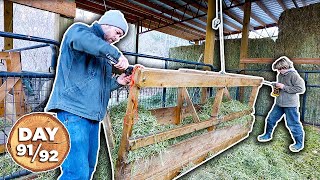
Day 92 of building a homestead. Wait, I forgot all the things. Tools. Gideon, that's your choice, buddy. You make the decisions, live with the consequences. Grab that tumbler, please. We actually accomplished our goals. We got an access road in, we tapped water, and we cleared 2+ acres of pasture in 100 days. Well, in 90, 89 days. So you know what that means, kids? If we accomplish the goal in shorter amount of time, it means we didn't set our goals high enough. Today we're going to look at what kind of stretch goals we can have. Did you guys get the alfalfa? No, because there it is. One possibility for stretch goals that I'm very excited about is We're getting some machines, a track loader and a Mini X. Why am I whispering? Because I don't want the boys to hear this. The Mini X is coming in March. We assumed both things were coming in March, but the track loader is actually— it's at the dealership now and it's just going through the shop and should arrive this week. The boys put something in here, not much, put something in here. Where'd you guys get the wood that you put in there? Somebody put some wood in there this morning. Who was it? Where'd you get it from? Oh, okay. The problem out here is we've riddled this together with mucho screws, and this keeps falling off, pinning their heads or blocking them from getting in there. We need to fix this once and for all. Where's your other glove? Have you lost your other glove? Hit the screw. Go somewhere else with it. We put in a bolt there, there, and down there. 6-inch bolt, half-inch, a flat washer, a lock washer, and a nut. With big animals like Vanilla and especially stud. He likes to rub on this thing. The bolts are going to make all the difference. Surprise problem, problem number 2. These bottom 1x6s have come undone. Maybe they just need tightened right there, but they're completely off over there. If we leave that undone, eventually it's going to get worse and pull the whole thing out. It's not going to hold hay in. Some of these screws might fall into the bedding and somebody might accidentally eat it and get what you call hardware disease. Gone all the way through.
Can we build an area where we milk?
What's wrong with where we milk now?
It's freezing.
You want a temperature-controlled milking area?
Yes, with a milk machine. You could take it all out of my bank account. I'll even build it.
I don't think it's good for them to go from cold to warm. My quiet time.
Whoa, I think this is a better spot.
And then I was able to like keep driving, but then I—
Oh! How'd we miss this? Oh, a box of leaf lard. I thought I did everything. You want to do everything when you have the grinder out. Look at that snow white lard. 1, 2, 3 and a half, almost 4 gallons, and we got 2 more trays of ground lard. Should be about 2, 2.5 gallons. Whoa, hear this for me, guys. Josiah, are these clean or dirty? Yeah, buddy, I'm watching. One food service tray equals one 5-gallon jug full of lard.
Papa is going to have us fix this brake. This piece came off from right here, so we're going to bang it back and weld it.
You guys make it? What about the wheels? Did you put extra wheels on it?
You put another wheel on it where it broke?
No, there was other wheels jacked up. There's probably 2 or 3 broken. What are you guys working on here?
Just a little thing for Henry.
Okay. Hey, oh, and I got this. We got to get these hides packed up. This is one, this is one. Take this. Josiah, do you need 2 crescent wrenches? Uh, already have. Oh wait, take this other one. There's probably at least 2.
I'm gonna go take this off.
Come on, G. Like this?
I mean, theoretically you could, but please don't. That's a nice— that's a very nice bike. See that? It's ridiculous. Chicken out. We got a sigh of relief after finishing the 100-day challenge. In a minute, we're gonna go look at some stretch goals. That's gonna get real exciting, but we gotta take care of some things on the farm first. Mistake of putting the poultry wire on the inside, even though it was tucked into these boards. The Pigs have picked it right out. We could put a pig panel. I was thinking here on the outside, it'll stop the chickens, but it'll stop them from tearing this up more. Wow. Okay guys, if we don't fix this, chickens are going to keep getting out, and your chickens with their chicks— are they even still alive?
Yeah.
Are gonna get got if we don't get them in. Chickens get up in here and get right out. There's some panels right here. I did a piglet training demo. Let's get some zip ties and some feed for the pigs. Gideon, get in! Gideon! Okay, there you go. Let's go. How'd you get the wheels replaced? Wait, you didn't need that one?
What do you mean?
Wait, I'm sure there's more. I'm sure there's more than one broken wheel.
All the wheels are good. We just changed them, you know.
Are you sure? Yeah, I'll go out there and check. It won't— it'll be okay. Just say let's put that back in the basement.
Okay. All right, and then y'all come on.
Lily!
Lily!
The chickens can't have water if their water is out here empty. Lily, bring the pig board please. I'm gonna get them fed, okay? And then we're gonna go in and put a zip tie these pig panels on the wall. A little bit of a Jerry fix, but it will fix this temporarily. We've attached a pig panel and zip tied it in many areas. We have an extra panel. We don't need both. We have these two little pigs that keep getting out, and that's a problem because They knock over the chicken's water, right? And they eat the chicken's food. Oh, they junk it up. Oh, they drank it. Okay, I think we need to zip tie the heck out of this one. Zip ties, bro, let's go!
Yes, Papa!
Stay with me, buddy. You want to be a rolly dirty? I think that'll do it, kids. We got like a bazillion zip ties in that thing. I think it'll hold them in. This feels pretty sturdy. We couldn't go all the way down to the ground because this has to swing open. You gonna stay in, little guy? Oh yeah, see, you can't just get out anymore. I'm gonna tell you what, this feels great to be putting in some work on the base farm. Some of these things have been neglected because we're so focused on the project. Those chicks are out! Now wait a minute, how did they get out?
In.
Here they come. Gideon, open the door. Good. I feel like a fireman going around today and putting out fires. Tim, confused by you not knowing how to do this because you do this every day.
Actually, the hose— you know, I never do this.
It's the hose frozen.
Yeah.
Okay, we'll do the water chores every afternoon and then you won't have to do— worry about a frozen hose. I would get 2 Waters. Uh-oh, get in! What happened? There's broken eggs. Come get these that didn't break and take them upstairs, please. We got a bunch of sandbags over here. I know it's 11:40. We wanted to be done by 11:30, but they're gonna poke holes in it. Let's go. Hey guys, get off the tarp please. It'll last 450 years if you don't put holes in it. Legacy tarp for y'all. Let's go. A bunch of bags here from these tarps that were over here. Let's get those. For any bags that don't have a good tie at the top, let's zip tie them. Everything must be zip tied apparently. If it needs tied, send it this way, okay? Put it down towards the end. Good job, guys. Let's do it. Let's go, everybody in. It's the only thing stands between us and lunch and freedom. Mom is up to things in here. Her little helper Gideon, she gets so excited about this. You get so excited about rendering lard. Why so?
Because it's expensive.
1 pound would be $10. That's about 3.5 pounds. That's $35. Yeah, for the lard right there. And you're gonna get how many out of the 5 gallons?
4 gallons out of both of those pots because they weren't all the way filled.
4 gallons. So half a gallon, 3.5 a gallon, 7— 7 pounds. $280 worth of lard right there. $280 worth of lard right there.
Yeah, and then, and that doesn't count what we did over there.
And we did 2 more of that.
This lard actually is more expensive than that.
So, over $500 worth of lard.
That's what I'm saying.
Wow.
And like, I like frying or cooking with lard. I like eating with it.
It's healthier.
It is. It's, so I also learned recently that lard is the, um, has the second most IU's. Of vitamin D, second to cod liver oil.
Isn't that crazy?
500 IUs per teaspoon if they've been raised correctly in the sun and all that. So it's good stuff.
Here comes FedEx. Is that your cheesecloth? Supposed to get cheesecloth today. Are you gonna be having enough until—
I'm just using the same one over.
It seems to be working. I want to tell you guys a story. Hey man, how you doing? Good. It's like Christmas for a homesteader. My Premier One order. Well, and some diapers. That's kind of boring, but— You coming with?
Yeah, we're gonna go.
Story time. There's my house. Here's the road where it happened. I feel like I was about right here and suddenly I had this pain in my groin. I didn't think much of it at the time. I was prone to groin injuries from my running and my soccer days. We just took it easy. We just went home and I just figured the level of pain it was, I just figured it'd be gone the next day. Next set, I treated that like groin injury, like a sports injury. But no matter what I did, no matter how much I rest, it never got better. And pain started to come up in different places, like in my feet. We didn't know what the heck was going on. We started spending some money trying to figure out what was wrong. We started spending a lot of money continually to try to figure out what was wrong. This is awful spotty shady right here. I feel like it happened right there, but because of this terrible light, I'm gonna— we'll pretend it happened right here. So we kept having to spend more and more money, and my ability kept having to go down and down. Eventually we figured out it was Lyme disease, but that wasn't much help to us because I had had it so long at this point. It was very hard to address, and there's no, like, real clean-cut solution. So I'm struggling with depression, with physical pain, lack of confidence. All these kinds of things. I'm running the farm, my kids are young, and I'm right here and I'm feeling my heart about right here. I said, you know, things ought to be connected. At the time, my kids were very young. The beautiful one would have been inside with them. I was doing everything on my own. What'd you say?
Where did you put my drills?
Oh, they're in the bag up there by the kitchen counter. Worst time of day to film something. There's shadows everywhere, but y'all bear with me. The chickens were here. The chickens were in the backyard. There were the chickens. There was the house. Bad side for chickens, by the way. That's the north side, especially in the winter. Look, ground is still hard and frozen. Can you get the spigot undone? The sun barely hits it. Were you able to do it?
Yeah.
See, look, there's frost right here. I didn't know any better. I didn't know about design. We'll get to that here in a minute. Okay, that did shut off. You want this on? Yeah, is it frozen, the line? No, I don't know, maybe. I am doing a bit, but I'm just helping my bro on the way out. That doesn't feel frozen. Have you checked the spigot to make sure it's working? I knew nothing about permaculture homestead design at that point. That's working, so water's not coming through this. Nothing. Although that's open, it's probably broke. No, I don't feel water in the hose. There it goes. Our house for reference. Our very first garden. You say, what's the problem? You have gardens here now. Yes, I have crop gardens here now. You don't visit them much. This was a problem. This is 130-ish feet to our front door. Thank you, my man. So, so no wonder I neglected it that early, that first year when Rebecca said, hey, are there any weeds out there? And I would look from our window way up there through a screen and say, no, I think it's okay. Well, I came out here the day we were to weed it in the weekend and it was terrible. And I'd been telling her all week it's okay. Justin got his stinking cap on, got the string trimmer, and went to town on the garden. And buddy, I was thinking, this is a thing. I'm gonna write a book one day. It's about weed eating garden, man. I'm, I'm Why nobody thought of this? Beautiful one came walking out and stood about right there.
My peppers!
Oh yeah, okay. To this day, if I get that string trimmer out, she's saying, where are you going with that? It was too far away. Fill that with sand, please. Don't. We'll never get rid of it. Instead, I should have had the garden right here. 1, 2, 3, 4 steps from the house and we've got a garden. Wonderful cover crop on these raised bed gardens this winter. All right, buddy, we're going back down. You're being so patient and good. Following me about. In a minute, we're gonna chase these chickens. I think these chickens were out. Hopefully they were out before we did that fix. If they're getting out before— after we did that fix, then we have another problem. So I'm struggling, and I'm feeling in my heart that things ought to be connected, things ought to be going smoother. Everything was so separated, I'm suffering. And a friend told me about Jeff Lawton, and I ended up watching one of Jeff Lawton's permaculture videos on how he set up Zaytuna Farms. There are 2 chicken tractor systems producing 1 cubic meter of compost each every week of the year. My big takeaway from Jeff's farm was everything was working together. Don't look at them. Oh no, what'd you do? What'd you do? Here comes— here comes—
giving you trouble.
Yeah, they're all giving me trouble. Get them all in. Okay, Josiah said he accidentally let some out on the other end. That makes me feel better. Clearly I was unfocused in my food growing goals because we had got a meat goat that we didn't plan to eat and a mule that was so old that not only wouldn't it work, we couldn't even ride it. Two lessons learned there: never get livestock because either they are free or cheap, and lesson two, never get livestock that do not line up with an appropriate path to your goal. Studying under Geoff Lawton at his farm in Australia, I learned how to work with nature rather than against it to make things more abundant and more fruitful with less input. I learned how to make connections between things and have things work together instead of being completely separate. And another key thing I learned— you know what, let's keep them there. Uh, I learned how to turn problems into solutions. I began to look at the world completely different, not just the farm but the world. That's right, amen, brother. Get in, come on. He's definitely having a good exercise and staying with me all over the farm getting these shots. Fast forward a bit, now I've got this crazy productive yard right outside my door. 1, 2, 3, 4 4, 5, 6 raised beds. It isn't just a garden bed here. Look right next to it. Sorry guys, it's winter, it's a little grown down, kind of our ugly season. Chickens be in here in the winter, and they're on this— what? Oh, summer, you're right, in this— in the growing season. Thank you, Gideon. Thank you. On wood chips, stirring it, adding manure. It's absorbing their manure and it's breaking down compost. Here, put some to this wood chips. Crazy, crazy, right? Well, it's frozen, it's frozen, but mucho compost. So the compost then— you stuck? The compost's coming. Compost feeds the garden. And of course, hey, you want to get some of this for the chickens right now? How? Well, I have to get you down first. Hang tight, hang tight. All right, ready? I got you, I got you. Swing your legs down. Good. Grab some of that for the chickens. The veggies and the weeds and the extra the abundance goes into the chickens and feeds them. These are cover crops. Who says we can't pick these for the chickens in the winter, huh? It's a great green for them.
This is for the rabbit. This is for—
oh, I like it. Please tell me that one chicken never got up. Josiah, can you help us get this one chicken? There you go. You're welcome. Keep coming, keep coming, keep coming. It sees me, it's scared. Oh yeah, there you go, there you go. Oh, I should have fed the grass a little further in. Keep it coming, keep it coming. Oh no, oh no, they're getting out. Okay, got that one back in. Here we go, in here. This isn't just, oh, where we're gonna put the chickens this winter. No, put the chickens in the high tunnel, put down the wood chips to absorb absorb their manure. It's nice and warm in here. They're out of the rain. They give mucho huevos, right? Why not put the pigs in here? Here they are. You happy in here, Beefcake? Winter home for the pigs and chickens, but in the summer they go out. They got jobs to do outside, and this becomes a heat-loving vegetable paradise. Tomatoes, squash, beans, Cucumbers. Yes. What happened? Did, did, did she like the grass?
Yeah.
Just wrap that around. Keep going with it because it's gotten stretched. Can you reach through and grab it more?
I don't want to get bit.
Will you get bit?
Yes, she bites. I literally once, I once tried biting her. Yeah.
Okay, good. Oh boy, where's our notebook? Did I Oh boy, probably put it down to chase chickens. Oh, but I see another chicken.
How much money do I get if I find it? $2.
That— what is it, was it too much?
No, that's too little.
It's a lot of money.
How much is that?
Especially for just finding a notebook. That's probably— well, I thought it would be right here. Haha. I'm impressed how well Gideon is listening. Did you hear that when he corrected me when I misspoke and said winter when I meant summer? He's listening. Now that I started practicing permaculture design on my homestead, I had been able to, you know, take multiple elements, multiple chores, and narrow it down to one system, or fewer systems at least. Uh, now my farm was more manageable even though I had Lyme. I don't know why I brought this whole thing over here because I made these mineral bins removable so I can just carry them. But anyway, my farm became more productive, I began to work more focused, and the work became more doable and enjoyable. The Aragonite, it's a Thorvin Kelp and Trail Nutri-Balancer, a special blend of minerals, vitamins, and probiotics to balance your feed program and ensure proper nutrition. And there's one more thing, best practice, you get it out of the creek sand, out of the creek. It's got minerals in it as well, but we've got a lot going on with everything right now. We just got some, we just bought some rooster treats, AKA grit. Yeah, you can, a lot easier, a lot easier just to buy it. $10 for this whole bag. Tamara's Too big.
Too big.
Then you got the notebook. This Sunday, 2 to 6 PM, my first annual homestead design course. It's basically a permaculture design course condensed down to 4 hours specifically for homesteaders so that you can come with some doubts or no idea or some idea of where you want to go on your homestead and go away with goals and a plan and a map. I know everybody's short on time and money. We're getting— I'm going to knock out the teaching in just a couple of hours, do some Q&A, and then call people in and do some consulting. So if you want a chance to be a part of that and get consulted, you definitely want to come to the show January 22nd, 2 to 6 PM. Here's what I'm going to be sharing with you: how to avoid the 7 biggest homestead pitfalls that keep you from being successful. We're gonna knock away at the age-old problem of time, money, and energy being the problem, and we're gonna turn that into solution. You'll see, it's gonna— it's amazing. There are 7 steps I've identified for setting the correct goals and knowing how to prioritize them to get the most important stuff done so you're completely satisfied and by the end of the day, even though you haven't done it all. Because none of us are going to do it all, and that's okay, because I've got some tricks that if you do these things that we identify, you will get the most production possible out of your farm, and you will rest peacefully at night. I'm going to talk about 8 things to look for in land. I know many of you are looking for land.
Yes.
Yes.
You want me to catch the rooster? You.
And even if you're not looking for land, it'll help you look at your land better. Know the order of building your homestead. So from whether you're on raw land and where do you start, we're going to go through all the steps, assuming you're on raw land, to all the way to where you're growing all your own food on your homestead. What are the steps you should take? I'm not going in there now. He's in the pig. I'm not going in there. Finally, 3-check 10 points for knowing where to start. Now that one would probably be higher up in the order there. Still developing the silly bus, if you know what I'm saying, for Sunday's show. But listen, come to Sunday's show. It's going to be on Abundance Plus. So we have 3 different tiers to choose from. Not only do you get the homestead design course, the live homestead design course, you get access to Abundance Plus. So we're going to send you an email, and all you members, you already have access to it. So just stay tuned. We love you guys. You're in, I'm gonna send you— when you guys sign up, here would be a reason to sign up early. Get in early now. Do some pre-work. Go in and watch my Intro to Permaculture Master Class inside Abundance Plus. And plus, I'm gonna give everybody 10 things to— one of them is going to include a notebook— begin to prepare to design your homestead. So I'll give you 10 items, and I don't think any of them, save maybe one, costs— well, a notebook does cost money, doesn't it? So maybe half of them don't. You probably already have them, okay? A lot of it. Hey, what you doing? You trying to get the rooster out of there? I could get him in there. He's in with the mom. He's in with the mama. She's, she's all right. I worry about Beefcake sometimes. Get your pre-show bonuses and content and come in ready for that show on this Sunday, this coming Sunday. He's trying to escape. See, just— I had that open, that he escaped earlier. Oh look, look! Oh, oh, oh, gave himself away. He hops up on here and then there's a crook in between where that door goes down. Chickens are hard to keep in. Okay, that's a problem for another day. You know what's stupid? He gets out and immediately wants back in. Comes both of them. Come on, there's two wanting to get out. Grab that one. Whoa! Oh yeah, keep it coming, keep it coming. There we go. Okay, now come on. Now what do you want to do with him? He's drawing a line. He's at the line.
No, I thought—
really? I think you're missing a step.
I thought—
all right guys, get signed up. Abundanceplus.com, link down in the description. Oh, plus there's a tier where you guys could come here later. I think it's February, uh, details are down in the description or down on the sales page. February 18th. Yeah, you could come here, you could come here if you get a lifetime membership. Uh, we'll have a nice meal together, you can come on chores, I'll give you a permaculture design tour of how we laid this place out. Anyway, Check it out. Hey, what's going on in here? This is a killer rink though. It's a perfect floor, right? You're a busy bee today.
I am.
You feeling better?
I am.
Good. How many dollar bills of lard have you processed? We did—
we have almost 4 gallons.
We said $400. $10 a gallon. No, that's way wrong.
$10 a pound. So there's— hold on, let's—
oh, there's, there's 7 in a gallon.
Yeah, yeah, so 70 per gallon.
Yeah, and you are boiling me some pork skins. How sweet are you?
Well, I knew they were in there and the pot was already dirty, so—
and I think that's the key, is to do them while they're fresh. Trying a little doing something in the kitchen tonight. We got our ground beef back. We told them to put 25% fat in it. We gave them a bucket of tallow. I think they must have put the whole 5-gallon bucket of tallow because I think it's like 50/50 fat. It's kind of— I hate to say it, the last time, you know, we put liver and heart in the last ground beef, ruined it for ourselves.
I think this time we just need—
so this time I I put one pack of US Wellness. It was, uh, grass-fed. It's 85/15, 15% fat. And this, I'm guessing, is 50/50. So those two together maybe won't have such a strong tallow taste in the burger. See that? How's it look, Beck? Looks good. Taste test. Keep overcooking them though, that's for sure. Okay, we're getting there, Beck. I think though a 1 to 3 ratio would be even better. There's still quite a bit of a tallow flavor. Look at all the grease in the bottom of that, that I've already poured out that much.
More from Justin






If I had to start my Homestead all over again, it could only pick one animal… 




