Building a Homestead in 100 Days - Day 12
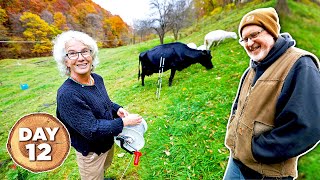
In this episode of the 100‑Day Homestead series, host Victor Justin Rhodes visits the Doherty family farm in Ohio to film a segment for the Abundance Plus course. The day begins with an early‑morning milking routine, where Sean Doherty explains his schedule, stanchion setup, and calf care. The conversation moves to feeding practices, notably using whey and skim milk to feed pigs, and then shifts to a detailed, hands‑on demonstration of dairy processing: separating cream, making Gouda cheese, and butter, with emphasis on probiotic cultures, rennet handling, and low‑tech equipment. Beth Doherty discusses milk as a "living food" and its health benefits. The family also shares insights on farm succession, the role of their eight children, and the importance of flexibility as the next generation takes over. Practical low‑cost building ideas are showcased, including a frugal woodshed design, water‑catchment and distribution using IBC totes, pumps, and gravity‑fed lines, as well as a smokehouse and root cellar. Throughout, the tone is conversational, instructional, and enthusiastic, highlighting the Dohertys' blend of traditional homesteading knowledge with modern frugality and family collaboration.
Chapters
Off farm today for the 100 days of building a homestead. What are we doing? Well, we're at the Dohertys in Ohio. We're filming a course for Abundance Plus, but we're also learning how to create and add to our 10-acre homestead we're building. It's an early morning start. He milks at 5:20. Arc 30 over here at the Salzer. Well, the ambitious fella is Already milking. I guess he's on Lombardi time, Dan, because we were here right at 5:20. Hey, Lombardi, can you come through this door? Hey, Coach, we're here at 5:20 waiting in the car up there at the top. Yeah, everything. Oh, we'll catch him coming out.
Sorry about that.
You must have, uh, you must be Coach Lombardi. Do you know what I'm talking about? Yeah, when he said 5:20, what he really meant was 5:05.
Well, that was— that's kind of theater talk as well. Theater talk is, you're there on time, you're 5 minutes late already.
This is your day every day.
Oh, it sure is.
You love it or hate it.
I love it. It's good.
We went to that party last night and everybody's staying up late and talking.
That's right.
And you gotta get up.
I usually try and dodge the parties. Okay, that's a rare occasion for you.
Okay, so you—
I usually— we usually take 2 cars and I leave earlier than everybody else.
What got into you last night?
Uh, maybe it was you being there and everything else. The other thing is that the kids— kids don't want me to leave early, or they don't want to leave early. Yeah, and we just didn't want to take 2 cars. Okay, it was getting a little complicated.
Does Beth get up early too?
She gets up earlier than I do.
Oh wow.
So she gets up now, she does the office, and then she, she starts writing.
What's she writing right now?
We got a couple of books that we're thinking about. We've got regular columns for magazines, Plain Value, and then we usually write for Hobby Farms.
And Dan, you're gonna be able to catch this before he's done milking?
Oh, I've got another cow to milk.
Oh, you do?
Yeah, plenty of time.
Look at these box stanchions. And have you secured them to the wall? No. Yeah, then you secure them to Not this one.
That one's not secure.
Best practice would have been to secure it.
Yeah, well, that one, that one we haven't been using because we thought, okay, we're gonna be able to put 2 cows in here. And then we thought, eek, I don't know, this is pretty tight. So, uh, Beth did come down with Raymond one time and they did put 2 cows in and it worked reasonably well.
But last time you didn't even feed hay while they're in the stanchion. But yeah, you must be doing that because it's winter.
We're being nice to them.
The stanchion's super cool. You could almost put wheels on it and have it a dolly and do it as A mobile.
Yeah, Raymond builds those for us now. Nice. I can now turn over more projects to him. He loves working in the woodshop.
And Raymond is your 10th son?
No, he's the 8th son.
Did he ever ask you why you had 8 children?
Raymond?
Yeah. Well, I say that because Zig Ziglar was 9 out of 10, and Zig asked his mom one day, why did you have so many kids? And she said, well, where do you suppose I should have stopped? I like that.
I mean, you can reset up after.
Okay, once she—
yeah, but she's gonna back up and she's gonna go out that door, and then the other cow is going to come in.
So, and having to adjust his light, it's, it's dark and it's going to be dark for a while. We got a calf in here. He's just built a little—
that's the one who—
this must be a 6-foot by 5.5 foot?
Yeah, something like that.
Just done deep bedding in here, the spent hay it looks like. Do you feed the calf overnight or not?
Yeah, we throw a hay in and then the clean water. It's warmer than I thought it was going to be.
I thought it was supposed to be 39.
Oh yeah, and it's 40, 42.
What are you reading there to know that? Where do you find out the temperature? Oh, it's right over there.
Right there.
Why do you write it down?
I don't know.
Act like you're official.
That's right.
Makes you feel—
that's right, makes me feel like a real farmer. It's the other notes we write in there that we look down. So we write down when Delphi's in heat. We write down things like Justin and Dan here spilled milk, Rosa in heat. Okay, so coming out that way, Dan.
You ever have any visitors at 5 in the morning?
Not in the morning.
We do— hey, can cows see in the dark?
Yes, they can, and she's coming in, so watch out.
She's—
you want to close that door?
Coming in, Dad. She don't care about you. Sean, do you ever use these hobbles?
Um, not really. We had one cow one time that, uh, we had to use those on.
Sean was just talking about how the cow is not the ball and chain everybody thinks it is. Yeah, and you're saying that, and you, you come out here and milk twice a day every day. So what do you mean by that?
I guess people just think, oh my gosh, I can't be tied to that. I love the, the, um, the schedule that it provides for the whole family because you are, uh, you know, it starts today, it ends today. Gives me an excuse to get out of parties. Yeah, because I say I got to get up early in the morning.
At first, was it hard on you?
Uh, very, very first it was. The first cow that we got was a disaster in many ways, and she would kick over the bucket and all that stuff, and I just thought Walmart's a lot easier than— but, um, it wasn't very long, you know, a week or so of that, and, um, we settled down.
And you guys are known for feeding the dairy to the pigs, right? Mostly skim milk. Oh, where they get some of the milk milk.
It's, it's often whey. It's what's left over from cheese. What's left over is buttermilk.
If somebody was to find a dairy that's, that's willing to get rid of their milk to a homesteader, and they were going to just feed milk to pigs, I mean, how many pounds of milk does pig needs in a day?
Beth has all that in her brain.
Okay.
But it doesn't— it's amazing. I think she says like 3/4 of a gallon to a gallon is what a pig needs from wean to full grown. That's the protein need. That would provide all the protein.
Just no matter what, what age the pig is, just give it a gallon of milk?
Yeah. Now you, you have to give other stuff. You know, everything else on the farm, the— okay, but that's everything else on the farm is weeds, uh, whatever's—
yeah, around all the almond milk. What do you guys do with all this milk?
Oh, we do everything. Cheese, uh, you know, everything for us. And we drink a lot of milk.
We're about to find that out today, aren't we? You're gonna do a class on, on the family cow. You're gonna, you're gonna milk, cream. Well, right, cream's easy. I noticed you just let, let it sit in them. Jar and you just scoop the cream off the top. That's all you do to do cream. Butter, yogurt, and cheese even. Yeah, that's the whole shebang.
That's right, you don't waste any milk. It's liquid gold.
How cold does it get here in Ohio at 5 o'clock in the morning in the dead of winter?
It can get below zero, but usually it's not for very long.
How do you keep your waters unfrozen?
Gonna have the cows up at the sister's by then. You know, if they have snow, they don't have to have water. So that's a help. We have a heater up there. They have—
they have a plug—
well water up at the— at one of their buildings up there, and we'll use that. And then we have to make sure we empty the hoses because they'll freeze up, and then we put a heater in a tank.
A little protest there at the end.
Yeah, didn't move her out fast enough.
He's taking them out. He's taking them back out to pasture. Okay, I tell people they're living 90— they're eating 90% of their food off their farm. Well, that's what we had in the last meal. You have a hard time believing it, you just gotta see this. What you doing in there?
This is one of our storage rooms. This is our cool dry storage.
Oh, we're showing off. It's—
yeah, I'm showing off.
Yay!
This is, uh, this is our tromboncino. So this is what we're gonna— we eat this, and then the pig—
you eat this? Oh, it's great.
We eat them when they're young and green. When they're— if the skin's tender, you just slice it up and cook it. That's what we had last night. Okay, but, um, then when they're big, we peel them.
Garlic.
What do you mean last night?
Well, at Mike and Gwen's, when there were those two salads in the bowl of squash, that squash Anna had made.
She was making this room also. We can—
you guys are real big fans of that squash.
There's a whole lot of this out in the other— by the cheese cave too.
Why this? Does it store better than like acorn squash?
Super well. Like, we've had those last into April.
Why not butternut squash? Why not?
It doesn't produce as much. We want to feed the pigs too.
Sean's showing us his business card.
Yeah, and, um, okay, they, they laughed about them. And they—
and I said, when you gave it to a designer, they laugh at you?
Well, I said to Thomas, I said, so Thomas, so get— do us a card. And he said, you know, those really match you guys. So he said no. Right before Thanksgiving, he had taken off an addition on his house. All of us went over there. We all went there and we had 5 days and we put up the addition.
3 floors.
It was so fun to work with my boys that way, and I thought, this is how I want to spend my older age, working with my boys on doing something like that.
What is the plan as you get older? It becomes harder to milk it.
Well, I mean, one of the things is we probably will do less up at the convent. And more here on farm, which is what we're already experimenting with. I mean, we brought some of the cows home and stuff like that, and that's working pretty well. I mean, we would like to partner with children.
Yeah, right.
So what do—
what happens on a healthy farm or in a healthy farm family is the kids take over. And although they won't take over, and I don't think kids should take over exactly what their parents do, right?
You have to turn it over.
You're gonna have to be flexible and let some changes happen.
That's right.
Oh, he's very flexible.
Raymond, what are you going to change?
I don't know. He may not be the one.
I'll put him in a tight spot.
That's right, that's right.
What'd you say? A little work.
What would you change?
Uh, quality of some of the work. Oh, right, right.
The kids always do that.
They're like, okay, Mom and Dad, less quality or more?
Oh no, more quality.
They want more quality. Oh my gosh, they're not trying to cut corners.
Oh no, no, this is—
I drive my kids crazy because they're like, oh, we could just— they might be their age that they see. I'm more thorough.
Oh, okay, that's interesting because I'm the opposite. I know, and I would have thought time—
you're just not tidy, right? Yeah. So we've been setting up systems and figuring them out, seat of the pants, made out of scrap lumber because we don't know how, you know, you start out, you say, I don't know how this is supposed to work. So you make something that'll do, and then you— and then it does for a while, and then your kids get older and they tear it down and they rebuild it.
And they do it, yeah, they do it really well.
I've seen this extension, he did a good job.
Do you hear that? I would always get stuff through garage sales, Craigslist, stuff like that. I'm now at a point where—
where—
so William just bought really high-end table saw and Miter saw.
New.
Brand new. And so Raymond makes his living making stuff. That's right. And Raymond said, Dad, we really need to go. So we bought exactly the same thing, brand new. Totally not my style, but these are going to last us for the rest of— oh yeah, of my life.
My dad was the most frugal man I ever knew. When he died, we were throwing away empty paint cans. Yeah, he just couldn't throw away even an empty paint can.
Right, right.
And one day I said to him, because he would buy a new truck or a new tractor or a new mower, and I said, Dad, what are you doing? You're like the cheapest man I know. Why are you buying new tools? And he said, well, it's not— it's, it's because I'm not— I'm not cheap, I'm frugal.
Yeah.
And I buy these new because in the long run it's cheaper in the end, and you get more work done. Right, right. It saves you time. His priority was the work.
That's right, that's right. Now with my last son, we're buying new stuff and my older sons say, where did that come from? Why didn't this happen when I was a kid?
And I know you must feel the same thing. We don't— we're not hoping our kids will be like us. We're hoping our kids will be standing on our shoulders doing something way better.
And they certainly—
and, um, you know, if you're— if you, like, you are in the process as a family lifestyle of figuring out how you live like farmers and you live from the land. You know, like we're in kindergarten and we want our kids at least to be in grammar school. Grandkids hopefully will have learned from— thank you, son— from them who learn from us. And they'll be— I'd like to see this land exponentially more productive under my grandkids than under us. So it's going to be different, but it's going to be better. So our daughter-in-law asked me, what do you think about those crazy squashes? I don't know.
Gideon, you want to grow some tromboncinos? No, that's what those big squash are. What about you, Dane? You're gonna go tromboncinos after this? Heck yeah, they're good. Oh, you had some? Yeah, I had some outside there.
That in that boy's hand.
What's this?
This is the mango wurzel.
Goodness, that's it. Related to it, looks like it. Yeah.
It's like a beet.
Okay, how do you— you really have to really dig that one up?
No, only that much is in the dirt.
What?
The rest of it is all above dirt. You just rock it back and forth and pop it right out.
Is that a day's eating for a pig?
I, I would think it's close.
Mango wurzel.
Mango wurzel. And the big pigs, you just throw it in. For the little pigs, we'll cut it up a little bit just so that they don't choke on it.
And you need to get really comfortable with the milk. And with all of it, because milk is a living food. It's not just a whole food in that you can live on it, which you can. The Mayo Clinic would put desperate cases on a milk diet. Literally, they would say, okay, you've got cancer, you've got consumption, back when those were, you know, like unusual things, and they would send people away to go on a farm and just drink milk for 6 months to try and get better. So this is a whole food, but it's also a living food. And what that means is, Lord God Almighty, when he made mammals, he said, I'm going to make them to hold their children and and feed them from their own body. And I'm going to make milk the perfect food. But it being the perfect food, we need to protect it from all the bacteria in the world that would want to jump in and have fun in it. Petri dish, if you leave it open on your counter, is going to incubate a whole lot of nasties that you don't want in your food. We don't want that to happen to milk. So if you're the Lord God, you say, I will make lactobacilli, and they live in milk. They're natural to the milk. They in fact live in the teat of the cow and they populate the milk as it's coming out of her udder. And they're good guys. They're the ones that you're trying to get, like Acidophilus bulgaricus, are the ones that you're trying to get when you eat yogurt to correct a gut problem. They're already in your milk, not just Acidophilus bulgaricus, but dozens of little guys who live here and their job is not only to protect it but to fill your gut, your baby's gut, the baby cow's gut, any baby mammal's gut with good guys. Those are your probiotics, and they're already here. What that means for milk and for milk coming into your house is it's already inoculated with probiotics, and it's going to go somewhere. It's going to— it is in, in the process of a gradual transformation that your family likes to eat. We do go through at least 2 gallons of drinking milk a day, but if you keep a dairy cow, or better yet 2, you're going to have gallons and gallons of milk. Sometimes of the year you'll have 12 gallons that come in in a day, maybe. You've got to know what to do with it, and the answer is this is going to power your farm, and you just need to know how to be friends with the lactobacilli in here and help them do the things they like to do so that you get yogurt, sour cream, butter, cheese, um, clabber like this. Let's see if this is clabber. This thicker milk is going to get fed to the pigs and chickens. This is buttermilk that was made yesterday. This is my fancy cheese-making equipment, right? You'll have to like send away to a special store and buy yourself all this fancy equipment.
What did she pour? What'd you just pour into there?
I poured the warm cream, so this was cream at 90 degrees. Okay, this milk at 90 degrees. Now I'm just making sure they're combined right.
And it's 50% cream and 50% milk.
So what I took was whole milk, half and half. Yeah, so what I took was whole milk and, um, skimmed off the cream that was there, warmed them up separately. Because when you try and heat whole milk that's already where the cream's already risen, um, the fat does not mix very well back into the milk. Whereas if you heat them separately, for some reason it does.
Usually I make some—
what are you making right here?
So this This is a Gouda. Let's say we're adding, um, 3/4 of a cup to this 3 gallons of milk.
What'd you add right there? What is that?
So that's just buttermilk from yesterday's churning. It's start— you can see it's starting to thicken a little bit. It's not properly clabber because it'll pour, but, um, it's starting to thicken. That's because it's full of mesophilic lactobacilli. That is milk cultures that like room temperature you know, more or less room temperature conditions. I'm stirring it just to make sure that when I add it to the milk, I can— it'll spread out nicely. And in fact, when I add it to the milk, I'm going to lower the bowl into the milk a little bit and gradually stir. Do you want a picture of this? Because I don't know how you want to catch this, but I'm going to be working down in here. So I'm going to lower the bowl into the milk, let milk run into the bowl, right? And I'm just going to whisk it, right? What I'm trying to do is make sure that the buttermilk is going mix nicely with my milk, right? So there we go, that's all mixed. I'll get my big whisk and we'll just stir this a little bit. You can even see in here, you're a whiz boss with that thing. Yeah, I'm gonna fit— there's something in there. Hold on, I don't want them to see foreign objects in my milk. Come on, there it is.
You feel powerful with that whisk?
Uh, yeah, right? I love my big tools. See the pot on the stove— on the table? No, where is it? Where do you put my big pot?
It's on the couch. What is that for?
That's for making cheese in, so that's what I would usually make cheese in in the summer. I don't— it's not usually full, it's usually about half full. Come on. Combined. Very noisy. We're whisking in our buttermilk to make sure it's well combined. One thing that you don't do when you're making a cheese, I would say of any kind, is you typically don't stir in a big spiral motion. That's because once you start a spiral current moving in this milk, it's gonna keep moving for a long time. Time. And if I want a nice solid curd, I don't want a spiral current in that milk to make cracks in my curd. Ain't the end of the world, doesn't matter a whole lot, but in the meantime, it is more helpful to do either back and forth or an up and down motion when you stir milk for cheese making. So I've got a pot, it's got warmed milk and cream recombined in the pot, 3 gallons of it. We've added about 3/4 cup of buttermilk to it. Not necessary, but a nice way to boost the probiotics in here, the lactobacilli that are going to drop the pH and make the curd form. Now we're going to add rennet to it so that the curd will form. So here are our rennet tablets. This is— I'm not advertising for Welco Rennet, but if it's actually calf stomach rennet, which I want. A word of warning for everybody out there. A lot of the things that you buy and you think that you know the source of, you maybe don't know the source of. Like, would it surprise you to learn that when you buy citric acid, it's probably not coming— in fact, it's almost certainly not coming from a citrus fruit? Each tablet is adequate for 1 gallon of milk. Since I know I have 3 in here, I'm just going to take 3 of these tablets and drop them in my mortar, and then I want to get them really reduced to a powder, so I'm going to grind them up.
See that white on white, right?
That's hard to do. That help? Yeah. If I dumped it in here, would be very difficult to mix quickly, so I'm not going to. What I'm going to do is get a little bit of— again, human beings like numbers, but the milk doesn't care— so a little bit of, we'll say, a quarter to a half a cup of body temperature milk. That doesn't mean go measure it, make sure it's 96 degrees. It means put your finger under the tap as you turn the water on And when it doesn't feel hot or cold, gather your, gather your half cup of water. So that's what I'm going to do. It's neither warm nor cold to my finger, and I'm going to use it to dissolve my rennet first in here. Now, why am I stirring this with my finger? Because that white powder is really hard to see, and so if I stirred it with a spoon or something, I might think it was really mixed and dump it in there before it's really mixed. But by using my finger, I can feel on the bottom, and when all the powder's gone, then I know it's dissolved. Add a little more water so that it's a little bit more dilute when I add it. And then I'm going to take my fancy ravioli lifter, and I'm going to add rennet to the milk. I'm stirring up and down, and that's going to do two things for me. One, it doesn't make a spiral current, and two, it encourages the cream, which the minute you stop stirring your milk is it's going to want to rise to the top. It encourages it to go down. I want it to stay down for a little while because remember my matrix of proteins that's going to form, join hands, fold up origami style and capture all my milk solids in here? I want that to happen while the cream is down in the milk. So here I am adding rennet. I'm just going to pour it around and do my up and down stirring for a minute. And in fact, to make sure all the rennet went in, I just rinse my mortar down in my milk a little. And you're done for a while. How long will this take to form a curd? Depends on the temperature of the room, depends on the milk, depends on how much cream's in there. But what we want is that it should stay about 90 degrees while it's getting there. Why? Because the rennet likes 90 degrees, and if it cools off too much, it's not going to work very fast. I have, among all my other fancy and expensive tools. I have this giant bath towel which I sewed together with drawstrings in the corners, and we're gonna—
this is what Raymond talked about. Maybe he would have a heating pad, wouldn't he? That's right. Or a dehydrator.
That's right.
We can keep it at 90.
Right, right. And my kids are always looking for methods, ways to improve my methods. But these are good starting methods because anybody can do them. You're not going to spend a lot of money to get to this point. You may decide, as I have, that works for me. You know, I don't usually have a film crew, so it doesn't matter what it looks like. And so I can go on the rest of my life using this towel to keep my curds warm, or I can figure out something that's even better. But I don't know if I'll ever bother. So I am simply wrapping my big cheese pot in towels to keep it warm. And this will take somewhere between half an hour and an hour and a half, probably. If it cools off too much, a little bit longer. And that's where we are at a stopping place on Gouda.
She just did an amazing class on cheese, makes it simple and easy. I'm sneaking away a bit to keep up with the edits.
All right, we are at the doctor's office. How you feeling? You excited? He just went back for an x-ray. We're all checked in. It's actually moving really fast. Very much looking forward to finding out what he can do. I feel like she's gonna say, "Get up and walk." I hope she does. Is it gonna be weird walking?
Yeah.
Eventually you're gonna get to a point though where it's gonna be just so normal. Yeah, you're gonna be back to regular.
I'll take it.
Yeah, let's lift your leg up.
You've been sleeping okay in the brace?
Yeah, the first week was hard, but it got easier.
Okay, just let it stay real. Does it hurt?
Okay.
Hurt?
Hurt?
Well, we're gonna start PT, and then he'll be able to do 50% weight bearing, and then we come back here in a month and hopefully he's healed.
Now she's gonna do butter.
So this is the last stage of butter making, um, before washing, and you can see that the butter has come in here. We stopped the churn and you can see that lovely golden butter. If it was spring, this would almost be yellow-orange primrose color because there's more beta-carotene in milk in the springtime. But here we go, there's our butter and it's come. Drain the buttermilk off of it and run some cold water in here to firm it up to make it easier to work. Where, where did you get that special tool you drained the buttermilk with? It's a broken ravioli turner. And wash butter with a paddle. You can wash butter with your churn by putting it back together and turning it on. But in this house, we finally got to the point where we have no ick factor when it comes to handling butter with our bare hands, as long as our bare hands happen to be clean. So I am just washing this butter by working it in the cold water. You can see that the cold water has a fair amount of, of milk solid in there because it's white. So we're going to drain it a couple of times and replace the cold water with more cold water until the water stays pretty clean. Again, that's because if you leave milk in your butter, the milk is not stable and it will become sour milk. So, but you're just trying to keep air off your butter and then stick it down the basement in the coolest corner.
Round 3.
Round 3.
So that's gonna be all the rounds?
Yeah, I don't think it'll get white enough though. I care. Farming is all about living stuff and there's not a whole lot of point in being a purist. Like, I could keep washing this butter until theoretically that milk— that water there was not cloudy at all, but I don't see the point, especially if you're going to freeze the butter, right?
You don't even have to be this thorough.
It's my paddle. So Jake Christophel of Fallen Aspen Farms made this for me years ago, and he makes them and sells them at events like HOA. And this is the best butter paddle I've ever had, better than the old-fashioned ones that you sometimes see that are rather wider because this is really sturdy. I like a high-sided wooden bowl for my butter bowl because I'm working against the side of the bowl as opposed to against the bottom of the bowl. Michelle got me this secondhand at a flea market. I'm working the butter with the back of the spoon. I'm not smearing it, I'm just pressing it in small increments to squeeze the little pockets of milky water out that are still there. And since in fact we're going to use this for eating and not for storage, not for passive storage, it doesn't really matter if I get it all out like Justin said. As with everything else we do on this farm, we measure carefully and we're very scientific. That's as careful as we ever get. So I put some butter on there and I'm going to work the butter— I mean, put salt on there. I'm going to work the butter a little bit more to get the salt mixed in. Can't wait to get me a plate. And I'll put these— so we just like our butter in balls. I'm going to take it, take a little bit of it. That's— I know from experience that's about a half a pound of butter right there. I'm going to work it into a shape that's easy to set on a plate, not have it roll away when you go to cut it. So we started with half a gallon of cream. Half a gallon of cream is going to give you— at least Jersey cream— it's going to give you right about a pound of butter, a little bit more maybe.
Beautiful hauler. The name of the game— we have just a little bit, a few more hours here. Let's walk around and just learn as much as we can by observation. I don't know what we'll learn. We're gonna learn something. This is the Dardys, some of the most experienced true homesteaders, frugal, living off the land that I know of. Already I'm eyeing this woodshed. You see, we need to build a woodshed, but we don't need it to cost thousands of dollars. If anybody can teach us how to build a woodshed, it's the Dohertys. Without— and, and if anybody can— and if anybody can teach us how to build a woodshed without any money, it's the Dohertys. Locust posts 2x12-foot beams notched in, bolted in. They would have— they would have lined these poles up with a line. They would have had poles at the end would have been sticking up more because it's much lower, or it's— yeah, it's much lower down on this side than it is up there. But the shed roof is level. It's just simple to 2x4s for the ribs and then 1x2s for the slats. Oh my gosh, I can build this! The kids and I and Mom, we can build a shed off the land. The bays, well, they're just scrap end pieces or whatever. The base. They're just scrap end pieces or whatever it looks like, and spaced broadly apart. Gideon, I want you to observe something here. Anything, I don't know, pick up on anything that we could learn and take home with us. An idea? Well, there's some sawhorses, I guess. Oh, I bet that's— no, that's, that's— you put logs in that and you can cut them, I think. Internet, what are these things? I would ask the Dohertys, but they're in class, man. They're doing it epic. Oh my gosh, we milked, we milked this morning, and now they're teaching how to make yogurt, how to make cheese, how to make sour cream, and what's the other one? And then butter. Oh my gosh, and that's bonus. I didn't even think we were getting That's a surprise. I didn't even think that's what we were getting from them. That's just an extra one.
Snaps, you're going to be in trouble.
Let's go look at that. There's some sort of water catcher under the— I'm especially interested in their water collection watering system for their animals because we're going to be needing to do that for the raw land we're developing.
We have one of Yeah, I guess we do sort of have one of those, like a bathtub, but it's a bathtub instead.
Oh, I know what you're saying, out of the back, out of the pond. Yeah, we've got a culvert. It's already here, it's already flowing.
And they've—
look what kind of filter they have on that. They don't even have a filter, and that's sucking. It's working. Uh, this is a drinking safe barrel. It's full of stones. I wonder if that happened over time or they put some stones in to hold it down. Probably some. And they don't even have a filter over this. They could go so far to put a filter over it. They probably come clean it every once in a while. It's running down their creek.
I wish we could have something like—
why, what do you like about it?
It's a hay thing.
Is it?
Hay's up here.
Is that what's up here? Let me see. Stay back and I'll open this. Same thing here, getting another catchment. This line's going down there and it's going off the edge and feeding your little duck pond down there.
Pay attention, Gideon.
Here's how you have to do it. It's going into a trough. He's got an exit pipe here, goes through under the ground and back to the creek where it came from.
What's this for? That pole?
That pole? IBC tote. But where does that come from? Let's find it. Get over that fence when you can. We'll follow that hose line. This one's probably on. This is affirming. I'm— I was wondering, we've done this to our trees. I thought, is this like so expensive? Is there a better way? We tried pallets, they break down in the field. I'm afraid nails and stuff are going to be lost in the pasture and cows eat them. But if this is frugal enough that for the Dohertys, definitely frugal enough for me. Here it is. This is not cattle panel, something that you buy on a roll. So that might be the trick, but there's no getting around the T-posts. That hose is going into another IBC tote here. Now what's feeding this? There's no hoses above it. I figured this was getting Mountain water. See this hose feeding it? It's not right now. That must mean they are pumping it up here and then feeding the farm from this. My take on this 45-degree slope: it is October and they have divoted it in place like this. A little bit of that is okay. You can see more of it happening here. I'll be honest, it makes me a little nervous. And I think Beth would agree with me. What, John?
Get in right there.
You wouldn't? What is it?
The hose goes right there.
Oh, okay, well, we're gonna track it down. We're trying to stay 30 degrees or less, and that's just what I've had experience grazing and haven't seen damage on. Permaculture will tell you less than 20% don't do it. Having to go to 30% because we need more pasture and it's just not feasible just to buy more land around us. Certainly for us, not feasible to move away. I think I can gain 10 more acres. I can double what we have on just 30-degree slopes. So I'm going to start there. And certainly this has proven to me, if we have to, if we need to, we could certainly go steeper. And I would then start on the south-facing slopes and only go to north-facing slopes if I have to. And she's doing this, guys, on a north-facing slope. No excuses for anyone out there. She's grazing weeds, she's grazing steep pasture side, and making the place better by doing it, not worse. It is— they got a pump right there. Here, let's follow the hose. I think they hook this up to a hose off of that culvert collecting water.
Cool.
What is it?
I don't know, there's a hose in it.
And this—
why do we not get this to do the pond?
Well, we have, we have water above us and we're collecting it in a big tank, dude. 225-gallon tank for the livestock. That's very fortunate. And if you guys were looking for property, that would be one thing I would suggest is looking for property that is going to be above where your house site is going to be. Don't put your house in the valley, put it somewhere 50 feet, 60 feet from the bottom of the valley in that sweet spot away from the frost. And then see how much resources you can get above you. And if you can help it, from south, southwest-facing slope. Dohertys show you that even if you have to settle for the north-facing slope, even if you have to settle with the water below the hill, you can still do some. Maybe they're not full-on gravity-fed water, they're doing a mix— gravity-fed as much as they can And then a pump on demand, you know, that doesn't have to always run. It's just when they need it, they pump it up there and they're good. I like this railing on the house, some sort of farm paneling, and then a shelf for a ledge.
Oh, that's a smokehouse.
Yeah, it smells smoky in here. Yeah, you hang your pig, get your fire going in that stove. It's a smokehouse. Pretty sure this is an outdoor kitchen, which is also very clever. Food grinding, a sink, burners, stainless steel table.
Yeah, and there's sinks up here and stuff.
Storage, coolers. A gigantic bowl. They're doing their storage class now. I think it might have been the root cellar. Guys, we're leaving. You guys have been amazing, above and beyond.
Well, it's been such a delight to have you here and show us— show you our farm and show you what we do.
It's been fun to put you on YouTube, and it'll be my honor to put you in Abundance Plus. Can't wait to see you there.
Good, wonderful.
It's good having y'all. It's been fun having you here.
Yeah, maybe first time meeting you, buddy.
Yeah, right.
Yep. Dan, wait, guys, you're in good hands with Dan. We'll see you, buddy. Take care, man. Good to see you again. Yeah, I know, right? Yeah, twice this year, we're doing good. All right, it's more than usual. Yep, he wants an assignment in Hawaii next.
I like that.
So we'll work on it. We'll work on it.
Yep.
We'll see you later, Justin. Give Rebecca a hug from both of us.
Okay, take care.
More from Justin






If I had to start my Homestead all over again, it could only pick one animal… 




