Building a Homestead in 100 Days - Day 28
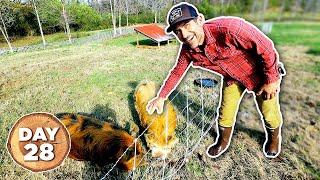
In this 28th‑day vlog of the "Building a Homestead in 100 Days" series, Victor Justin Rhodes (Speaker A) and his neighbor/guest (Speaker B) walk viewers through a full day of homestead maintenance, animal management, and community celebration. The episode opens with a cold‑weather prep and a quick modification of the Chickshaw 3.0 trailer (shortening the rear legs and reinforcing the axle). They then review the breeding and dry‑off schedule of their cow “Honey,” updating their farm journal with precise dates. A lift‑gate delivery arrives, prompting a discussion on how to get the gate into the barn and repurpose the existing structure as a feed barn. The pair harvest cream the old‑fashioned way while troubleshooting a broken milky‑cream separator. After the work, they host a house‑warming party, describing the food, guests, and the celebratory atmosphere. The vlog continues with a neighbor’s fence‑clearing project: clearing 180 ft of overgrown fence, using chainsaws, blade trimmers, and the Joel Salatin low‑cut method, then installing an electric fence to train two piglets. They discuss plans for a swale and high‑elevation pond, including equipment (Mini X backhoe) and contour‑marking techniques. Throughout, they reference tools (chainsaw, brush‑saw, string‑trimmer battery), share anecdotes about learning new skills, and highlight community ties. The episode ends with a quick meal prep recap and a sign‑off.
Chapters
Get our shoes on. Don't judge us by this side of the shop. Judge us by, uh, that side of the shop. Two things, top of the vlog this morning. It's going to get very cold, like 18 degrees in the morning, and we've got plenty of wood there. We've got plenty of wood there. We do not have plenty of Kintland. Which that, that will come in very handy. And we do not have plenty of wood on our porch, so we have to do that. And we have to do that before we go to sow the lands. Here, guys, look! I took the Chickshaw 3.0, and you can't tell from there, but these legs stick out lower. They're lower, lower. I say it's lower. It does look a little bit like a pimped out ride because it's lower here and higher there, but I don't think it's too bad. Water will better run off the roof. The ramp still reaches. We are working on an epic project to get you guys all my plans for all my designs, but this is part of it. As Chris, my partner in this, the engineer, goes through and makes these plans, we had— I, I have Part of it is, hey, you know, I wish I would have made those legs shorter because they drag when you pull it sometimes. It's a big process of him outlining the plans, me tweaking some stuff, make sure this thing's perfected.
Like this.
I don't know if you can see it, but— yeah, you can see a little bit. There's a gap between the nuts and the wood. This rod that is the axle twists out sometimes. Chris found some heavier rods. Because they also can bend when you put 300 pounds of chickens in that. But I just remembered, I think there's a bar that goes all the way across, which would be ideal for strength and it not twisting out. Although it might just pull the other side tight. Anyway, I got those 4 inches shorter and it works beautifully. Wait a minute, it's been over 3 weeks. Weeks since she got bred. She got bred October 6th, Homesteaders of America weekend. The reason I know that is because she hasn't come back in the heat. About every 3 weeks, a mature cow comes in what you call heat, and she can get bred. You don't have to really know when that is when you have a bull. They'll tell you because they go nuts for her for about 3 days, and he hadn't gone nuts for her in over 3 weeks. It's been more like 4 and a 4 or 5. Now we need to consult our trusty farm journal. Let's just put in Apple. I think I put Apple bred— nope. Okay, so let's say she was bred on October 6th. Apple Why am I calling her Apple? Hey, that's why I couldn't find her. Why am I calling her Apple? Her name's Honey. Okay, Honey Bread on September 15th, so obviously that didn't take. She came in, uh, because she went into heat, uh, she got into heat September 15th. We said Honey Bread, but obviously that didn't work. Sometimes it doesn't stick because she came into heat about 3 weeks later. Let's delete that. Oh no, let's change what it says. Honey heat, because then we'll know she failed. And then now we need to go to honey bred. We'll add it. Okay, so she was bred on the 6th. So now to eliminate ourselves here. Get some better lighting here. All right, there. How's that? Now, to eliminate some thinking on our end, let's go ahead and put when we need to dry her off, which is in 7 months from now, and then when she's going to be due. November, December, January, March, April, May, June. June we dry her off. And then July, August, she's due. Just realized I did the math wrong, I think. Uh, it was, uh, November, December, January, February, March, April, May, June, July.
Peter's here.
We ordered a lift gate, but then we're like, how are we going to get it to our garage? We can't. Asking him if he can drop it at the barn. Thankfully he's got the smallest truck they got. The people barn is going to have to become a feed barn. He's got it! Look at that! I've been worried sick over this. It's running into some soft gravel up there, spinning out. Ah, it's too soft. While he figures this out, let's go get the pallet jacks. Impressive driving right there. You've been driving a while? Yeah. Throw it right there in the middle. Time to test if we're getting more cream. Because we separated Graham. Our cream lines haven't been that great, and that could be one reason. Oh, there, that's, that's more. Oh, look at that! That much in that one, that much in that one, compared to an older one like this. You guys see that line? Oh, it's the same date. Yeah, it's funny how one has more cream than the other. Okay, we have these 5 gallons. We let the cream rise to the top, and we're harvesting cream old school instead of— okay, can you spot me? I'm gonna have to try to carry that without jiggling it too much and breaking up the cream. We don't know where the cream is. I know, we said we were gonna cream separate, it's why it was in those pots heating up, and then our new milky cream separator was jacked up. Uh, that's disappointing, but we're gonna make do. Next time they'll be in jars and we'll be able to see it, probably gallon jars.
I jiggle it too much, the cream will mix back in with the skim.
One reason they don't have really thick cream is they're on winter grass. Oh boy, I hit the skim really early. I think I need a smaller ladle. Look, the problem with doing this in these big pots is The cream line is so thin because it's so spread out wide. Trying to get it without getting the skin in, but it's— well, that kind of works, but still got skin. Again, the skin is thick. I mean, the cream is thick. Okay, Taylor, I'll be there in just a second. Look at this. I think that's working. Nice, this is working. Tell her I'll have to be there in a second. Mom made hot chocolate for the housewarming party. Made me some pork rinds. Everybody else is eating corn chips. Look at all these minivans. Minivans and Suburbans. That's me. Henry fell asleep. That's them partying without me. So we'll just eat my fish and beef soup, and we'll wait for little Henry to wake up, because you never wake a sleeping baby. Look who woke up! Come on, come here, come here, come on. Come on, let's go. You're a big boy, you're a big boy. Congratulations on the house.
Oh, thank you.
Yeah, thank you, both of you. Thank you. Looks good. Look at your party barn.
I know, right?
Right, this first big party.
Yeah, it is.
Okay, good.
It's crazy.
Everything you thought it would be? Yeah, plus some.
I think so. There's a lot of people here. This is probably the most people we ever had in our house ever.
Good job, good job. I've stole Jason away from the party. Good party, my man.
Yeah, thanks for coming.
Just from the rain. Yeah, we got a lot of crazy rain. We did last night. You know it's going to get crazy cold, right? It's going to be 18. Yes, where I'm at. That's awesome. Okay, so this is it. This is— you've been clean— you've been clearing 180 feet of fence. Yeah, because your fence is— well, you want to electrify it, I imagine, right?
This is like this old horse fencing that's been here, and I just want to reestablish it and use it.
And it's—
since it's here I mean, I might as well use it, but it's all overgrown. Yeah, all the way around the property.
Is this your property line, or is that—
no, the property line, a little bit in there, that pink.
Okay, nice.
And then it goes— oh, it goes out that way, so there's more up there.
You actually have some pasture you could clear for more pasture, but you don't need any more right now. No, you got more than me. You got more pasture than me right now. I've got 75 acres and only about pen and—
oh man, yeah, we have so much capabilities here that, you know, and I'm just doing it by hand. Yeah, I know, I just start in one spot.
That's right, I'm just going. So we just walked the length of what you've done by hand.
3 days.
You did that in 3 days? 3 days. How many hours do you work a day?
I mean, that was probably— I don't know, probably 4 hours a day.
Okay, and then You— what are you doing, chopping it off the top and then working your way down?
Yeah, I'm just kind of going, you know, like I started doing the top on these ones. Like, this is probably like the worst part of the fence line. Yeah, um, so I'm just starting from the top and working my way down and then seeing how that goes.
Okay, you know, and I'm imagining you don't have a chainsaw. I do. You do? Are you using it?
I am using it, yeah.
Are you using a blade trimmer?
Uh, both. I'm using the, you know, table saw blade trimmer on the trimmer and the chainsaw.
Okay, good. And you're doing the Joel Salatin method, I imagine, which is you're just cutting it down as low as you can possibly go, or are you improving it somehow?
I don't know, I'm just chopping it down. I just want it—
you are, you're doing the Salatin method. You're— what are you gonna do with that? With that? Oh, from there, finish this plant.
This one, I'm probably gonna take it all the way down to the ground.
Okay.
Yeah, you know, like, I really just want it off the fence line.
I see, I see. So that way— so you don't— you're not putting this into a pasture situation yet? You're just getting it off the fence?
Yeah, I just want to be able to charge this fence so I could tie onto it and then put pigs in here in the forest. Yeah, use this as an electric—
because you have here 100 feet. Yeah, they're gonna love this forest.
Yeah, and they could still use this. I mean, this is not terrible. You can get a pig to get in here. Yeah, you know.
Oh yeah, they could help you actually clear it up.
Yeah, it's just all this.
Put them in there first.
It's just been neglected so much, but it would be hard to get them.
Yeah, look, here's your— here's your before, here's your after. Can we go see the said pigs?
Yeah, let's do it.
Okay, your soil is already so much better. I think I came in very early spring.
Yes, you did.
Yeah, it's already so much better. Oh yeah, and I'm here in the— I'm in— I'm here now in November, which it would have already started dying off again.
Yeah, like all year we ran 160 meat chickens for the year, and it was basically all in this area, just running chickens. And you know, plus the, the beef— the beefy boys.
There they are. Yeah, I see them. Is that what you call them, the beefy boys? When do you kill them?
Uh, the plan is to do it in December. I could probably wait another year, but honestly, we need meat.
Look, you got little ones.
Yeah, they're about 2 months old.
You got them in this pig panel to train them doing electric fence?
Yep. I got one wire down there about 6 inches high off the ground, and then I'm just training them in here.
Have they learned it?
Well, we've had them for 2 or 3 days and they've already hit it a few times already.
They will test it, won't they? Yep. You guys ready for the cold? Pigs are ready.
And these are— yeah, these are my hired help. There they are, our rototillers.
Yeah, they are. What are they gonna do with this area?
It's really just a sacrificial area, just, just to get them growing a little bit bigger.
Okay.
And to train them on that fence. And, you know, just put them on here.
Good job. We're starting to climb your mountain, as Lorraine calls it. Yes. Uh, you're gonna build a pond up here?
That's what I'm hoping.
Oh, nice.
I had some guys up here to figure out like a swell and a pond, and because there's no way of getting water up here.
Oh, that's true. And if you had a pond way up there, theoretically you could feed the whole farm.
Yes, because our hose, just like right here, it takes an hour to fill up this trough.
Does it? So that's the limit.
That's the spot where Yeah, I can't go up further.
Yeah, well, let's look at these beefy boys. You got one right there. Yeah. Hey guys, have you petted them yet? Is that you wanting to try to pet them?
Yeah, I pet them. Oh, they're pretty friendly.
Okay, where's the third one? Did you have a third one?
No, just two.
Oh, okay. I won't come too close, guys, make you get up. All right, that's enough. Don't want to disturb your—
it's a Jersey Angus.
That's a good sign you're feeding them enough. What is them sitting down?
They're sitting down.
Okay, that means they've gotten enough and they're gonna sit down and chew their cud. That's good. You want them sitting down. You don't want them roaming around all the time. Your hay there, it's good. That spot will be so much greener. All these spots, when it comes back, man, you're gonna have this into a paradise by end of next year. I see a lawn chair over there. You come out here and hang out?
Yeah, that's where we get the best internet right there. Oh, that's where I edit all my videos.
I thought, I thought we were gonna have a zen, uh, a zen moment here.
Nope.
The lone chair in the middle of the field. That's it.
That's internet. It's the best internet while I observe my, my animals.
What's all these orange?
This might be a swale.
Oh, okay. There were— who marked it?
Uh, Billy, my friend Billy.
How did he catch contour?
Um, he had an A-frame.
Oh, okay.
Yeah, that he marked it off with.
Okay. And then where was he seeing the pond?
Either the pond on that end or a pond on this end.
Okay. How you gonna dig said swale?
Probably with a, uh, backhoe. Yeah, Mini X. Yeah.
All right, you might have to rent my Mini X, buddy. Oh, here it is.
Yes, the best internet.
I thought you were going to say this is your quiet time, your—
well, that too—
your meditation spot. Yeah, wake up, observe everything. Yeah. All right, a little behind the scenes for Sow the Land. If you watch his channel, this is where— this is where it all goes down. Fancy office. Here are your Ewoks over here. Yeah, pets.
These are basically our pets at this point.
They never bred, huh?
Yeah, no, never bred. This is Zeke. Super like, they're like dogs. They're like super calm. Belly rubs, anything you want.
You're a California immigrant. You came over here from California.
Yeah.
Did you know how to chainsaw before you came out here?
No, like not even prior to this property. So we've been in North Carolina—
oh wow—
for 7 years. Prior to this year, I maybe used that chainsaw maybe 4 times.
Wow. How did you teach yourself how to chainsaw?
Just by doing it. Wow, like I'm still watching, watching YouTube videos on how to, how to chain, how to rechain it and like sharpen it and all that stuff.
What about your brush saw? Yeah, I just got handy.
Yeah, yeah, it's a steel table saw blade basically.
Which brand is it? It's the 111?
Yeah, because— okay, so I was using this one battery.
This is your string trimmer battery.
But like, I knew like this was not going to cut it anymore, you know, maybe on 1.5 acres or around your house or an apartment.
This too, I got this.
What does that do? This basically does what the table saw blade does, but apparently this is for like brambles, like softer things.
Okay.
And then the big blade—
you should have one of those.
Yeah, but they generally do the same thing, I guess.
Okay, nice. Thanks for the tour, my man. Oh yeah, congrats on the homestead. Thanks. The men hanging out out there. The women hanging out right there. The kids hanging out right here. Just left the party. Party was good. This time I'm driving. But I think we might have left Rebecca's water bottle. Normally she drives because she's better at getting around and I get the business done. But I'm giving her a break this time. You got your water bottle? Yeah. All right, let's do it. Home sweet home. It never gets old, even if we're gone just for 5 hours. Love coming home. You got to be home. He's going right in. We realized that the party— I didn't set any— set out any meat for dinner, and Lorraine said, what do you guys do for a quick meal? Well, let's go see. Leftover ideas: Mexican rice, baked potatoes. She made collard greens, mashed potatoes, shredded cheese, a burger. I think we have a burger thawed out out here. I think we have a steak thawed out for some reason. So how about steak fajitas? There's pork ribs. Yes, pork ribs. We're gonna do that when— early in the week when your grandma's here.
Okay.
Uh-uh, cat, uh-uh. Cat got in the house.
Two cats got in the house.
That's dance! I think a fast food for a family who never eats out, quesadillas. Do you have quesadilla though? I do. Okay. Oh yeah, on hand. And we have some burger. So it looks like I'm having burger and they're having Mexican. Here's plate. Her plate, his plate, their plate. That's a wrap, folks. Happy day. See you in the next one.
More from Justin






If I had to start my Homestead all over again, it could only pick one animal… 




