Building a Homestead in 100 Days - Day 4
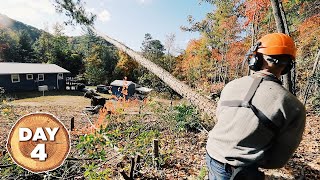
In Day 4 of the 100‑day homestead build, Victor (Speaker A) and his family, together with forestry consultant Ian and a horse‑logger, spend the morning clearing trees for pasture using a tractor‑mounted tree‑pulling tool and manual sawing. They discuss silvopasture, deciding which trees to keep for wildlife and soil health versus those to harvest for timber. Chickens are used to prep garden beds, and the family milks a goat, dealing with the practical challenges of dirty teats. The group then surveys the property for potential house sites, reviewing contour maps, existing logging roads, and timber quality. Ian explains high‑grading versus sustainable silviculture, recommending specific species (yellow pine, tulip maple, white oak) for future timber‑frame construction. Plans for a passive‑solar consultant visit on November 2 are outlined, along with a timber‑frame design that will use on‑site harvested wood. The day ends with the discovery of a root‑cellar footing, a brief family dinner, and a reflection on the fatigue and satisfaction of homestead life.
Chapters
Day 4 of 100 days building homestead from scratch. Today, show them the tool, Josiah. Show them what we got there. We are gonna continue to clear for pasture, sawing these trees off right here. Then you think it'll work? Yeah, uprooting them. We're gonna find that out today. Thanks for joining us. Hang tight. Do you want to go? You gotta get your clothes on. Look at this, they do such a good job clearing. Here you go, ladies, have at it. How do you manage to still get some turdlucks in here? The kids finished putting compost on Boots' garden. Let's cover it for the winter. It's working! They've revealed our squash, man. Shoot, if they can jump up on that cage— I was thinking about raising this to cattle panel size instead of pig panel. How are you guys doing that? I don't know if that'll help. Sidewalk's supposed to be poured today. That'd be interesting. You have to stay off of it. They pour this. Okay, basically no work gardening. I just plant it. The chickens prepped this, had mulch, then, uh, I transplanted starts. Acorn squash. And then I did weed it once. I weeded it once, and now I've set the chickens in to get all the greens up. If I enter this, um, I could probably win. Yeah, you could. Too bad the fair is over. And this is a beautiful acorn squash. Thank you, ladies. It's an exchange. I give them fresh greens, weeds, access to those, and they give me acorn squash. Flossie, what have you done? Or what has somebody done? It looks like somebody has pooped on her. Oh my gosh, that's when we need a water hose. Look at your jacket. Can you milk her without leaning on her fur? We're gonna need to clean it up too. It's the other side jacked up too. No. Well, yeah, there actually is some poop on the teats. All our cloths later. Yeah, Lily went to take Henry home, get more cloths. I think she's ready, but we have nothing to wash her with. I thought I was gonna milk her, but oh, I got poop on my— yeah, I need to wait on the cloths, clean myself up. Well, there's what's happened. Yeah, Flossie, I guarantee you, is laying down in fresh manure because it's warm. She had a time, buddy. This would be fun. We have a new tool to pull up roots. And we get some tractor. We've got this tree pulling tool we're gonna try today. You put this on the tree, hook this to the chain, hook to the tractor, pull it up. We had to find a chain. Gideon thinks he knows where one is. Can we borrow this? Yeah, I think that's locked in. That's welded. Yeah, it's welded in. Gideon says there's one under at the splitter. Yeah, did you find it? Yeah. What's that? Sword. Nice. Oh yeah, there it is. Perfect. All right, let's bring it. Hey, are you bringing the chain? Too cold. Oh my. You got it? Okay. Do you think we can do that little bit right there? I do. I think we can do that. Start with this tree. Yeah, that's probably a snack. Let's come in here. You saw down the trees and then you hook that up and try to pull it out. So let's do this patch of smaller trees. Okay, that'll be the goal. We only have this morning, but we do got a good amount of time, about an hour and a half, because this afternoon the horse logger is coming Meeting with our designer and we're gonna figure out what we've got and how to plan for building our own house from the land. We are trucking now. The only problem is chain came off, but we did a nice swath all the way from the brush pile to where Josiah mowed the other day. But yesterday I was wondering, should we really be doing this? Like, I could hire a machine, they'd do this in 15 minutes. But then I saw those guys working so hard. And I thought, we're doing this together, we're building this together, and that, that, that's just priceless. Plus we're not tearing up the earth, and we'll have— we'll be grazing here this time next year. Oh, this mountain laurel, I don't know if it'll make it out in direct sun or because I cut half of it off, but I was like, wait, let's keep this, it's so pretty. And I hate that I cut that. Actually, we aren't clearing all the trees, by the way. We are keeping trees for a silvopasture. Yeah, we could go to that tree next. What we're gonna try is to pull these up with the tractor. I kind of doubt that thing will get this big old root out. If it doesn't, we have to saw it down, saw it to the bottom, and it just sprouts back. That's the problem. So we have to keep it mowed, we have to keep the animals in it for sure, and eventually it will die. So it's not a huge problem. It mines minerals from deep below. And brings them up to their leaves. And then when the animals eat that, they get mineralized. So it's not terrible. My hunch is it'll probably pull up the size of that one. We should tighten it. We should get it going and then tighten it after it gets warm because it loosens up. All right, they want to get this one. It's big, it's fat. Hey baby, perfect. It's even, it's on the log, so it's going to be easy to cut. Lifting it up for us. That one actually might be longer, so what, we need to measure 16 feet. Well, you go right for the big one, huh? You think it'll pull that one up? Look at that root system. We can always— I think there's no way, but certainly we can try. Oh, but now we have a big hole. I think it could be easily raked over. Look, look at what this thing pulled out. I was surprised. I'm learning I need to pull up and out and it breaks off the roots like that. That's a much better pull, doesn't uproot the ground so much. It's a nice seed disturbance anyway too. And now that they can get sun, this will grow a patch of grass. It just broke off the mountain laurels. So we're gonna have to saw them down. You guys are sucking it down. Yeah, it's good. Been working hard. They've been working hard, Mom. I bet they have. Jonah, you've been working hard healing. Hot chocolate worth it?
You did it!
Yeah, you did it! 2 inches. Did he? 13 pounds. Concrete's here. The kids and mom had nachos and I thought, oh, I can have nachos, pork rinds, and somehow it turned out really good today. Just use them as a corn chip. Weren't you fasting today? No. I'm carnivore today though. Alright, pull that guy, he can get one. You don't want too much wheel. Just fire away at the top of it. Our designer's here. Also the horse logging guy is here. Hopefully we're gonna get a good idea on Well, if we can build a house off our land, how much can we get and use for a house? He'll give us a good idea about that, what kind of trees we should save for that. First things first, we're going to look at the map. If you look at the contour lines, this is a crazy steep road to get to them. We're going to want to put in a road. We already have a logging road that goes like this. What is it? Uh, the existing house is up that hill. You'll come down here first. These are— there's a pile of lumber in here somewhere. That might be it. Maybe, maybe.
I think it's that.
I think this is firewood. This might be some lumber in here. It's a possible house site here. We're having the passive solar guy come November 2nd to look at various places to make sure it's going to get enough winter sunlight. I'm maybe a little concerned about that ridge. So we might have to go higher up to the next possible place, but I know this— all this is too thin for you to work with. Do you want to walk up that way, or we can walk up this way, or both?
Yeah, both.
Okay.
My job is to take stock of your forest resources.
Okay.
And to see how those can inform, you know, a sustainable ecological building project.
Nice.
So, you know, without sacrificing— so it's only ecological if it doesn't sacrifice a quality forest.
The thing to do in this region is to do what's called high grading. Okay.
Basically means you're going to go into the woods and you're going to take out the very best trees And you know, if you've ever worked wood, you can appreciate why you would want to do that, you know, because nicer timber is easier to work with.
Nice.
However, um, what that does over time, if you can think about it from the perspective of a gardener or livestock— yeah, manager or a geneticist—
your forest just keeps getting worse worse.
Yeah, you're just kind of robbing the woods, or you're robbing the bank of good interest-bearing accounts. Yeah, it takes kind of a holistic mind to see, all right, where is the forest at and what does it have to offer that will— you could provide for something to build with but doesn't get you into the realm of high grading. Silvicultural standpoint, um, silviculture meaning the art and science of growing a forest, um, as opposed to agriculture. Um, not opposed, but distinct from agriculture.
Yeah.
Um, you know, you're with silviculture, you're trying to keep a forest.
Forest.
Yeah, you're trying to in some form, right?
Yep.
And that can be a really broad definition as far as a pretty broad concept, but the idea is that they're still growing trees and trees that are regenerating. In my opinion, there's also value in kind of keeping it more or less like it is, save maybe putting in a home site or, you know, some more woodland type, you know, activities, say like cultivating shiitake mushrooms or planting, you know, different, uh, you know, medicinal species that grow well in the forest if things like rhododendron don't provide too much shade or too much acidity. Yeah, but in terms of things you want to like that we could saw up and build with, based on the map and based on what I see here, it might be that we would get some wood here for certain things, but as far as framing something up Probably need to find some pine on the other side.
We'll go outside. You're definitely getting off the road. Can't hear or see the road, and we're not too high too. If you get too high, you start hearing the roar of the town. Little oaks. Is that a good sign? Yeah, it's a wonderful sign.
It's got the potential to be a very thriving hardwood forest.
Nice.
If it were— if it had a little, just a little bit more management.
But we exhausted our search. On the new side across the creek found a lot of cabinet, a lot of flooring, not so much timber framing. So we're over here on the— on our side now, the old side, looking for pine.
You've got a similar forest really, except it's a little more open, a little less roaded in, but there's still some. Obviously the thing I didn't see across the creek that you have here is the yellow pine component. And this yellow pine right behind you, yeah, that's something I would encourage you to keep actually and not cut.
Can your horse pull out a big old log like that?
Yes, sir.
Really? Dang. How, how wide was that? Horse says how, how, how wide is that? You measured it?
It's about 20 inches.
What's your horse's max, both of them together?
It just depends on the grade, depends on the species, what time of year it is, whether or not they're feeling good or not. But I mean, you know, they can pull a 16-foot log out of that tree.
Wow, it's a gigantic tree.
It's gonna be heavy.
It's cool to have Ian here because he, you know, he would look for white pine, but he's saying, um, you have not— we don't have a lot of white pine, but we do have a lot of tulip maple, tulip poplar. So we would use that instead, which is super cool because he's, he's looking at the land and what we have and our needs and marrying those. Well, this could be a hole in our plot. When we were back at the— that pine, they started eyeing that slope, which is on the side we're currently on. Actually, it's on the other side of the road. They're thinking, well, that's your, that's your house site. Hole in the plot. We're trying to develop this side for the 100 Days of Building a Homestead, so if we're going over there, we'd be shifting our focus in a different direction. Of course, it'd be the same concept— raw land, clearing ourselves— so it's not that much different. John, I wanted to show him down here by the fort. So he's got some pines over here. At first I want to get frustrated about the changes, but actually it's actually good. I mean, we're— what does permaculture teach us? Work with nature rather than against. So we're looking at slopes, we're looking at access. A lot easier to access that place over there, you know, it's not so steep to get some of— to some of those more ideal places. I'm gonna have Ian look at my silver pasture project that we're currently working on, making sure he can give me an idea, a better idea of what to keep, I think. So you see this slope? This is good. I like this slope. What should I keep?
You tend long term? Do you tend to, like you've done before, thin it and then keep some, you know, 2, 3 trees?
Yeah.
An acre, and then sow grass?
Yeah. Okay, and then graze it.
So I'd cut the pine and I'd cut all the rhododendron and I cut all the maple. You might keep a couple of oaks, keep that white oak. So this is a red oak, it's a scarlet oak most likely, or a black oak one. I can't— okay, I think it's a— and red oaks will hybridize, and I think that's what's happened here.
And you don't like the red oak?
Well, it depends on the red oak.
Oh goodness. So I'm gonna have to get you to come out here and mark the trees.
Even if this, say, was a white oak, see how there's this frost crack in here?
You're gonna get rid of that.
I wouldn't want to keep it.
Okay, okay, okay.
The injuries— I'd have been injured.
We are back. Time for a table meeting. Like a flow, uh, of the floor plan. This would be really be the first sketch I'll be doing. Um, but definitely south-facing. We talked about that's where we want the kitchen, the family, the dining, you know, the common areas to take advantage of the solar. What do you think, Beck, after the meeting? Austin's still here. You're going to join us for supper. Ian's gone. It's interesting. It's, it's changed our plans a little bit. Maybe. Yeah, maybe a different house. Not in a bad way. Maybe. We're gonna see that. Pull up Passive Solar God, November 2nd. So how did he change your plans for you? Well, it's— well, it's a different type of house, which I'm totally okay with. Okay, so it's timber frame. Dan, can you pull up a timber frame shot? Because I don't understand. It's big beams. It's beautiful. It's so— so they harvest the wood from the farm for the timber frame. Uh, there'll be accents with it inside the house, right? And it's perfect for passive solar because you can do things with insulation with it because they're like 6-8 inches thick. Grandma and Grandpa had him. He looked at that air purifier like it's evil. Hi! Are you ready? Another surprise. He can't— he doesn't cut the wood till February. I know, which is the sap and stuff, and then it'll be ready to be built by June. Which puts us on top, but it'll be after the 100 days. I was hoping to get these horses during this 100 days, but we need content after the 100 days too. So more track loaders and excavators. Uh, that's what he's voting for. So the passive solar guy will be here November 2nd. That'll help us get a better idea. Now we have a third possible house site way up there to talk to him about, so So that'll give us a good idea moving forward. I'm excited. You excited? Yeah, this is way— this is like, you didn't know what you were signing up for, did you? Yeah, but it's, it's gonna be really cool because we're all gonna learn a lot, a lot of different designs, and yeah, it's gonna be a good project. You're gonna be working with a lot of people because we're working with him on the, on the timber frame and the design and the passive solar consultant, and then, and then with passive solar. Well, you're just going to expand your portfolio. Yeah, really going to learn a lot. It's an awesome opportunity. Oh, you guys want to check out the foundation for the root cellar? Overall, it's been a good day, hasn't it? We got a lot of clearing done this morning. We're all safe. The persimmons are ripe. There's a lot to be thankful for. I, I am very tired. That's actually probably a good thing. That's the cool thing about a homestead life, is you're tired at the end of the day. And you sleep very well. Oh, look at that! We got us a footing for a root cellar. Boom! Join us tomorrow, will ya, where we continue one day at a time to build a legacy homestead from scratch. See you tomorrow.
More from Justin






If I had to start my Homestead all over again, it could only pick one animal… 




