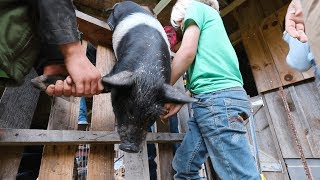
In this informal farm‑yard video, Victor Justin Rhodes (Speaker A) leads a small group—including Speaker B and Rebecca—through the decision‑making, emotional, and practical aspects of castrating two male piglets on‑site. He explains why male pigs are castrated (to prevent boar taint and to calm the animals), acknowledges the moral weight of performing the procedure himself, and outlines his sense of responsibility as a consumer of the meat. The group reviews and gathers the necessary supplies (iodine/Beta‑dine, a castration kit, disposable scalpels, gloves), discusses the differences between disinfectants, and debates hanging versus sitting the pig during the operation. Speaker B describes the anatomical challenges of pig castration compared to cattle, detailing the need for two incisions, testicle extraction, and cutting or pulling techniques. The conversation also touches on waste‑avoidance (using the testicles as food) and attempts to minimize stress by inverting the pig’s head, acknowledging that the process will never be completely stress‑free. Throughout, the tone remains conversational, instructional, and reflective, blending practical how‑to guidance with personal ethical considerations.
Chapters
Hey Jonah, have you given Phyllis— Hey guys, hold the bucket for a second. I'm going to give her alfalfa. All right, you can start grabbing. I go through great lengths to give my farm animals a really good life. I used to have this saying I picked up somewhere that my animals only have one bad day, and that's harvest day. And it's so quick and humane, they don't even remember it. But I realized a while back that that's not entirely true. Not for some of the males of the farm. They unfortunately get two bad days, and one of them they're gonna remember.
People holding their legs here and then have their body right here.
Case in point, you see, with Pigs, male pigs, if they go through puberty at about 6 months old, they get what you call boar taint. I mean, it's totally natural for them. There's nothing wrong with it. It's not like a disease. But some people can actually pick up on a negative taste inside the meat. And those that can pick it up, it's bad. So we castrate. That also calms the pig. I'm not looking forward to this. I hate this day. But if I'm gonna eat animals that would have been castrated anyway, I feel like it's my responsibility not only to harvest them at the end and to take that hit and emotion on myself, it's on me now to castrate. The problem is I have no idea how to castrate. Thankfully, I have a friend who knows how but has never done it before, and I have somebody inside of my member area who has helped another member on how to do it, and they were able to do it successful. So I'm going to take those instructions, combo of my friend, and we're going to get this done. This is the gear. Rebecca, tell us about the stuff that you got to make this go down.
I don't, I don't know if I'm really qualified, but, um, I just, I bought some Betadine or an iodine wound spray. And so I figured I'll let you decide because I felt like— oh yeah, when we did it with Bear, you were like asking me for things and I was like, I don't know.
Yeah, so just show him what you got.
And then I got a castration kit, but then I also bought more disposable scalpels in case we needed them. I mean, it's a lot, but sounds good considering we only have 2 pigs. And then just gloves.
What? So yeah, there's only— is this an either-or or is this both?
I have no idea.
Either or. Either or.
They're the same basically.
Okay, I didn't know and I was like, I'm just gonna buy both.
Which one do you like better? Or—
I don't know the difference.
It's a disinfectant, right?
They're both disinfectants and they're either the same or closely related.
You just pour the iodine in there.
Yeah, basically castrating pigs is a little harder than other animals because there's really nothing hanging. With a cow, you got some hanging going on and it's really easy. You can take the bottom off of the scrotum. With pigs, it's a little harder because everything's so compact, and so you basically have to make two incisions, pop out the testicles, pull them out slightly, and then you can cut, and then you can pull a portion of it. Some people cut, some people pull.
Okay. Are these edible like the cow testicles? Oh yeah. Okay. All right, so we don't want anything to go to waste, guys. A little appetizer for supper tonight.
You know what that means?
Just hanging his back legs over. Since we have so many people, one man on this side, another one on this side, and then you'll show us where to go from there. Where does the iodine come in?
So we're gonna clean beforehand with iodine, and then when we're done, we'll just spray all in there, in inside our incisions.
Okay.
And people might think the hanging is, is cruel, but honestly, so your options are either hanging or sitting on the pig. So it's kind of one, one way or the other. Both ways it's stressful. It's going to be really quick though.
I'm glad you brought that up because actually the hanging, putting his head upside down, is just like when you butcher a chicken. It Actually sedates them a little bit. Blood flowing to their head, um, so it calms them a little bit. I'm glad you said that. And we're making it as comfortable as we can. There's no stress-free— this is not gonna be 100% stress-free.
Nope.
But we're gonna try to eliminate some of that.
It's these two.
How can you tell? I already seen the back.
This one. Wow. Okay, there we go.
All right, how's everybody feel?
I feel fine, but I'm a girl, so—
Yeah, I mean, think about it though, if you're going to eat this stuff They're going to be castrated anyway, partially. I feel like it's better that you take on the responsibility, I take on the emotion and torn feelings of like, is this right? Like, should we just keep them intact, take the risk? It's good to feel that weight because it is an animal we're talking about. Yeah, I agree.