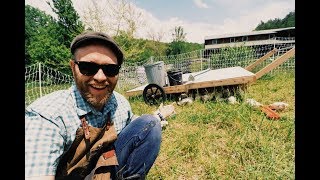
This content was created by Victor Justin Rhodes. This content was uploaded by Victor Justin Rhodes. This is a YouTube video titled "Chicken \"Coop\" Cuts Feed Costs 20%" (created 2018-05-11, last edited 2026-04-10). The clip is a farm vlog/demonstration (Day 1 of a "100 Days of Growing Food" series) featuring a primary host (SPEAKER A), Sonya Becker (introduced as being from Becker Family Stock Farm in Thermopolis, Wyoming), and several children/helpers (Jonah, Josiah, Gideon) and helpers like Mr. Brown and Rebecca. The content documents moving sheep and Cornish Cross broilers (called "sea monsters"), setting up portable paddocks and electric poultry netting, feeding and watering, and describing a mobile, tractor-free chicken shelter concept (the "meat shaw") to reduce feed costs and allow free-ranging (about 20% of diet from grass). It also references predator protection strategies (electric netting and a guard goose) and draws on a previous Great American Farm Tour example with Sonya Becker.
Chapters
Come on. All right, we're gonna move these sheep and sea monsters or what? Yeah, let's go. You know what today is, Jonah? You guys get to see monsters. Are 3 weeks old. No. Yes, you're going to Grandma's. Whoa, snake! Oh look, we got a king snake right there. That's a beautiful one. Whoa, wrong way, dude. That's our house. He'll keep the mice away. You know what today is though? It's the 100 Days of Growing Food, day 1. Can you say, "Woohoo!" Our goal is to see how much we can grow in just 100 days. We're going to document what we bring in, what we push out. We're going to vlog every day. I cannot wait. I'm personally very excited about it. You guys excited about it? You excited about it? Okay, day 1, 100 Days of Growing Food. Moving the sea monsters out, moving the chickens up. Let's do this. The sheep are out where the sea monsters are gonna go. Sea monsters, in case you don't know, it's C, the letter C for Cornish cross sea monsters because they grow so fast. They're just ferocious growers. They don't like tall grass. We have the sheep going ahead of them mowing it down. We have to create a way to move these sheep easy. Problem is there's only one opening in a corner, and right now the opening is on the opposite end of the way we want to move them. So I have this idea to do one straight strand of electric fence that can be our base, and from that fence we build a rectangle with another electric fence for the sheep. And then once they're done in there, we go ahead and build another one right next to it, and then we can easily— oh man, that's not gonna work. Ah, yes it is. Then we roll up the side of this thing. Jenna, now we have the two fences next to each other. All we got to do is roll this one up just to the end. Roll that one up to the end. You understand what I'm saying? Just, just this one side, not past their fence. And then I'll roll up this one. All right, you want to herd the sheep in here? Jenna, Jenna, Jenna! There we go. Didn't take much. They love it. All right, put our fence back up. You put our new one back up there and we could pull our old one and go ahead and set up tomorrow's paddock. It's hot, isn't it? Before, after. And the chickens are gonna love this naturally mown grass. Let's go get our poultry net up. Let's get the feeders out, fellas. Does that have any more grain in it? Empty out the shavings. We got our water set up. We gotta hustle. We want to get this done before lunch. Lunch should be any minute, actually. We got to get our red feeders over there. Josiah, can you take our red feeders? Jonah, actually, Josiah's gonna take our red feeders. You take the fermented feed that we have already made. I can, I can step on that. That'll do it. Here's a pea, Josiah. You're going across to eat grass. Yeah, 20% of their diet will be grass. Put that black bucket on your storage shelf. Dry grains. Put— fill that up with your dry grains. And we got our running water running over there, we can fill it up. Put my water a little closer in case they get hot. That's enough, isn't it?
Yeah.
Bring on the chickens! Let's get them in there. That's one way to get them over here. Wait, no, put them up by their water. Dip their beaks in the water, or just put them out there. That's fine, they'll know. There you go. Look, Mr. Brown, look how they forage right away. They know exactly what to do. You think they're happier in here? You want to hand them out, Josiah? Jonah, hop in there. Jonah. Hey, Mr. Brown, look at him. Mr. Brown. What are we doing, Gideon? Going up the bend in the wheelbarrow. You guys are cute. Am I holding up the line? This looks like a parade. Is this the Burl Holler parade? You got you a bucket of chicken right there.
That's right, Anna, our friend.
Thank you for helping us. How's it going under there? You think they like it, Rebecca?
Yeah, I think so. They're a little confused.
Well, give them a second. They got a bird brain.
I know.
Look, they'll be chasing bugs and scratching. And look, they're already starting. Last year when we were traveling all of America on the Great American Farm Tour, we came to a special person. Her name was Sonya, and she was in Wyoming.
My name is Sonya Becker and I'm at Becker Family Stock Farm in Thermopolis, Wyoming.
At her place, she had this amazing chicken system. An amazing chicken system there. She had this trailer that she had all her feed and water and everything on top of it.
We are gonna feed these little broilers some homemade chicken feed.
And the chickens, the Cornish Cross meat chickens, were living underneath it. Wait a minute. There were no walls. Wait a minute, wait a minute. Where's their house?
Where's their house?
Yeah, where's their house? That's their house. There's no walls under there. My first concern was, what about predators?
Nope, there's no walls, there's no protection, there's no fence, there's nothing. I have a dog that comes out and most of the time she protects them. We did get a coon in not too long ago and lost some birds, but usually she, she guards the chickens and we leave them out. We don't lose them to hawks or anything like that with the dogs.
And what I liked about that system is those chickens were free to range, absolutely. And if they are free to range, they can get 20% of their diet from the grass.
And then we feed them on the ground and allow them to pick through the feed and use what they want of it, and then they run free and and, and get the bugs and all the goodies and any other grass or alfalfa leaves or whatever they want.
The only problem that I could see in her system for me was they had to pull it with a tractor. It was kind of a commercial-level system. I think she had hundreds of chickens. I came back from our trip wondering, how can I implement that concept without a tractor at the homestead level, at like 75 chickens a run level? Introducing the meat shaw. One person can easily move this. Just put it on the very edge right here. It has no walls. They're out roaming on the grass. They've got their water right here. They have shade. They have protection from the rain. But what about predators? That's where this electric poultry net comes in. It keeps the predators out, it keeps the chickens in. What about aerial predators? Good point. That's where the guard goose comes in. Just a reminder, will you hurry up and grow up so you can guard our chickens? I think with the simplicity of this system, it's cheap and inexpensive to build, it's easy to move, the chickens have free range. I think we're gonna revolutionize the way we raise meat chickens on homesteads.