Chicken System grows 375 LB of meat in 49 days
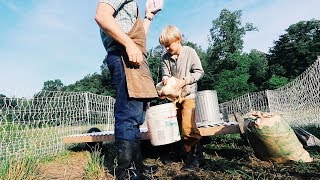
In this extensive farm‑vlog, the narrator walks through a day of operations on a diversified homestead, focusing on the upcoming chicken harvest, ongoing guinea pig health, garden maintenance, and livestock integration. The video opens with setting up a brooder for the next batch of broiler chickens (referred to as “sea monsters”), detailing heat lamps, feed, apple‑cider‑vinegar water, and a play fort. The narrator reports that guinea pig mortality has ceased and demonstrates handling techniques. Garden updates cover sweet potato progress, mulch overload causing nitrogen deficiency, and corrective actions using fish and liquid fertilizers. A food‑forest tour highlights layered planting (raspberries, persimmon, dandelion, herbs) and the benefits of edible weeds. Pigs are praised for clean water and rich manure, and the narrator muses about co‑grazing pigs with chickens to reduce chores. Detailed chicken growth data are shared: birds now weigh 5–8 lb, feed consumption is high, and feed fermentation is being trialed to improve efficiency; the optimal harvest window is discussed. Modifications to poultry netting are explained, moving toward a free‑range “chickshaw” system. The narrator also describes hardening‑off seedlings, experiments with corn, peas, and plums, and plans to replace the glass greenhouse with a roll‑up plastic cover. Cow milking updates, a potential pregnancy, and bull replacement plans round out the livestock section. Throughout, family members assist with chores, adding a personal, enthusiastic tone to the instructional content.
Chapters
Beautiful One's going to get more sea monsters. We're doing 3 batches this year, 3 batches. She's going to get batch number 2. The ones in the field are going in a week. It's an update video. Gotta do some things though. We gotta get the sea monsters brooder ready. You ready? Come on, help me. We're gonna go on a walk, but we gotta put the We gotta get this brooder ready. I don't know how long it's gonna take. Is that working heat lamp? Got it set up. 2 lights, a dirt trap, apple cider vinegar water, fermented feed, and what's that?
A house.
Okay, let's put the play fort down here. Just in case they want to cuddle up by the lights. There you go, the play fort's in there. We put cardboard under the feeder there so, you know, the shavings and stuff fall off their feet before it gets to the feed. Let's give you an update on the guineas. We have no more deaths. It's— the dying has stopped. You guys are the, the strong survive. You guys ready to go on a walk? Okay, go ahead. She just wrapped herself around the stairs. She went under the stairs. Yeah, let go.
I'm gonna pull it through.
Okay, do you guys know how to make it short?
Yeah, we do.
Okay, that's too long right there. Here, come on. And then keep her on your right side. You understand, Josiah? Yeah, you understand? Hold her from your body too so she doesn't learn to trip you up. Just go, just tug. What, what are you saying, Mr. Brown?
I just thought I'll play around with what's on here.
All right, she's already— better stop an itch. Good. She's already doing better than yesterday and the day before. I was having to tug on her all the way, way over there. Now She's already going.
Now she's tugging on the line to go faster.
That's good.
Let her do her business.
Oh, she's just checking out the view.
Look at that reflection.
Sweet potato update. How are they doing? You know, we had some rain. They like to be established in water, but then it's been pretty dry, but they seem to be doing just fine. Weed pressure staying at bay. I mean, there's a few things like right here. But no big deal. There's a big poke root coming back. Have we lost some? Looks like we've lost a few. For the most part, they're jamming right next to the sweet potatoes. The first place we mowed behind the cows, it's getting lush. Some of the weeds are coming back, like— I mean, yellow dock, it's not a weed, but the cows don't eat it. Let's see if this grass has recovered. What we're looking for is blades. Blades. We don't want it to get to seed. So what we're gonna have to do, I think, is come back on this with the cows and then mow everything because it's starting to turn brown. He's a chatterbox this morning.
Can you lift 100 pounds?
I could if I had to. That's 100 pounds. If it goes to seed, if the cows don't like it at seed head like this, they definitely don't like it when it's browned, starting to brown, kind of like that. Raspberries doing good. Look, Gideon, we might get some fruit. The flowers mean fruit. Whoa, that one's really tall down there. But what everybody wants to know, do we have any blueberries? Whoa, so close! Actually, this is gonna fall down. We need to— we need to trellis these, Mr. Brown, very soon. We're gonna have a blueberry. Oh, we'll eat them when we get ripe. Your guess is as good as mine, Mr. Brown. How soon will those be ready? 2, 3 weeks? Maple. The bus that's been to all 50 states. How's she doing? Well, she is officially for sale, but we haven't officially listed her, so we hopefully take pictures one of these mornings, evenings, and get her online, hopefully this week. The chicken garden miracle kitchen garden. Mama's got some tomatoes coming along, but this is way too short to be coming along. We have— our theory is we have way too much mulch in here. It's like 18 inches in some spots. I mean Look at this. Boom! I dug down 18 inches to get to the soil. I think what's happening is that mulch is just sucking out the nitrogen. So what mom has done is she's gone around yesterday and put liquid fertilizer on the plants. We're going to hopefully save them.
I mixed up some fish fertilizer and I'm just putting that on them just to kind of make sure that they're getting enough nitrogen.
Some of this just got too wet in the flood, and I don't know if it's gonna make it. I mean, maybe something's gonna happen there, but I sort of doubt it. You want out? Mom's herb garden though is jamming, especially up here. Look how it's doing better up here. I think because it's drier, this is not where the water is going to collect. Oh, Mom's back with the chicks. They're up here, buddy. Big old box.
Oh yeah, a big old box. Give me a kiss. Papa! Ma, I helped Papa! You helped Papa? Yeah. Good, you're a good helper. Yeah.
Not one person's dead. Good, good. Oh, don't let the cat or the dog—
No, back up, Manzo!
She's not paying attention. Pay attention, honey. I won't, I won't. Hello? I've got her, I've got her collar. Oh man.
Amanzo, back up!
Oh, look, I think those two are like best friends.
Oh, they're hungry birds.
Look how thick they are. They're already bigger than the guinea. All right, Almanzo, you don't hurt chickens, okay?
They seem really lively.
I think so. And not one dead.
Yeah, they seem— you know, I wonder if the last batch, because it took so long to get to us and then it was really cold Yeah, it's like too long in the mail. Yeah, so because these ones are jamming.
Oh, is it from the same place?
It is.
Where?
Um, the poultry hatchery.
You're dipping their beaks in the water. I didn't make them apple cider vinegar though.
4, 5, 6, 7, 8, 9, 10, 11, 12.
Yes, you got to count them as you put them out. Let's compare these hefties to the, uh, guinea. Same size. Day 1. Those guineas are a week old. Look, they're so hungry. You guys are— here you go, Rebecca. 17. One more. Dipping their beak in the water. Got apple cider vinegar in there. Beatty's gonna make some magic water here in a bit.
19. No, no, no, gosh!
How many we got?
75. 75 goobers.
Look at the other goober above your head.
Royal, you don't want to eat them.
Get your daily therapy, Rebecca. Right.
Look at them, they're so stupid. They're standing in the water, but they're very light.
That means they're lively. They're very lively because the other ones weren't doing that. But look how they're—
look at these guys, like they're scratching already.
That's a difference between one day late shipping. What, you want to help her get in? You know, this is a good example. I guess we do have a food forest going on because we have this. We've just kind of let nature take its course here. Look at this, what's naturally come up. Yellow dock, yellow dock, yarrow, uh, raspberries. They've spread themselves. They kind of used to be over here.
Okay, so we had—
and they died off. Two plants, two plants right there came from this. Look at this, fruit everywhere. Can you guys see that in there? This would be a good place plant the ground layer. The kids have kind of already started a garden there. You can come plant some comfrey or something like that. And then you have your shrub layer. What are these beautiful blue flowers, Rebecca? You have your shrub layer of the raspberries, and it's climbing up this— that's not, uh, dandelion, is it?
No, it might— I don't know what that is.
It looks something like dandelion, but I don't know what it is. And the flower is crawling up, and it's just absolutely beautiful. And here we have our persimmon not suffering from this invasion. There you have the— there you have the overstory tree, the shrub layer with the raspberry, the beautiful flowers, the beautiful herbs mixed in there. Look at the base of this. We actually have— oh, look, like the kids might have planted some lettuce. And we actually have a dandelion, which is beneficial. You can eat— you can eat every single bit of the dandelion— the leaves, the flower, the root. Hey, you gonna help me? Oh good, their water's clean.
Very weird that the water is clean, right, Papa?
It is. It's weird since they're pigs, but they keep the water clean. Here we are, one of my favorite elements in the farm. Why? The pig. Rich manure, till fast, eat anything. Did I tell you I love you? Oh, don't jump, don't jump. Oh, he's looking at me. He might take me down. You don't like a head scratch? There you go, that's better. Come on, come on. You guys are growing fast. What? Nothing's growing over here. Give us some time. We planted it by seed. It's got to germinate and grow. We'll see. We all had much to lose there. Oh yes, something is growing. Some of your cover crops are sprouting. The pigs are over there. This is our crop growing chickens. You know, we're not going to plant in June. We're taking a little break. Gotta start planting again in July in the greenhouse. Those plants grow up, then we need to transfer So they've got 2 months. I don't know if they're going to get that down in 2 months. I'm thinking real hard about blending the chickens and the pigs to speed up that process. I have them on 2 jobs if I don't have to. If we're gonna— I know there's some difficulties to work out, but, uh, you know, we've got to keep the chicken's feet elevated. I think these chickens are big enough, the pigs are small enough that the pigs aren't going to eat them. I think it would be cool. It would definitely cut our chores down some if we could blend them. The chickens are there now. This is where they were. I love, love, love how the COVID crop is coming in. I don't love how some of these are doing. Yeah, that one's doing terrible. Although this one, this one's doing better. Like, it's like in this case, the lower we go, the better they're doing. Up there in our kitchen garden, the higher you go, the better they're doing. I think one major thing here, and then we're going to improve on this in the fall, is transplant shock. We're just jumping from the greenhouse to the field. And that's a big jump because one, they're getting moved, their roots are getting cut and disturbed if they've extended past the soil blocks. And they're going from being watered and nice heat every day to coming outside to not necessarily getting watered every day, being exposed to wind, direct sunlight. I'm going to take this greenhouse, I'm going to remove the glass greenhouse and put a plastic— put plastic on it. But on at the end of it, down here, say I'll mount it to a 2x4 that can be just rolled up. And then that way, like a day like today, it's not going to rain, just have it exposed. And that, that's what you call hardening off. So say these plants, they've been in the shelter of the greenhouse. When you remove that, they have the direct sun and they harden off. You can come down here if it rains and cover it so you just don't destroy your soil blocks.
But I'm having an experiment.
What is it?
I planted corn and peas in this.
Okay, we planted plums in this. So we're all about experimenting, aren't we?
I planted corn and peas in there.
Oh, you did?
Yeah, I found some off— I got some out of the chicken feed.
Cool. Go give me that tray of veggies. Let's harden it off right now. The one over there to the right.
This one?
Yep, bring it out. Jonah made this cart. I think we can use it for that. Come put that tray right there and we'll let that harden off. We left water, look like it looks like that got fried from not getting water. These two, I think they're best friends.
Hey Papa, look at Papa, look at the jet ski!
Two more bags of 2 more bags of feed for the sea monsters. They're going through about 2 bags in 2 days now. Come on, these guys are getting huge. We weighed them yesterday. Our biggest one, 6.5 pounds. Our smallest one, 5 pounds. That 6.5-pounder is going to be over 5 pounds in your freezer. You knock off 25%, that's what you got in your freezer. I said, Beauty, do we have bags big enough? In retrospect, I think it would have been— I think we could do harvest at 7 weeks. We're going to lose some of our efficiency this week for the amount of meat we gain versus the amount of feed consumed. You know, the efficiency declines at a certain point. I think we're to that point. Maybe next time we'll harvest them. They say fermenting feed can make them grow faster. That means with this system those chicks, we could possibly grow 75 chickens in less than 50 days. What are you gonna do, weigh one? Yeah, catch that turkey. It's going like— we don't even need to get a turkey this year. You're huge.
You want to scratch stomach?
Here, come on, let's weigh it.
They're also very strong.
All right, put it— put him in there. Scale it down. Can't even fit in the bucket.
Okay, he's—
he needs to stop moving. Good Lord help us, I pray. 6, 7, 8. He's 8 pounds. Okay, here, take him.
Too overweight.
Never mind. Our biggest bird is 8 pounds.
That's because you just ate His crop.
Oh, did he just eat?
Yeah.
Okay, so we're gonna just let them run out of this feed and then they're done. You know, we don't need to get much happier than that. Yeah, don't feed them any more than that. We've tapped out. Okay, 8 pounds. That's 6 pounds in a freezer bag. I have to ask Beauty if our freezer bags are gonna even hold 6-pound birds. Y'all notice anything different about the net? We were having to move them every 3 days in one net. Put two nets together, one long strip like an L, and then one strip over an L. Two L's put together, one long rectangle, and we don't have to move the fence but about every week. Right here, you guys have pretty much just turned into free rangers. We pretty much open them up, they're out and about. Nothing's getting them. I don't know if it's because they're more agile than the sea monsters Or because the scarecrow's working. So that means we don't— I don't know if we need this poultry pen. I had that for aerial protection, but they've been just fine without it. So it might be Chickshaw time very soon. You guys want a Chickshaw? Good morning, y'all. Violet, you ready to be milked? Stepmuffin, how you doing? Hopefully they snuck and got pregnant. She basically dropped from 2 gallons of milk to a gallon. Come on. Look though, she's so full and she is starting to shed. She's not breathing hard. We're happy about her progress. Hopefully he snuck and impregnated her. That would be some stud muffin. And we can get her tested in a couple of weeks and then we harvest him. We don't need to keep a bull all winter, all fall. Kids could be more involved with the cow chores if he was gone. We have already called the breeder. He's got another bull lined up for us, but if she's pregnant, we'd need her somewhere toward about this time next year. Look, perfect pumpkin pie. Mom tying up the calf this morning. Look, he's up to your waist.
Come on, dude. You're a goober, dude. You're a goober.
Took the milk inside, got 1 gallon, consistent gallon. Also looked into the sea monster thing. I've been counting. First of all, from the day they've got here— actually, it took them 3 days to get here. That's probably why so many died. I mean, we lost 20 out of 75. Come on, come on. What?
Do we have to move them?
No. Okay, come on. We don't move them in the morning. Um, so actually, they are turning 8 weeks old on Monday. There's no way we can wait till Saturday. We just amped this up, so we're going to be making our orders for our stuff today, busting our tail prepping it on Sunday, hopefully butchering these guys on Monday.
More from Justin






If I had to start my Homestead all over again, it could only pick one animal… 




