Chickens Escaping | 2 Strikes and You’re Out
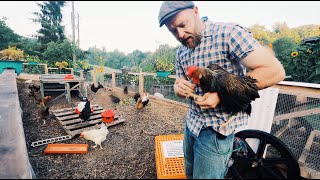
The hosts manage a mixed-species homestead with cows, sheep, chickens, ducks, and turkeys in rotational grazing. They use a two-strike rule before culling hens, milk cows daily and heat it to 100°F, and feed the skim milk to pigs. They also bury wire to reinforce chicken enclosures and buy compost from Red Bud Farm.
Chapters
The chicks are the people and the dinosaurs and the chickens are the dinosaurs. How are the ducks and geese? They like the water so much they eat the monsters. Yeah, they drink more than the sea monsters too, don't they? They drank that whole— or they splashed more anyway. Yeah, go ahead and get their shipping box out of there. Thank you. Yeah, look, they love it. Everybody's doing good. We got some chickens that didn't even go up last night. Josiah, you got any ideas how we can catch 2 chickens unoriented out in the middle of a field? Aroon to the rescue! All right, all right, let's put her in the cage. I'll put her up at Lily's posse. So here's what's going on. We have like 60-ish laying hens. I mean, well, 20 of them aren't hens yet, they're chicks. So ultimately we'll have 40. We'll raise 20 every year, new chicks to replace the old ladies. The problem is you got to have— see, you get the chicks, but they aren't laying right away. You gotta let them grow up. That's then when you cull hard and replace the older ladies. Until the hard culling in the fall, we're gonna hope these escapees from the pasture posse stay in Lily's posse. So I'm gonna mark these guys with a green band because, um, they don't never— I need to know that these guys will not stay in a sheep fence. And they don't need to go back out to pasture. All right, you stay in here. These are our chicks. We got them specifically for their size. They're going to be especially big and especially calm, so hopefully they'll stay in a sheep net. Come on, get in, let's go. So ideally we wouldn't cull any of these bigger birds that are in lay until these chicks come of age to replace them, until they come and start laying. But so we're gonna put people in Lily's posse, and then if they escape from there, I think, I think 2 chances is enough. Yeah, then they become pig feet. It's important that these guys stay. This is a sheep net, so we already set it up. The sheep already came behind the cows and it's already set up. So it'd be so nice for it to just be a pasture net for the chickens because they go around and scratch the cow manure and spread it and eat the fly larvae. We're trying to get them not to follow the bucket right now. Okay, good. It's good that they follow the bucket, but not when you're wanting to leave and not encourage them to bust through. We move the chickens from over there to here, and then we pick up the net, and that net becomes the, the next net for the sheep. The sheep are down there, and then they're going to come in here. I'm gonna have to go milk. John is gonna have to set this up. This is where the sheep are going. The chickens are staying in nicely. It's a beautiful sight. I really have hopes that it will work because most people don't get out of that. Most of them don't get out, and it's a wonderful thing. We just got to get the right hens for the right job. It's a bit of a transition from how we used to have to do it. Another reason that's so important is because we have limited amount of land for the amount of food we need to raise for our family. In that one spot, in that one grassy spot, we've had cows, which is milk and beef. We've had lambs, which is going to be lamb. And then we've had chickens, which is chicken and eggs. And even more so, then we eventually run turkeys on the same land, and we run sea monsters on the same land, and ducks. Do you see? Do you see how it's compounding? And you're getting so much more from the same amount of small property. All right, it's a little after 8. We're milking early today. Cream separation day. Haroon is back, thank goodness, helping me with this. He's gonna finish. What I want you to do is we're gonna finish burying this woven wire. Yeah, that's the foundation, so you're gonna have to go in front of it here. Wow, that goes way out. I'd say that's deep enough. So we're gonna dig down— I don't know, what is that? Maybe that's 10 inches. We've done the wire mesh there and they're not getting out there anymore.
You see these little chicks finding holes underneath, and this is why we have to get serious. Somebody didn't get in, we didn't know it.
And they got killed last night. How's it going in here? Oh good. Am I on time? Yeah. Okay, good. I'm gonna start milking. Hey, your look— your hair looks extra special today. What's going on? It's extra beautiful. I just washed it and did it.
All right, so wear it down.
It means I just like spent some extra time. So you are heating this milk up? 100. Correct. All right, remember, don't go over like last time. I've got them the milk in here, done milking. And how's it going? It's going really good. Yeah, you're caught up. Yeah. Okay, it's a lot better when Grandma's here, isn't it? Grandma's our secret sauce. That's right, secret sauce. All right, we've got that quart right there plus 2 cups of cream. Grandma's just cleaning up after it's done. Mucho skim milk to feed the pigs.
That was Red Bud Farm. We just bought some organic compost for our gardens. Leaving it up to the masters to make our compost. Finding it easier just to import it. Leave it up to the super pros. And bring that stuff in, put it on our gardens, and see what happens. What, like the market farmers do it? Casey Ostwich, JM Fortier, Curtis Stone, all these guys bringing in compost. Oh, Elliot Coleman. But anyway, before we close, I got, I got a little something exciting for you guys. This morning I found out my friend Jessica from— you might know her from Roots and Refuge— she just launched a a pre-launch, like, for a book. It's called Growing Vegetables: The First-Time Gardener's Growing Vegetables. And I know Jess, I know this is going to be amazing. And why I'm telling you guys about this, I'm so excited about this. I'm excited about this for Jess and her followers and those who get this book and go into gardening. But what's really exciting me and really caught my attention is she's number 1 in like the organic gardening category. She's at number 1 in like 2 different categories. Last time I checked, number 54 in all of Amazon books. Like 54 in all Amazon books in sales, and this book doesn't even come out till February. So I was thinking about it, guys. You know, you saw us cream separating this morning. Well, before we cream separated, we milked. We milked actually every day for 7 days, and then we cream separate every 7 days. And before we milk though, we brought the cows in. And before that, we moved them. We moved them every day. And before that, saw to it that they had a birth and had a calf so they could have milk. And before that, we saw to it that they— 9 months before that to get pregnant. And before that, what? Getting them delivered. And then before that, finding them. And before that, researching. It takes time. That was a year-long process. This is the same with gardening. This book, it's pre-sale now. What is it, July? Doesn't come out till February, but what an amazing time in February. That's when the seed catalogs come out. That's when you want to be planting your garden. So if you want to jam and garden in 2021, it starts now. It starts now in 2020. What I'm most excited about this and happy to share this is because, well, we're dear friends with Jessica and Jeremiah, but we also know that this is catching the attention of the world. Like, when it gets into the Amazon list, that's going beyond this homesteading YouTube world, and it's getting their attention. We're taking a stand. We're saying this food growing movement is here. It's here to stay. This is something good. Everybody on Amazon, look! Here we are! So guys, I'm asking, I'm going to go order it right now. I'm going to go preorder it right now. But I ask you guys, consider it. I mean, it's going to be worth your money. I mean, I can't believe the value that is a book. What is it selling for?
Jessica, what's it selling for, girl? Okay.
It's selling for—
where did I have that up? There it is.
It's selling for like $27, so that's exciting. For $27, you can learn how to grow vegetables and get thousands and thousands and thousands and thousands and thousands and thousands of dollars worth of food over the year. So anyway, go check it out. It's on Amazon. I'll leave the link to the pre-order down below. And Jess, if you're watching this, thank you and congratulations. On writing this. I'm very excited for you. We need more of this in the world.
Good job.
More from Justin






If I had to start my Homestead all over again, it could only pick one animal… 




