Cow Delivery 101 | When Helping Hurts
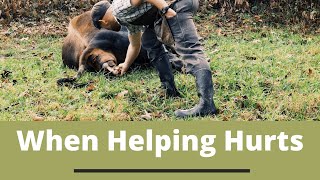
Justin and Rebecca's cow Aunt Flossie gave birth to a stillborn calf after the placenta came out first and suffocated it. They didn't intervene and share ten lessons on monitoring labor, the dangers of pulling a calf, and when to call a vet.
Chapters
A couple of days ago, one of our family cows, Aunt Flossie, gave birth. But unfortunately, she gave birth to the placenta first, therefore suffocating the calf, and the calf died. Then we shared that story in in our recent show, and since then I realized I think that there's some perspective missing, some whys, and there's also some learning moments for you guys. So I want to address two things. One, the perspective that we're coming from and that you guys are coming from, a viewer, is very unique, and I think it needs to be addressed because it can create some confusion. The second thing I want to address is I've got 10 things to talk about that we did and/or learned that will help you, because helping doesn't always hurt. There's this idea that perhaps we should have intervened and pulled that calf. I'm going to talk about why that might not be such a great idea, and certainly I can talk about why we didn't do it, because I realized so many, many, many of you guys are in that beginning stage, or you're just getting started, or you don't have cows. And from a human perspective, perhaps what we did doesn't make sense. Hopefully you're going to put it in perspective today. Let's do this. Before I get into the 10 educational experience points, let's talk about perspective. So when something bad happens on this farm And that's what the show is about? That— well, that really kind of needs to be the title. I mean, it's exactly what happened. Uh, Flossie gave birth to a stillborn. Now, it sort of puts the viewer and the creator at a disadvantage. The disadvantage is this: in the title, you already know what's going to happen. So I think automatically it puts that— it has to— it puts that perspective as you watch the show. But as— but you got to realize, as we were filming, we didn't know what was going to happen. So we didn't know Flossie was actually giving birth to a stillborn at that moment. We didn't know what was coming out before the calf. I had thought it was a placenta. I said that a couple times in the film. I wasn't 100%. This is very rare what happened, and in my entire life growing up around cows, I've actually never seen that happen. In a way, the viewer has an edge over us in the film. They might— you might think, oh, why didn't you do this, or why didn't you do that, based on— because you already know the outcome. That's sort of a 20/20 disadvantage. Hindsight is 20/20 disadvantage. But here's the interesting thing: would I do anything different? No, I actually think we did everything right based on our management practices. And so I think we have a lot to learn about that. I think actually there is one thing I might have done different, and that is offer Flossie, maybe I should have given you a snack. Uh, maybe she would have taken some alfalfa. Brianna has suggested maybe some molasses water. She's never had that. I don't know how well she would take that. Uh, but maybe I could have given her some alfalfa to give her some energy to help her along a bit. But other than that, based on the situation and as it was out playing, even knowing what I know now, even going into it again, and if I knew— yeah, that's the placenta, this baby's stillborn. I wouldn't have done anything different, would I? I wouldn't have done anything different. Good girl, good girl, good girl. I milked her yesterday. She did good. She did not like the brushing part. She kicked me for some reason yesterday, but today she seems to be all right. Oh, it was the water. If you're gonna get kicked, you want to get kicked close to her. It's when you're out here that you can really have that impact. So it may seem ironic and scary, but you got to get close. All right, I've got the warm water. Let's see if she'll— she'll let me do this. Okay, she's okay. I don't know what it was yesterday, but she wasn't having it. So let's get into the 10 things that we can learn from out of debt, 10 perspectives from where we came from. And hopefully you guys can learn a little something from it. So you definitely want to be careful and slow to intervene. Like I was saying, afraid she was going to kick me. These are very strong animals. It can be stressful on— I'm jumping ahead of myself, but it can be stressful on them. It can be, uh, even dangerous. One thing that you can do is if you actually go and start helping the calf out You could actually— well, if the calf's still alive, you could one, pinch the umbilical cord and kill the calf. If you could actually pull the calf out, let's talk about that for a minute. It is physically difficult. These animals are insanely strong, and it looks like you could just go up and pull out. You can't. In fact, when I was growing up, I was a young boy, we had a cow, it was in distress, the calf was stuck. Uh, it was probably in a bad position. I don't remember. I'm pretty sure the calf was dead. I think mama was suffering. We tried to pull that calf out. We had to get the four-wheeler, and the four-wheeler was going down a steep hill, 35— the mom was on a steep hill. We were heading down a hill, 35-degree slope, and it was hard pulling that calf out. So it's hard. So, but if you could You could quite possibly tear the mama. So that leads me to my other point is these cows are largely unhandled. So, you know, they'll tolerate me milking them, but they don't, they don't like kisses and giggles and hugs, right? So it would be very stress— it's very stressful for her to get— for me to get close to her anywhere besides the expansion, and it's definitely not something we do on a regular basis. So that's a stress point. I could get severely hurt if I go up to her, you know, maybe when she got on her back, whether she did that on purpose or accident. If I were to go over there, she could kick me. She is so fast and so strong. Once my dad got kicked while milking. A dog came up and barked, and it jumped the cow, and it hit him in the chest and put him— slung him clear across the room. We're lucky he didn't break any ribs or anything like that. This is why I say I don't think we made a mistake, because we, we monitored it and we had a book. We had the book, um, Keeping a Family Cow. It was a quick reference for us. We also have Mr. Google Pants, but you got to be careful with Mr. Google Pants because he will give you so many answers, and you really— anybody can really put an answer on there. So Ultimately, you've got to choose an authority, and for us it's Keeping a Family Cow. But it's also— we had online direct text a man who runs a grass-based dairy. That's where we got these cows, so he even knows these cows. So, um, we have them at our fingertips. One thing the book said was 2 hours, the pushing stage is normal. You don't even want to get— start getting concerned for after 2 hours. But even then, as long as it's progressing, meaning over 30 minutes— you have to look at a 30-minute period of time. Has that baby come out any further in 30 minutes? And she was making much more visible progress than that. I mean, she was, she was making if you walked away for 5, at most 10, and came back, you would see even a significant difference in the distance of that calf from her. A few of you guys have noticed this and even complimented on this. This is a good cow, you know. And I asked, I asked Josh, you know, after this was over— he's the guy we got the cows from and our mentor— I said You know, is this bad luck or is this genetics? And he said it's bad luck and it's very rare. And why I was asking that, because guys, I'm looking for really hardy genetics. I'm raising cows for my grandchildren. I don't, I don't need stock on this farm that can't thrive here naturally. It doesn't— our stock needs to not need a lot of input, so If somebody's going to be meatier and not thrive here, well, it's going to be what you call cull. And, you know, either sold or harvested or whatever. So the implications for us in our management style of helping someone is not, oh yeah, you're— you didn't do it, you're gone tomorrow. No, we look into it, we look at all the implications, and we look at the replacement possibilities. You might not be able to find a better replacement. So, but I'm just saying that's some of the implications of what would happen if we were to have to intervene. But it turns out she is a hardy stock. It has nothing to do with genetics, it's bad luck. And, and, and it's very fortunate that she was able to push out a stillborn calf without being hurt, without dying. We're— it's very fortunate. That, that's a good stock. One person said in the comments, you know It's your management. I mean, it's the way these cows are, are raised. They're in the best possible environment to thrive in a bad situation like that. They're given fresh grass every day. They have shelter every day. They have fresh water every single day. They are extremely well taken care of. We have sheep running behind them eating any of their parasites that are left behind, digesting those. We have 16 minerals for for them available at 24/7. We keep the herd together, we minimize stress. We're now milking out in the field, not, you know, that's one less thing. They don't have to walk to the barn and back out. They're just out here with everybody else. It's a low-stress environment, which gives them a chance to thrive in a bad situation. So I think— I think that commenter for that, thank you, thank you for— appreciate that. And seeing that. But I also want to thank Josh and appreciate all those breeders out there who aren't babying their stock and aren't— I mean, it's one thing we would, we would do what we need to do to save this life, but it's a whole other thing if we then continue to breed that. I think we're doing a disservice. I think we're actually doing a disservice to ourselves and the breed. And that's just my opinion, and that's where we're coming from on that. Basically, that's it. I had mentioned it earlier, there's only one thing that maybe we would have done different. So, and that would have been, um, by providing snacks. Maybe that would have— I don't know, it would have just made her perhaps a little more comfortable. I don't even know if she would have ate the snacks. I was walking home from milking, I realized I forgot to throw something else in there. Um, and why I didn't intervene, because she was moving along And really, you only want to have— might have to help a calf out is if its position was wrong. And we knew what positions it needed to be in, again based on that book. I mean, ideally, textbook, hoofs together first, then the head. We had one hoof out and then the head. So one thing I did look for was making sure that other hoof was there. That other hoof ended up being right here. If that other hoof would have been back here, you'd probably have to push that calf back in, reposition that hoof, but even then, still let mama do the work, not pull. Because at that point, you wouldn't be sure, especially like if the, if the placenta isn't clearly already out. That calf is dependent on the umbilical cord. You don't want to tear the mama. Again, I'm just re-emphasizing that. Yeah, let's go to the house, get some thoughts from Rebecca. Rebecca?
Yes, sir.
Let's get your take on what happened. I want to say this though, from the human perspective, a woman don't walk around with a baby hanging out for up to 2 hours. That's a big emergency.
Yeah, that wouldn't happen in a human birth. How it goes with a cow, it's a little different.
Yeah, so other than that, what, what is it? Maybe a perspective you have.
So I did not grow up around cows, and I didn't grow up around farming. We had horses, but they never had babies. Anytime a cow gives birth, I'm always like, maybe we should help, maybe we should help.
I'm glad you brought that up.
Like, I'm always nervous.
You, you want me to put the calf on the mom?
Yeah, I'm always super nervous about it.
I'm like, just let it play out. We actually—
I actually, when Joel was here I asked him when I picked him up at the airport, I was like, so I have to ask you, like, what is the time frame? Because I get really nervous. And he's like, oh, it just has to be a couple hours.
Yeah, because you were thinking an hour, 30 minutes, and you always push. Yeah, yeah.
Okay, I'm always pushing Justin.
It's always— it's all—
it's tension between us.
It's getting less and less. I think we're learning. Well, I'm learning how to calm down because I'm very just like, let them go at it. And you're like, you feel like you got to do something.
Yeah, and so then even out there during the situation, and it's something that you just can't catch on camera 'cause it's in survival mode. You're in a mode of just like, I'm dealing with the situation at hand. That's why I came back to the house, was because I was like, I need to read the book. I need to read the Keeping the Family Cow book. That's the book that we've chosen to use as our guide. And so I came back and I looked through it and it calmed me down. It made me be able to be like, okay, She's progressing fine. She's, even though, and the book says even slowly progressing is progression.
Yeah.
It doesn't matter. And then, you know, it gave a time frame which, which it was like, okay, so there's 2 hours. This could go on for 2 hours. And then it was kind of like then at 2 hours, then Justin and I would have made a decision to probably intervene.
Yeah, but then if— I guess there was still— You don't just pull out.
Yeah, there's like technique. There's special ropes.
Yeah, you, you don't pull out, you pull down. And so it's best if you don't know what you're doing to— well, we let nature take its role. Now, a vet, guys, our vet is 45 minutes away.
Well, and that's if she's not farther away at another call.
That would be an emergency call, which would be Very expensive. It would be like $800. And so—
It would be, and that would be like her having to cancel all of her appointments. That would be like, that would just be—
And what's she gonna do? She come out here and pull the cap out?
Well, the cap would have been out by the time—
If we were pushing 2 and a half-ish hours.
Even if, well, she probably could have given us advice over the phone, which she's done before.
Yeah, that's true.
But at the same time, if we would have called her immediately as soon as we saw the placenta hanging out, she prob— the calf would have been born by the time she got here. And then there's a whole host of issues that come with pulling a calf. It can cause issues with the calf too, that because it didn't get like the proper squeeze coming out. Um, it can, it can tear the mother internally. It can cause her uterus to prolapse. It can just cause a whole host of problems that, that cause more interventions.
Yeah.
And that, you know, we just try to be as low intervention as possible. So it's, it's a hard call and it's one that everybody has to make. And, you know, Justin and I talked a lot about this, like we had several conversations about it after the fact. I mean, we basically talked all day Tuesday and about this, and we talked to other people about this, and we basically came to the conclusion that we, we feel like we did the right thing with the situation, how it came out, how it turned out. Um, yes, and it's, it's just a hard situation in general.
Yeah, and just know this, this is a documentation of our life, and we're just sharing our life with others. And these are our opinions and viewpoints, and, and others are gonna have to— you're gonna have to make your own decisions. But hopefully this has given you some insight, and so that at least you'll be careful if you go to start intervening, at the very least.
Yeah, and the Keeping the Family Cow book, it was very specific about that. It was like, you, if you're going to intervene, like, you can't just start intervening and then not finish it. Yeah, and, and then It's— there's just so much. And I think the important thing is, is to find a mentor, a book, something, and stick with what that says.
Because there's 10 different viewpoints.
Because there are different ideas of what— of how we could have handled the situation.
Yeah.
And what we chose to be our guide from the beginning, like Keeping a Family Cow book, that was the very first book that we read. Is it perfect? No, but it's what we've chosen.
It's a foundation.
Yeah.
So tell, tell, tell the people, give a kind word as we conclude here to the folks reaching out and supporting you and maybe even giving you some insight on what happened.
I don't mind people asking like, why didn't you? Like, I don't mind that at all because it's, this is a teaching moment. Like, I don't mind. It's hard. It's hard to be vulnerable. It's hard to share these, these moments with you guys because We are just humans and we are not perfect and we could have made a mistake at some point, you know, like in that, that we could be looking back and being like, oh man, we should have done that.
We've made plenty of mistakes. Oh yeah, saying we made some mistakes. There was plenty of things we would have done different with our first sheet experience.
Yeah.
Yeah. But this, we, we happen to do it right.
I feel like we did a good job with this one. And so, and I don't mind sharing sharing it. And I don't mind even when we make mistakes, I don't mind sharing it. I think just as long— I'm thankful for people who remember that we're just people and that we could have made a mistake, and to give grace there because nobody's gonna homestead or farm 100% correctly. And hindsight is always 20/20. I just appreciate all the kind comments that, that have come in and And even the questioning ones, they don't bother us. It's, um, it's, it's good, it's valuable, it's— this is good information.
Like, I put out this video because I felt like there was maybe some confusion. This is not a video for the haters.
Well, this is not a video.
There's no pleasing haters. This is a video for the lovers.
Yeah, we just want to teach you. We're not explaining ourselves, we're just letting you guys have context into the situation because at the time, like, there's so much— like, when you're in a situation, like, you're just focused.
Yeah, we're not getting anything.
No, no, this is definitely just like a context video of like what, what our thoughts were, why we chose to do what we did. And it's okay if you want to intervene, like, it's okay. Like, there's no judgment from us.
Like, we don't care, just Be careful, but do be careful.
Like, know what you're doing. That's the important part.
Let's wrap it up. We're, uh, we want to thank you guys so much for, for supporting us, the kind comments. We appreciate that. That's a big plus for creating these videos. We have this amazing community. Uh, a little tease: I'm about to head out. Should we tell them? Yeah, I'm about to. It's crazy how this story happened. You're gonna have to watch the whole story. But long story short, you'll get the long story tomorrow. We're going to get a calf. Yeah, we're going to get a calf for Aunt Quassy. Gives me chill bumps to think about it.
I know, I'm excited.
We're gonna hope she'll adopt this calf. We'll hope this calf will adopt her. Lily, we gotta go. Lily and I are going. I gotta wrap this up, get it to Dan Omen. He's gonna edit for me this weekend. Thank you, Grass-Fed Homestead. Let's get this to Dan. Let's get on the road. Let's go get this calf. All right, see you guys tomorrow. That's going to be a fun video.
More from Justin






If I had to start my Homestead all over again, it could only pick one animal… 




