Crazy Amount of Worms Changed My mind about Plastic Gardening
This content was created by Victor Justin Rhodes. This content was uploaded by Victor Justin Rhodes. This is a YouTube vlog titled "Crazy Amount of Worms Changed My mind about Plastic Gardening" (created 2019-04-08). The excerpt is an on-farm, instructional/observational video in which the host (labelled SPEAKER A) and helpers (Jonah, Scott) along with guest Casey Oswitch of Honey Tree Farm discuss and demonstrate practical small-scale farming techniques: cover crops, use of agricultural silage tarp/plastic, observing abundant worms and worm castings, shallow tilling/rotary plow use, building permanent raised beds, seeding/planting, temporary electric fencing for cows, and setting up a brooder for chicks. The host also mentions a paid membership offering and upcoming registrations. The scene is conversational and collaborative but presented as a farming vlog rather than a formal lecture.
Chapters
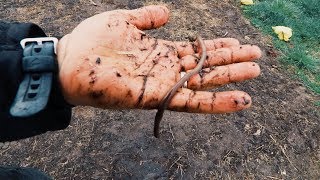
Having a little snack on our cover crop there. Look at how the COVID crop had come up. Look at the clover and the peas, rye. The guineas are loving it. The chickens are about to love it. Look at the difference. This looked like that 2 weeks ago. Nutrients for the chickens, soil building, cover crops. We're gonna get the chickens from here to here. Let's do that now. Kasey Oswitch is coming later and we're going to start planting in this animal garden miracle. You're gonna get to see a lot of the process today. It's an exciting day. On to step number 2, plastic. Let's see, this plastic has been here— it's been here a month. Normally we're going to move them every 2 weeks. We weren't quite ready, but let's see, Jonah, what this looks like after having plastic. Um, this is agricultural grade silage tarp. Let's see what it looks like. Holy smokes! 1, 2, 3, 4, 5, 6, 7, 8, 9. 9 worms just right here. Just right here. 10, 11, 12, 13. You see them? Oh my gosh, this has helped soften it up. Look at all the worm castings. Holy smokes, that's worm castings.
I think that's a big one. Oh, that's scary. That's big picky too.
Look at that length of that worm. Let me show you guys something. I'm just checking to see if, like, could we do this by hand? Could we rake this up by hand? I think we could, but then there's this. We won't break that up like we should. This is a complete root system that is just gonna spring forth. So a shallow till will help break this up.
Oh my gosh, hold on, that's a worm growing together.
Oh weird, are they mating? Probably, they're probably mating.
This—
all right, Jonah, maybe while I'm milking, you could put down the sandbags here. This is plastic. I love a hate relationship. Don't like it that it's plastic, but heck, I've never seen so many worms in my life.
I'll bring them down the road.
And worm castings. Worm castings all in place. Yeah, we're gonna bring them down the road now. We're gonna bring the cows. I'll show you where the cows are, way over there across the street. We've gotta, we've gotta bring them down the road. How do you think this is gonna go, guys? You think we'll get them to walk down this road?
Oh yeah.
Oh yeah, they won't go down our path right there.
No.
A premium member my Do-It-Yourself Abundance area texted me yesterday and said, you know, I'm in a pinch, I've, I've gotten some cows, I got to get them fast, I, I don't have any experience, how do I set up a fence? Well, we had this area over here. It was so easy to put this up. Look, I like the rebar electric fence posts, insulators. You can get those at Tractor Supply or Amazon. You can get these at Tractor Supply as well. And then this is a Greg Judy recommended line. That's it. That's all you need for keeping these cows in. It's absolutely crazy. And I do 10 steps and I put, put another one in, and you get them where they want. I've set this up in about 30 minutes, guys. It was that easy. And it's 2, 3, 4 days of feed, and then all you need is an energizer. We don't have power out here, so I did the IntelShock by Premier One, the 120. That's it. Oh, and then we have a water trough. We have a portable water trough hooked to water, so Bring on— come on, Gideon. They're driving them. We're gonna make sure they don't get off the road. Well, that was beautiful. Okay, incidentally, that's what my premium membership is for— it's people in a pinch. I could help that guy easy, fast, make him feel a lot better about getting these cows. Here we go, Flossie. Come on. That was fun being able to help that guy. Listen. I want to help you guys too, so in a deeper way than just these vlogs. And you can be a part of that membership area. I'm going to open that spring registration, I think Wednesday-ish. It's only going to be open for 5 days, and there's going to be limits because I want to adequately help people. Watch out, Josiah. So stay tuned for that. I'll leave a link down for it in the description so you can start getting your info for it. We'll do a countdown until the registration opens. You'll want to get on that fast so you can get in at these premium levels where you get live webinar twice a month, question and answer, you can directly text me, all kinds of crazy stuff. I won't even go— I'll get more into it, like discounts from other companies like Premier One. Yes. Yeah, you can do the shavings. If you guys missed it, we're starting to build a brooder downstairs here in our, uh, basement slash stall. Chicks are coming Thursday. Yeah, I know that's not a lot of milk, but we filled up one 2-gallon bucket. Have a little left over here. Look how, uh, yeah, that's— that means cream. Okay, we are gonna divide and conquer. Oh, Casey and Corey Oswitch are here from Honey Tree Farm. Yes, they do have a YouTube channel. Yes, I'll leave the link in the description. They help us with the garden. They're go-to experts in this market-style garden as we develop a marriage between permaculture garden, market-style garden, using animals to do the work of the farm, but also a bit of machinery. We're going to use a rotary plow because I asked him, I said, what about the worms? We're not going to kill the worms, are we?
No, it's the rotary plow spins but throws the soil off.
Okay, good.
Instead of like chopping it.
I like that.
But it's, you know, you can consider it as tilling still, but it does do a bit of a—
it will kill— it will get some of these weeds that the chickens left.
Yeah, it'll— I mean, it's going to expose some, but it's also going to aerate everything. So, okay, any manure that hasn't broken down with the extra oxygen will be available, you know.
Oh nice.
And, um, we're also building the beds that are going to stay there forever, so you're working the soil but you're building something that's going to make a big difference.
Okay.
For a lot of things. So your cover crop will be feeding bees, building soil in your beds.
Yeah.
And you're going to grow food in the beds. The chickens will end up being able to eat on those beds. And yeah, so it's a big disturbance once and then that's it. You can start like going this way and then come back. Yeah, and create a ditch, and then you can get into a rhythm where you're like filling what you just did, and it's mostly flat. Then I'll just rake it. I could use the tiller to flatten it out, but that's just more soil work, so we'll do the rest.
We're trying to do minimal soil work. What do you think about this job that the chickens did and then that the worms did? Do you see the castings? Do you see all these worm castings? They're everywhere, Casey.
Yeah.
Do you see? I mean, I lifted this up this morning and then I— tens of thousands of worms.
Yep.
You're not as excited as me.
I see it all the time, the tarps and stuff.
Oh, it's just every day where you—
the tarps are super cool. Like, yeah, it's plastic and stuff, but like, you can see how— like, if you're going to be using plastic, it's awesome.
It didn't absolutely smother the weeds. I'm 100%— chickens left this. Will that help with this?
This will throw this root structure out, and then as we like shovel the beds and start raking, we'll get the big things out.
Okay, it'll make it easier to get the big things out because it's going to expose it, right?
Yeah, I made 40 100-foot beds this way, basically pretty much by myself.
So it's— how long?
How long did it take?
Yeah, how long does it take to make one 100-foot bed?
Well, if you tarp it first, not very long. Like, so today I could do one, I could do a 100-foot bed in probably 30 minutes by myself.
I'll help you. Hopefully, hopefully I'll get the trays done. I can— oh, we have Scott. Scott showed up. Yeah, so if I'm not done with the trays, Scott will help you. Okay, when will you need that? You'll come get me when I'm done? Okay. Okay.
Yeah.
What, you already out of work? Yeah, you're waiting on me now.
We're waiting on you.
Dis-repaired soil block trays. I repaired all our trays. 3 that they haven't gotten yet. Here's 3 more. That's all I have for repair. How many more do you need?
I don't know.
How's it going out here?
It's going good though.
Well, how many are you gonna make?
How many have we made so far?
Do you know how many more trays we need, Tori?
2 or 3.
That's it?
Yeah, probably 3.
Well, there's 3 right there. They're ready. How'd it go, Casey? Pretty good.
We're getting set up now for the beds.
So what else do you need? Do you have tools for— Yeah, I got all these folks.
Uh, yeah.
What else do you need me to get? Because all these boys are ready to go. Scott's ready to go. Yeah, I am. I'm ready for some tea inside.
That's what he's good at.
A flat shovel that you don't need any hard rakes. Okay, smell that, Scott. You can see it though, look how dark. Smells like what? Pre-food. Pre-food. Breathe it in. You like that smell, Casey?
Yeah, this soil is really nice.
It's pretty loamy, isn't it? Look, you're shoving that in with your hand.
Yeah, I felt bad running the rotary plow through of it, but it's gonna be really productive. Yeah, but you can smell it too. Like, I think that oxygen is going to help break down some of the older manure really a lot faster. Just follow the edge. We're going for a shovel width pathway. It'll be like 2.
You guys go at it. This is my— when the, when the, uh, hard labor hand tools come out, I've got to go make lunch.
Yeah.
Somebody's got to do that. Casey has eaten and gone. Look at him. That's a working dude right there. If you guys haven't seen his gardens on his Instagram account, go check out his gardens. And then if you ever wonder why his gardens look so good, it's because he works so hard. Oh, you got a new friend.
Oh, that's a new friend.
You're putting the edge in at the end, huh?
Yeah, just so when we're seeding it's all a straight line, then it will stay a straight line forever.
Now we've got our 1, 2, 3, 4 rows, and you're just going through with a soft rake, huh? Not a hard rake, or you already did the hard raking?
Yeah, this is just to get everything nice and ready for the seeder. Yeah, everything seeds nice.
Scott is picking up the wood, the old firewood, filling up these raised beds. You're seeding already? Yeah. What are you planting?
Carrots.
Hey, you guys ready to bag some sand?
Yeah.
You lay out a tape.
Yeah, so you get your spacing right. Yeah, so when you're, when you're cultivating, it's gonna make a huge difference with everything being square. Yeah, because you can come this way and go this way. Straighter and more precise everything is.
6 inches is as close as you can get and still have a nice cultivate.
Yeah, um, that's where most, like, most of your tools will fit in between this. Poking some holes in here now. So we can take the onions and plant them.
You're gonna do this entire bed or just this half bed?
Uh, we'll plant all of them, see how far it gets us.
Okay, Jonah, let's start planting them behind him.
Did you guys finish? We didn't do all of them.
Where'd you put the bags?
There's 4 over there and 8 over there.
Okay. Wow! I'm really impressed. You guys done?
Oh yeah.
Oh, it did it. It did it. No chainsaw required. Good job. Will you help them carry sandbags now with that?
Oh yeah.
Work never ends around here, Scott.
Oh yeah, I know.
Where?
And he keeps on coming back.
More from Justin






If I had to start my Homestead all over again, it could only pick one animal… 




