Crooked Cabin: What My Sons Built & What It Built on Me
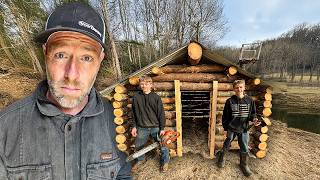
In this candid, handheld video, father Justin Rhodes films his teenage sons Josiah (18) and Jonah (16) as they attempt to cut logs, notch them, and assemble a small log cabin on their family farm. The footage alternates between practical, on‑the‑ground construction dialogue (measuring logs, using chainsaws, hatchets, and improvised lifting tools) and Justin’s reflective monologue about his evolving parenting philosophy. He argues that children have an innate drive to explore, create, and learn, and that parents should step back, provide resources, and allow failure. Justin traces the origins of this view to his own upbringing, a shift from conventional schooling and agriculture to homesteading, permaculture, and the influence of mentors like Steve Meeks. He discusses the emotional stakes of supporting his sons’ outdoor‑adventure YouTube channel, the financial risk involved, and the deeper purpose he sees in the cabin‑building project as a rite of passage toward manhood—emphasising the principle that a man should be a giver. Throughout, the family’s interactions, jokes, and occasional frustrations (heavy logs, broken tools, looming rain) illustrate the messy, learning‑by‑doing process and the shifting father‑son dynamic from leading to following. The video serves both as a how‑to glimpse of rustic cabin construction and a meditation on parenting, mentorship, and the legacy of giving.
Chapters
My 18 and 16-year-old boys are building a cabin from the farm. We're filming a video for them and their channel, and I thought that's what this was about, but it ended up reminding me about how my relationship with them absolutely needs to change. On one hand, I'm grabbing on to the old way. The other hand, I'm excited for the new way but scared, and this video, we're going to reveal and learn a lot about that process. All right, what's the plan?
Uh, just cutting down trees and getting 12-foot logs out of each one.
How tall is this cabin going to be?
8 foot maybe?
It's not gonna be no 8 feet if it's nothing. Well, if it's gonna be 8 feet, you need 16 for one wall.
Okay.
What's your duty? Well, measure and then he'll cut it.
How far are you away? Just got a few more trees.
How are you sure?
I'll be counting to keep track of all of them.
How many trees you got?
Uh, I think like 25.
I think you guys probably have about half what you need.
There's these 3 and then we have a bunch in there we gotta finish. I don't think so. Oh, but we did not realize how heavy these walls were.
Yeah, pull it.
This one's small, it's hard to pull up.
What's your job, Josiah?
I pulled the other one down.
Well, grab it. Gotcha. So where Where did the boys get this from? Well, this has been one of my whole philosophies in my parenting is the boys don't get this from anywhere. They get this from their self and they're no different than any other child. Children have a natural desire to learn, explore, be creative, build things, fix things. Where my philosophy comes in is we as parents and as adults just need to step out of the way. We can over-educate, over-curriculum and say Sometimes they just need time, money, energy, and just support to pursue their God-given desire which is to explore and create. Another big part of that is you've got to let the children fail. They'll have these big ideas, they'll want to do these things, and you'll know better. You're the adult and sometimes you'll be wanting to look after them and you'll maybe have good intentions with your "shoulding" and, "Oh well, you could do this or that." Just shut up. Just let them go and just let them fail. If parents can get out of the way in giving children time and then seeing their interest and then supporting them in their interest and then letting them fail, we're gonna go a long way and your teens will also build a log cabin or code some program or dance some jig. I don't know what it is, but you let them. You let go and you let them. Tell me what you're thinking.
I don't know, I'm just thinking it's gonna be pretty hard to build this whole thing in one day.
Go ahead and pick it up, big guy.
I don't think we realized how heavy these logs were gonna be. We thought we were gonna do it all by hand.
Your goal is to have it done today. What are the chances of that happening?
I think it's pretty high.
What's this for?
We're using this— I don't know what it's called, but we're just using this thing to pick the logs up so we don't beat the logs up using the thumb. Push it out farther.
What are you gonna do with the hatchet? We're gonna—
first we're gonna cut the notches with the chainsaw, just like a V, and then we'll go through with the hatchets. And they need to be 10 feet apart, just, uh Hold it right in the middle there.
Hey, Josiah, don't you— don't you notch the bottom one too? No.
Okay, so not how we're gonna do it.
All right, I was still on YouTube. You notched this one.
Okay, rolled it in.
Okay. Oh my gosh.
Oh boy, I think we might have underestimated this. I have no clue what I'm doing.
Just do the next one. I'll chop that little out.
Yeah, right. Is it that hard?
No, I can get it.
All right.
Ready?
Oh, mine needs some work.
Perfect. Well, no.
One down, 39 to go.
All right, I have no clue what to do.
Just, uh, what's wrong? It's hitting right here.
All right, Jonah is done.
Pursuing a YouTube career and their own channel. It's a different style channel. It's gonna be an outdoor adventure channel. I'm happy for them. I want to support them in that. I'm the producer, but they're mostly the talent and the ideas and the characters of the show. They're gonna build a cabin from the land. You might wonder, where did this philosophy come from? How, how, how was I raised? Well, it wasn't like this, and that may be where it came from because it's almost opposite. I, like many of you, were set up to be normal. I went to school, I went to church, and traditional schools and churches, normal like everybody else. I was gonna have the job, I had to go to college, that was my trajectory. Thankfully, I questioned, or Rebecca questioned, one thing, and that was our food source, and we lost trust in the big ag food providers of the food that is in our grocery store. And we were sus, and we became sus of everything else. And it led us into our health journey, which led us into the homestead journey, which led us into then permaculture. We couldn't just be normal, like, uh, conventional homesteaders. We had to be weird there too. We became permaculturalists. On a permaculture board, I saw that somebody talking about a book, Free to Learn, and it was all about this concept of Just let the kids be and do. They'll teach themselves. My dad had this habit of fussing, correcting, telling me how to do things, and it was of good intent. It was to save me. For example, he told me when I first launched this career and I was launching Permaculture Chickens, my first course on the internet through Kickstarter, it was a make-or-break deal. He told me, Son, you won't sell 5 copies. And I think he was trying to save me from all the trouble of launching this thing and the risk and the shame. You won't sell 5 copies. Well, he was right. I won't sell 5 copies to this county. But we ended up selling thousands of copies, over a million dollars worth of permaculture chickens over 10 years. But on the other hand, my dad gifted me something else, something opposite, something good. Oftentimes, if I were working, say string trimming in the in the yard or something, I would catch him. He would just be looking at me with this proud smile. And I'll never forget it. I don't think I can reenact it, but some things a son wants more from his father than love, and that would be his pride. And I would get it from him. So he wasn't without that, thank God. So what I'm trying to lean into is more of that. The looking on with the pride. The cheering on, the being there for you if you fail, if you succeed.
Inspector's here.
You want to see the Tweaker Wall, Momma?
What's the Tweaker Wall?
It's a really bad looking— It's got the third biggest crack in the world.
I think you guys have done really well.
Why do you need such a big one?
We want them to be thick so that we don't have to cut so many and build— make so many notches.
Oh my gosh.
All right, I'll help.
Everybody's going to need to move.
Okay, use it.
Use your escape. Get out.
Really interesting.
I'm filming in this this barn that Grandpa Henry built almost 100 years ago by hand. I kind of have no doubts my sons could build this barn, and they're well on their way building this, um, cabin. And it's more than that though, isn't it? It's about becoming a man. If you— if you think about why you homeschool or whatever, have your homestead or whatever, What do you want for your kids? What do you want them to be? Well, I would want my kids to grow up to give more than they take. Not only carry their own load, but to give more than they take. So I want my boys to become men and my girls to become ladies. I've learned, if I can pin it down, it would be what my late mentor Steve Meeks taught me. He said, "First rule of manhood is a man is a giver, a boy is a taker." And sure, A boy will have moments of manliness where he gives, and a man can have moments of boyishness. But for the most part, the man gives more than he takes. In the Bible, the man in, in the Song of Solomon is the lover. The woman is the beloved. The man is the giver and the woman is the receiver. And when that dynamic happens, there's no other moment besides splitting wood with a maul— just kidding— that a man becomes a man when he can serve the woman. So here I am just letting these boys naturally express their manliness. Well, how so, Justin? They're just, they're just playing. They're just building a cabin to sleep in for a video. Big whoop. No, they're not. They're just playing, yes, but that is how children learn. They play with today's tools to one day become a citizen and that, you know, productive citizen. Here they are learning so much. At the core of it though is they are learning to tap their own resources and the resources around them. So inside of them, the talents, and then the resources around them, the woods and the logs, and they're building this for nothing. Yes, it's learning now, but actually that cabin could end up becoming of service. It could become a heat spot, it It could become an intern housing. It could— who knows? But if none of that, they have very least been practicing for what it means to tap your own resources inside and out to become productive, to provide something. And that something will one day be for their farms, their families, their communities. You see, it's something so much bigger.
We're gonna put another log right here and then another log on the top of that.
Does it make sense to you? Yeah. Yeah.
All right, so let's make this thing look level. To come towards me some, can you afford that?
Yeah.
All right, that's good, right? You'll still be able to cut it at an angle. Okay, do you get it now? Still don't get it?
No.
We'll put another board right here.
Okay.
And then we'll put another one on the top. And then we'll cut it.
Okay, down. Maybe. You got a lot— you need a lot more wood than that. We're not going up too high.
We're not going up very high. All right, keep going up.
Right there. Now I was having some problems filming this this day. I'll confess something. I ended up having to drop what I had wanted to do. I wasn't able to shoot a vlog as I would have around a project I wanted to do. I found myself immersed up there and going back and forth so many times from my family across the street to them filming that, that You know, I was in turmoil because I wasn't able to do what I wanted to do. But I've come to realize there's a phase in the father-son and then the son relationship, isn't there? And that dynamic. At first, you're a man finding his way, and then you're a man on a mission. Then you're a man on a mission with his bride. And then you're a man on a mission with your son or with your children. Get it? I'm on a mission and they're with me. They're coming with me. Then you become a man, a father on a mission with his son. Get it? So his son now is leading and the father is following. That's at least what I aspire to. That's the stage I'm in. It's a very difficult stage. It doesn't just— it's not a graduation day at a high school, you know? It's more ebb and flow, back and forth. You know, he's on the mission with me, I'm on the mission with him, and that can happen forever. We're on each other's missions, but for the most part it changes, and it has to be his mission and me supporting him because of what's next. He will be on a mission on his own. I will be gone. And if we want him to succeed on his own, we need that previous mission. I was feeling a little stressed and anxious about it, and Rebecca said, you are doing something today. You're getting something done. You're supporting them in their film. And we are in that stage with them and any young man's life where you're not profitable. I mean, their, their channel is— we spend more money than, than we make on that channel. And it could be successful. It's, it's the outdoor world. So it could be even bigger, you know, than the homestead world. It's a bigger industry. But it's no guarantee. I'm taking a risk for them, and I guess I'm willing to fail with them if this fails. I'm just saying it's not easy, and hopefully this will encourage someone, a man, whatever stage he's in with his son, to first take them along, take them with you, take them with you to the bank, take them with you to the work, take them with you even when it's questionably inappropriate. Take them until somebody says you can't, and then when they say you can't, change your job. I don't know if your Ridge is waterproof. It's gonna rain tonight too, isn't it? It is.
Oh God.
Well, it's at least gonna rain tomorrow.
I just didn't— I haven't bought a Ridge.
What's wrong? It's just not hard. It's not.
So we're trying to cut this tin off and the tin snips just aren't working that well, and my grinder's kind of broken.
So I need to show y'all how this is done.
I think so. See, look, it actually looks pretty cool inside. Just call your dad.
So y'all expect when you saw this that these little screws are going to keep these logs from falling down?
No, no, this is just the outer edge one.
Once you screw that, all the weight's going to be on that screw. Once you saw that out, all the weight's going to be on that screw.
Oh, what if this just falls down?
Well, can you put a chalk under that? It's going to Just call your dad. Oh my gosh, I'm actually pretty big. Hey, I'm glad I'm making this sacrifice for them. In the end, when they are 30 years old, I want them to look back and think, you know, my dad was nuts. He just gave us so much free time to just do and just be wild and just learn and just fail. But he also supported us there. He was also— he was always cheering us on. I hope I can be more like my mentor, Mr. Meeks, who was always encouraging them and cheering them on. And he cheered me on. I hope I can do that with them because I do see the tendencies of my own line coming out and pushing perfection and fussing and always finding something different. You know, there was a moment when Big Daddy came to see what they had done, and the first thing he asked was, "Where's the door?" I don't think he meant any ill will by it. I think he's actually being helpful. Where's the door? Like, you need a door. It broke my heart in some ways, though, and maybe shouldn't have. I mean, Jonah just rolled it off and he just Teased right back, but I don't know, it reminded me of those moments with my dad. Where's the door? Don't you see I just built this whole cabin? I put a roof on it and I just did this in 2 days on my own with no help, with no videos, with no books. I hope I can take that moment and remember to be the cheerleader because we've trained and it's natural for us to find the fault and there is going to be a time and space for that, isn't there? So I hope when they're 30 they look back and they say, you know, Papa was on our side. I would hope that they would say this: Papa had faith in us even though he didn't always believe. Does that make sense? Even though he didn't always get it or think it was possible, he had faith in us and, and trusted us and trusted the process and let us do and let us prove to him, and we made him proud. That's what I hope they go away with. We made him proud.
More from Justin






If I had to start my Homestead all over again, it could only pick one animal… 




