Cut Chicken Feed Costs 100% - 20 Creative Ways
Permaculture expert Justin Rhodes shares twenty ways to feed chickens without commercial grain, from comfrey and kitchen scraps to soldier-fly larvae and fermented grains. He cut his own feed costs to near zero while increasing meat weight and fat through daily movement and free-range grazing.
Chapters
Hey, I'm Justin Rhodes. I've taught thousands of people to grow their own food in a more sustainable way, especially with chickens. Not just growing chickens for eggs and for delicious meat, but also using them in, in the garden, preparing your garden, fertilizing your garden, tilling it, and then harvesting it, spreading mulch, all kinds of cool stuff. I'm gonna give you a free chapter from from my movie, from my course, Permaculture Chickens. There's been a lot of talk lately on my channel and a lot of excitement about creative ways to feed chickens. I think this— I don't remember off the top of my head whether there was 19 or 20 different creative ways. Basically, so many different ways that you could feed chickens without commercial grains. Your chicken feed, especially if you're doing it well with non-GMO or organics, is gonna be some of the most expensive stuff, but we've only had grain for chickens in the last 100 years, but they have been with us for at least 10,000s of years. So enjoy this chapter. If you are interested in more of that, more on how to raise chickens, I would, I would suggest checking out my free online class on how to raise chickens the permaculture way to make it easier for you but give you more abundance at the same time. Check that out in the description. A free video class includes 3 videos on various subjects related to chickens.
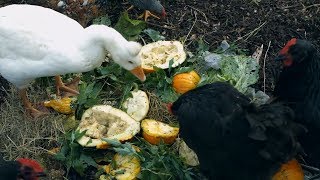
My interest in creative feed started several years ago when my wife and I switched from GMO to organic. As you can imagine, that was much more expensive. Actually, it tripled in our price. But a really cool thing happened. When we made that plunge, I also made a vow to find more creative feeds for the chickens and see if I couldn't cut my costs. It was going to be impossible to raise our own birds. I mean, we might as well buy them in store. Our expense was more than if we would have bought this equivalent in the store or at the farmers market. So first thing I started to do was move the chickens every day. They were already on pasture and I was only moving them once a week, but I got to where I could move them every day in about— in less than 10 minutes. I began to ration their feed, so I began to every week measure how much I was giving them, and I began to cut it back. And with moving them every day, I cut their feed consumption, their grain consumption, down to a tenth of a pound, from one-third of a pound to a tenth. At that point, actually, because I was moving them every day and rationing their feed, I was actually paying less for my grains even though I was spending 3 times as much on grain because they were eating so much less grain. Then we went to a free-range system the next year where I just let them go wherever they wanted, eat whatever they wanted, and of course that cost nothing. I compared 2 flocks. I raised 1 flock with access to grain. I raised another flock where they had to find everything themselves. And when it came butchering time, now mind you, these were heritage breed stock, Australorp, they're hardy, they found their own food. When I came to 16 weeks, the flock that was free-ranging actually weighed out a little bit more and had a little bit more fat. I was just absolutely shocked. And it came to about 67 cents a pound for organic meat. But not everybody can free-range. It can kind of get annoying. You get poop everywhere. You're not directing their work effort. Work efforts. So ultimately I came to the compost system that I talk about in the working chapter, where I developed a system where in just a chicken run you can feed your chickens 100% on compost. There's just so much bio to there, and then every week you get a cubic yard of compost. So not only do you cut your feed cost to nothing, you get $80 worth of compost every week. So from there I found out more ways, more creative ways to feed your chickens. And it can be so easy, and I've come up with 20 ways. One is soil-building plants like comfrey and stinging nettle. You can order comfrey online. You can plant it in fertile holes, give them 3 square foot each, harvest it 8 times a year, cut it down to about 2 inches, feed it directly to your chickens if, if you have more than enough for your chickens. Put it in your compost pile. It's a great source of nitrogen. It's got vitamin B12 in it. It's the only plant with that. It's got protein properties in that green plant. The other one is stinging nettle. You can harvest it in the wild, or you can actually plant stinging nettle. The second creative feed is— we're going to start getting real interesting here. So this is animal carcasses. This is classic turn a problem into a solution. You got a consistent predator that you just can't shake, trap him or shoot him, and then feed him to your chickens. Remember, they're omnivores. You— there's two ways to feed them to your chickens. One is you cut them open so that the chickens can get the access to the insides. Cut them open, feed them to the chickens. Sounds gross, they love it. Don't leave it in there too long, just leave it there a couple more— couple days. If you want to be more efficient, build a maggot bucket. It's just to suspend a bucket in the air with just a little wooden tripod, drill 3/8-inch holes in it, put your carcass in there. Hey, you could do fresh roadkill this way. Put your carcass in there, or, or your caught mouse, any, any of that kind of stuff. Put it in there. The flies will come through the holes. They'll lay their, uh, they'll lay their eggs. You'll have maggots that come and crawl out of the hole and fall to the chickens, and they'll eat it. And that's actually a more efficient way than if you were to just cut up and feed it to your chickens. The maggots will consume more of the meat and the chickens will eat those maggots and it'll turn into eggs and chicken meat. The third thing you could do is catch mice. I left my feed out one day, I soaked it, I had water above it. I usually kept it in a mouse-proof bin, but one night I left it out. The mouse actually crawled in there, drowned, and when I came the next day, I said, "Oh man, I forgot to put this away," but then I saw the mouse in there and I was like, "Oh, wait a minute." Chicken eat mice. So I just poured it into their trough with their feed and it was gone by the end of the day. Fourth thing you can do is cover crop. If you're building your soil through cover crops, why not, when that cover crop is done and you're ready to till it in, why not put your chickens in there and let them till it? They eat the COVID crop, they till it in nicely for you, and then you go behind the chickens and plant whatever crop you were wanting to plant in there. The fifth thing is weeds, if that's such a thing. I mean, weeds can be so useful, especially in chickens. We have a plethora of dandelion, stinging nettle, lamb's quarters, clover, yellow dock. You can actually go and harvest those things, or nowadays you can even plant those. Feed chickens from the garden. There's so many ways to feed them from that. Trimmings, or, you know, browning leaves, things like that. Trim them off, carry them to your chickens. Leftover crops, maybe more than you need, put your chickens over it after you're done, or cut it up or uproot it, take it to your chickens. Potatoes are a great source of food for your chickens. Don't need to feed it to them raw, but cook them for them. I take potatoes and cook them over our wood stove. We're warming our house with our wood stove, why not cook something at at the same time. Winter squash, it saves really well, even at room temperature. Grow some winter squash, put it away, feed it out to your chickens. Cut it open, they love the seeds, they love the flesh. Another thing to do is feed wild seeds. A lot of those can meet their grain needs. Like blackberries are in season right now, but then you can feed autumn berries and June berries and wine berries. Then there's forage or grain crops. Go ahead and plant some crops just for foraging, or even grain for your chickens. Dent corn, sunflower, sour gum, amaranth, buckwheat, alfalfa, clover. I planted myself buckwheat, alfalfa, and clover and amaranth, and that's just a few. There are many that you can plant for them. Number 9, nut trees. So prevalent in the fall, especially around here with acorns. Just go out and harvest your acorns, bring them in, wrap them in some jeans or hard material, crush them up with a hammer, or you could put them through a grinder if you have that, and feed them back to your chickens. A great source of protein and fat just from the wild. 10th creative way I've identified— we're halfway through, I'm going to tell you about 20— but number 10 is fruit trees. Go ahead and plant fruit trees for yourself, but you're going to have so much excess you can feed it to your chickens. I've planted pawpaw and persimmon. You can plant mulberry. I've planted apple trees, peach trees, you name it. If you can eat it, the chickens are going to eat it. Two ways of feeding that to them: you can actually run your chickens through there after the fruit has fallen, and they can get it, and they sanitize the orchard. Or you can harvest the fruit and take it to them. If it's a harder fruit, you can cook it over the stove and haul it to them, or just feed it to them as is, and as it begins to rot, they begin to eat it. Number 11 is garden pests. Turn a problem into solution. Harvest your bugs off the garden. They're taking down the plants? Go ahead and get you a bucket of shallow water. Go around and knock the beetles down into that water. They can't fly off with water on them. And pitch that to them, water and all. And they love it. It'd actually be the first thing they pick out of the pile. If you give them a variety of things, greens and grains and, and bugs, they're gonna go for the bugs first. Another cool way to feed them is through a pond. Grow fish in that pond for you, and if you eat that fish and, and your leftovers from processing that fish, give it to them. Also harvest fish just for them. You can also grow duckweed. It takes over, but great, it's a great source of protein. You can harvest that duckweed, it reproduces itself you throw the duckweed on the bank, duckweed, and let it dry out, it becomes 40% protein. 13 is soldier flies. Soldier flies are amazing. It's like getting protein out of thin air. You get a specialized bin, fill it with vegetable and rotting material. The soldier fly looks like a wasp, but it's black. It's alive as an adult for just a few days, but all it's looking to do is mate and lay eggs. It doesn't even have a mouth. It doesn't even eat during that period. It finds a place where there's rotting vegetables. It lays eggs. They hatch. It grows into a grub eating the food. The grub wants to then get out of the vegetable. So with this bin, there's a way for it to crawl up and out, and we set a bucket next to it through the chute, and the, the grub falls down through the chute into the bucket. And you just come in and you harvest that on a regular basis. You add material, you wet it down, and you come in and you harvest your soldier grubs, throw it to the chickens. They absolutely love it. If you're gonna feed your chickens grains, why not get whole grains and sprout them? Why? Because it can increase the protein digestibility up to 30%. I'll talk more about that in the winter chapter. Also, compost. I fed my chickens 100% on compost. There's so much biota in the compost that the chickens can thrive on that. I talk more about that in the working chapter. Then there's vermicomposting, which is putting worms on rotting manure or newspaper or cardboard. Why not turn that into rich vermicomposting soil and then feed your chickens those worms? And if you don't take all your worms out and feed them all at once to the chickens, You leave enough in there, they'll continue to reproduce themselves. It'll be completely self-sustaining. You just harvest the worms, soil and all, just before it's completely into vermicomposting soil, and just throw it to your chickens. And since your chickens are on a garden bed or a future garden bed or on the pasture, they won't eat the soil, so the soil will be left and it'll be great fertilizer. And you could feed food scraps. They say that 16% of our food waste is in our food scraps. So save 16% on your trash bill and get a bucket or a pail depending on the size of your operation. Put your food scraps in there, feed it to your chickens. They can eat up to a third of a pound of food a day, so that could significantly cut your food bill, and you turn all your chicken— your kitchen waste into eggs and great chicken meat. Number 18 on the list would be grass. 20% of their diet can be on grass. You can do that in one of many ways. You can cut and chop grass to them. You could, uh, collect grass clippings from mowing, or you could put them directly on the grass and move them around in paddocks. You can also feed them, especially during the winter, hay. You'll be surprised at how much chicken will eat of hay, especially during the winter. If you're on a farm, think about feeding them other farm products. I have a family cow, so I have a lot of extra milk when we're in milk season. I milk our cow, we, we eat a lot of it. I'll set some aside to ferment for the chickens. I'll just leave it out for 24 hours. That makes it even better. Feed it directly to them in a feed, feed bowl, or mix it into their grain. You can also Feed them slaughter from other animals. What about the beef? If you don't eat the tongue or the heart or the offal, if you're not eating that stuff, feed it to the chickens. Cook it or feed it to them raw or put it in the maggot bucket. You can also feed them bones. Ask for the bones when you, when you take your meat to slaughter. There's always some meat left on the bones, and if you don't use those bones for broth— I hope you do, but if you don't, make broth for the chickens and then mix it into their feed or put it to them in a bowl and they'll drink it. You can also feed chickens their own eggs. It may sound crazy, but you'll have a time where chickens are giving you way more eggs than you can use. You can crack them open and put them in with your kitchen scraps, or you can go ahead and scramble them if you want to spoil them and give it to your chickens that way. You can also feed your chickens their own feathers from their own own butchering. If they need it at the time, it's full of protein. There's some things in there that they might need. Throw them some of the feathers, and if they need it, they'll eat it. If they won't, it'll compost right where it is. Last but not least is fermenting. I know it's not an alternative source to grain, but it is greatly improving on it. If you're going to feed them grain, why not ferment it? It boosts their health. And it helps them digest it, so it's going to go further. And it's so easy to do. All you do is take a bucket or a bowl and you put a couple days' worth of food into it. Then you cover it with water, at least 2 inches. The water doesn't let the oxygen in and allows the food underneath the— to ferment. Leave it for a day, you've already broken down the antinutrients and it's already easier for the chickens to digest. Leave it for 2 to 3 days and it's fermented. Go in there on that third day and scoop the daily ration out and feed it to your chickens. And then just go in every day as you go in, just replace what you've taken out with new product, and the fermenting process continues on and on indefinitely. It should smell sour, not moldy. If you begin— if you begin to smell mold, just throw it out. Fermenting process should be sour. If it gets moldy, that just means too much air has gotten to it and you need to throw it out and start over.
I hope you enjoyed that. If you guys want more of that info on how to raise chickens the permaculture way, where less input, more output—
hey buddy, you see the tractor?
Okay, if you want more of that, I've got a free class. Be sure to sign up for that. It's, it's 3 videos. I think the total is like 40 minutes. Sign up for it, link in the description.
More from Justin






If I had to start my Homestead all over again, it could only pick one animal… 




