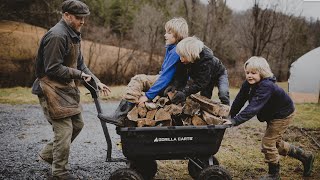
In this spoken excerpt, Speaker A recounts his family's history of subsistence homesteading in the 1930s, describing how his grandfather and father grew and ate food from their own land. He contrasts that nostalgic, self‑sufficient past with his father's later shift to buying store‑bought produce, citing cost and convenience. Speaker A then explains his own move toward regenerative agriculture, specifically rotational grazing inspired by Joel Salatin, which involves daily movement of cattle to new paddocks using electric fencing. He describes the increased management intensity, the need to learn everything from scratch, and the ecological benefits of avoiding monoculture and pesticide‑laden feed. Speaker B interjects with a brief question, prompting Speaker A to elaborate on his father's resistance, which manifested as teasing the “crazy wires” used for the electric fences. The narrative highlights a generational tension between traditional, cost‑focused farming and modern, ecologically‑driven practices, ultimately showing a shift in mindset as the father begins to understand and respect the new methods.
Chapters
I can remember my dad telling me stories of how proud grandpa was when they would sit down and say, this is food from our land. We grew this. My dad could remember grandpa being that way. And grandpa, back in that day in the '30s, if you didn't grow it, you didn't eat. And everybody had what you call a sustenance homestead. I can remember my dad gardening one time and when we'd help in the garden, and that was it. And I can remember thinking, because he would tell me all these stories of his past, of how they would sustenance farm this land, and it wasn't this like begrudging thing, it was this cool thing, and he had good feelings towards it. And one day, you know, he did that garden, and then that was kind of it. And I said, why don't you do that anymore?
Why don't you garden?
And he said, because it's cheaper to buy it in the store. My dad would keep cows, I think, probably just for nostalgia, but probably more important for the tax write-off. I mean, he was a frugal guy. We were made to feed them, feed them their hay and grain, but really it wasn't like what I do now in the sense that, you know, we're rotational grazing. It's a little more management intense. Our cows were throw the hay in the winter, They come get it, they walk away. In the summer, nothing. Make sure the fences are okay, they had access to the creek. For him, he didn't make that connection of the pesticides or besides the lack of nutrients in it because it's this huge monoculture thing, this connection to like, he wasn't seeing it that way. So when we started to grow our own food, It was, I don't know, nothing but electric energizers and how to herd a cow. I had to learn everything from scratch. And in fact, when we started learning it, when we picked up on Joel Salatin, and that means we're moving our cows every day to new paddocks, my dad gave a big resistance. I almost feel like he felt threatened. He used to call my wire. I would set up these electric wires to move the cows in every day. He would used to call them the crazy wires and almost make fun.
That was a clip from my new docuseries, the first episode, Rooted. Spoiler alert: we work it out with my dad. My dad changes his mind, and not only does he become our biggest fan, he pretty much on his deathbed bet he recanted, and it went from crazy wires to you got it looking beautiful up there. Now I would love for you guys to get the rest of that story, to get in the middle. How did we go from almost making fun of me to becoming our biggest fan and praising us for what we were doing here? It's a neat story. I would love for you guys to see it. That's episode 1 of Rooted. Right now you can watch a good portion of Rooted for free down in the description. I'll link it, or you can go to watchrooted.com. In the future, we may put the whole episode there, who knows. So just check it out, there'll be something down there at watchrooted.com. And if you guys want it now, you want the full-on episode, you want future episodes, it's going into Abundant Permaculture. That's my member area. You can get a hold of that, and probably the best, easiest way. And so I can I can still just give you one call to action, is link in the description, watchrooted.com. You'll get in there, you can watch the sampler, but then there'll also be a link once you're in there, you've signed up for my email address, you'll get the sample video, but there'll also be another link there that where you can go and get Rooted for Keeps and get in on all future episodes. I hope you enjoyed that sample. I hope you're inspired by this. I've got a few more samples coming out for you guys. So get in there, enjoy it, and be inspired. Because listen, we all go— we've all had struggles with finances, with health, with family thinking we're crazy when we go on this lifestyle. But we all also always have the positive things too. The people to look out for that are supportive of us. Folks changing their minds. People who thought we were crazy and weren't supportive turn into your biggest fans. We can all relate to that. From going from a scarcity mindset to a mindset of abundance. Come on, get in there, check it out. I think— I know you'll go away encouraged based on the tens of thousands of people who have already watched it and are just blowing up our email, our social media feeds. We can't even keep up with it, with how much people are being encouraged by this. I want you guys to be encouraged by it. If you've seen it, go watch it again. Go share it. Just get in there, watchrooted.com, share it, watch it, enjoy it, and we got more coming.