Dealing with our Last Power Outage
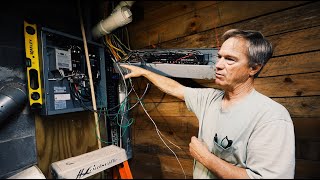
Victor Justin Rhodes and his farmstead crew handle a power outage with a new transfer switch and diesel generator. The video shows daily farm work: rotating livestock, milking cows, making yogurt, and preparing food while discussing the electrical upgrades that keep the operation running during outages.
Chapters
Missed you guys. Took a couple days off after the 100 Days of Growing Food. When I saw you guys this morning after a couple of days break, saw you, you know, the camera represents you guys, I was like, oh, it was, it was like a— come on, cutting up already. Stay with me. I don't know, it was like a relief. It was like after I didn't have pork for a while and then put bacon in the fridge, it's like waking up, there's bacon in the fridge. I think that's a great measure of whether you actually like your job, if it's sustainable, is if you could take a couple days off and then you miss it when you come back. I love my job. I love you guys. Oh, to Justin, happy clucking. Joel Salatin. I think Art and some of the students had something to do with that, sneaking off and getting Joel to sign my chicken water. That's cool. He's here every weekend. Come on, come on, let's go, let's go, come on, come on. What you doing? What you doing? What you doing? What you doing? So the cows are in here. He grazed it down pretty good, moving them every day. This is where they would be going. One thing we had Joel do with us this weekend is coach us. Is this ready? I would have reckoned this ready. Ice cream grass. He looks at the— so, so, so, see, look, we got clover coming up. We got some clover sprouting. I don't know, we're going from 6 inches to 12. I look at this little nook of pasture here and say 2 days, but can we make it 3? And how? What do you think, Joel? Is Is this grass ready? He looks at this and says, no, it's not ready. You need 2 more weeks. You're 2 weeks ahead. Long story short, if I have hay and can put them up in one of the lesser pastures that aren't doing as well, how do you improve that? Well, that's one way. Use it as what you call a sacrifice paddock. Let's run the cows and the sheep in the sacrifice paddock up the hill for 2 weeks, stopping the rotation, giving that grass time to grow, and then that becomes 3 paddocks instead of 2. Good morning, guys. How you doing? I'm ready with my moonshine. Yeah, Benjamin, let's start watering these and setting them out on these tables, hardening these guys off. We talked to our sheep mentor. They got to go somewhere too for 2 weeks. They're a little more successful— success to parasites. Claire said let's put the sheep somewhere they haven't been been at least 6 weeks. See if we track where have they not been in 6 weeks. That would be kind of easy. That needs nutrients. The, the solo pasture, the orchard right up there, the orchard. Why not?
Oh, that zigzagging, that's gonna be so cool.
We have— we're gonna go measure it, Rebecca, because your mom is out there measuring fence right now, and we have a room, so we're thinking about protecting those trees like today. Do that around And I got 14 and 2/3 feet. Okay, so if that's right, then we'll just get a 16er. Yeah, for every fence. So instead of zip ties, let's do metal wire that we have. Okay, so because metal eventually rusts, plastic will be with us forever. How could we pin this so that we could actually open it? Carabiners. Big carabiners. Would you maybe order those at Lowe's so that we could pick them up. And Arun, we'd have you go— I'll order— or Benjamin to get these 16. So you'll need to go count how many alive trees we have. I think you could do that. Yeah. Okay, I'm pretty sure we're gonna have enough T-posts. 1, 2, 3, 4, 5, 6, 7, 8, 32, 34, 35. We could probably get 36 if we need to. Here we go, here's the verdict.
5.
5 are alive. Okay, unless there was— we have enough for 6. Oh, we do have already here. Yeah, T-posts. Oh, sorry. No, we're gonna have to go for cattle panels. Hey, look at this guy! Where are you from? I'm from Tennessee. Looks like it. Did you hear the sound? Oh, and Tennessee boys, they know how to roll. Oh yeah. Okay. Hey Johnny, you You gotta get out. Let's go. You and I will go look at the— where the cows are going. All right, I need to go with Jonah, but Gideon doesn't need to be destroying the house. Actually needs to go with me. I found Gideon. Finding his shoes is another story. I guess that works, but, but do you have the other one? I don't mind the fluffy flip-flops, but you gotta have them too.
Alright.
Wait, no, no. Oh, you can't wear those fluffy flip-flops? Can you still fit these boots? We're going up to the cow pasture. Do you want to just go barefoot? We're just going up. Okay. He only wants to go if I take Sally. Just a short little walk, but it's more important to me that he goes. So yeah, who cares? Let's just go. I can't see a thing. Can you see? Can you see anything?
No.
Let's just let them in here for 2 weeks. They can go over there for shade. We'll feed their hay in a different spot every day.
We're not setting up any fences.
Nope.
We have to do the pigs when we are done and milk.
Yeah, we gotta go do the pigs first.
I'm sure they're starving.
Don't mind me. Don't mind my wincing. Don't mind my wincing. I got to hurry because I don't want to bust through this fence. Learning how to do— oh shoot, that could have been bad. All right, I don't know what it is, but my leg especially hurts. I mean, the back is everything. Tweaked it a little while ago, I think, setting off in a run. I haven't been able to quite kick it yet. All right, you taking the cows in?
Yeah.
Okay, they're gonna go in for milking. About this grass, I was paranoid of it getting old, you know. Ideally, I wanted to hit that teenage grass, but talking with Joel, this was like— he blew my mind. He's like, it's okay, it's okay. For it to get old. I said all the nutrients go to the seed. He said yes, but they'll eat some of the seeds. So slow down and not worry about it getting ahead of me. You want to put him on the T-post and then come with me? You stay with him. Feeling pretty good about this. Jonah's setting up up there. I gotta move the luchadors, the ducks. Got 15 minutes. You guys ready? Move animals every day. It's important to let the grass recover before you hit it again, or else you just damage it. You encourage weeds. That's why I'm so adamant about moving them every day. You also want to fight parasite pressure. Moving them every day, they're not returning to the first spot for a while, takes that parasite pressure off. They die off. You're not grazing close to the ground.
What?
What do you mean moving day? Yeah, we got to move the ducks. Can you want to help me herd the ducks? Well, you could tie them up to this post. Look where they went. It's a little valley here, a lot of water here. Oh look, it's our electrician. Getting ready for the generator start tomorrow. Tomorrow we're gonna crank up our Cummins generator. You kind of bring them this way, I'll bring them down. Come on, guys, cut them off that way. There you go, they see it now. Look at that, easy. Now that's one way to do it. Barefoot. Oh yeah, man. Benjamin, we're gonna miss you. I'm gonna miss you big time. You guys are— I was actually getting teary earlier. You were? Yeah. Let's see, it's been what, 10 days? Yeah, something like that. Yeah. Can you come back? Going back to city life?
Can you like apprentice for us?
Maybe we can get him to come back at the end of the month for my surgery. Yeah. You want to come back and farm sit? I think I might, with Jonah. Yeah. Run the farm for a couple days. That'd be fun. So what was yesterday's video about? Yesterday's video was about all the, all the animals on the farm. Thought I'd just kind of get some close-ups and some backstory from the kids. Yeah. And see, uh, see what story came from that. What's next for you and the Garden Guy channel? Oh man, I'm gonna make— I'm launching the 3 more videos from the course. Yeah. And, uh, Video number 2 is going to be about the placement, how to know where to plant your garden, and just all the factors that go with that. Cool. I'm gonna leave a link to your channel. Cool. So although we're gonna say goodbye to you, we can keep following you. Sounds good. It looks like it's in good hands. I'm gonna go check on the— oh, I should show you this. We've hardened off our fall, our fall crops. They've been in the greenhouse. We've written them out. Hopefully going to plant them this weekend. So Dave, this is our— this is our old panel.
That's correct.
Transfer switch. New panel. Correct. Basically right now you're just cleaning it up. Yes, you're just taking each one at a time and transferring over here. It needed to be much bigger, didn't it?
Right. This is a 40-circuit panel. Yeah, um, with a lot of tandem circuit breakers. We're cleaning this up so it's all single breakers here. This is a 60-circuit panel, and then this is our transfer switch for our new Onan diesel generator that's going to power up the whole house. We will have a couple of circuits that will be on a load shed, which will mean that if the generator comes on and it approaches its peak load, it'll turn those devices off so not to overload the generator. But it's a very good diesel generator. It should last for forever and ever. But this is our new transfer switch, and this electrical panel will be hot all the time except for when we have a power outage. It will be no electricity there until the generator comes on, probably 20 seconds, and then And then from then on, we'll be on generator power. So the whole house should not be out of electricity longer than 20 or 30 seconds.
Nice. And I don't have to— I don't have to come out and crank it up or turn on any buttons. It happens all automatically, correct?
Yes.
Cool.
Very nice system.
Yeah, nice.
All right.
Okay. Yes, they got done with milking. I'm gonna remember to do yogurt today. Let's filter this out. Let's get some yogurt to be our starter. Uh-oh, shoot, somebody ate yogurt! I don't know if we have enough. Somebody's been eating my yogurt. I refrained last night even though I wanted some because you need 1/3 cup for 1/2 gallon. I think we might have Enough for one? This is a third of a cup. This is all we got. Huh, do we have enough for two? We take our yogurt and just pour it into our milk. That's it. Maybe if we scrape it, maybe we'll have enough. The kids ate the yogurt this morning. Oh no, this will be two. Is that enough? It's almost a third. No, it should be fine. Put the yogurt in that second batch. She says it's gonna be all right. Hey, look, looky here. Okay, we switched out for Lily. All right, I'll relieve you, Benjamin. Looky here, it's born Friday. Today is— what day is today? Wednesday. You've been spending time with it, Lily? You got a tamer? This is a heifer, so this is Probably gonna be ours or somebody's family milk cow. Look who's here! Haroon's back. I'm filtering this next batch. Oh shoot, it's all right, all right. Uh, Jonah, you got any ideas? We're gonna get the cows up the hill. Okay, we'll set everything up. Please set the lanes up. We don't need drama, okay? Look at them go! That little calf is adorable. Thank you, Jonah, for getting the cows up into the sacrifice pasture. Shoot, that means I need to bring them some hay. All right, spot number 1. We'll just feed hay, different spot every day, moving around this waterer. This is a place that needs more fertility, going to be a great sacrifice area. Well, we were in the middle of cooking and Dave had to cut the power. So really, I think we're gonna have to do one thing at a time out on the grill. Wow, that was quick, came right back on. Maybe we won't have to go to the grill. Oh, the stove didn't come back on though. Look at that, just turning certain things off.
This one going, but you want—
you got it going for us with the grill going? How's that going? Yeah, might as well do the grill too, heat up those leftovers. We need to get the grill going.
I'll go get a few spatulas.
Can we do this? I don't see why not.
How come there's no fire?
There is, I see it right there.
Yeah, but is it gonna get more and more?
Not really. If you clean it, we can, uh, put the bacon down. I have never done grilled bacon. This will be interesting. We got a little bit of a flame in the grease. Let's move our bacon up.
That was gonna burn.
So this is, uh, oh wow, it's gonna be interesting. I'm just heating up the tortillas. They're already pretty pre-made. Nice, that's nice and soft. Liable. All right, how's that grilled burrito? How you even gonna shut that burrito? I'm just gonna shut it in my mouth. That's what I'm gonna do. You're not even gonna be able to roll it up, are you? No, honestly, the burrito is just, just for fun. The real thing is the eggs. Oh yeah. Oh, actually, look at this. I can hold it. Okay. All right. The power was on and off all day today. Got it editing. Yeah, this was my editing. Normally I'm editing over there in the corner. Power was off a lot over there, so we actually just— Rebecca has all this, all my hard drives, my computer into one. I don't know what you call that, but it's got a battery backup too, so it worked for a while over there. But it all plugs into one cord, so I could actually— I can actually unplug one cord and roll this anywhere I want. It's nice. And our buddy Mike is here with a watermelon bigger than Mr. Brown. How you gonna cut that up? You got your chainsaw? It's like we're gonna have surgery.
This is actually one of the smaller ones compared to years past. This one's about 70 pounds. We've had them 110, 130, and some people grow, grow them up to 200 pounds.
Nice. Does somebody have a machete?
Yeah, but they're all rusted up.
And you want me to just do it down the middle? Whatever.
I usually do start with a quarter, but because then it's easier to move around. So when I cut it, it's going to flop out. So that's probably—
this is like we had a butchering class or something. So yeah, so here's where you cut.
Nice sharp knife.
Next.
Gonna have a big rind.
Yep.
Whoa, the rind is huge! So there you go.
So what do you think?
How is it?
Love it!
Can you guys eat that whole watermelon? What do you call this method, you farmstead fruitsmith? Uh, cutting of the watermelon method. Oh, this is just the way you've always done it?
Yeah, well, when they're this big If you go to cut this way, you end up with large amounts of rind with just a little bit. So I like cutting them in, in circles like that and then doing wedges instead. Okay, so you cut a circle out of that, or sometimes I'll cut halfway through.
Oh, and then you wedge it? Yeah, when you go halfway through.
More from Justin






If I had to start my Homestead all over again, it could only pick one animal… 




